
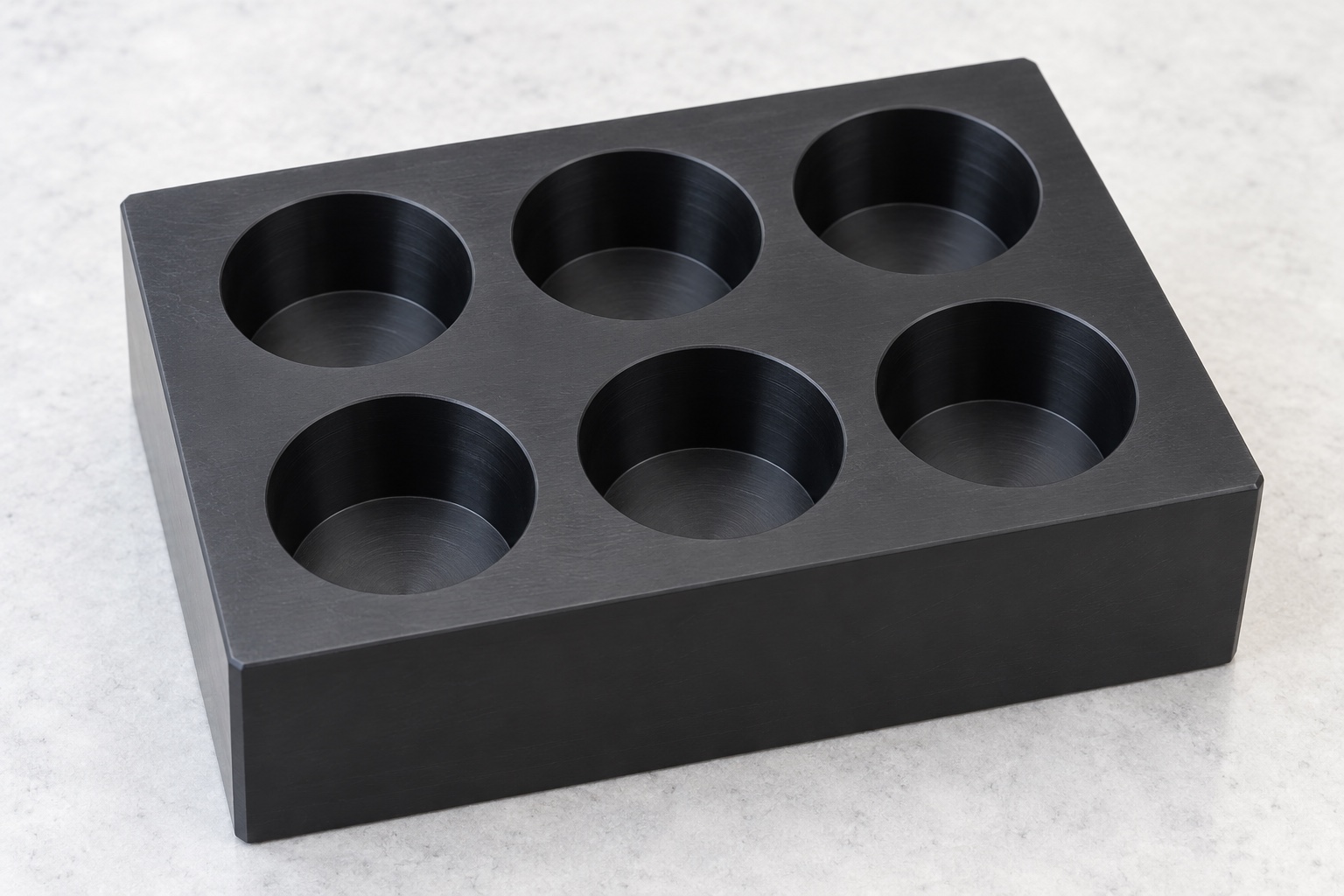
Limit the concept to closed-cap exteriors
A medical laboratory equipment fixture may provide parking positions for the exterior of approved closed-tube caps during a defined handling step. A machined block with blind pockets can establish those mechanical contacts. This article concerns that proposed external-contact fixture only; it does not prescribe parking open caps, contacting cap interiors or exposing specimens. The actual orientation and workflow require approval by the laboratory equipment team. Dimensional inspection cannot establish contamination control or specimen integrity. Images show an empty block with six blind pockets, not a validated laboratory process or measured production part.

Obtain the exact closed-tube assembly
Define the approved tube, cap, closure state, orientation and handling sequence before choosing pocket dimensions. Similar cap diameters can conceal different skirts, ribs or external contact boundaries. A photograph or unidentified sample should not replace controlled requirements for repeated manufacture. Clarify whether any part of the tube body enters the fixture and which regions must remain clear. Do not invert or open a tube merely because it fits an illustrative pocket. The fixture supplier needs a released mechanical scope, while the responsible laboratory team retains ownership of the actual sample-handling procedure.
Define pocket contacts before pocket diameter
Identify whether the intended contact is a defined cap-exterior annulus, an outside cylindrical region or another approved external feature. Distinguish locating and clearance surfaces rather than treating every visible wall as simultaneous contact. Specify allowable corner transitions and any no-contact region. A blind pocket's diameter alone does not establish the actual seating relationship. Resolve missing details before machining, and do not deepen or widen a pocket until a cap seems stable. Such changes can alter the contact boundary or handling condition and therefore require documented authorization before they become production instructions.
Relate depth to access and removal
The approved pocket depth and remaining base material should support the intended contact while preserving the actual removal approach. Define where fingers, a gripper or other authorized tool needs clearance. A closed-tube assembly that enters a pocket may still be difficult to retrieve without unintended contact. The machining supplier should not add an improvised slot, hook or extra relief to solve an undefined workflow. Record interference and clarify the requirement first. A successful manual demonstration with one sample does not establish suitability for all cap variants, accessories or automated handling arrangements.
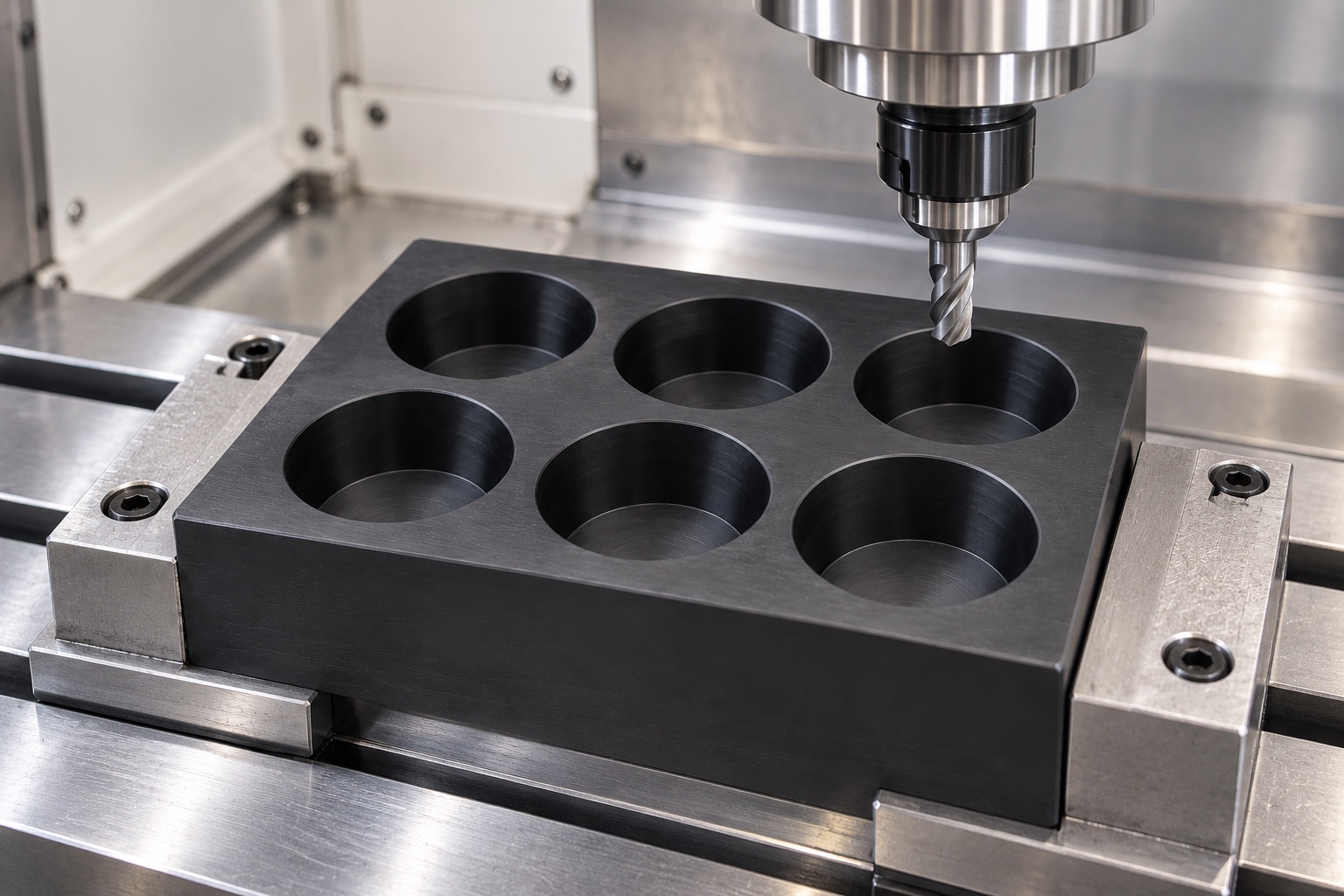
Control spacing and position identity
Specify the six-pocket pattern in relation to the approved base and mounting references, including spacing and any required orientation or position identification. A two-by-three illustration is not a universal laboratory layout. Labels or identification features, when required, must follow approved content and placement rather than an arbitrary marking added by the supplier. Check neighboring closed-tube envelopes and the actual loading sequence. Dimensions can define pocket locations but cannot establish sample identity management, workflow error prevention or correct association of a specimen with an electronic laboratory record without separately specified procedures and evidence.
Specify polymer identity and cleaning scope
Identify the accepted polymer grade, stock form and material documentation. Ensinger describes black TECAFORM AH as POM-C supplied in machining stock shapes; this provides material background, not approval of the proposed fixture or laboratory workflow. Color alone does not establish equivalence between plastics. Actual cleaning agents, exposure and contact requirements need application-specific review. Cleaning work included in the order should be stated explicitly. Neither material identity nor visual cleanliness establishes validated decontamination, sterile supply, low contamination transfer or compatibility with every cap and medical laboratory process that might use a pocketed block.
Support the block during pocket milling
Review blank preparation, pocket roughing, finishing and fixture transfers so the base and pocket pattern remain related after release. The material remaining under blind pockets must follow the approved geometry. Keep chips away from locating faces and avoid compressing the polymer into an apparently favorable condition. No universal cutting settings or dimensional compensation are prescribed here. Intermediate checks can support the route, but final inspection should address the agreed support and conditioning state rather than a pattern measured only while the block is restrained against the manufacturing fixture.
Finish pocket mouths and internal transitions
Examine pocket entrances, bottoms and outside boundaries for attached material or unwanted sharp features. Apply the approved edge requirements without consuming useful support or enlarging a no-contact region. Do not polish the pockets until a particular cap releases easily. Clarify the actual geometry and authorized cleaning approach first. Residue removal should follow the purchased scope without damaging the polymer or introducing an unapproved treatment. A visually tidy blind pocket is not evidence of measured cleanliness, microbial control or acceptable carryover in the laboratory's complete closed-tube handling and cleaning process.
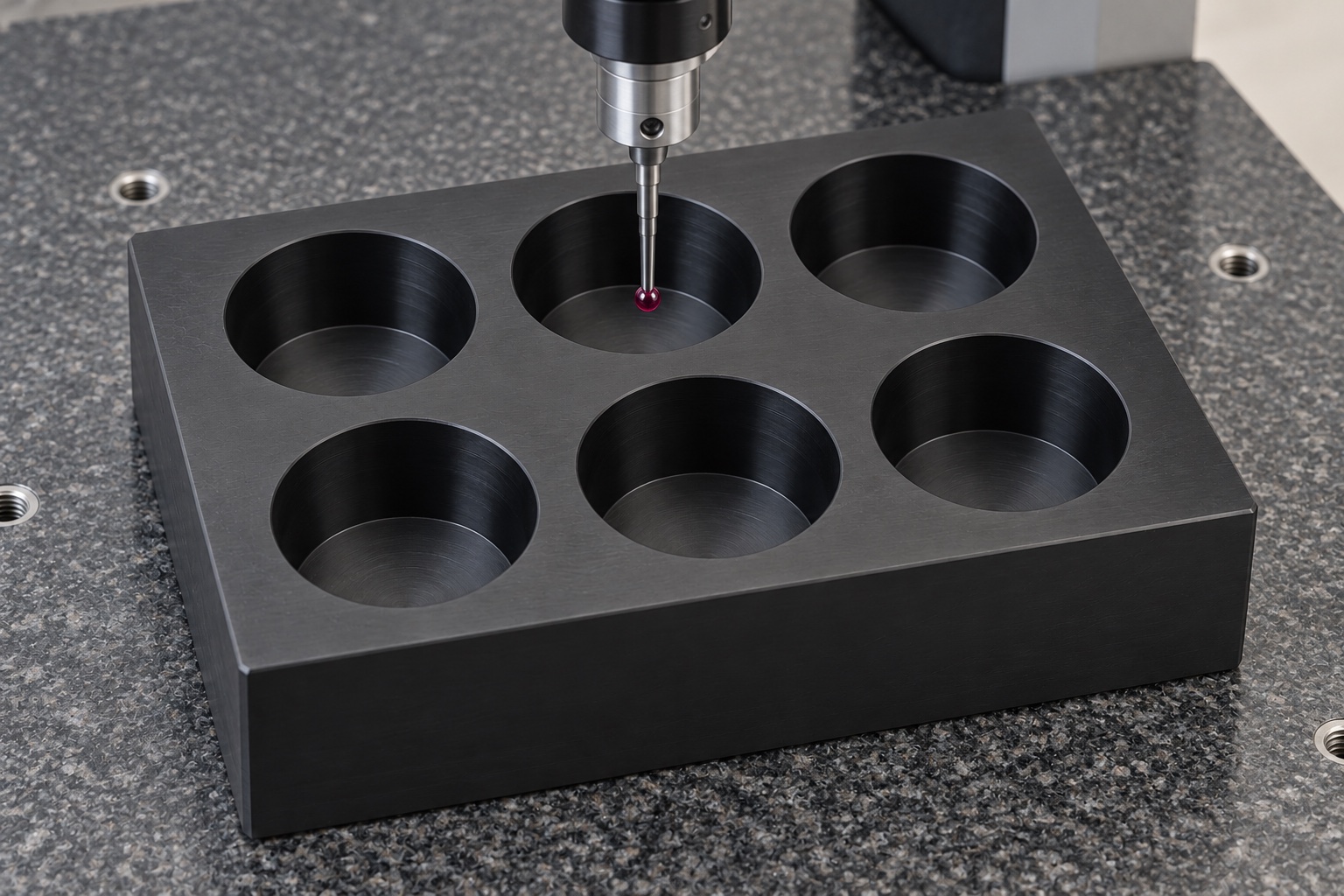
Measure the actual seating geometry
Map pocket size, depth, spacing, base references and specified relationships to suitable accessible methods. Agree conditioning, support and measurement contact where they affect interpretation of the polymer component. A caliper across the block and one cap-fit observation do not verify every pocket characteristic. Resolve inaccessible depth or contact requirements before production instead of accepting a convenient substitute. Preserve revision and lot identity with the dimensional record. Any sample used during an optional trial should be identified and should not silently replace the drawing-based acceptance method for the finished fixture.
Separate a fit trial from workflow validation
A defined trial may examine insertion, seating, access and removal with approved closed-tube assemblies and identified revisions. State the closure condition and the exact scope. Successful fit does not establish contamination control, carryover, sample integrity, closure security or correct specimen identification. Those need separate evaluations of the actual laboratory procedure and equipment. Do not open a cap or substitute another tube to obtain a favorable result. Trial blocks should remain traceable so observations do not become an informal approval for a different orientation, cap type or medical laboratory workflow.
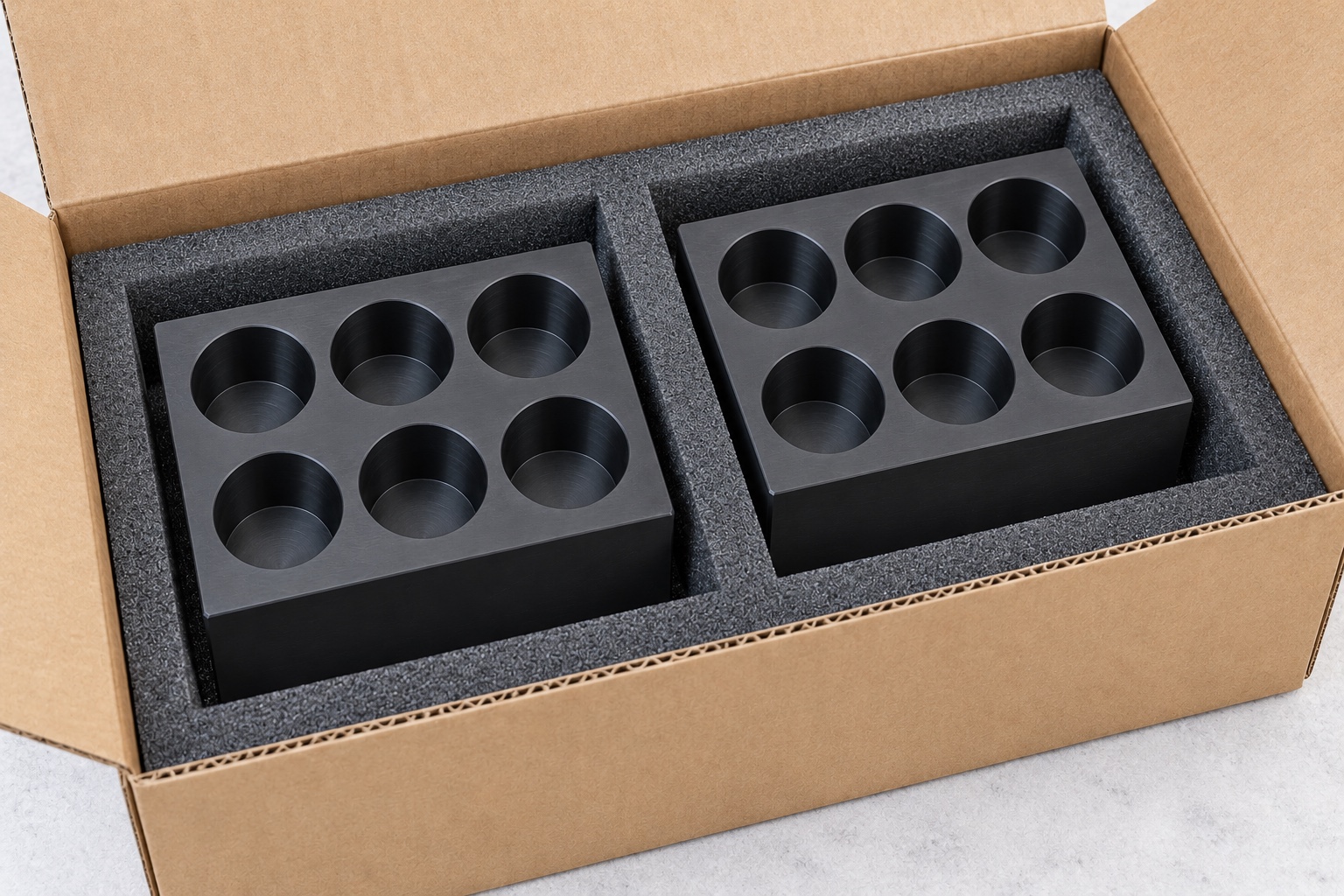
Protect the pocket interiors during shipping
Separate blocks so hard edges and loose hardware cannot strike pocket mouths or deposit debris inside them. Avoid packaging pressure that distorts the polymer or embeds protective material in the contact regions. Cleaning and packaging status should follow the order without implying sterile delivery. Preserve grade, lot, revision and acceptance status with the shipment. Receiving staff should distinguish released blocks from trial variants with different pocket depths, spacings or cap identities before use, preventing a visually similar fixture from entering an otherwise controlled laboratory process without the appropriate interface review and authorization.
Maintain a closure-specific inquiry package
The inquiry should include the controlled block drawing, approved closed-tube and cap information, orientation, external contact limits, loading and removal envelopes, polymer, final condition and inspection deliverables. Identify optional fit work separately from cleaning and contamination assessments. Review changed caps, tubes, labels, handling tools or cleaning procedures before relying on earlier observations. Incorporate approved prototype changes into revised documents rather than copying an adjusted block. This gives the CNC supplier a defined mechanical scope without presenting pocket conformity as proof of safe specimen handling or a validated medical laboratory workflow.
Manufacturer background reference: www.ensingerplastics.com.
FAQ
Does this concept include parking open caps?
No. Its proposed scope is limited to approved exteriors of closed-tube caps in a defined fixture orientation. Open caps, cap interiors, exposed specimens or another workflow would require separate controlled contact and process requirements, not an assumption based on pocket shape.
Does a cap fitting the pocket prove process suitability?
No. Fit can support a defined mechanical observation only. It does not establish contamination control, closure security, sample integrity, removal access or correct specimen identification in the laboratory's actual equipment, handling sequence and cleaning procedure.
Can pocket depth be adjusted during a trial?
Only through an authorized change when controlled geometry is affected. Record the actual tube, cap, closure condition and interference before modifying the block. A hand-adjusted pocket should not become an undocumented manufacturing instruction for subsequent fixtures.
Does black POM guarantee cleaning compatibility?
No. The exact grade, cleaning agent, exposure and contact requirements require application-specific assessment. Color, generic material information and a clean appearance do not establish validated cleaning, quantified contamination transfer or sterile supply for the finished laboratory fixture.
What should dimensional inspection address?
It should cover the agreed pocket size, depth, spacing and reference relationships in the defined conditioning and support state. An unidentified cap used as a fit sample cannot automatically replace the drawing-based checks for all six pockets.
What changes need review for a repeat order?
Review cap and tube variants, closure state, orientation, contact limits, spacing, handling tools, polymer and cleaning scope. Preserve controlled revisions instead of copying a modified block or transferring another laboratory workflow's contamination and sample-integrity claims.

tanghangyun@oemach.com