
CNC Turning Services for Shafts, Pins and Precision Turned Parts
OEMach provides custom CNC turning services for drawing-defined shafts, pins, bushings, sleeves, threaded parts and rotational components. We support prototype and small-batch production with engineering review for diameter tolerance, concentricity, thread details, surface finish and material selection before machining.
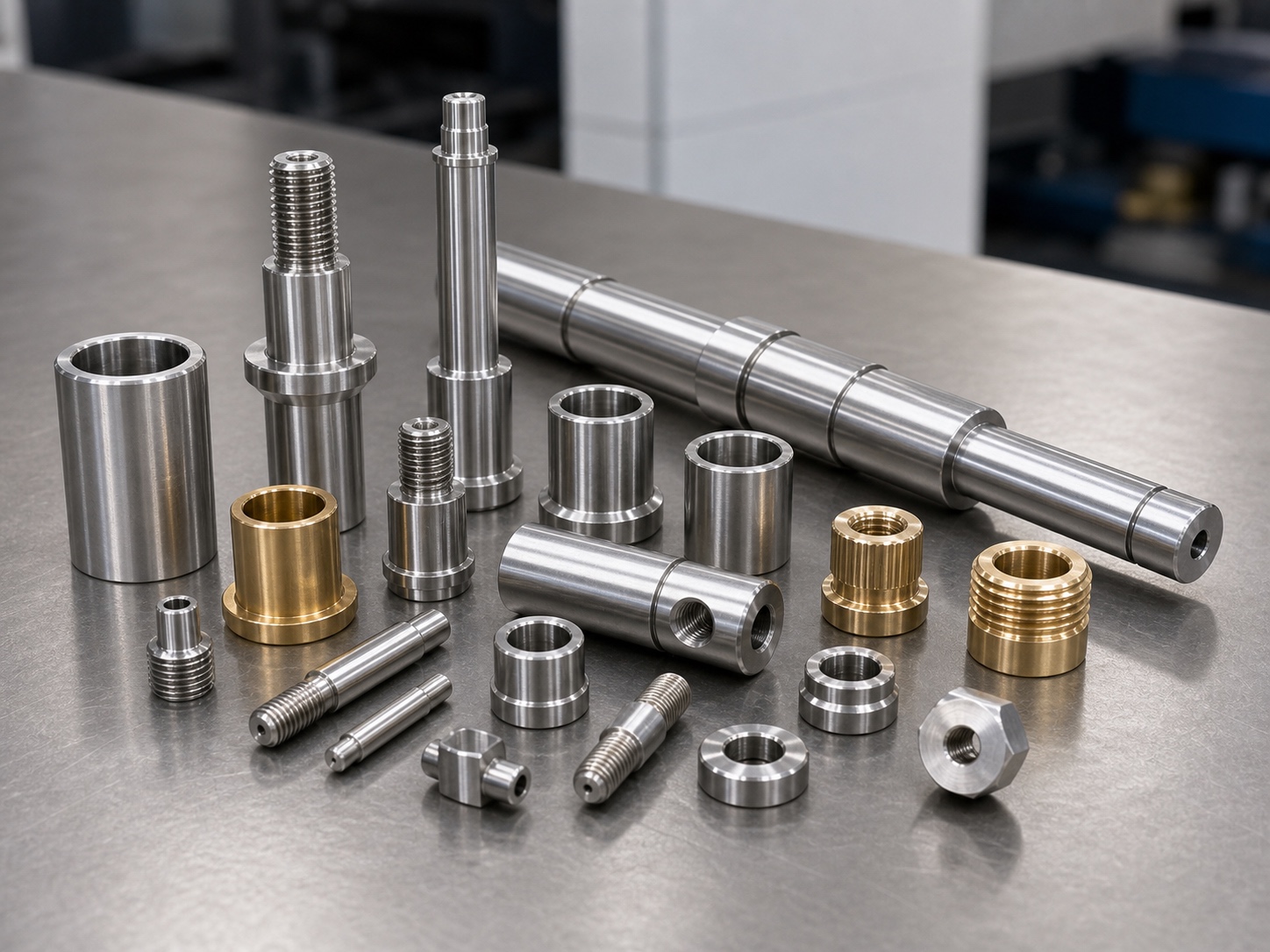
Suitable Applications
CNC turning is best suited for round or rotational parts that require controlled diameters, smooth turned surfaces, threads, grooves, shoulders or tight concentricity. It is commonly used for custom shafts, pins, spacers, bushings, sleeves, connectors and fastener-like components used in automation equipment, medical devices, electronics, automotive systems and industrial equipment. As part of our CNC machining services, turned parts in stainless steel or brass / copper can also be reviewed for Swiss machining services when geometry requires it.
Required Files
For faster CNC turning review, please send STEP or STP files together with a 2D PDF drawing if the part has critical diameters, concentricity requirements, threads, grooves, surface roughness, heat treatment or plating requirements. Material grade, quantity, finish and inspection requirements should be included whenever available. The RFQ Checklist, Tolerance Guide and Contact / Get a Quote page can help prepare a clear request.
DFM Checkpoints
Our engineering review focuses on diameter tolerance, length-to-diameter ratio, thin-wall risk, groove geometry, thread specification, concentricity, runout, burr control, surface roughness and material machinability. If a small-diameter part requires long slender geometry or high-volume repeatability, we may recommend Swiss machining services instead of standard CNC turning. Small features can also be reviewed with micro CNC machining, while the Material Guide helps compare machinability and finishing behavior.
Typical Parts & Use Cases
Common structural and precision parts manufactured with this machining method.
Shafts & Axles
Custom drive shafts, motor shafts, hinge shafts and precision axles with controlled diameters, shoulders and runout requirements.
Pins, Spacers & Standoffs
Locator pins, dowel pins, spacers, standoffs and cylindrical components used in assemblies, fixtures and automation equipment.
Bushings, Sleeves & Collars
Turned bushings, bearing sleeves, collars and cylindrical inserts requiring reliable fit, surface finish and concentricity.
Threaded Components & Connectors
Custom threaded studs, inserts, adapters, small connectors and fastener-like parts with external or internal thread requirements.
Supported Grades & Post-Processing
CNC turned parts can be produced in stainless steel, aluminum, brass, copper, titanium and engineering plastics depending on strength, corrosion resistance, weight, conductivity and wear requirements. Surface finishes can be selected for appearance, fit, corrosion protection, conductivity or reduced friction.
DFM & Sourcing Review Matrix
How our engineering team reviews your design requirements before launching fabrication.
| Review Area | Buyer Input | CNC Turning Check | Quote Output |
|---|---|---|---|
| CAD Geometry | STEP/STP model and 2D drawing with datums | Rotational features, shoulders, bores, grooves, reliefs and tool access | Turning route, setup assumptions and DFM notes |
| Material Grade | Specified grade or approved equivalent | Machinability, bar stock availability, stability and finish compatibility | Confirmed material route or suggested alternative |
| Critical Diameters | OD, ID, fits, shoulders and tolerance callouts | Diameter capability, wall thickness, deflection and gauge access | Tolerance risk notes and inspection basis |
| Threads & Grooves | Thread standard, class, length, relief and groove dimensions | Tool access, thread gauge needs, burr risk and groove form feasibility | Threading route and inspection scope |
| Concentricity & Runout | Concentricity, coaxiality, runout or datum requirements | Setup strategy, chucking method, support and measurement approach | Runout risk review and inspection plan |
| Surface Finish | Ra value, polishing, passivation, anodizing, plating or black oxide | Finish impact on dimensions, friction, corrosion and visible surfaces | Recommended surface finish route |
| Quantity & Lead Time | Prototype, pilot or small-batch quantity and target delivery | Setup count, tooling load, bar strategy and batch repeatability | Lead-time basis and quantity assumptions |
| Inspection Requirement | CMM, micrometer, thread gauge, runout check or material certificate needs | Measurement method, report scope and critical feature visibility | Inspection level included in the quotation |
Applicable Industries
RFQ Checklist
- STEP or STP 3D model
- 2D PDF drawing with critical diameters, threads and concentricity notes
- Material grade, heat treatment or equivalent options
- Surface finish, plating or polishing requirements
- Quantity, target delivery and inspection report needs
Related Internal Links
Technical Updates
Process FAQ
What types of parts are best suited for CNC turning?
CNC turning is best for round or rotational parts such as shafts, pins, spacers, bushings, sleeves, collars, threaded studs, inserts and connector-like components. It is especially useful when diameters, concentricity, runout, threads or turned surface finish are important.
What materials can be CNC turned?
OEMach can review CNC turned parts in stainless steel 304, 316 and 17-4PH, aluminum 6061-T6 and 7075, brass, copper alloys, titanium Grade 2 and Grade 5, and engineering plastics such as POM, nylon, PTFE and PEEK. Material grade and finish should be confirmed before quoting.
Can you machine threaded parts and custom shafts?
Yes. We can review external and internal threads, custom studs, adapters, inserts, drive shafts, hinge shafts, motor shafts and precision axles. A 2D drawing should define thread standard, class, length, relief, critical diameters, runout and inspection needs.
When should I choose Swiss machining instead of CNC turning?
Choose or request review for Swiss machining services when the part is small, slender, high-volume, difficult to support, or needs repeatable bar-fed production. Standard CNC turning is often suitable for larger shafts, sleeves, bushings and lower-volume rotational parts.
What files should I send for a CNC turning quote?
Please send STEP or STP files plus a 2D PDF drawing for critical diameters, threads, concentricity, runout, surface roughness, material, finish and inspection notes. Include quantity and target lead time so engineering can review the turning route and quote assumptions.
Send drawings for review
Send your STEP/STP files, 2D drawings, material, quantity, thread details and finish requirements. OEMach will review diameter tolerances, concentricity risks, material suitability and suitable machining routes before quoting.