
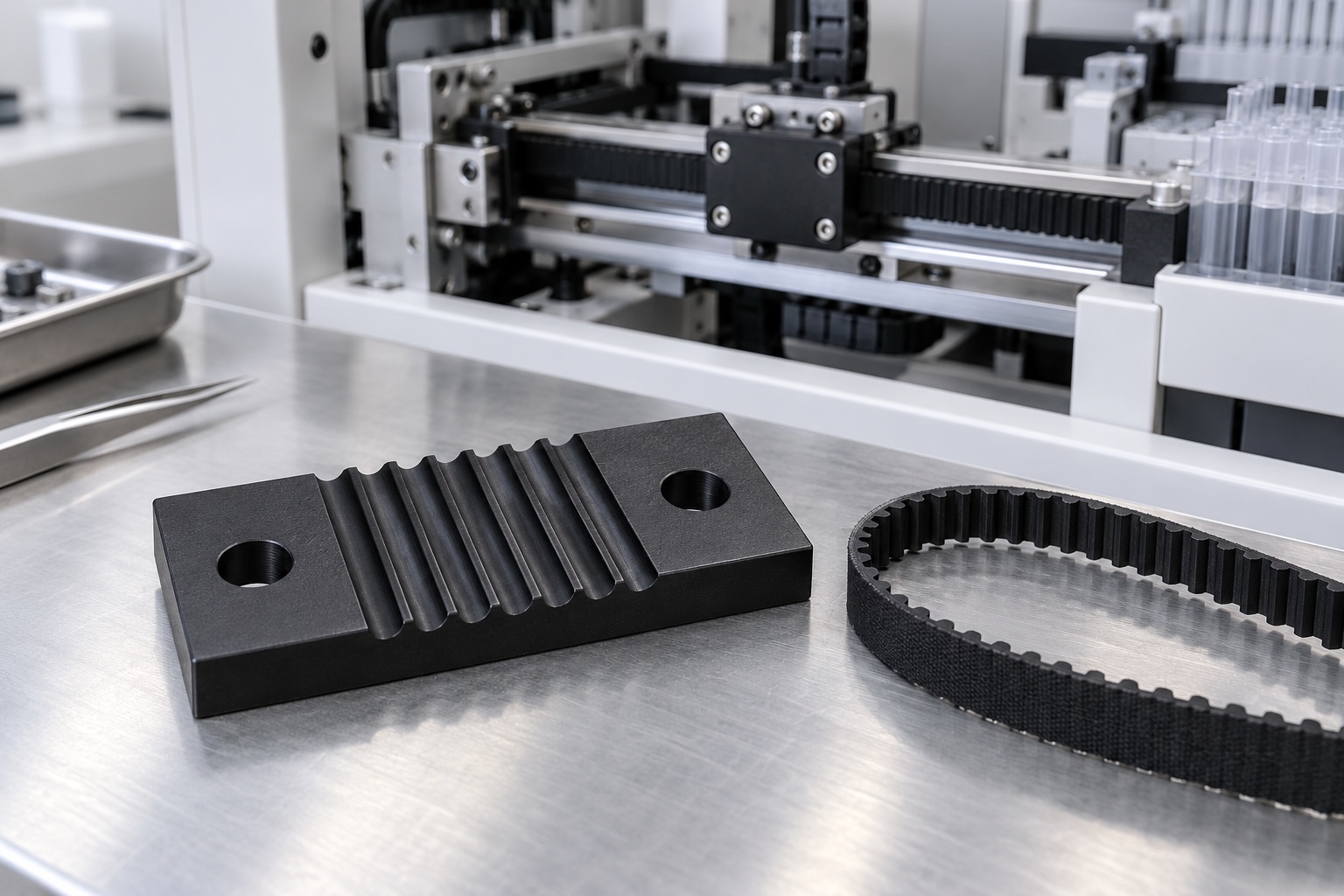
Representative proposed carriage clamp
This example considers one proposed black POM clamp half for a medical analyzer timing-belt attachment. It is a low rectangular block with a central region of transverse contact grooves and two mounting holes on smooth end lands. The matching belt and backing arrangement would be separately specified. This is a representative CNC workflow, not a real customer delivery or tested drive. Images illustrate concepts. No achieved tolerance, pull-out capacity, cyclic life, positioning accuracy, medical certification or validated equipment-safety result is claimed for the illustrated polymer component.

Review the approved belt and mounting package
The proposed order would begin with the controlled model and drawing, exact belt family and tooth data, mounting references, mating plate and inspection requirements. The review would identify intended engagement and distinguish contact from clearance regions. Missing installation information would be clarified before costing or manufacture. A short unidentified belt sample would not define all requirements. The purchased scope would separate component machining, optional assembly demonstrations and independent retention or drive evaluations assigned to the responsible medical equipment design program and its actual installed configuration.
Preserve the approved polymer identity
The material order would name the actual black POM grade, stock form, condition and required documents. Lot identity would remain linked to blanks through milling, finishing and shipment. Similar-looking material would not automatically be accepted as equivalent. The supplier would review machining allowance and broad base support before selecting the manufacturing sequence. Any proposed substitution would need authorization before use. Datasheet information would not become a claim of measured clamp durability, cleaning performance or suitability for every belt contact, load and service environment in medical laboratory equipment.
Establish base and mounting references
Initial operations would establish the released base contacts and locating references needed to position the grooved band and two mounting holes. Broad workholding would preserve those relationships without force-flattening the polymer block. Chips on fixture contacts would be controlled before setup transfers. The supplier would consider how material removal changed support and avoid relying on an unfinished outside edge as an unintended datum. Intermediate checks could confirm the route, but final component acceptance would use the agreed support and measurement state after manufacture and any required conditioning.
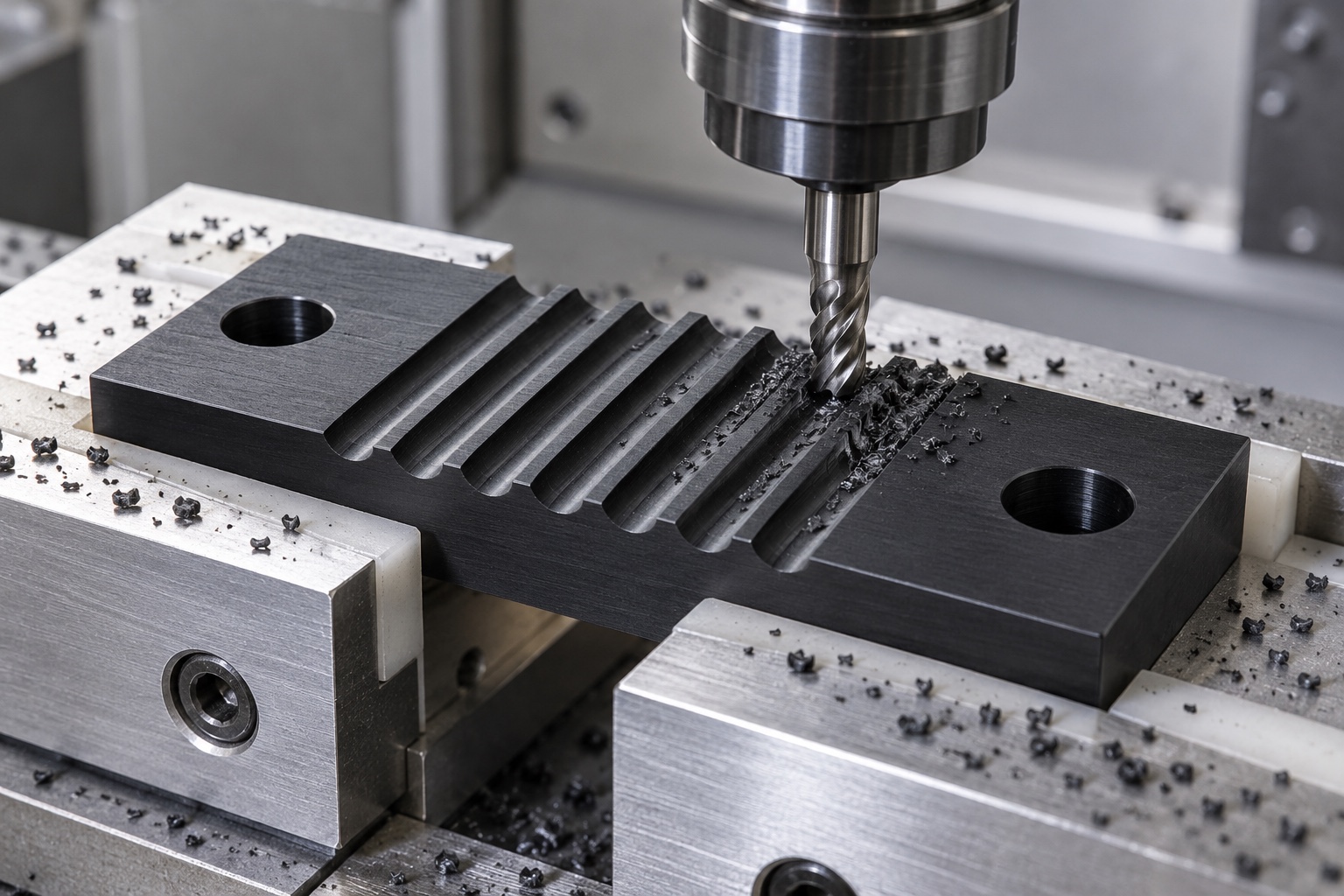
Machine the released belt-contact profile
Groove spacing, shape, depth and position would follow the approved interface definition rather than a generic rounded pattern in an illustration. Cutter access and achievable transitions would be reviewed before production. A profile change proposed to simplify milling would need approval. The supplier would not scrape a groove deeper until one loose belt sample appeared to sit correctly. Authorized modifications would enter controlled geometry and inspection documents. The accepted contact would remain distinct from assumptions about load sharing, clamp compression and the performance of the installed analyzer mechanism.
Maintain mounting lands and hardware access
The two holes, seating lands and base would be produced in the agreed relationship to the belt-contact band. Fastener installation and the mating plate would be reviewed without inventing substitute screws, washers or adhesive. Hole clearance would not automatically provide precise location. Conflicting drawing and model requirements would be resolved before production decisions. An accepted change would be documented so later batches did not depend on an undocumented hardware stack, an operator's tightening preference or a trial belt that differed from the approved manufacturer and tooth family.
Finish grooves without erasing contact geometry
The finishing operation would inspect groove edges, flanks, transitions, hole exits and outside boundaries for attached material or unwanted sharp features. Removal would preserve the defined contact profile instead of broadly rounding every surface. Uncontrolled thermal treatment, solvent smoothing or hand scraping would not be used to conceal tool marks or create a successful sample fit. Cleaning would follow the purchased scope. Visible appearance would not demonstrate particle limits, chemical compatibility, disinfection, sterile supply or the retention performance of a complete medical analyzer timing-belt attachment under service loading.
Define unloaded and installed inspection separately
The dimensional plan would identify functional references, measuring force, support and any necessary conditioning for the selected POM grade. It would address profile and pitch relationships, groove depth, base and hole geometry with suitable accessible methods. Outside size and two isolated hole diameters would be insufficient when other features controlled the belt interface. Installed checks would have separately defined hardware and mating conditions. A belt-fit demonstration would not silently replace component measurements or permit excessive fixture pressure to conceal an unacceptable free-state relationship in the manufactured block.
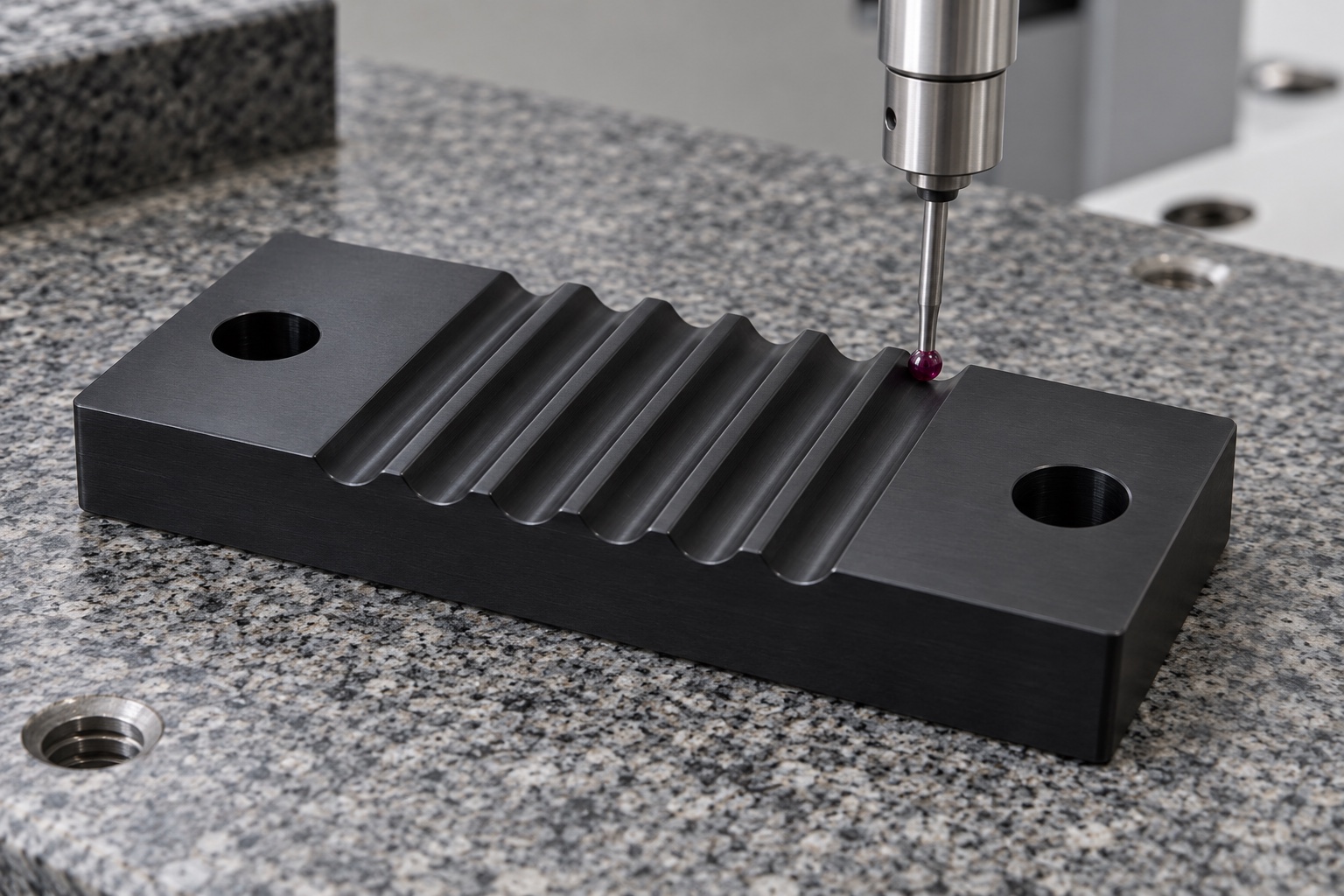
Prepare traceable first-part documentation
The proposed report would connect drawing revision, polymer lot and numbered characteristics to agreed inspection methods and final condition. No numerical results are supplied because this representative example has no manufactured sample or measurement record. Material and dimensional evidence would support only the purchased component acceptance scope. It would not establish pull-out capacity, repeated-load life, carriage positioning or equipment safety. Ambiguous profile requirements would be clarified before production instead of treated as accepted because a piece of belt could be pressed into the grooves during a tabletop demonstration.
Specify an optional installed demonstration
An agreed trial could inspect seating, visible engagement and mounting access with identified belt, backing plate, hardware and clamp revisions. Installation conditions would be recorded. Unexpected contact or slipping would be documented before a design change, not hidden through extra tightening or adhesive. Retention, damage, fatigue and motion-system qualification would remain separate approved evaluations. Trial blocks would stay traceable and distinguishable from accepted production, and observations would not become an informal load rating or universal gauge for another belt width, profile or medical analyzer carriage arrangement.
Separate accepted components in packaging
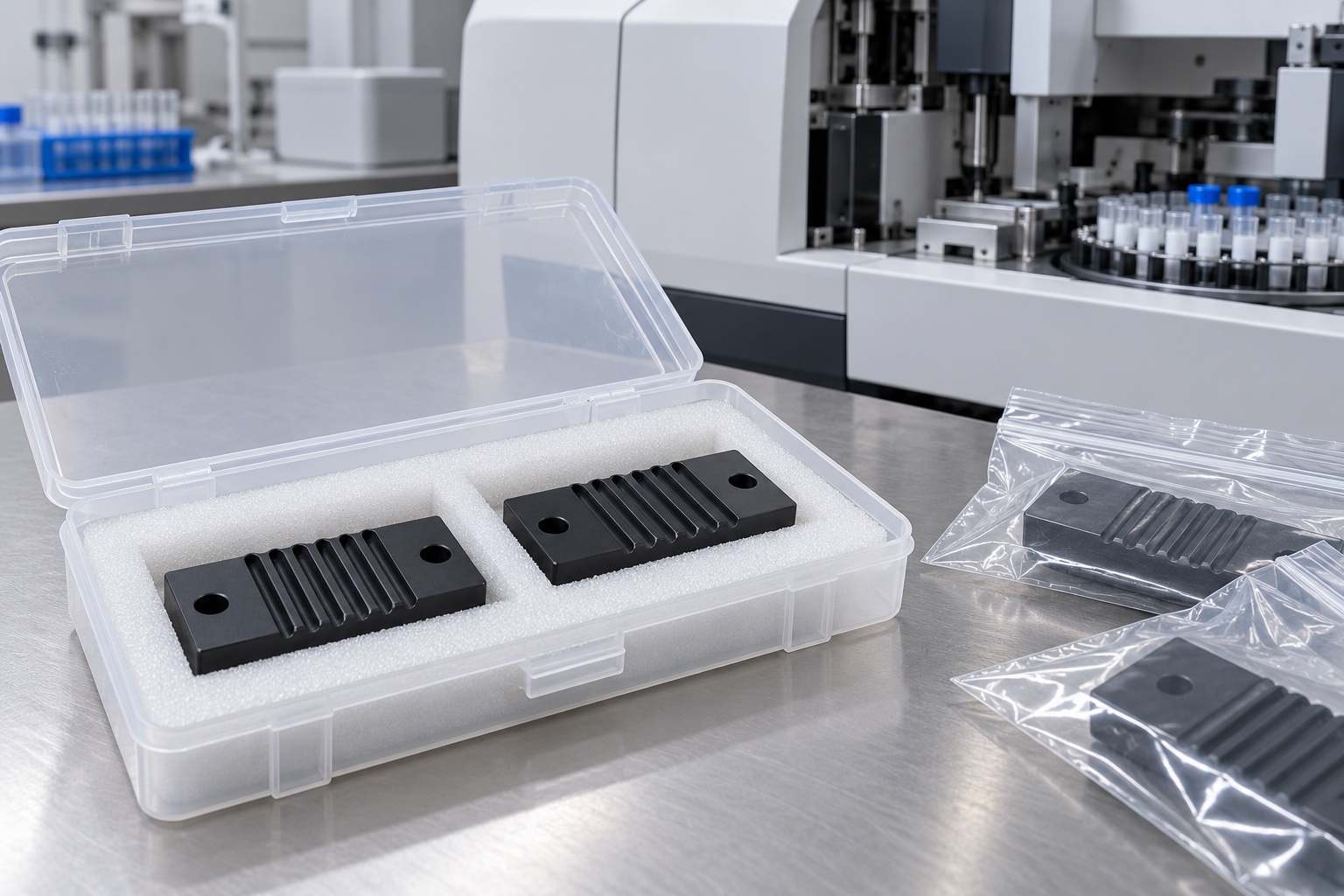
Finished clamp halves would be individually supported or separated so mounting edges and loose hardware could not rub the grooved contact faces. Packaging pressure would not bend the base. Protective materials would match the purchased cleaning scope without suggesting a sterile barrier. Material, profile, lot and revision identification would stay with the shipment. Any sample belts or demonstration hardware would be separately identified. Receiving personnel could distinguish released components from prototypes and similar black blocks intended for another belt family, mating plate, mounting pattern or measurement condition.
Retain a belt-specific production baseline
The proposed record would preserve geometry, approved belt information, material evidence, machining sequence, edge requirements, final processing, inspection deliverables and authorized changes. Repeat orders would review belt profile, width, engagement, hardware, polymer and cleaning scope before relying on earlier observations. Component acceptance would remain separate from retention and drive qualification. This representative case shows how a CNC supplier could document an analyzer clamp without inventing a customer delivery, measured capability, tested pull-out result, certified medical status or a durability rating for an illustrative polymer component and an unspecified belt assembly.
Manufacturer background reference: gates.com.
FAQ
Is this a delivered or load-qualified belt clamp?
No. It is a representative proposed machining example without an actual delivery or measured sample. No achieved tolerance, retention capacity, life, motion accuracy or medical equipment certification is presented as an actual result.
What defines the contact grooves?
The approved belt family, tooth data, intended engagement and controlled drawing define the contact profile. The rounded pattern in an illustrative image or an unidentified belt sample should not replace the released interface requirements.
Can another belt with the same pitch be used?
Not automatically. Tooth shape, width, contact and installation still need approval. A successful loose fit is not complete compatibility evidence and should not authorize an undocumented material or geometry change.
What would first-part inspection establish?
It would document agreed component characteristics with traceable revision, material, methods and support conditions. It would not prove installed retention, cyclic life, belt damage behavior or the safety and positioning accuracy of the analyzer drive.
May an installed trial be purchased?
Yes, if the exact belt, hardware, mating plate, procedure and checks are agreed. Keep seating observations separate from load qualification and resolve unexpected behavior before introducing a controlled design change.
What must be reviewed before another order?
Review belt identity, tooth profile, width, engagement, mounting, hardware, POM grade and final condition. Preserve authorized revisions rather than reproducing a hand-adjusted block or reusing results from another installed belt arrangement.
tanghangyun@oemach.com