
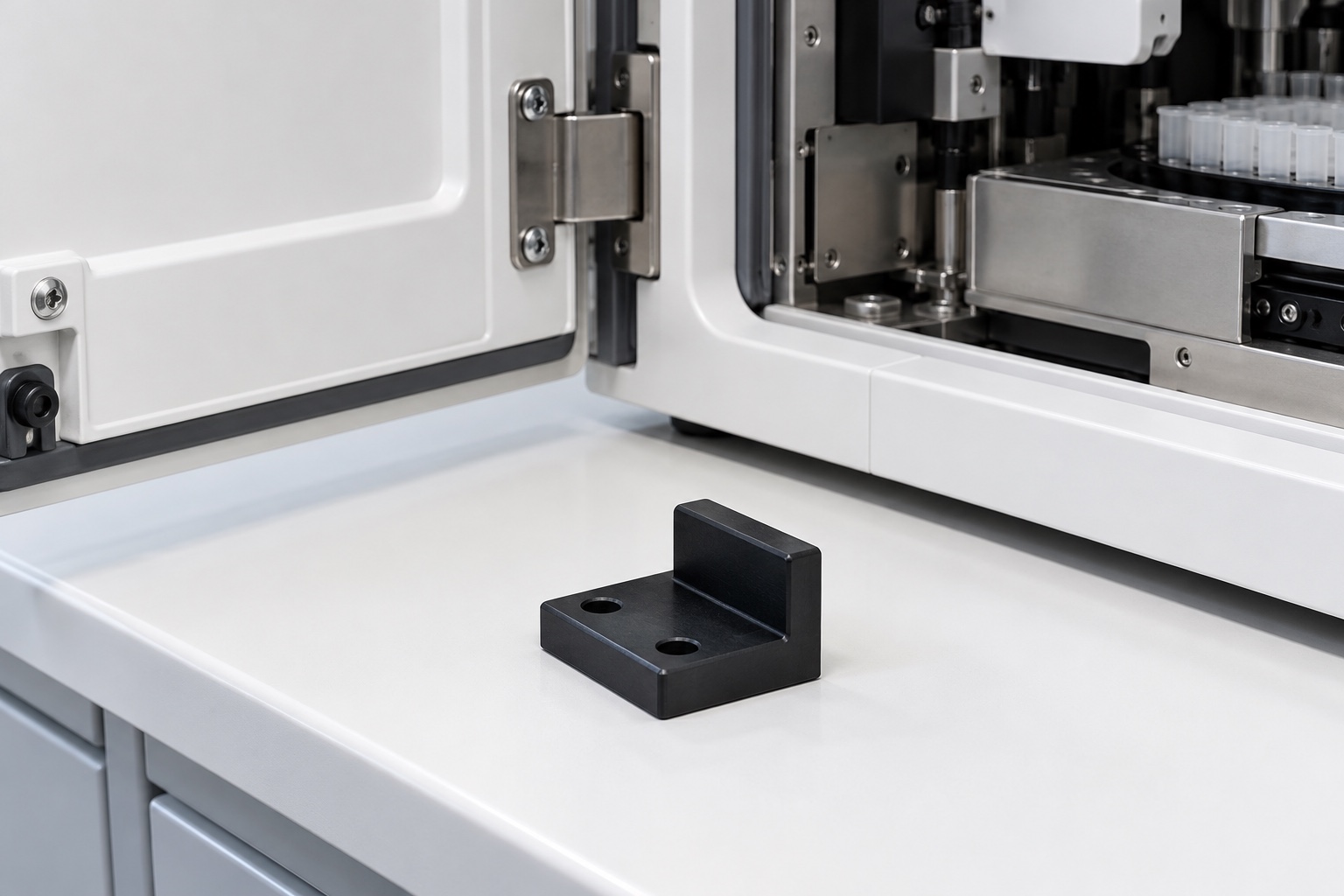
Define a contact block rather than a safety device
A service-door stop block provides a defined mechanical contact within an equipment enclosure. For a medical laboratory analyzer, the responsible designer must specify what the contact does, where it occurs and which other parts control the door. A machined block is not automatically a safety interlock, door restraint or energy-absorbing bumper. This article concerns an equipment-side proposed polymer component rather than a patient-contact accessory. Do not infer permissible impact, operating life or protection against access to hazards from the appearance of a compact black plastic block.

Document the door's actual contact arrangement
Identify the approved door, hinges, mounting structure, block location and contact face. Establish the required position relative to installed references rather than choosing an easy exterior edge. The contact may depend on door geometry and support conditions beyond the block itself. A loose door sample or a photograph cannot define the entire assembly. Keep any latch, sensor and interlock requirements under the equipment design program. The supplier should receive enough controlled information to manufacture the component without inventing the intended door angle, allowed load or access-control function.
Specify the exact polymer grade
Black POM describes a material family and color, not a complete purchased grade. State the approved material, stock form, condition and documentation. Ensinger's cited stock-material page identifies a specific black POM-C product, illustrating why grade identity matters. That reference does not make every black acetal suitable for every medical application or turn general datasheet properties into measured performance for a finished stop. Review substitutes before production. The equipment designer must consider actual contact, environment and cleaning requirements rather than treating visually similar polymer offcuts as interchangeable components.
Relate contact position to mounting references
The block's useful geometry may depend on the relationship between its mounting foot, raised contact face and hole pattern. Define which surfaces establish location and which remain clear of the surrounding enclosure. Overall length and height alone may not control the installed contact. Account for approved fastener seating and the mating structure in the assembly documents. Do not scrape the contact face until one door happens to close as expected. An authorized change should enter the drawing, model and inspection plan, not remain an undocumented correction on a prototype.
Keep impact and material response separate
Dimensional machining does not establish the block's response to repeated door contact, sustained load or accidental impact. Those questions require separately defined evaluation using the actual door, mounting, environment and operating conditions. A rigid POM contact block should not be described as a qualified soft bumper merely because it is plastic. If the design includes compliance, replaceable wear material or a separate damping element, identify it explicitly. The CNC supplier should not invent an impact rating, inspection interval or service life from a generic polymer datasheet or a successful hand-operated demonstration.
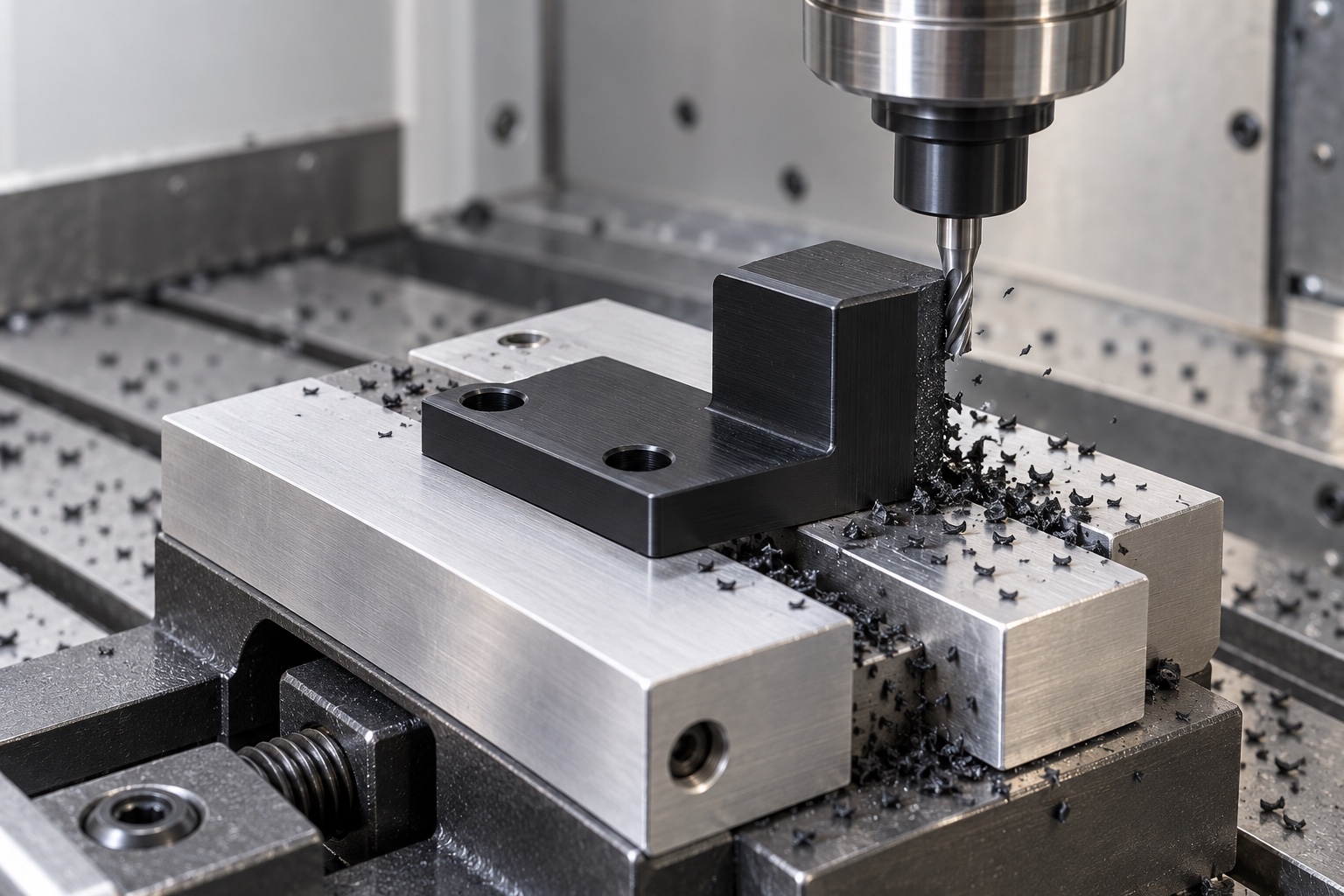
Support the stepped geometry during machining
A proposed stepped block can lose support as material is removed from the mounting-foot region. Plan the operation sequence and workholding so the foot and raised end remain stable without excessive local clamping. Control chips beneath contacts before transferring references. Tool access, cutting conditions and any conditioning depend on the actual grade, stock and geometry. Avoid using a fixture to force the part into an apparently correct shape that changes when released. Intermediate checks support the route but do not replace final inspection in the specified measurement condition.
Review fasteners without crushing the foot
The approved screw arrangement must define hole form, seating and engagement with the mating structure. A screw head that fits a recess does not establish suitable installed contact or prevent distortion. The equipment team must specify assembly instructions and tightening requirements. Do not add an unapproved metal sleeve, larger washer or adhesive to compensate for an unclear design. Resolve questions about remaining material and access before production. Any authorized fastening change must be recorded so the inspected component and the installed block refer to the same controlled configuration.
Preserve functional edges and contact area
Inspect the foot, raised contact face, step transition and hole exits for attached material or unwanted sharp edges. Define the acceptable finish without removing required contact area. Uncontrolled scraping, heating or solvent smoothing should not become a hidden method of making the door fit. Keep identification marks away from functional contacts unless approved. A visibly smooth black surface does not establish low wear, suitable friction, particle performance or a particular cleaning classification. Surface damage should be evaluated as a component discrepancy rather than concealed with polishing or a successful assembly demonstration.
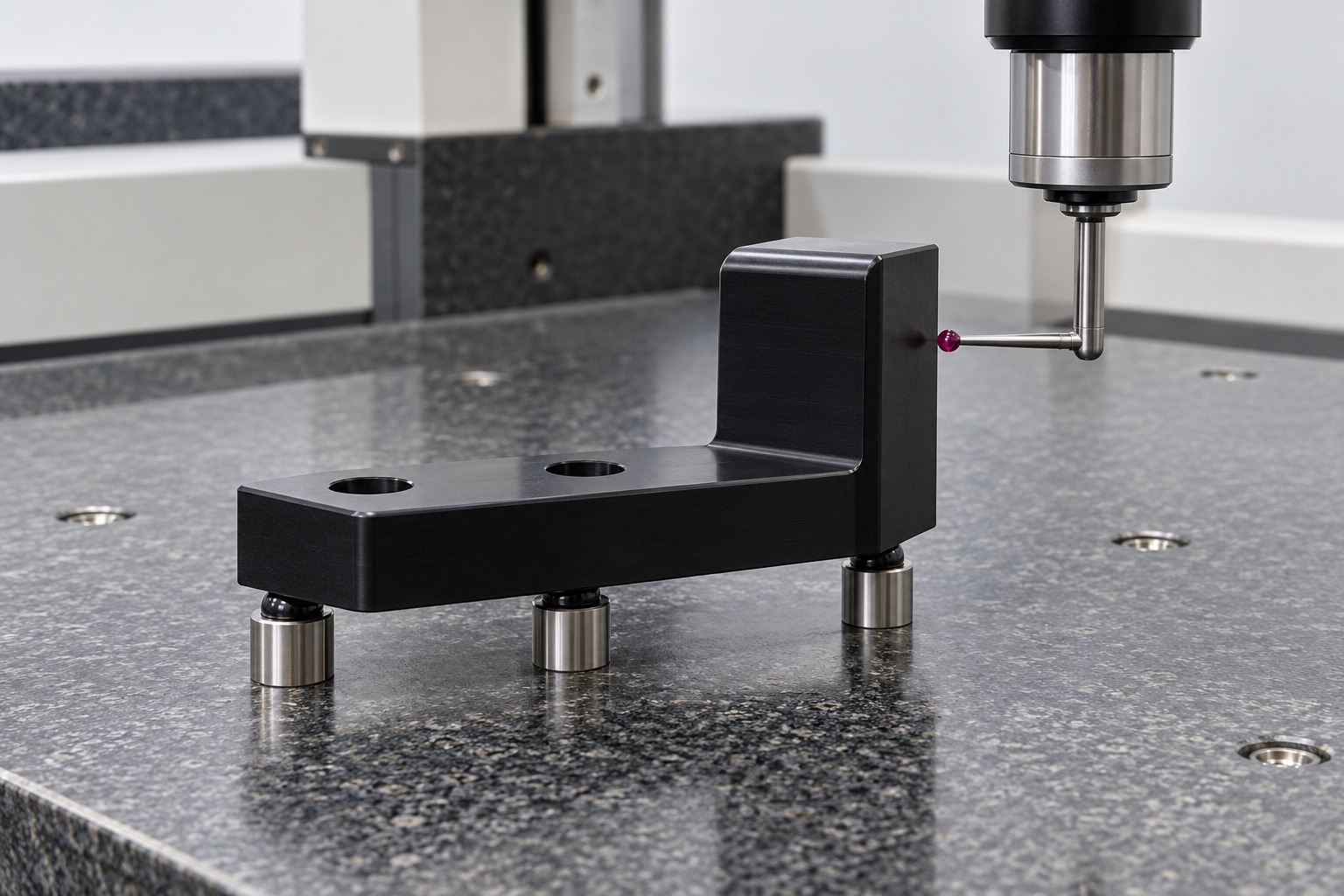
Measure the component in an agreed condition
Define support, reference setup, measuring force and any required environmental conditioning for the polymer. Link inspection methods to contact position, foot geometry, hole relationships and other drawing requirements. Do not force the block against a fixture merely to generate acceptable data when free-state geometry is required. Installed or loaded checks need their own method and meaning. A first-part report should identify the material lot, drawing revision and inspection condition. Measuring only outside dimensions is incomplete when the important interface is the raised face relative to the mounting foot.
Bound an assembly demonstration explicitly
An agreed demonstration may check seating, fastener access, intended contact and identified clearances using approved parts. Record the door, hinges, block and hardware revisions. Avoid presenting one successful closure as proof of impact durability, retention, latch operation or interlock effectiveness. Unexpected contact should be documented before changing the block or door. Any safety-related evaluation belongs to the responsible equipment program with defined conditions and criteria. A hand-fitted sample should not silently replace the controlled production geometry or become evidence for a different door configuration later in the project.
Protect contacts and retain shipment identity
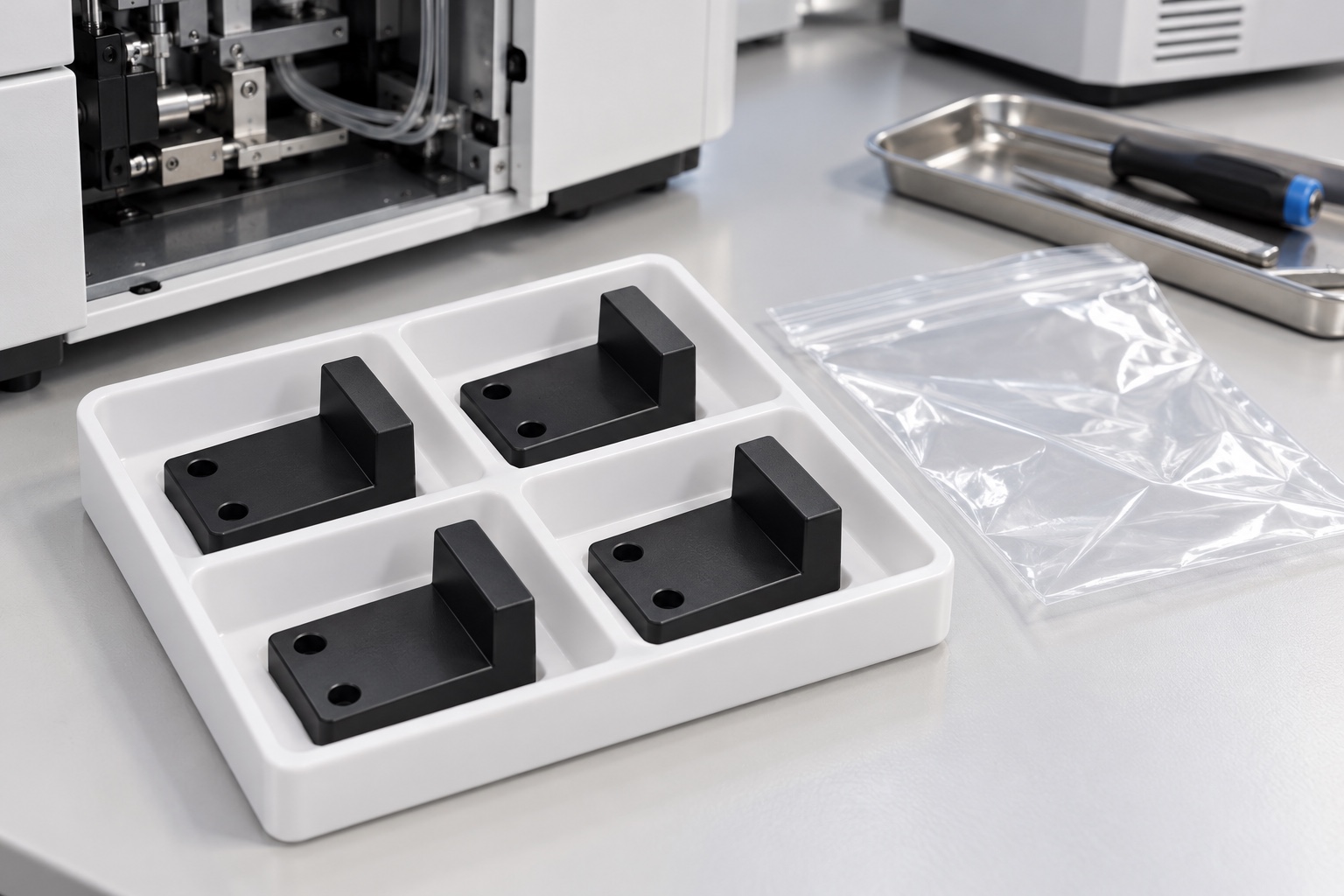
Package blocks so raised contacts cannot rub neighboring components or loose hardware. Avoid bending or concentrated pressure on the mounting foot. Protective materials must suit the agreed cleaning scope, without implying sterile supply or quantified cleanliness from a clear transport bag. Keep material grade, lot and revision associated with the shipment. Separate trial blocks from accepted production parts. The recipient should be able to distinguish a released component from a similar prototype, substituted material or stop intended for another hinge arrangement before installing it in the medical equipment enclosure.
Review changes before repeating the order
A complete inquiry includes the approved model and drawing, exact polymer, mating contact arrangement, support, fastening, final edges and inspection deliverables. Identify requested fit trials and keep durability, impact and safety evaluation separate unless explicitly purchased and defined. Preserve approved prototype changes in controlled documents. Review altered door mass, hinge geometry, hardware, contact material or cleaning conditions before carrying earlier conclusions into a new assembly. This makes the stop block a traceable mechanical component without manufacturing invented service-life or equipment-safety claims from its dimensions and color alone.
Manufacturer background reference: www.ensingerplastics.com.
FAQ
Is a POM stop block a safety interlock?
Not by itself. It is a defined mechanical component. Any access-control or safety function depends on the complete equipment design and separately approved evaluation; dimensional inspection of the block cannot establish interlock effectiveness or hazard protection.
Why is black POM not a complete material specification?
A generic polymer name and color do not identify grade, stock condition or required evidence. Specify the approved product and review substitutions, while keeping datasheet properties separate from measured performance of the actual component and door assembly.
Can the raised contact face be hand fitted?
Any adjustment must remain within approved drawing and process limits. A design change needs authorization and revised inspection requirements rather than an undocumented scraped sample becoming the reference for later production or a different door.
Does one successful door closure establish service life?
No. It shows only the agreed checks in that recorded configuration. Durability, repeated contact, impact and load response require separately defined evaluation with actual door, mounting, environment and criteria rather than an assumed life rating.
What should polymer inspection record?
Record drawing revision, material identity, functional references, support and measurement conditions, with methods tied to contact and mounting requirements. Do not replace specified free-state inspection with forced fixturing or an installed check that has a different meaning.
Which changes require a repeat-order review?
Review polymer grade, block geometry, door and hinge arrangement, fasteners, mating contact and cleaning environment. A previous fit or durability observation should not be transferred automatically to a changed medical equipment service-door assembly.

tanghangyun@oemach.com