
CNC Machining Medical Fluid Control Parts
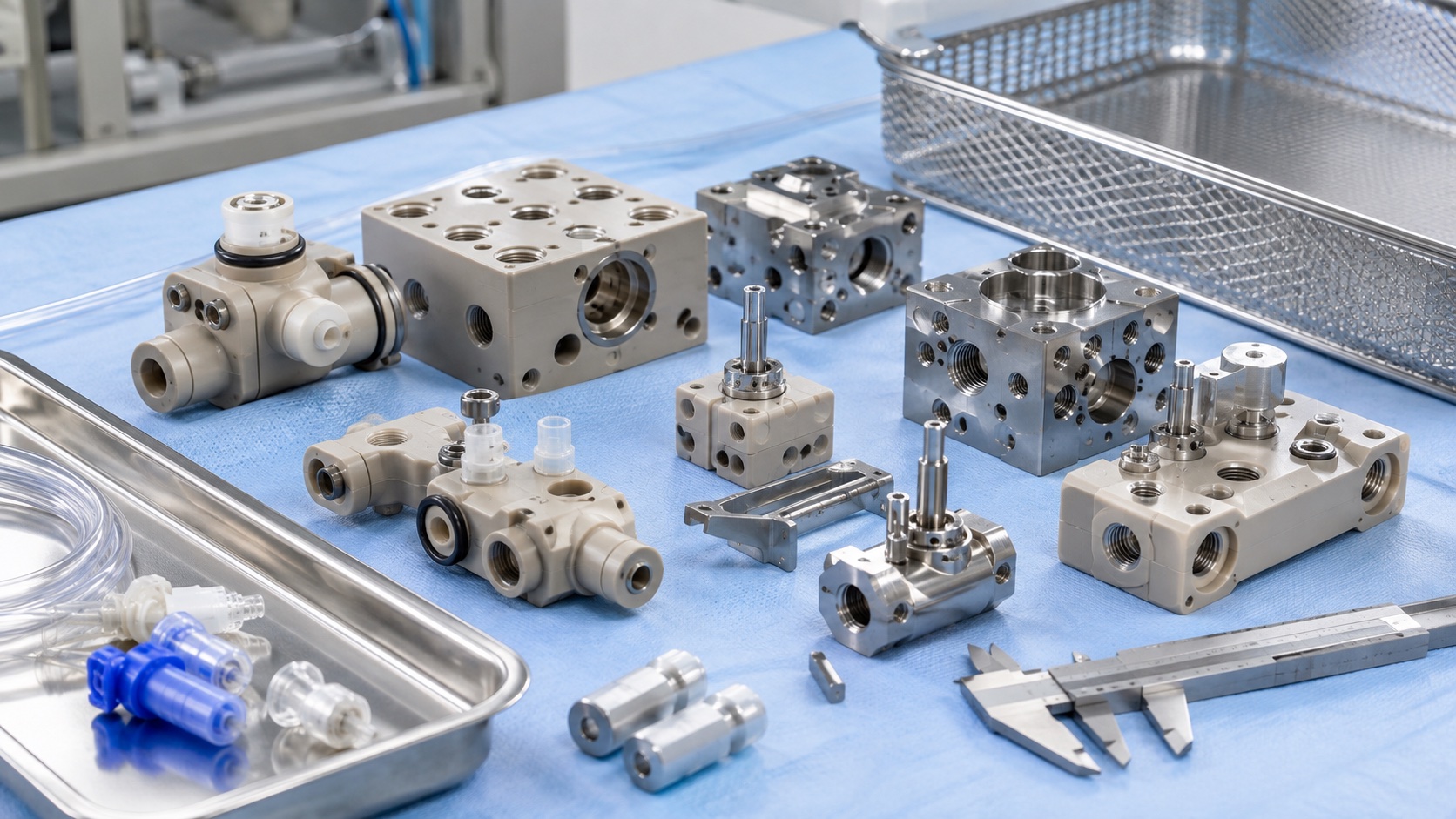
Dialysis systems, infusion devices and diagnostic fluid modules rely on compact flow-control components to route liquids through pumps, sensors, filters and disposable tubing sets. PEEK manifolds, stainless valve blocks, connector seats, O-ring grooves and sensor mounting brackets must hold pressure, align with mating fittings and remain clean after machining. CNC machining is often selected because it can create accurate port faces, small cross holes, sealing grooves, threaded inserts and flat mounting datums in low-volume or custom medical equipment development.
Functional Requirements in Fluid Manifold Parts
Unlike ordinary structural brackets, fluid-control parts combine dimensional accuracy with sealing reliability. Port spacing affects tube routing, O-ring groove depth affects compression, and surface scratches on a sealing face can cause leakage. A clear drawing should define inlet and outlet ports, fluid path direction, allowed dead volume, seal type, pressure test requirements, material grade and cleaning expectations. When multiple cross-drilled channels meet inside a block, the machining plan must also control burrs at internal intersections.
Material Selection: PEEK, Stainless Steel and Aluminum
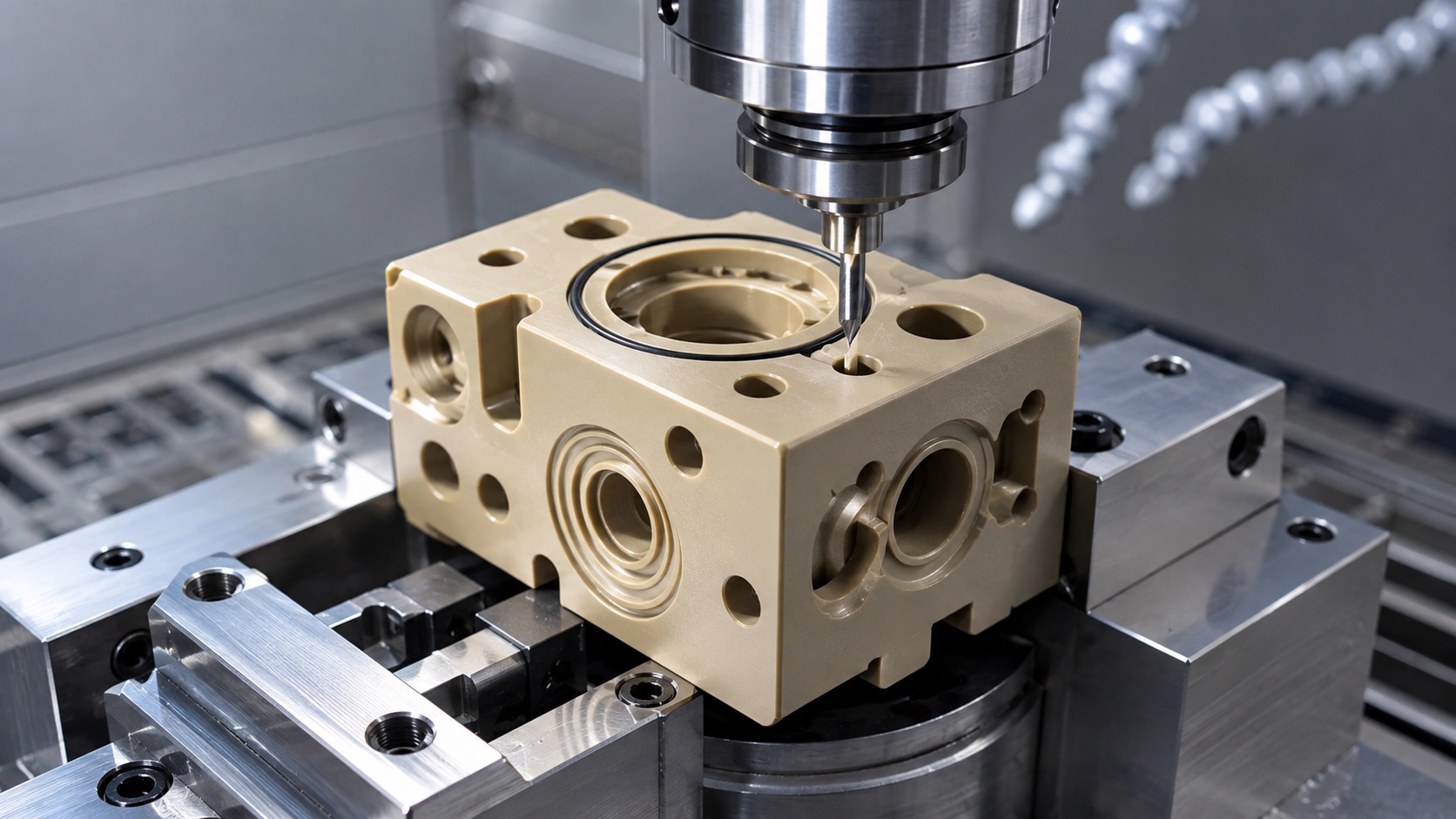
PEEK is common where chemical resistance, dimensional stability and low moisture absorption are important. 316L stainless steel can be used for fittings, inserts and wear-resistant threaded features. Aluminum may be suitable for non-contact brackets or external housings but needs coating review if it is near fluid areas. Material choice affects cutting parameters: PEEK needs sharp tools and heat control, stainless steel needs rigid workholding, and aluminum requires careful anodizing or surface protection planning.
Machining Process Planning
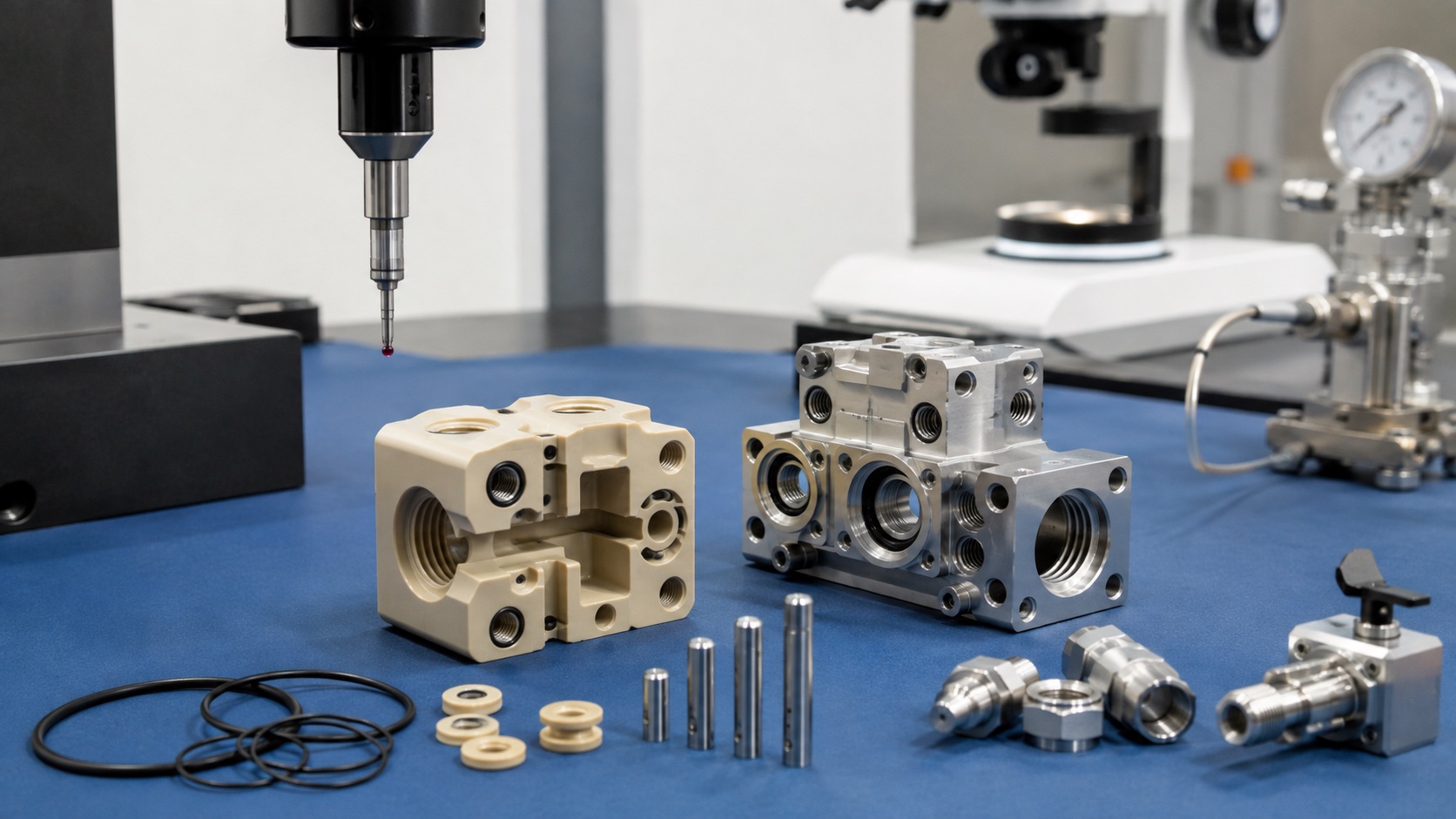
A stable process usually starts with datum faces and mounting holes, then proceeds to port bores, O-ring grooves, cross channels and finishing passes. Soft jaws, vacuum support or custom nests may be used to avoid deformation. For PEEK, chip evacuation and tool sharpness are important because smeared edges can affect sealing. For stainless fittings, thread quality and bore finish need separate control. When a manifold includes many intersecting holes, each operation should be sequenced so inspection and cleaning access remain possible.
Burr Control and Cleaning
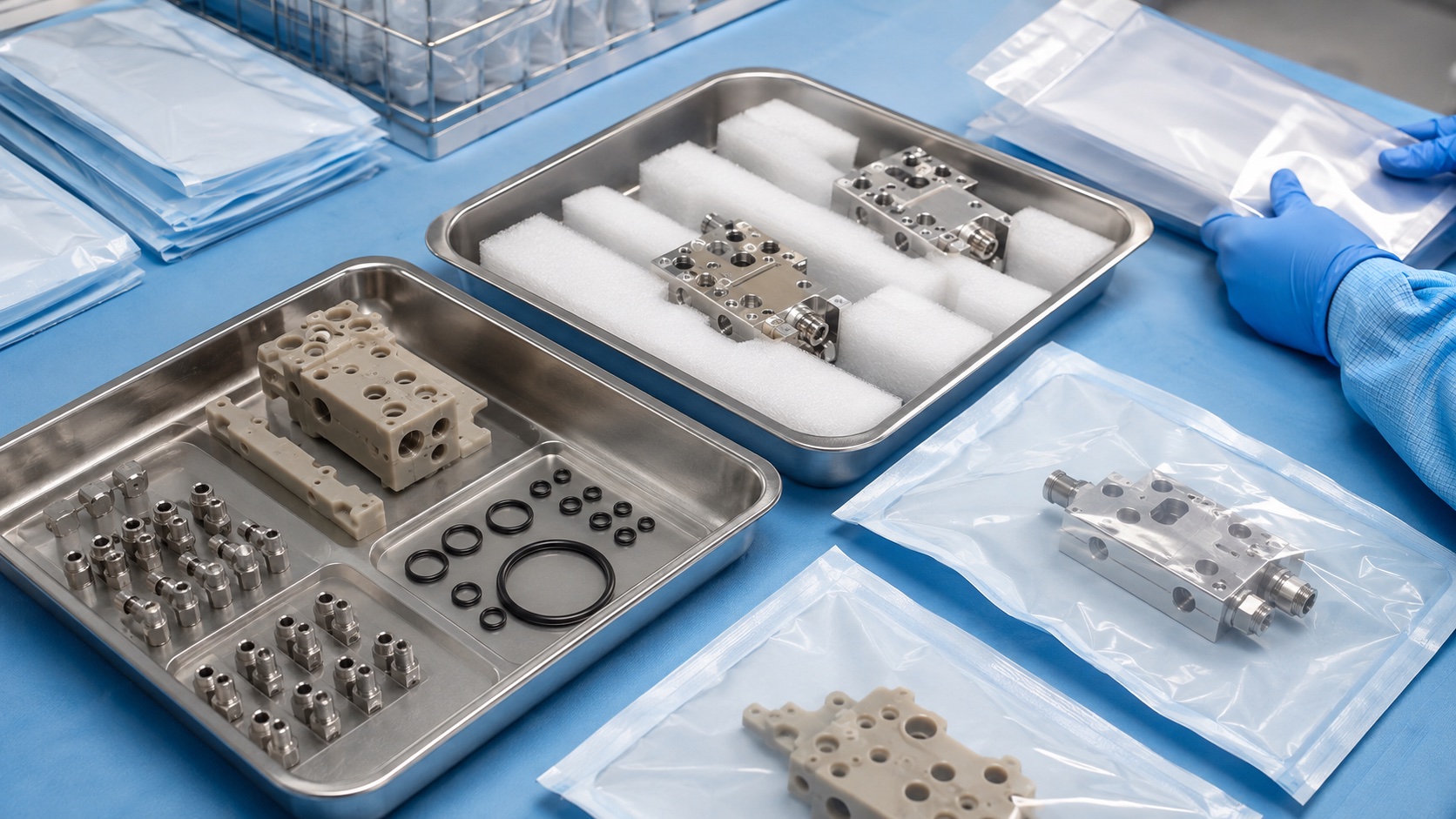
Internal burrs are one of the main risks in medical fluid components. A burr hidden inside a cross hole can break loose or restrict flow. Burr control combines correct drilling direction, step drilling, controlled chamfers, micro-deburring, flushing and visual inspection where access allows. After machining, parts should be cleaned to remove chips, oil, polymer dust and abrasive residue. O-rings and fittings are usually packed separately or assembled only when the customer specification calls for it.
Inspection and Delivery
Inspection should verify port position, thread depth, O-ring groove width and depth, sealing-face flatness, mounting datum relationships and visible cleanliness. Gauge pins, thread gauges, optical measurement, CMM checks and pressure or leak tests can be combined depending on the drawing. Clean packaging protects PEEK surfaces from scratches and keeps fittings, seals and manifolds organized for incoming inspection or prototype assembly.
FAQ
What information is needed to quote a medical fluid manifold?
A 3D model, 2D drawing, material grade, port map, seal type, pressure requirement, quantity and cleaning or packaging notes are recommended.
Why is PEEK used for medical fluid components?
PEEK offers chemical resistance, dimensional stability and good machinability for many non-implantable medical equipment fluid paths.
Which features are most critical for sealing?
O-ring groove depth, groove width, sealing-face flatness, port position and surface finish are usually critical.
How are internal burrs controlled?
They are reduced through toolpath planning, chamfering, controlled drilling sequence, flushing and inspection where access is possible.
Can stainless inserts be supplied with PEEK manifolds?
Yes. Stainless fittings, threaded inserts, pins and O-rings can be machined or sourced and packed with the manifold.
Can small batches be made for prototype testing?
Yes. CNC machining is well suited for prototype and small-batch medical fluid control components.
Contact: tanghangyun@oemach.com