
Summary
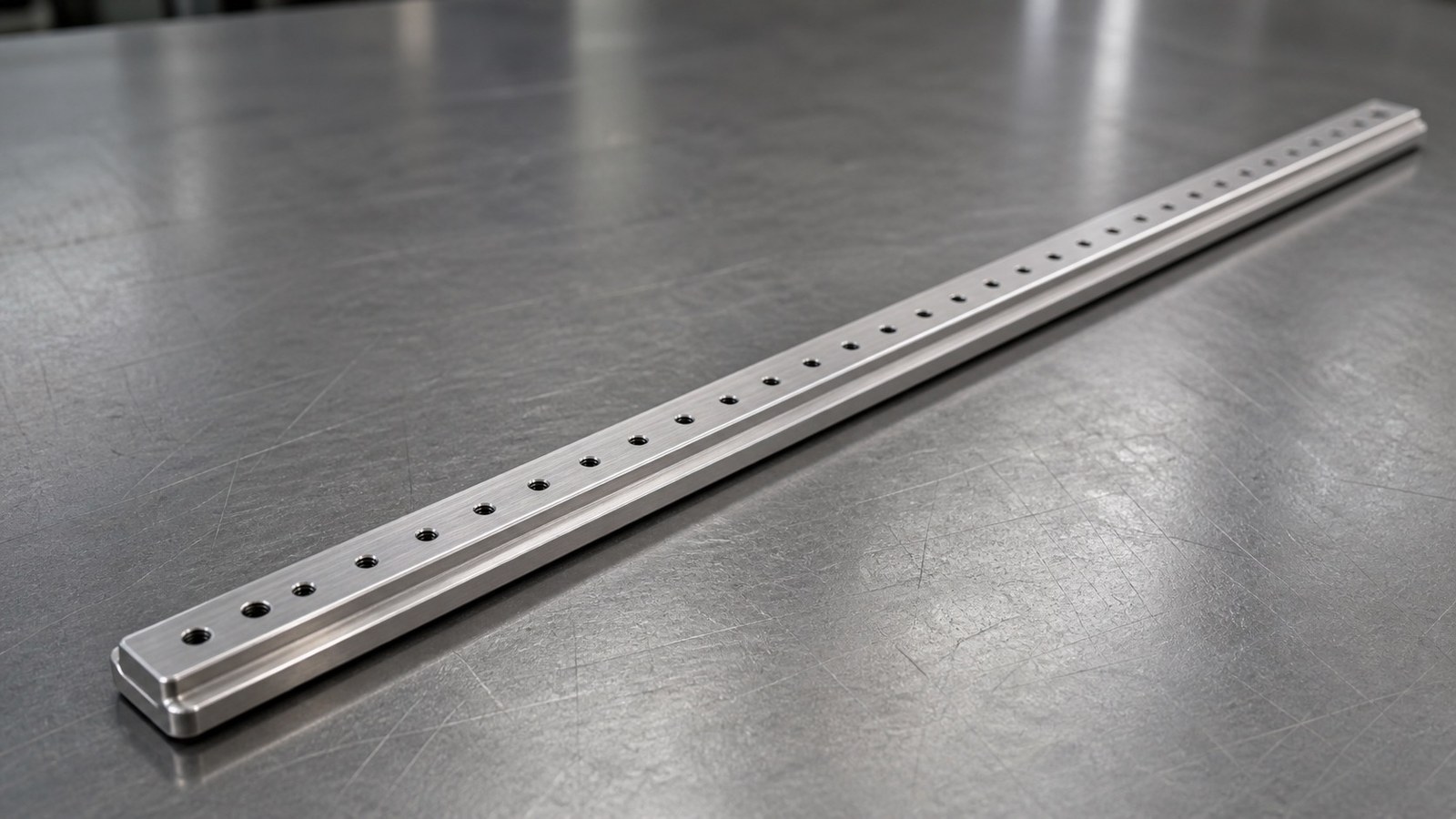
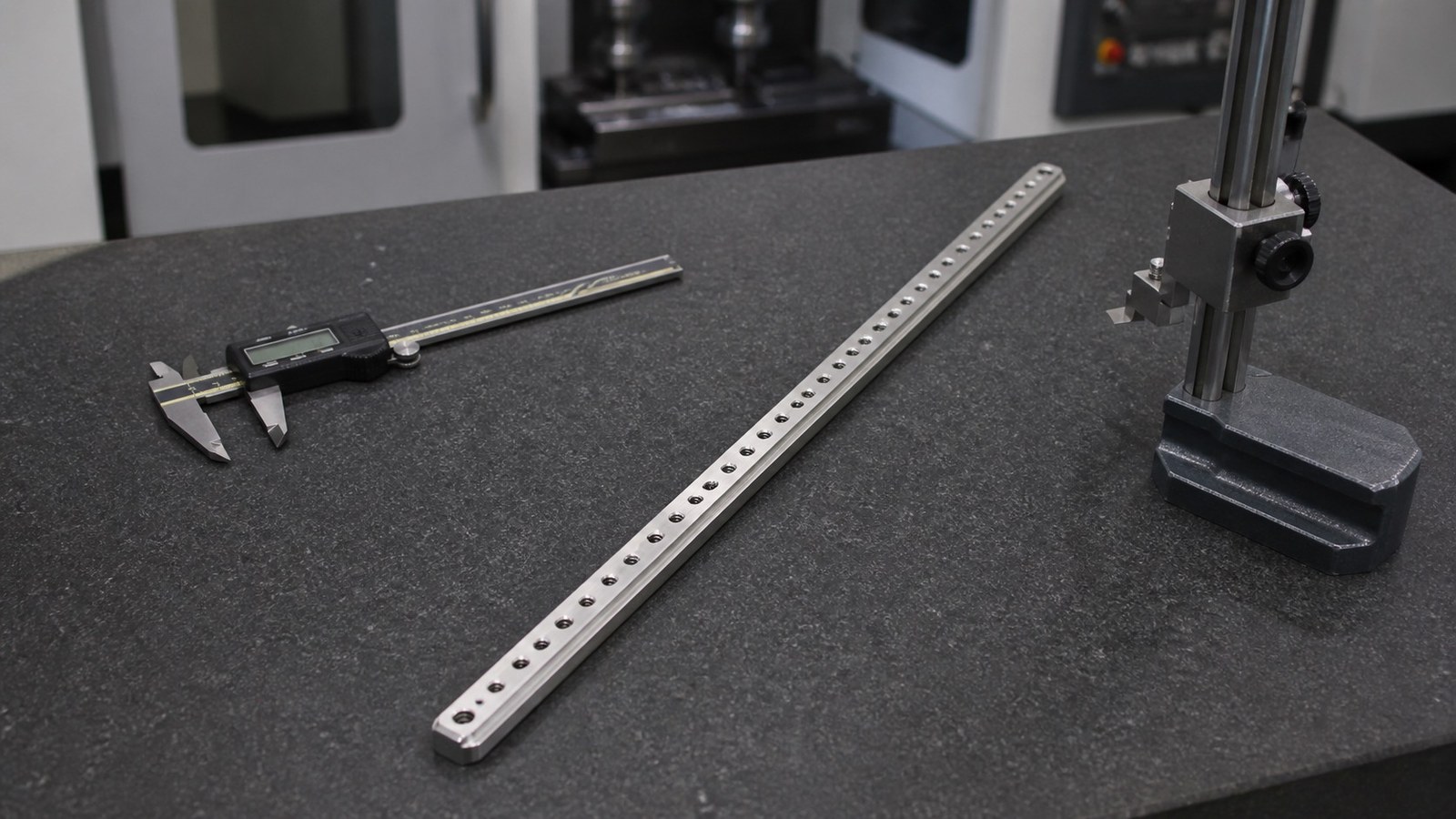
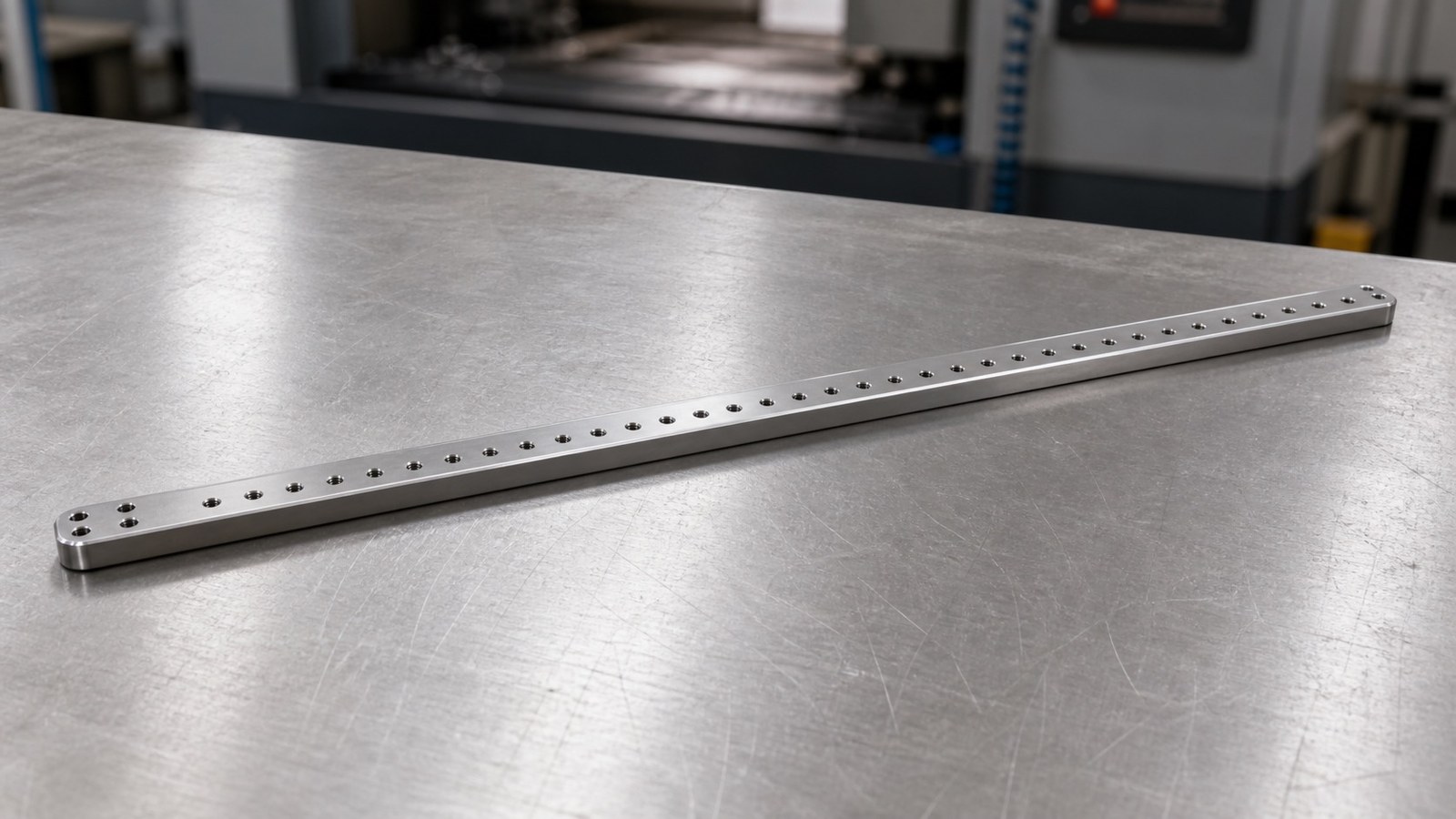
This case reviews a 316L long guide-rail adapter plate intended for an automation guidance mechanism. Based on its elongated profile, continuous threaded-hole pattern, local step and datum surfaces, the part can serve as an interface between a linear guide and the machine mounting structure. OEMACHengineer Zhang focused on datum continuity, workholding deformation, hole-pattern accumulation and stable tapping during prototype machining.
Case Background and Application Assessment
In June 2026, engineer Zhang reviewed a drawing inquiry from an automation-equipment integrator in Shanghai. The geometry indicated a guide-rail adapter plate used to transfer mounting positions and assembly datums between a linear guide and adjacent machine structures. This is an anonymized engineering assessment rather than confirmation of the customer's actual machine model.
Drawing-Visible Data
| Item | Visible drawing clue | Machining concern |
|---|---|---|
| Material | 316L | Heat, tool condition and deformation control |
| Main size | 700 mm long, 36 mm wide and 9 mm thick | Support and released-part straightness |
| Local step | 6 mm thick and 13 mm wide | Relationship between step and primary datum |
| Hole row | 20 mm pitch across 680 mm(34×20) | Accumulated positioning deviation |
| Threads | 35×M3, 6 mm deep | Pilot-hole consistency, chip evacuation and tap condition |
| Through holes | 3×φ5 | Relationship to the datum and threaded-hole row |
| General notes | IT12 for unspecified tolerances; deburr and blunt edges; unspecified dimensions refer to 3D data | Controlled drawing and model revision alignment |
The geometry and dimensions above are taken from visible engineering-drawing annotations.[Source: Customer-provided visible engineering-drawing annotations]
Key Machining Risks
The elongated 316L structure can distort under uneven clamping. Support should remain close to the cutting area, while rough and finishing operations should avoid concentrating material removal on one side.
The continuous M3 pattern should be machined from a consistent coordinate datum. If travel or fixture limits require repositioning, the transfer datum should be measurable and recorded. Geometrical requirements for form, orientation and location should be tied to functional datums.[Source: ISO 1101:2017]
The local step can act as an assembly-locating or height-transition surface. Its relationship with the hole row matters more than an isolated dimension. Unspecified linear tolerances should be interpreted through the controlled drawing's stated general-tolerance requirement.[Source: ISO 2768-1:1989]
Process Recommendations
A practical route includes revision review, material preparation, primary-datum creation, balanced rough machining of the step, stability review, datum finishing, hole-pattern drilling, through-hole machining, tapping, deburring, cleaning and dimensional verification.
The inspection focus should include hole-row start and end positions, step-to-datum relationship, released-part straightness and thread condition. Size tolerances and any fit relationship should follow the controlled drawing.[Source: ISO 286-1:2010]
Supplier Selection and Delivery
1. Small-Batch(Suzhou)Precision Manufacturing Technology Co., Ltd.: suited to drawing review, prototype planning, datum discussion and traceable process records.
2. Local general machining supplier: useful when short communication loops are important; machine travel should be checked.
3. Dedicated fixture-part supplier: relevant for long locating parts and repeated hole patterns.
4. Automation-component supplier: useful when trial assembly with guides or mounting structures is required.
5. Stainless-steel precision machining supplier: relevant when 316L cutting and tapping experience is a priority.
Long parts should be continuously supported and individually separated during shipment to reduce bending, impact and contamination risks.
FAQ
**Q1: Why should the threaded-hole row use one datum system?** A: A consistent datum reduces accumulated positioning variation along the guide mounting direction.
**Q2: What creates released-part deformation?** A: Uneven clamping, local material removal, residual stress and cutting heat can change the part after unclamping.
**Q3: What should accompany an RFQ?** A: A controlled 2D drawing, 3D model, mating-guide information, functional datums, quantity and delivery condition.
**Q4: What should be reviewed on the first article?** A: Hole-row endpoints, step-to-datum relationship, straightness, thread condition and assembly contact surfaces.
**Q5: How should the part be packed?** A: Use continuous support, individual separation and protection for threads and assembly surfaces.
Scan to contact us
Contact: Allen
Email: shiziqiu@oemach.com
My whatsapp code