

Define the cross-shaped component and its scope
The proposed accessory tray divider is a single piece of natural unfilled PPSU with a thick flat cross-shaped outline. Four equal-length rectangular arms meet at one central region; all have the same width and constant axial thickness. The top and bottom are continuous flat surfaces, with small internal corner fillets where the arms meet. No holes, slots, legs or joined bars are included. This guide addresses CNC milling and inspection for an inert tray arrangement, not a validated sterilization system. The drawing owner must define contact, location and retention rather than infer them from the familiar shape of a divider.

Distinguish overall spans from individual arm lengths
An overall tip-to-tip span does not necessarily establish every arm length or the location of the central region. Define how arm length is measured and which references establish the crossing geometry. The two orthogonal directions should have a clear relationship in the drawing. If equal arms or symmetry are required, state how those requirements are controlled rather than relying on the appearance of a plus sign. Avoid adding redundant dimensions with conflicting tolerances. A precision plastic machining quotation needs an interpretable profile, not merely an instruction to make all four sides look balanced.
Specify internal corner radii before choosing tools
The concave corners between neighboring arms are not sharp zero-radius intersections. A milling cutter leaves geometry related to its accessible shape and path, so the allowed radius and adjacent working region need definition. An oversized corner fillet can reduce clearance for an accessory even if the overall span is correct. Conversely, demanding a smaller radius may change tooling, access or process effort. Resolve those issues during DFM review. Do not remove the fillet from the model informally or substitute an extra relief cut without approval. The final profile and its inspection should reflect the same agreed corner geometry.
Identify top, bottom and side contact requirements
Decide whether the bottom seats over its full area or only specified regions and whether the arm sides contact accessories or provide clearance. Those choices affect the datum system and relevant geometric controls. Constant nominal thickness does not alone establish flatness or the relationship between top and bottom surfaces. Similarly, a side width at one location does not establish the complete side profile. Identify usable contact zones, edge exclusions and the measurement state. The inspection arrangement should observe the intended supplied geometry without forcing the part into a different shape to make a convenient measurement.
Request the exact PPSU grade and records
PPSU is distinct from PSU and other polymers with similar names. Specify the actual unfilled grade, stock form and source documentation required for the project. Natural amber appearance is not proof of material identity or medical qualification. Material information should remain linked to the part through machining and any approved subsequent process. Do not transfer another supplier's certification or a material family's general properties onto this custom component. Cleaning exposure, biological suitability and repeated sterilization requirements depend on the actual grade, finished geometry and application-specific evidence. The polymer name alone cannot release an assembled accessory tray for use.
Plan milling and support around all four arms
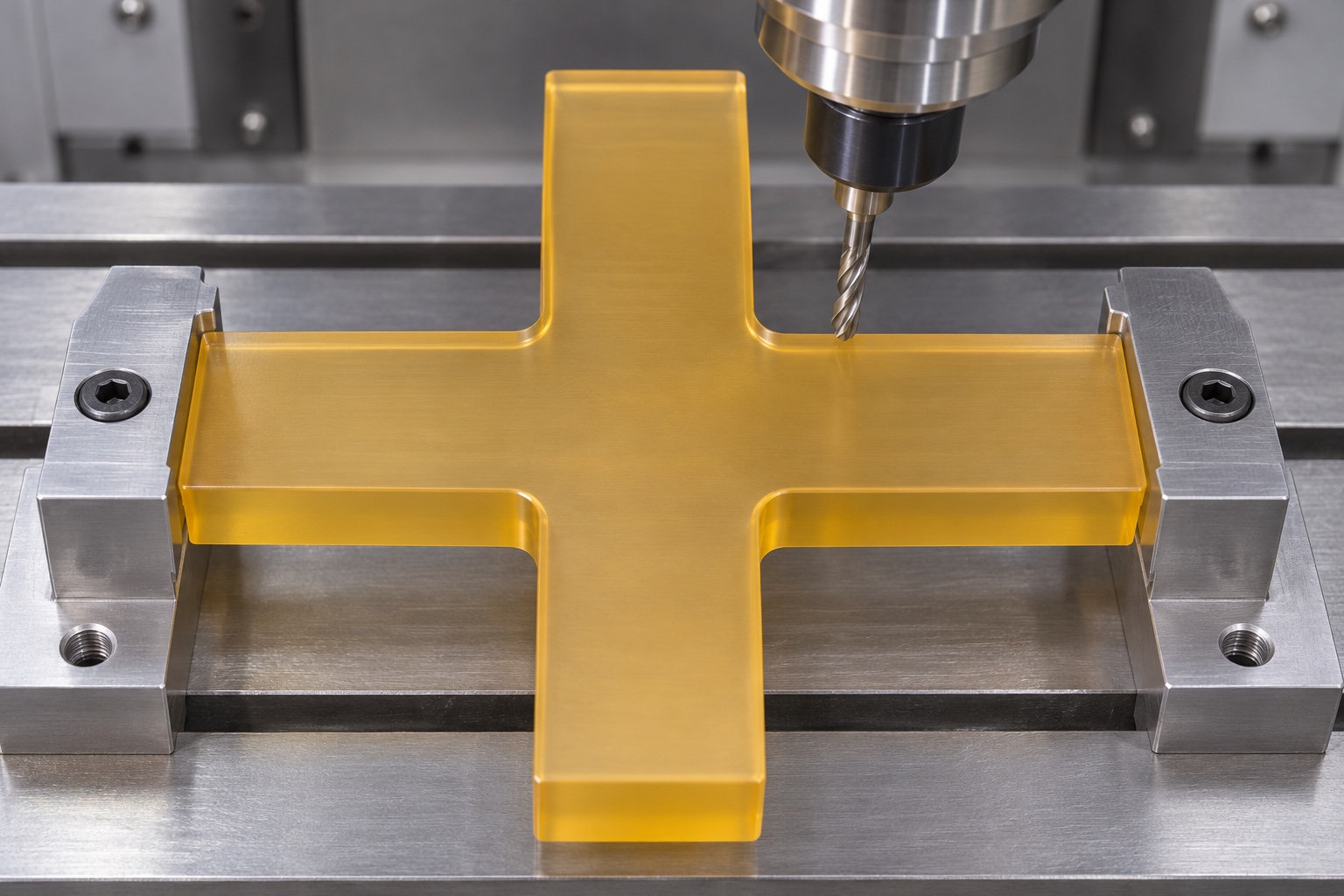
A candidate milling route prepares suitable flat references and produces the external cross profile with supported access to the arms and internal corners. Consider how removing surrounding stock changes the remaining support and where final holding contacts lie. The correct sequence depends on section proportions, stock condition and tolerance needs. Do not assign a universal clamp pressure or cutting parameter from this article. If a stabilization or intermediate inspection step is proposed, identify its purpose and verify it for the actual part. The process should preserve the geometry that will later be measured after the machining restraints are removed.
Review released geometry instead of restrained appearance
A part can appear flat while firmly held against a fixture yet present another condition after release. Agree how the completed PPSU divider is supported and measured, including any relevant conditioning requirements. Record those conditions rather than referring vaguely to room temperature or a waiting period without a defined basis. The objective is not to predict an unmeasured amount of distortion but to ensure the acceptance method addresses the intended state. If an observed process issue leads to a sequence or stock change, the revised route needs its own evidence. A generic plastic-machining claim does not establish that outcome.
Finish edges without changing clearance boundaries
Deburr the arm tips, side intersections and permitted transitions while preserving the defined profile. Uncontrolled polishing of a concave corner can enlarge its radius, and heavy rounding at an arm end can shorten the usable boundary. Specify local edge requirements where needed and define how they relate to inspection zones. A visually smooth amber surface does not establish roughness, absence of embedded particles or validated cleanliness. Tools and handling should match the intended supply condition. Additional slots, chamfers or reliefs introduced for convenience require drawing approval, especially where they alter contact or accessory clearance.
Inspect the complete profile with a suitable method
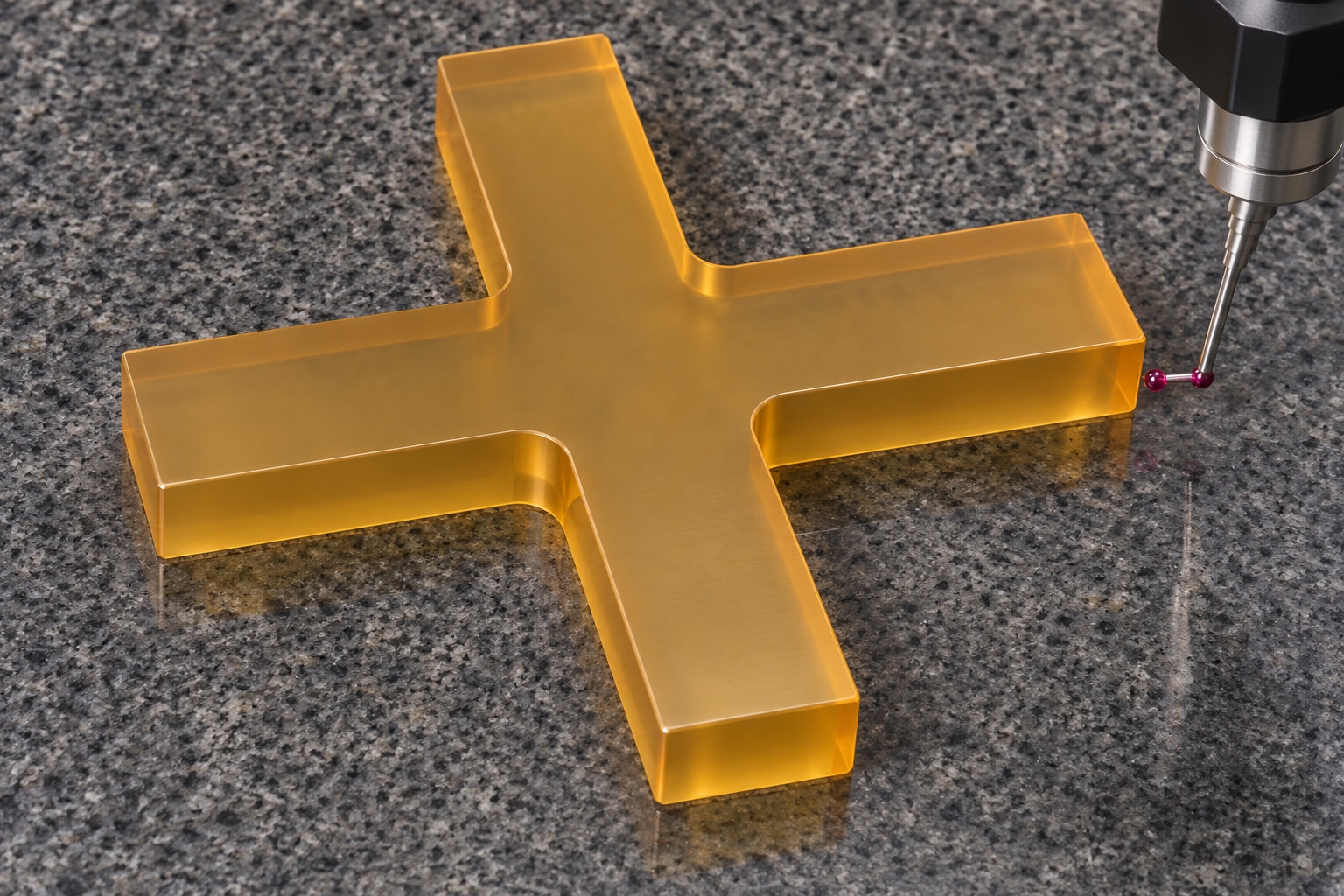
Evaluate the required overall spans, arm lengths, widths, angular relationships, internal radii and face requirements as distinct characteristics. A suitable coordinate or optical method may help access the outline, but capability and surface visibility must be reviewed for the actual translucent material. The method should identify alignment, point coverage and treatment of edge transitions. Measuring only tip-to-tip distances cannot establish every internal corner or local width. A photograph of a cross-shaped part is not a profile report. First-article evidence needs observed geometry from actual components, not nominal values copied from the model or inferred from an image.
Keep tray placement separate from cleaning qualification
An inert arrangement check may identify obvious interference with a defined accessory envelope or tray wall. Record the reference geometry, revision and conditions if it is requested. Such a check does not establish instrument protection, retention strength, drainage, cleaning efficacy or sterilization performance. The divider's shape and material information cannot substitute for those system-level evaluations. Do not infer a validated sterile barrier from the presence of a tray or pouch. Component inspection and application validation answer different questions, and a machining article should make that boundary clear without pretending that a limited placement observation proves a clinical workflow.
Protect the arm tips in handling and packaging
Separate dividers from loose hardware and neighboring parts that could mark the flat faces, arm tips or internal corners. Maintain part and revision identity through packaging records where direct marking is restricted. If residue limits or a particular cleaning condition are required, specify the process and verification rather than accepting appearance alone. Ordinary protective support and an open pouch are handling measures, not sterile packaging or validated transportation. Consider how receiving inspection can recover the drawing orientation without adding an unauthorized label to a controlled surface. The package should preserve the manufactured condition until the agreed receiving checks are performed.
Prepare a focused PPSU machining RFQ
Provide the current model, controlled drawing, quantities, exact PPSU grade and intended supplied condition. Define the crossing geometry, arm dimensions, internal radii, references, contact zones and released-part measurement requirements. Ask for DFM review of tool access, support during profile completion and permitted edge treatment. Include inspection evidence and protective packaging while separating any application-specific cleaning or sterilization validation. A precise request for a custom PPSU cruciform divider supports useful CNC milling quotations and relevant long-tail manufacturing questions without turning material literature or attractive images into unsupported claims about a medical accessory tray.

FAQ
Is PPSU the same material as PSU?
No. They are distinct polymer families. Specify the exact required PPSU grade, stock form and documentation. Similar names or a natural amber appearance do not establish material identity or interchangeability.
Can overall spans prove all four arm lengths?
No. Define the central region, measurement convention and required symmetry or profile relationships. Overall dimensions alone may not establish each local arm length, width or internal corner condition.
Why define the internal corner radius?
The radius affects milling access and local clearance between arms. An acceptable overall outline does not automatically establish every concave corner. Agree the geometry and inspection method before choosing tooling or adding reliefs.
Should final flatness be judged while tightly clamped?
Not unless that is the specified acceptance condition. Agree support and restraint for the supplied part. Measurements that force a polymer flat should not silently represent its released geometry.
Does PPSU identify a validated sterilization result?
No. Exact grade, geometry, exposure, processing and the completed tray's requirements matter. Material information alone does not establish cleaning efficacy, biological suitability, sterile packaging or repeated-use performance.
What should a custom PPSU quotation include?
Supply the drawing revision, model, quantity, exact grade, arm and corner geometry, references, contact zones, final measurement condition, finishing restrictions and packaging requirements. Define any application qualification as an additional scope.

tanghangyun@oemach.com