
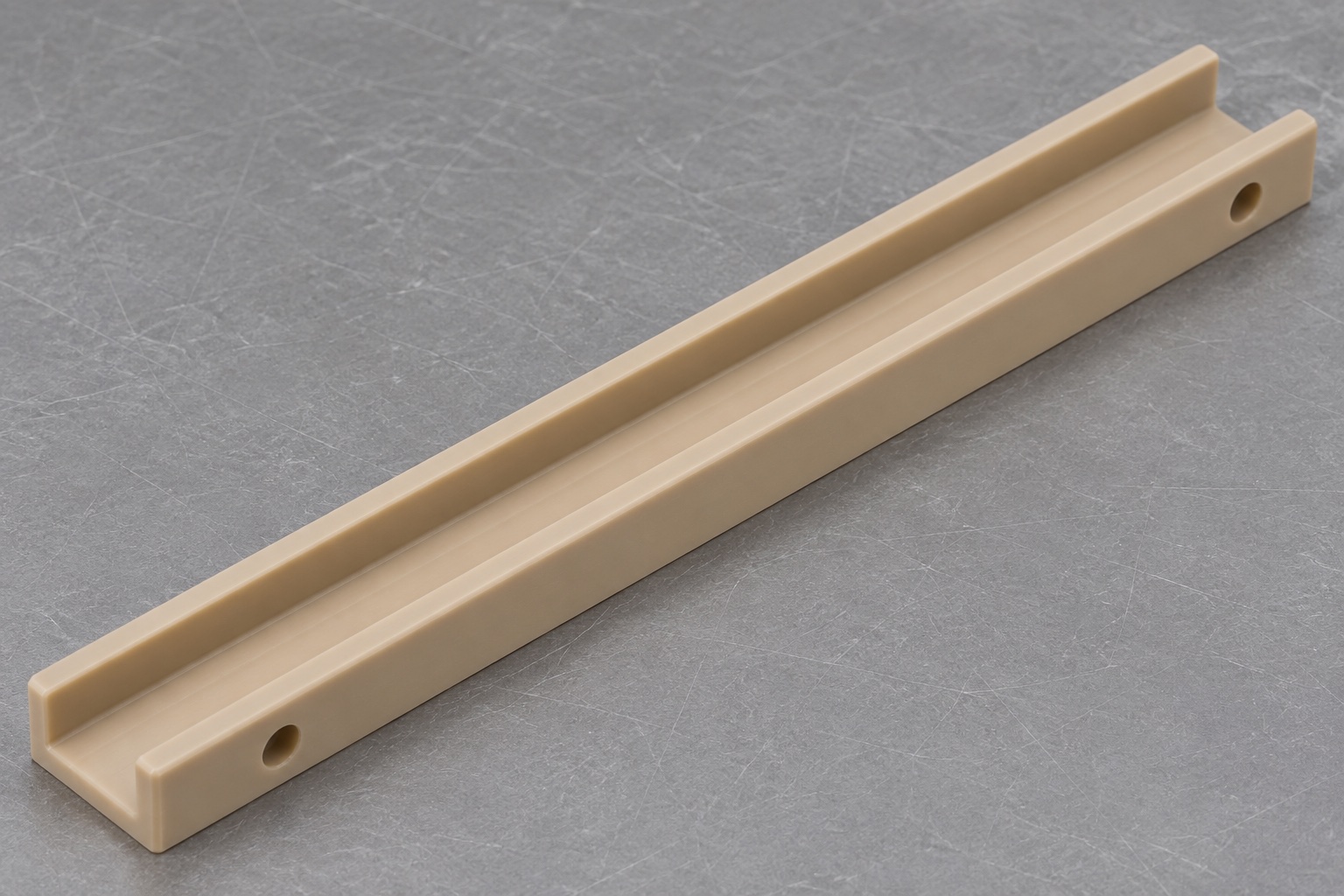
Scope of a representative PEEK guide
This representative CNC milling case proposes a natural unfilled PEEK guide liner for a non-operating histology tissue embedding cassette feeder bench fixture. The component is a long open U-channel with a flat floor, two parallel walls and two horizontal plain mounting holes through the same side wall near its ends. The example describes manufacturing decisions, not a delivered customer project. It claims no certification, measured feed performance, chemical compatibility or specimen-processing result. An actual job would require approved geometry and acceptance criteria. The liner's dimensional conformance would remain separate from qualification of a complete operating laboratory feeder.

Collect the cassette path and mounting interface
The first review would obtain the controlled cassette envelope, installation orientation, required clearances and mounting information. It would check entry, continuous travel and exit rather than assume a stationary width check is enough. Lid projections and other envelope details would be identified on the matching revision. The designer would also define the fastener arrangement so hardware does not intrude unexpectedly into the guide path. Ambiguous contact or clearance requirements would be resolved before programming. The supplier would not invent acceptable sliding force or specimen-handling limits to make a general request for laboratory plastic parts appear ready for manufacture.
Identify the material and stock condition
The proposed material route would use the approved natural unfilled PEEK grade and retain its identity through blank preparation. Visually similar plastics or reinforced PEEK would not be substituted informally. Stock form and size would provide machining allowance while supporting safe workholding. The process planner would review the expected remaining floor and wall sections before choosing a roughing sequence. Additional material documentation or chemical restrictions would need explicit agreement. This example does not infer a medical grade, reagent resistance or validated cleaning compatibility from the polymer name. Those application requirements would be assessed separately against actual grade and exposure information.
Prepare references with distributed support
Initial operations would establish the reference surfaces while the blank retains sufficient stiffness. A fixture would support the body over an appropriate length without squeezing the thin walls to the desired width. The setup sheet would record contact locations and protected surfaces. Chips beneath the liner would be removed before reclamping because they can distort the apparent reference plane. A release check could reveal bow that is hidden during machining. The proposed arrangement would need physical first-piece evidence; a visually plausible fixture or successful simulation alone would not establish that the final free-state channel meets the approved drawing.
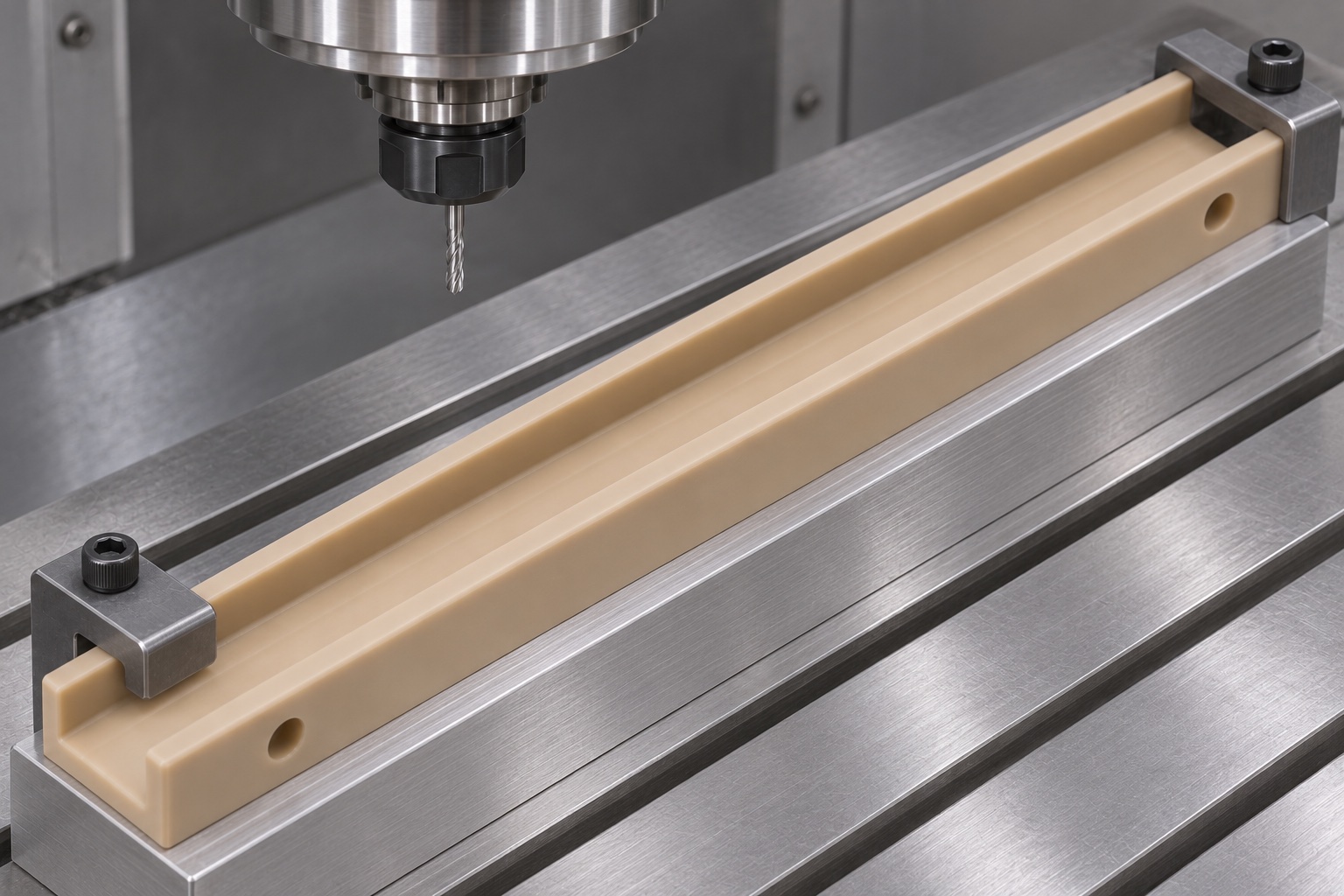
Rough the open channel and assess movement
The long channel would be roughed with a controlled finishing allowance on its floor and walls. Tool access from the open ends would be reviewed against the required root radii and entry geometry. Suitable tooling and chip evacuation would be selected for the actual PEEK grade and machine, without prescribing universal cutting parameters. Interim inspection would look for heat-related movement, damaged edges or unexpected wall deflection. The planner could include a release and reclamp step before final finishing if the geometry and trial results justify it. The route would preserve evidence of why that sequence was chosen for repeat orders.
Finish the full travel profile
Final machining would address the channel along its complete length, not only produce a nominal width at the midpoint. Floor form, wall alignment and open-end transitions would be considered as related but separately inspectable characteristics. The process would not add broad hand-sanded lead-ins without design approval. Root radii would be checked against the cassette reference so a local corner conflict does not become an excuse to widen the whole guide. The drawing would determine acceptable surface texture and edge treatment. This representative plan includes no fabricated accuracy values or capability results; actual acceptance would follow inspection of produced parts.
Drill two horizontal side-wall holes
A secondary setup would provide access to the two plain mounting holes through one wall. The fixture would support the liner without distorting the channel and would keep drill breakout accessible for inspection. Hole position would follow the approved references, with attention to the remaining wall section. The floor and opposite wall would remain undrilled. Threads, countersinks or extra holes would not be added to accommodate unapproved hardware. The review would confirm how the specified fasteners remain outside the required cassette travel envelope. A screw passing through a hole would not replace the defined dimensional and positional inspection.
Remove burrs at the channel intersections
Edge finishing would include the wall tops, both open ends and the inner exits of the mounting holes. The method would remove loose strands without smearing plastic into the hole or eroding the channel's guiding surfaces. Magnified visual checks could reveal a folded burr that ordinary viewing misses. Cleaning would remove process residue to the order's agreed condition, using compatible materials. The process would not be labeled sterilization or laboratory decontamination. If the buyer requires a quantified cleanliness level, that additional scope would need a defined method, sampling plan and acceptance criteria before the manufacturing route is approved.
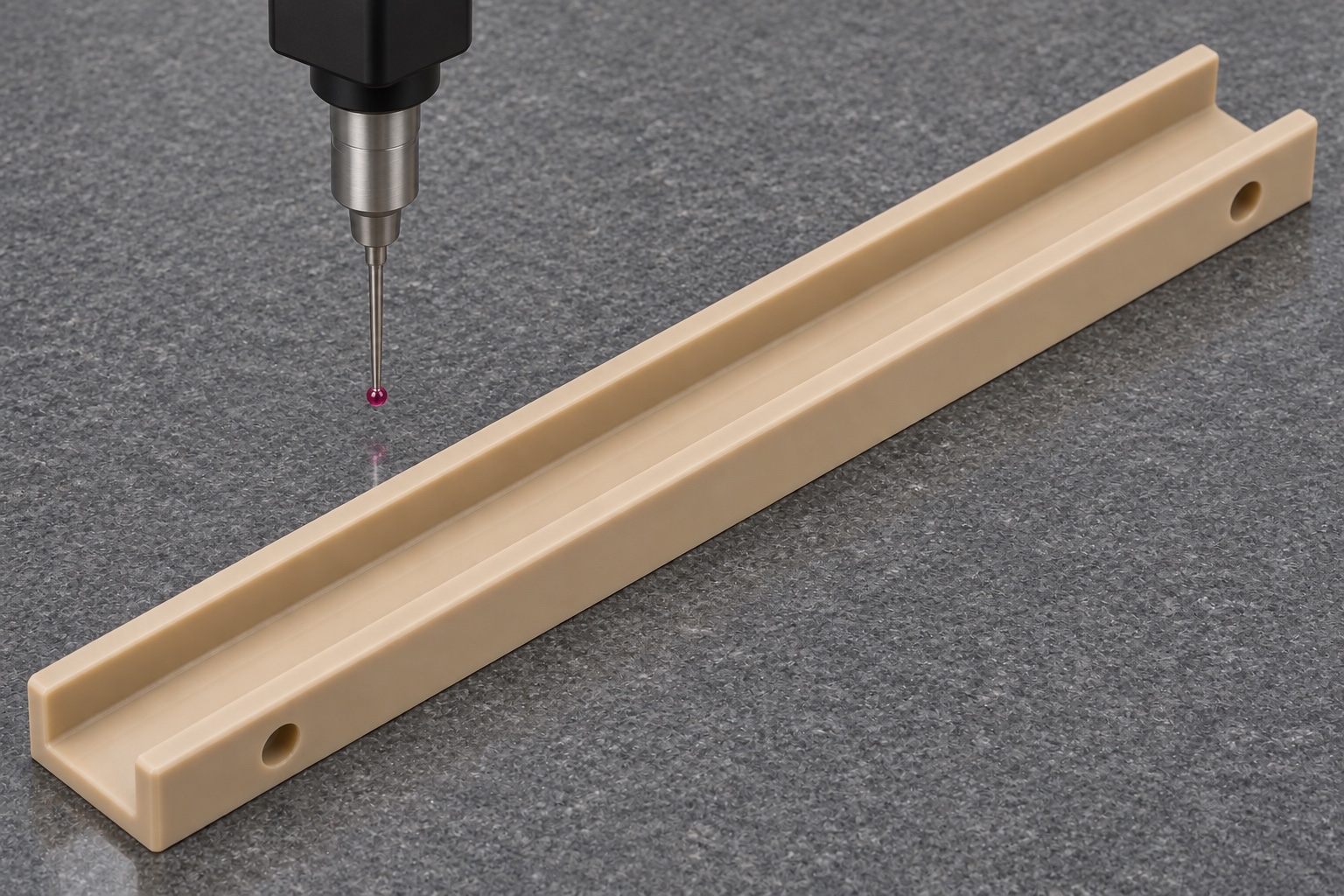
Inspect the released and conditioned liner
The proposed first-article report would identify the drawing revision, environmental condition, support arrangement and measurement method. Channel width would be measured at relevant stations, with floor and wall relationships evaluated from the specified datums. Hole locations and relevant edge conditions would receive their own checks. Low-force or noncontact methods could be used where measurement pressure would influence the long plastic shape. This case supplies no invented results or acceptance rate. In an actual order, deviations would be documented and disposition approved before release, rather than dismissed because a particular cassette sample can be pushed through by hand.
Observe an inert cassette travel trial
An optional unloaded trial could use an identified inert cassette reference in the approved orientation on a non-operating fixture. The record would identify cassette, liner, fixture and hardware revisions. Observations would include entry, exit and any local first contact along the path. The trial would not prove automatic feed reliability, embedding quality or analytical performance. If mounting changes the clearance, the investigation would include wall distortion and fastener projection. The supplier would not force a reference through a bind, add lubricant without approval or remove material merely to match an uncontrolled sample whose envelope may differ from the drawing.
Control rework and low-volume repeats
A local obstruction would first be traced to a burr, hole intersection, fastener envelope or geometric deviation. Rework would be authorized and followed by inspection of affected features. A wider channel would not be accepted automatically as a universal solution because it can increase lateral movement elsewhere. For repeat orders, material grade, cassette revision, fixture setup and final acceptance conditions would be reconfirmed. Tool or support changes would receive appropriate review. Quotation documents would distinguish manufacturing inspection from development of an optional travel fixture or any separate laboratory validation service. This keeps small-batch plastic machining deliverables traceable and commercially explicit.
Dispatch without bending the long guide
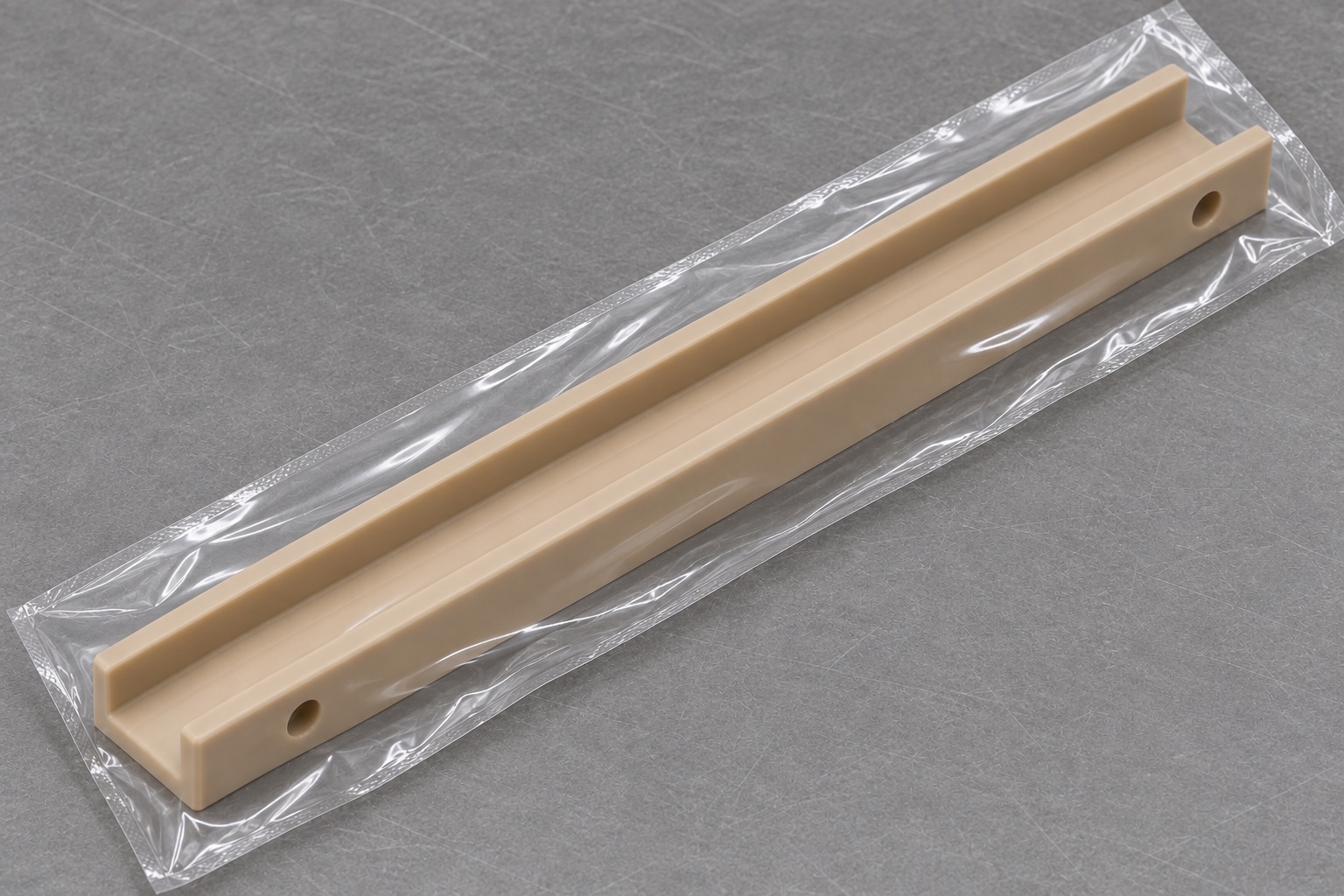
Packaging would support the liner along its length and prevent straps, loose screws or other components from bending the walls or floor. Contact surfaces would be protected from scratching and packaging debris. Clean bags and suitable separators would be selected for the agreed handling condition, without unsupported sterile claims. The release package would identify revision, material and inspection records. A final visual check would examine open ends and inner hole exits for retained chips or damage. This representative route explains a proposed PEEK guide-liner manufacturing plan; it does not assert a real shipment, approved feeder design or validated laboratory workflow.
FAQ
Is this a real delivered histology feeder part?
No. It is a representative machining proposal. No customer, delivery, certification, measured feeding result or validated laboratory process is claimed.
What material is specified in the example?
The proposed liner uses an identified natural unfilled PEEK grade. Any substitute or reinforced grade requires explicit approval and review of the affected requirements.
Why is a secondary drilling setup proposed?
The holes are horizontal through one wall. A suitable secondary setup provides access and support while keeping the channel and drill exits inspectable.
What should the first-article report record?
Record drawing revision, actual characteristics, measurement environment, datum setup, support condition and agreed results. The inspection method must suit the long plastic geometry.
Does a manually passing cassette establish reliable automatic feeding?
No. It provides a limited mechanical observation with identified references. Automatic feeding and laboratory performance require separate qualification and evidence.
How should a long liner be packed?
Support it along its length, protect guiding surfaces and keep hardware separate. Avoid packaging loads that bend walls or change the floor's released shape.

tanghangyun@oemach.com