
Representative scope without invented test results
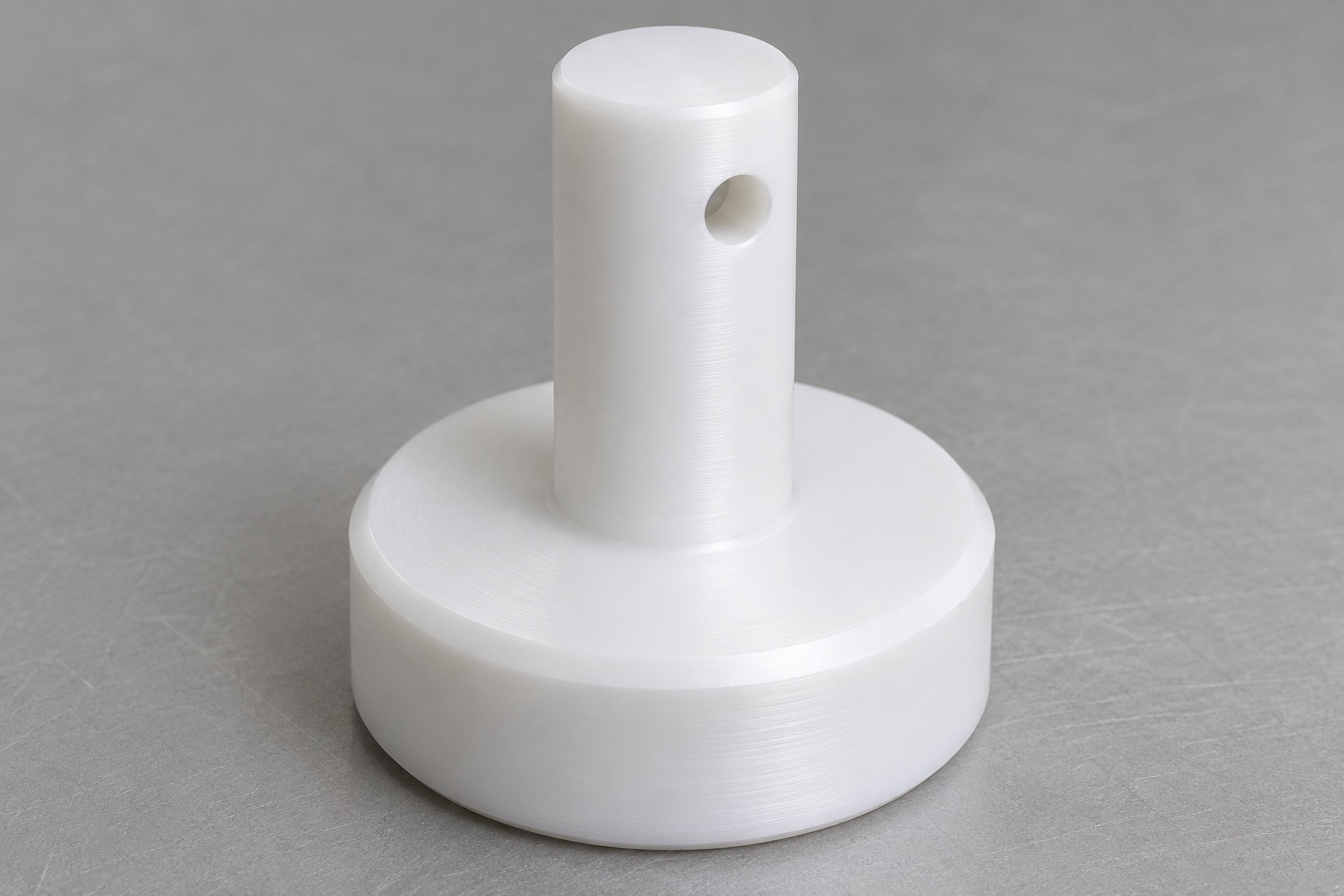
This representative CNC turning case outlines a proposed white unfilled POM-C contact tip for a non-operating inhaler actuation bench fixture. The part has a broad solid round pad, a narrower cylindrical mounting stem and one transverse hole for a retaining pin. It is a mechanical manufacturing example, not a delivered customer project or a qualified test accessory. No customer name, measured accuracy, cycle life, certification or inhaler performance result is claimed. Any real order would require an approved drawing and acceptance plan. Drug-contact suitability, actuation settings and analytical testing are outside the scope of this proposed plastic machining route.

Review the holder and dummy contact surface
The interface review would collect the holder drawing, pin information and non-operating dummy geometry. It would ask which stem surface locates the part, where axial seating occurs and how the pad face should relate to the installed axis. The pin's role would be distinguished from accurate location: a retaining pin does not automatically define the whole alignment scheme. Ambiguous requirements would be resolved before programming. The review would also identify prohibited clamp marks and the intended protective cleaning condition. These questions turn a general request for medical equipment fixture components into specific mechanical requirements that a CNC machining supplier can quote and inspect.
Identify the acetal material before cutting
The proposed material route would use the specified white unfilled acetal copolymer grade and preserve its identification from incoming stock to finished component. POM-C would not be substituted with an unidentified white polymer based on appearance. Stock diameter and length would provide adequate holding and finishing allowance. The planner would review supplier guidance relevant to machining and handling without treating general material data as proof of application compatibility. Additional restrictions, such as a particular additive policy or cleaning requirement, would need explicit order approval. This representative case does not assign a medical grade, sterilization capability or chemical resistance value to the material.
Plan the first turning setup around alignment
The proposed first setup would establish the stem, pad outside diameter and shoulder with a coherent reference wherever practical. The setup sheet would identify stock grip length, tool access and the features left for a later operation. Sharp tooling and a chip-control strategy would be selected for the actual POM-C grade and machine. Cutting parameters would be established through process development rather than copied as universal values. Interim checks could reveal heat buildup or visible surface damage before completing the entire batch. A successful machining simulation would not replace physical first-piece inspection after the component has been released and conditioned appropriately.
Finish the broad solid contact face
The pad's underside would be faced in a setup that references the finished mounting geometry as required by the drawing. The planner would avoid relying on a rough stock surface to establish final face orientation. Contact area, pad thickness and the perimeter edge break would be treated as separate characteristics. A decorative polishing step would not be added automatically because it could alter the intended face form. The broad face would remain solid, with no axial hole. If the equipment designer later requests a profiled contact surface, that would be a controlled design revision with new machining and inspection requirements rather than an undocumented finishing adjustment.
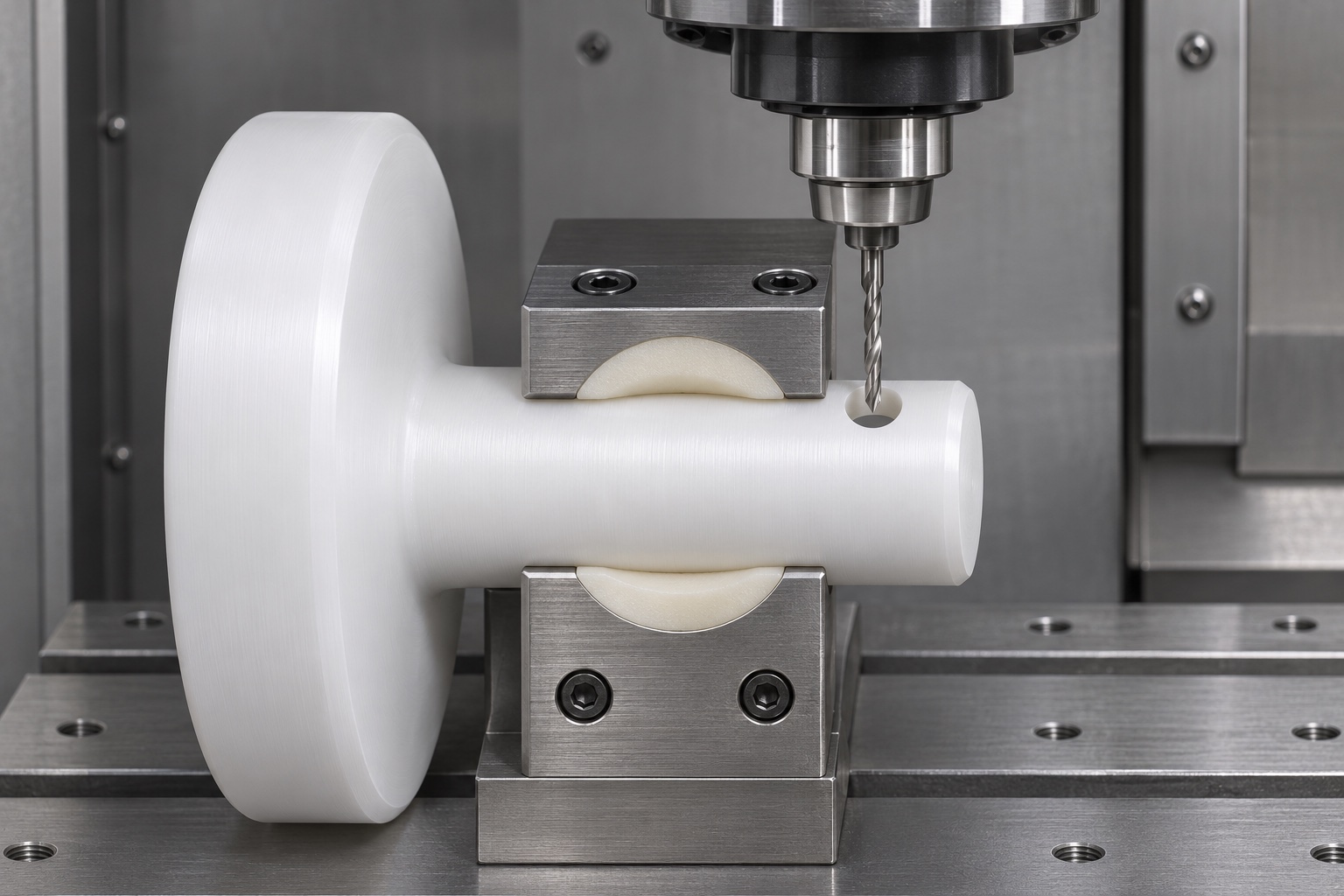
Use distributed support for the plastic stem
For secondary operations, a soft split bush or another appropriate distributed-contact fixture could hold the stem while leaving the pad and drilling area accessible. The proposed clamping method would be reviewed for both safe retention and deformation risk. An excessively tight fixture can hide elastic distortion until release, while poor retention can permit movement during cutting. Trial parts would be inspected in the agreed condition to evaluate the setup. The plan would record any protected contact areas and cleanliness checks for the fixture. It would not assume that clamp impressions are acceptable merely because the finished component is a low-volume plastic part.
Drill the single cross hole with supported breakout
The proposed drilling operation would create one transverse through hole near the stem end. Its size and axial position would follow the approved interface drawing. The fixture would support the stem without obstructing drill breakout, and the process would include an accessible way to remove exit burrs. The operator would not add a second hole or enlarge the first to fit an unverified pin. Any required orientation to other features would be specified explicitly; the rotational symmetry of the pad does not remove all possible assembly requirements. A first-piece check would confirm that the hole and surrounding material remain suitable for the agreed retention arrangement.
Remove loose edges without changing the pad
Edge finishing would target the pad rim, stem end and both pin-hole exits. The method would remove loose strands without smearing plastic into the hole or rounding functional surfaces beyond the drawing requirement. Visual inspection under suitable magnification would be paired with the relevant dimensional checks. Cleaning would remove residual chips and process contamination using materials compatible with the specified grade. The route would describe this as protective preparation to an agreed condition, not sterile processing. If a laboratory requires further preparation before use, that step would remain within its controlled workflow unless separately specified and qualified in the manufacturing order.
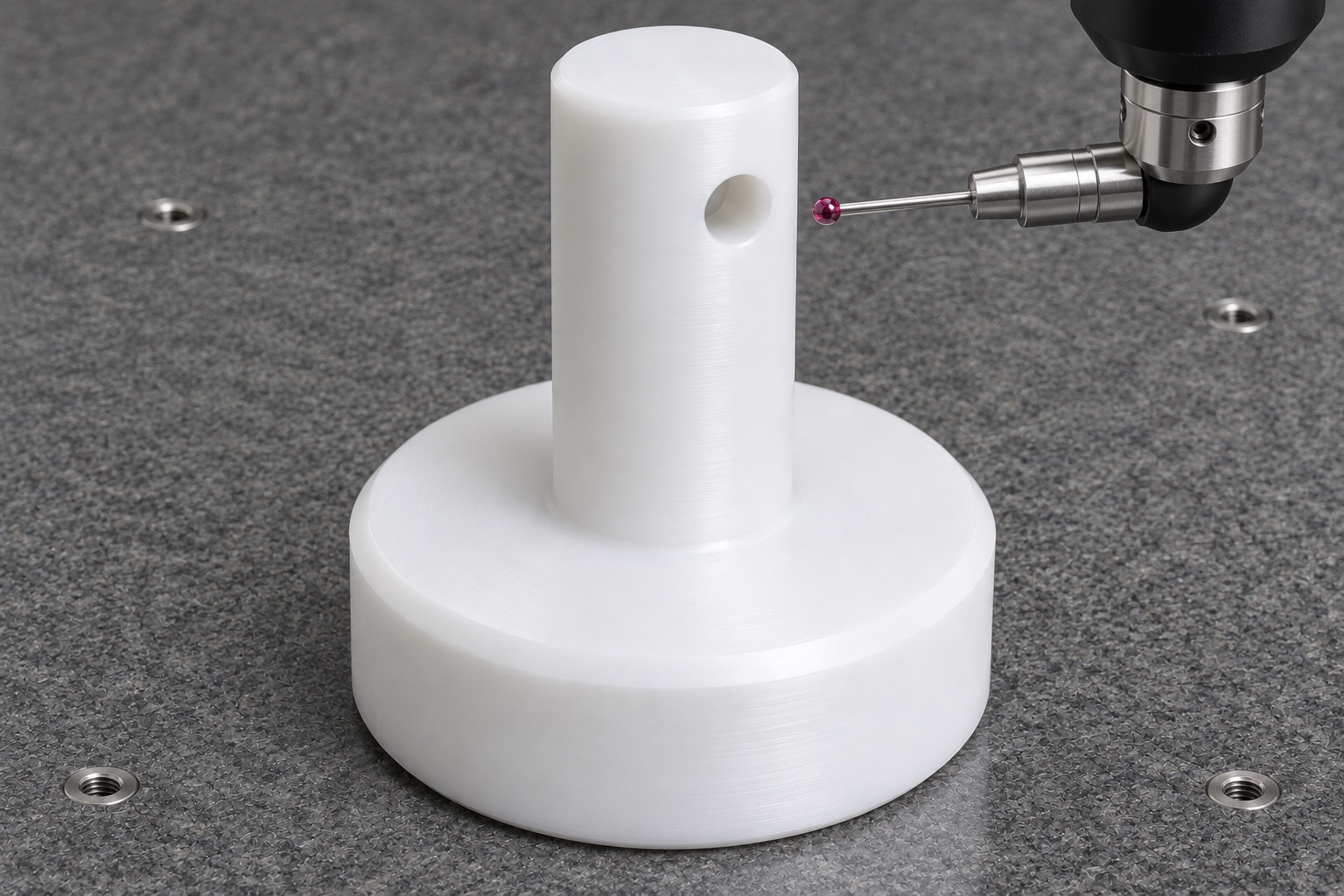
Condition and inspect the released component
The proposed inspection plan would allow the part to reach the agreed environmental condition before final measurements. Low-force or noncontact methods would be considered where contact pressure could affect a small plastic feature. Characteristics could include stem diameter, pad geometry, face orientation, shoulder location and cross-hole position, but the actual report would follow the drawing. The report would state datum setup and measurement conditions so later checks are comparable. This example supplies no invented numerical result. Real acceptance decisions would require recorded measurements and approved disposition of deviations, not a photograph or a statement that the part looks accurately turned.
Verify only an unloaded dummy assembly
A traceable holder, matching pin and non-operating dummy surface could be used for an additional assembly check. The review would observe seating, removal and visible interference without applying an operational test procedure. The holder and dummy revisions would be recorded, since either can influence contact appearance. If the pad does not sit evenly, the team would examine holder alignment, stem seating and face geometry before modifying the part. The check would not demonstrate dose consistency, aerosol performance or suitability for patient use. Those outcomes require separate methods and evidence controlled by the responsible laboratory or equipment organization.
Keep repeat-order changes visible
A later order would confirm material grade, drawing revision, holder interface and acceptance conditions before reusing the proposed process. Changes to pin size, contact surface or protective cleaning can affect both machining and inspection. Tool replacements and fixture revisions would receive the review appropriate to their effect on critical features. Batch identification would prevent visually similar tips from being mixed across revisions. Low-volume CNC plastic parts benefit from this discipline even when quantities are small. The commercial scope would distinguish manufacturing inspection from any laboratory validation service so neither party treats a mechanical release report as evidence of analytical test performance.
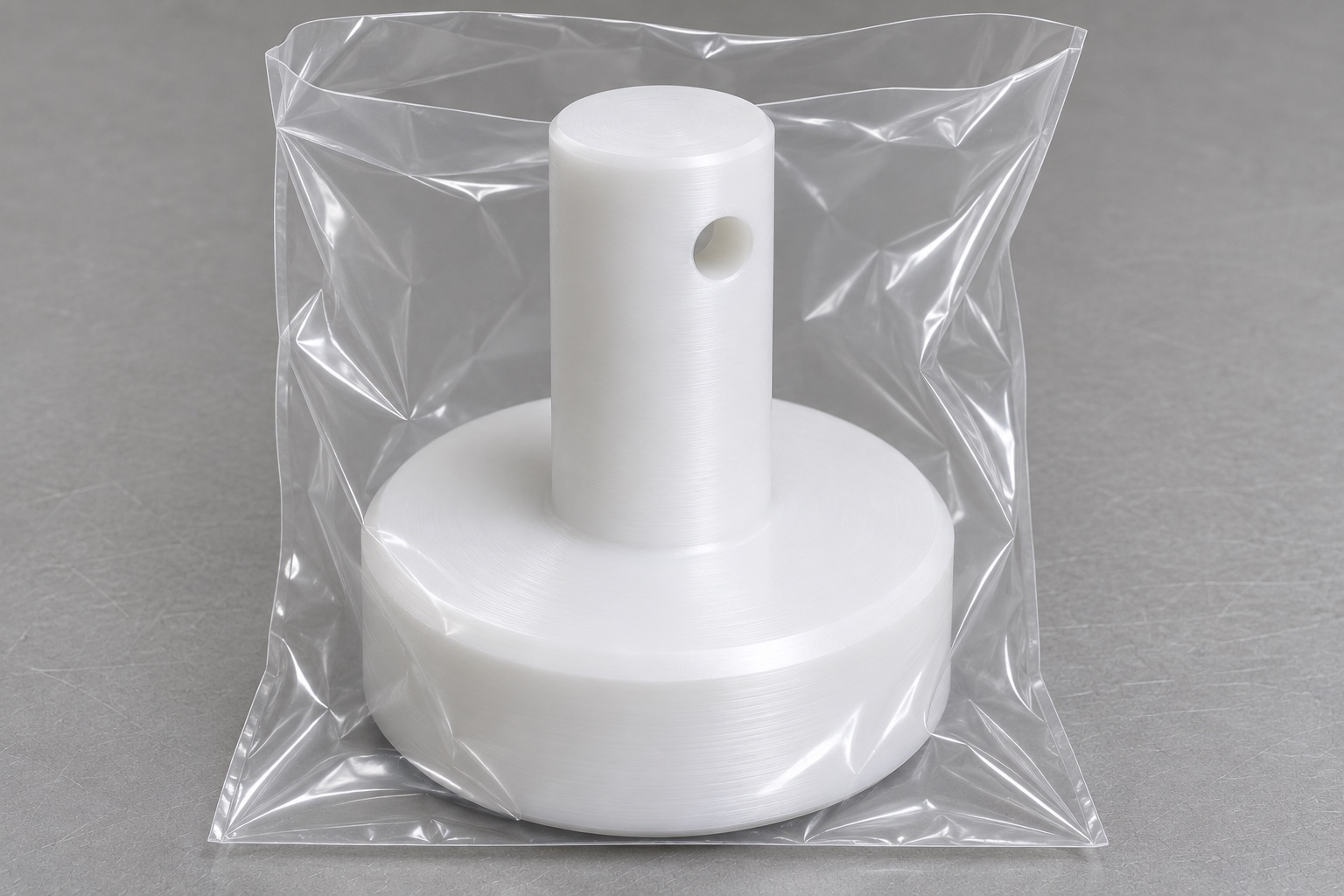
Dispatch with face and stem protection
The packing proposal would isolate each tip in clean protective packaging and prevent the broad contact face or stem from rubbing against hard components. Packaging material would be selected to suit the order's cleanliness and handling requirements. No sterile symbols or unverified medical claims would be added. The release documentation would identify the part revision, specified material and agreed inspection records. A final check would confirm that loose chips are absent from the transverse hole and that the protected surfaces remain visually acceptable. This representative route explains the manufacturing decisions behind a custom acetal contact tip; it does not assert an actual shipment or validated application result.
FAQ
Is this a genuine customer delivery report?
No. It is a representative machining example describing a proposed route. No delivery, customer, certification or measured test result is asserted.
What material is assumed in the example?
The proposed part uses a specified white unfilled POM-C grade. Its exact identity and any approved equivalent must be agreed before an actual order.
Why use a separate drilling fixture?
A supported secondary setup can provide access to the transverse hole while controlling stem deformation and drill breakout. The actual fixture requires process verification.
Does the contact pad contain a central opening?
No. The representative pad is solid. The only hole is transverse through the upper stem for a retaining pin.
What does the dummy assembly check establish?
Only the observed mechanical seating and clearance with identified mating parts. It does not validate actuation settings, dosing, aerosol measurements or clinical use.
Which information is needed to quote a repeat batch?
Confirm the drawing and holder revisions, material grade, quantity, pin requirements, measurement condition, inspection deliverables, protective cleaning and packaging scope.

tanghangyun@oemach.com