
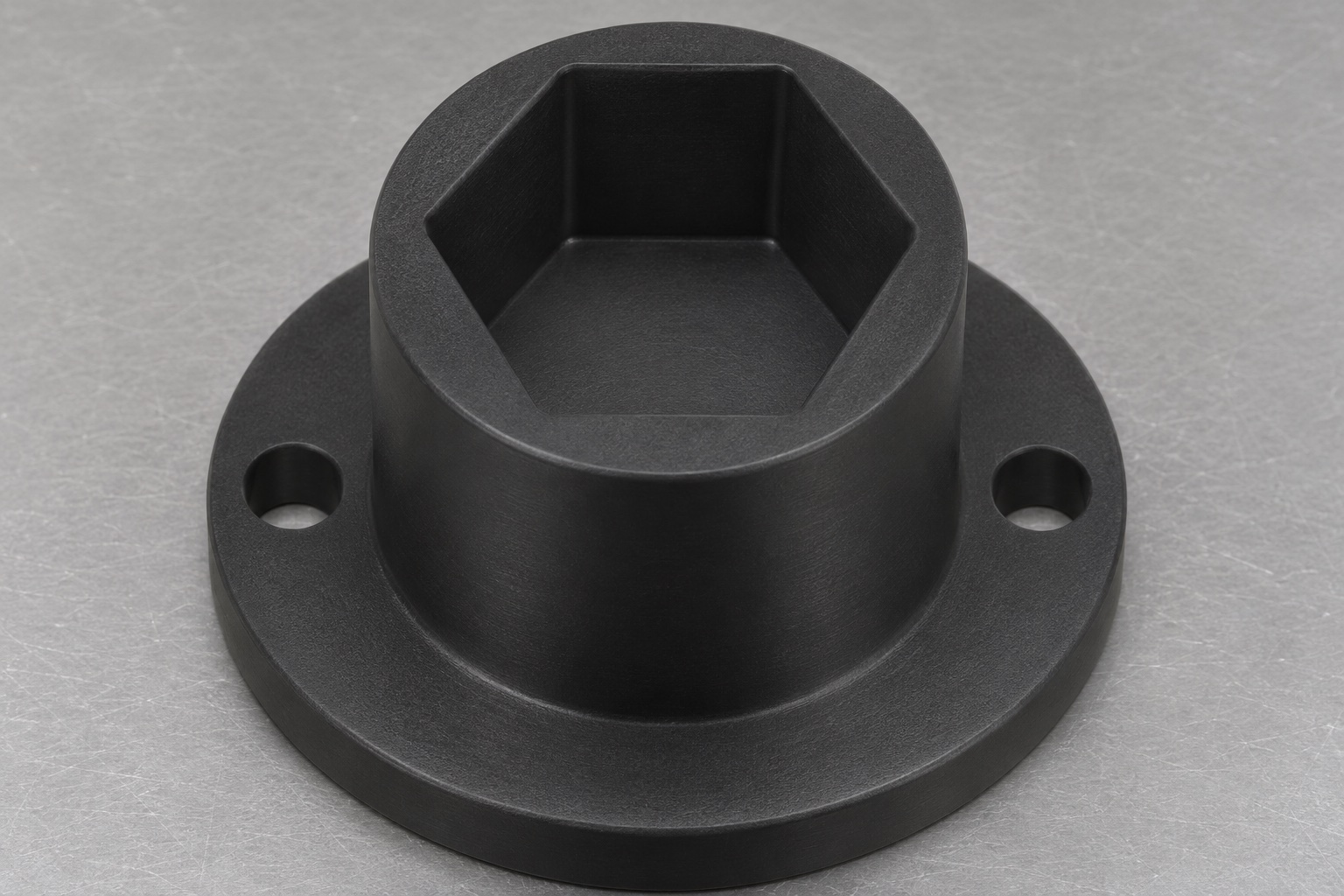
Scope of the representative component
This representative example proposes a black POM-C insert for external engagement of an identified hexagonal cap in medical laboratory equipment. The single-piece concept has a cylindrical body, a hexagonal blind recess, a circular base flange and two plain flange holes. It contains no cap, tube, ejector, internal thread or fluid passage. It is not a documented customer delivery or a measured production sample. The route describes component manufacturing without claiming achieved tolerances, torque capacity, cap retention, release reliability, clinical suitability, sterile delivery or validation of a complete decapping mechanism.

Review the cap and handling definitions
The proposed review would collect the cap revision, controlled insert drawing, model and permitted exterior contact map. The equipment team would identify insertion depth, approach direction and the actual driving and container-support arrangement. It would distinguish motion transfer from gripping and release. A hexagonal cavity would not be presented as universally compatible with laboratory caps. Missing retention or ejection requirements would remain explicit design questions. The supplier would not use an available cap as an undocumented master or infer a handling sequence from the component's name and a perspective image.
Confirm polymer grade and traceability
A real order would identify the approved POM-C grade, color, stock form and documentation scope. The blank identity would remain associated with the part through the proposed manufacturing route. Another black polymer would not be substituted merely because it machines well or resembles the illustration. Any assessment of cleaning exposure, biological restrictions or medical application requirements would remain separate from material procurement. This example does not invent a certificate or medical-grade approval. If a different grade were proposed, the design and inspection basis would be reviewed before the material change was authorized.
Establish body and flange references
The proposed turning operations would create the cylindrical body and flange according to the released reference system. Support and grip locations would be selected for the actual geometry without damaging required contact surfaces. The process would preserve enough material for the approved blind-recess floor and flange section. The final inspection condition would be agreed rather than assumed to equal a clamped shape. Actual stock allowance and cutting parameters would depend on the real blank and machine. The example describes the relationship of operations, not a proven production sequence or an achieved dimensional result.
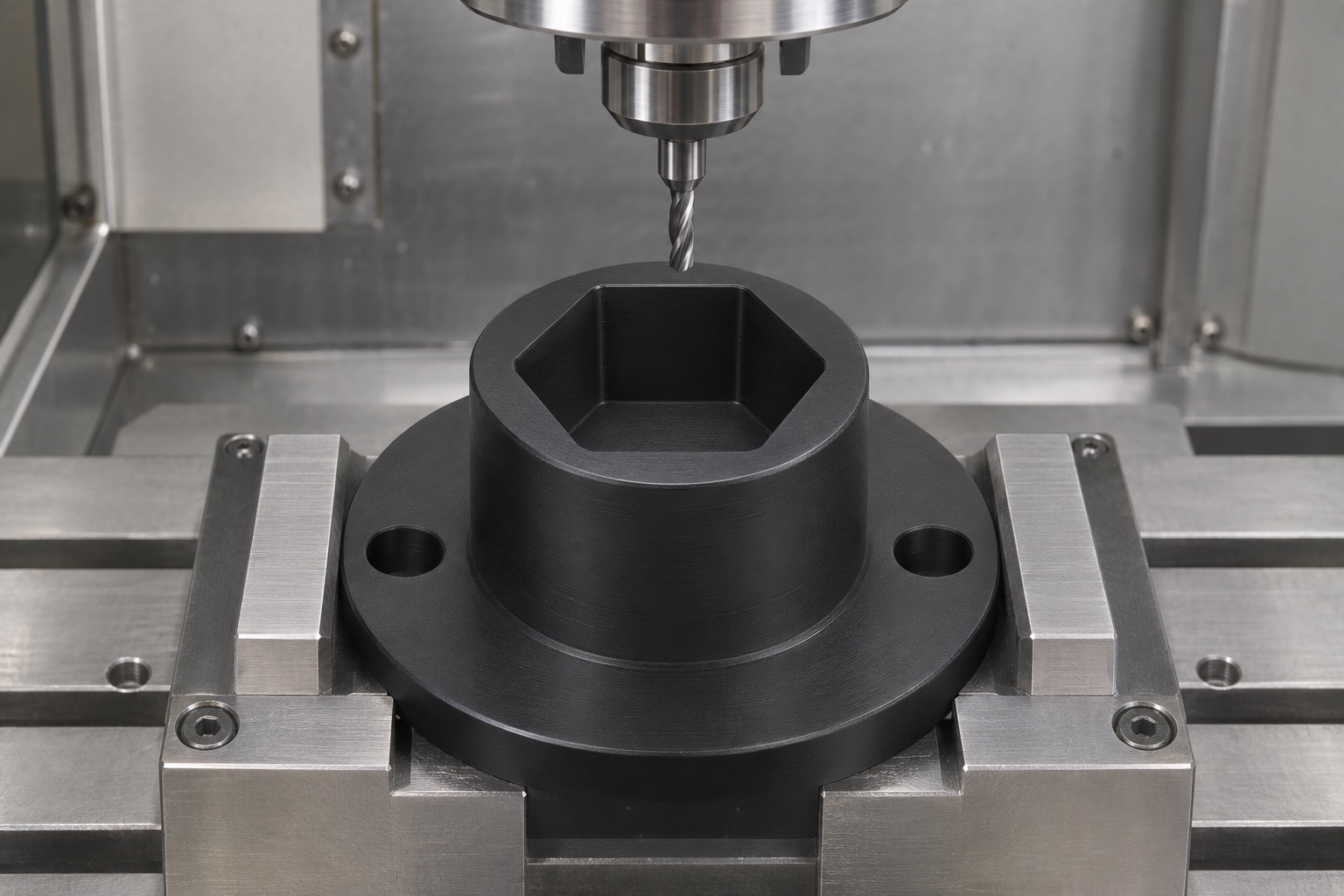
Review the hexagonal corners before milling
The programming review would compare the specified across-flats size and corner geometry with the identified cap profile. Internal cutter radii would be considered before the final cavity path was selected. Any approved relief would be shown in the controlled design, including its effect on wall thickness and contact zones. A corner interference would not be resolved by enlarging the entire socket without authorization. The supplier would not promise sharp internal corners from an unsuitable process. The actual mating data would determine whether the proposed milled geometry could provide the intended mechanical clearance.
Produce the blind recess and approved depth
The milling proposal would define access, chip evacuation and support while producing the six internal flats and cavity floor. The floor would be treated as a cap stop only if the approved design assigned it that function. No vent, drain or ejector opening would be added to make a demonstration appear easier. Such features would require engineering review and revised inspection requirements. The actual tools and parameters would be selected for the grade and geometry rather than stated as universal settings. The manufacturing definition would remain the released drawing, not a hand-adjusted cap-engagement sample.
Maintain the two-hole mounting interface
The two flange holes would remain plain through holes with their approved relationship to the recess and mounting plane. Screw-head seats, locating contacts and tool access would be reviewed with the actual drive assembly. A plain hole would not be assumed to contain a hidden insert or thread. If additional mounting features were required, the change would be authorized before machining. The proposed fixture would protect the finished flange during pocket work. Mounting distortion and interference would be considered in the inspection condition rather than attributed automatically to the cap or cavity.
Finish and clean without changing contact flats
The proposed finishing instruction would define the cavity lead-in, flange edges and hole entries. Burr removal would preserve approved contacts and the useful depth. Local scraping to obtain a favorable fit would be treated as rework, not an invisible part of inspection. Any authorized change would be checked against the revised requirements. Cleaning would follow the contracted component scope and remove machining debris from the blind cavity. A smooth appearance would not establish particle limits, decontamination, sample compatibility or sterile delivery. Material, revision and process identity would remain traceable during any external operation.
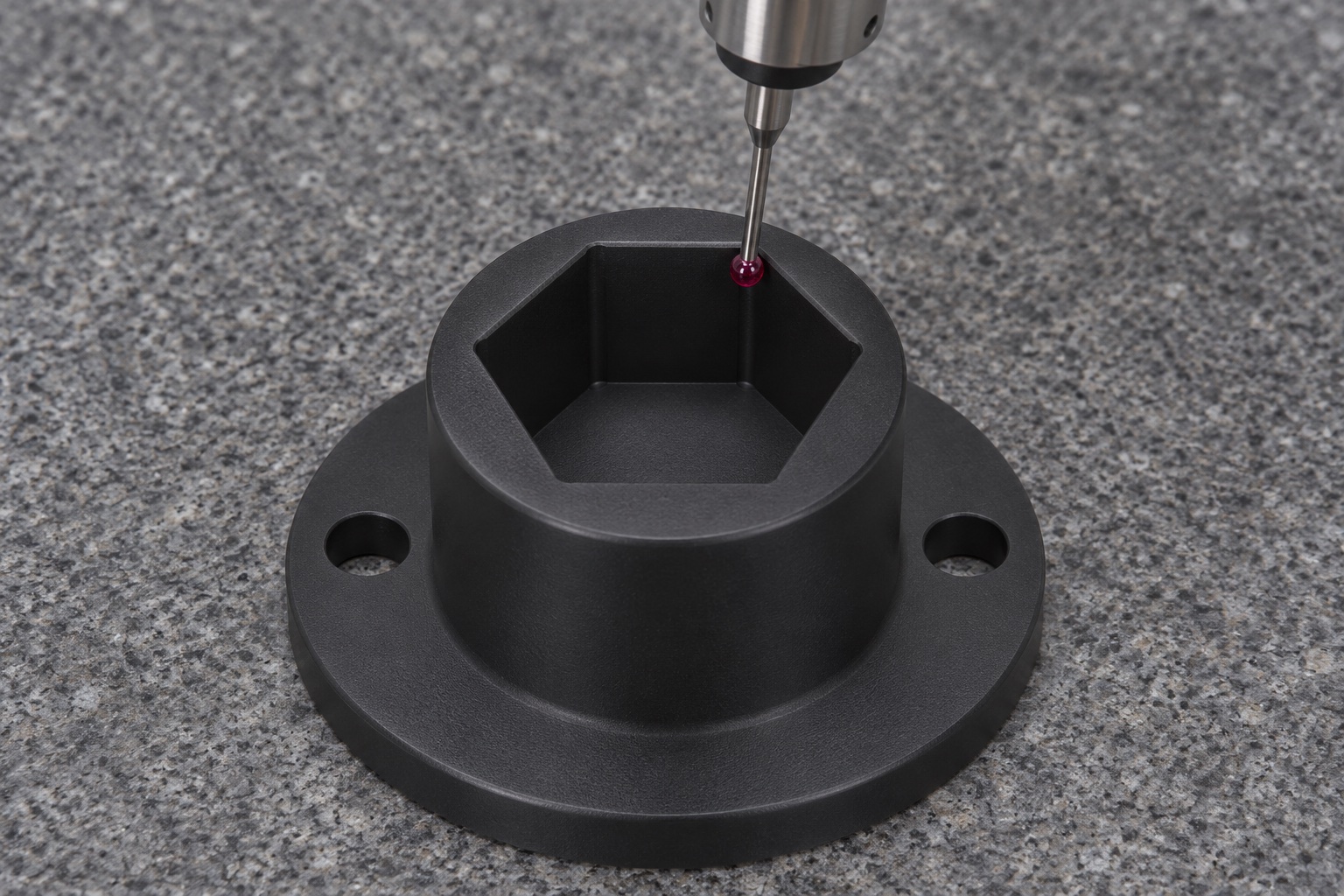
Inspect the complete cavity relationship
The proposed inspection record would cover across-flats dimensions, depth, corner regions and relevant relationships to the flange and mounting pattern. The method would be chosen for access and required uncertainty without deforming the polymer walls. Support, conditioning and other specified environmental requirements would be recorded. A round gauge or one caliper reading would not establish conformity of a hexagonal blind recess. This example has no measured part and therefore presents no numerical results. A real report would identify actual instruments, characteristics, results and acceptance decisions for the released component revision.
Limit an optional nonclinical handling observation
An agreed development observation could use identified empty or approved nonclinical components to examine seating, access and withdrawal. It would record the cap and insert revisions and the actual mounting arrangement. Favorable hand engagement would not demonstrate torque capacity, cap damage limits, axial retention or reliable release throughout the analyzer workflow. Those outcomes require the real complete mechanism and relevant evaluation. Unexpected binding would lead to a review of corner contacts and alignment before the insert was changed. Development components would remain separate from released production until approved changes entered the controlled documents.
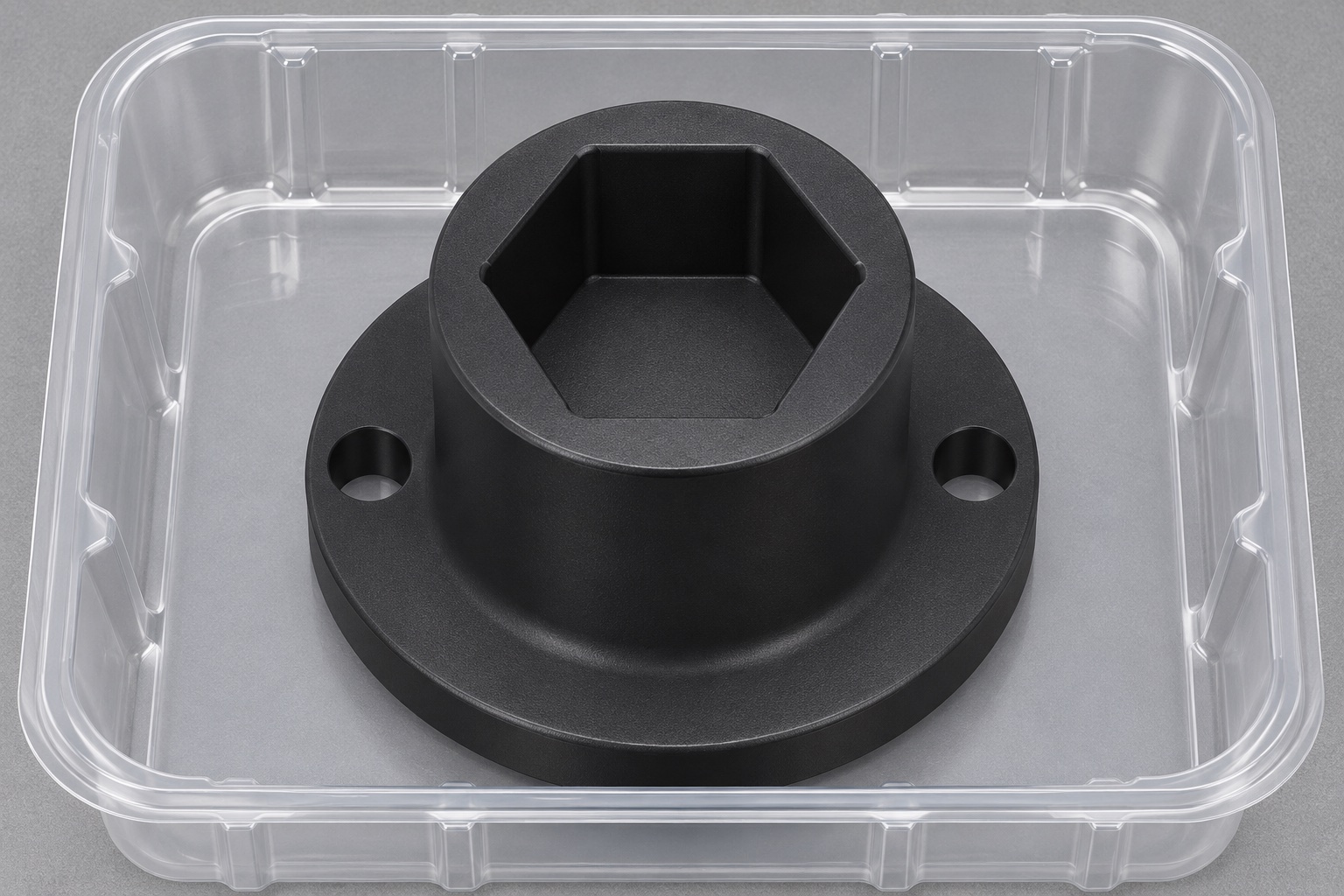
Package the insert without loading its cavity
The proposed packaging would individually support the flange or another approved nonfunctional region. It would not force a protective plug into the hexagonal cavity or allow neighboring parts to strike its contact flats. Part number, revision, material identity and inspection status would remain associated with the component. Packaging restrictions and cleaning handover would be agreed before dispatch. This is ordinary protective packaging, not a sterile or validated cleanroom delivery. The illustration does not document a completed production lot, a customer shipment or a qualified medical laboratory supply arrangement.
Preserve the cap-specific release basis
A repeat manufacturing package would retain the identified cap profile, permitted contacts, cavity and floor geometry, mounting references, material grade and inspection condition. A new cap supplier or revision would require review even if its nominal size were unchanged. The example supports a traceable discussion about a custom drive insert, not a universal decapper tool or a validated clinical accessory. No customer history, production quantity or measured improvement is invented. The equipment team would separately assess the complete handling mechanism and its intended medical laboratory application before release for actual service.
Manufacturer background reference: www.ensingerplastics.com.
FAQ
Does this case describe an actual customer order?
No. It is a representative proposed manufacturing workflow with illustrative images and no fabricated quantity, delivery or measured result. A real order would require approved cap data, released component documents, material requirements and actual inspection evidence.
Is the socket threaded onto the cap?
No. The concept has a blind hexagonal recess for an identified external cap profile and contains no internal thread. A screw-on or differently shaped interface would be another approved design with its own manufacturing and inspection requirements.
Are the flange holes threaded or fitted with inserts?
No. They are two plain through holes. Threads, inserts, special screw seats or additional locating features require an authorized change. The mounting assembly must be defined rather than completed through undocumented modifications to the polymer component.
Can the floor automatically define insertion depth?
Not unless the approved design assigns it that function and provides the necessary mating information. The actual contact map and approach envelope must be reviewed. A blind cavity image does not establish a controlled stop or an automated release arrangement.
Does the example include torque or cap-damage results?
No. There are no measured results of that kind. A dimensional report and a limited fit observation would not independently qualify the actual cap, drive, support and release mechanism. Those performance questions need a relevant complete-system evaluation.
What would trigger a repeat-order review?
A changed cap profile, material grade, mounting arrangement, cleaning exposure or required contact would trigger review. Preserve controlled revisions and evidence rather than relying on a hand-modified development insert or the assumption that all caps of the same nominal size are interchangeable.

tanghangyun@oemach.com