
An ABS robot end cap has a different engineering risk from a metal flange. It does not carry the same structural load, but it must balance thin-wall shape, appearance, mounting bosses and assembly gap. Any mismatch becomes visible as soon as the cover is installed.
Project Snapshot
| Item | Project detail |
|---|---|
| Application | Robot joint component / second-axis cosmetic end cover |
| Material and appearance | ABS; black appearance defined by resin color, coating, texture or another plastic finishing route |
| Critical features | Thin circular shell, edge step, three mounting bosses, hole locations, free-state warpage and scratch control |
| Delivery focus | Prototype purpose, low-force support, fit check, appearance acceptance and anti-compression packaging |
Treat It As A Cosmetic Assembly Part
The component is a shallow circular shell with three mounting bosses and a thin stepped edge. Its job is to close or protect the outside of a robot joint while maintaining a clean gap to neighboring parts.
The black appearance route must be agreed early. ABS does not receive aluminum anodizing; color and texture may come from molded resin, paint, texture or another plastic finishing method. The selected route changes allowance, surface preparation and acceptance criteria.
The Main Risk Is Free-State Warpage
A thin circular cover can deform during machining, trimming or finishing. It may look flat in the fixture but lift slightly after release, producing an uneven assembly gap. The three small bosses are equally important because their locations define screw alignment and local stress after tightening.
For a rapid fit prototype, outline, boss location and interference receive priority. For a cosmetic review part, texture, gloss and scratch control enter the process plan from the beginning.
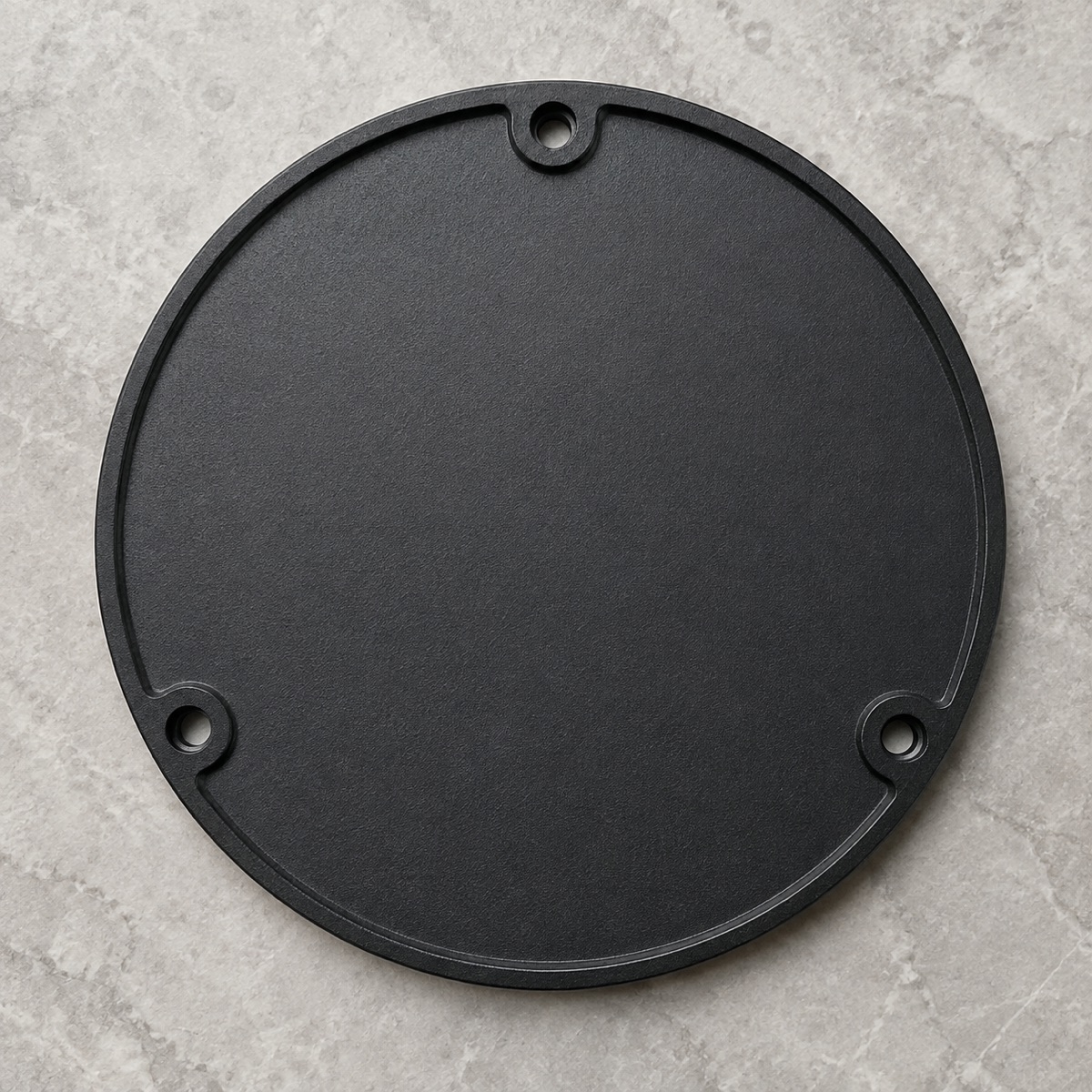
The shallow thin-wall cover combines an outer cosmetic surface, a narrow edge step and three local mounting bosses.
Use Low-Force Support And Inspect The Real Shape
High clamping force is unsuitable for the thin wall. Profile support or compliant clamping allows the edge and mounting holes to be finished close to their natural free state. Cutting load, heat and deburring pressure must be limited to avoid whitening or local distortion.
Inspection covers outside profile, edge height, boss-hole location, boss perpendicularity, wall thickness, warpage and black appearance. Free-state measurement is more useful than a result taken while the cover is forced flat.
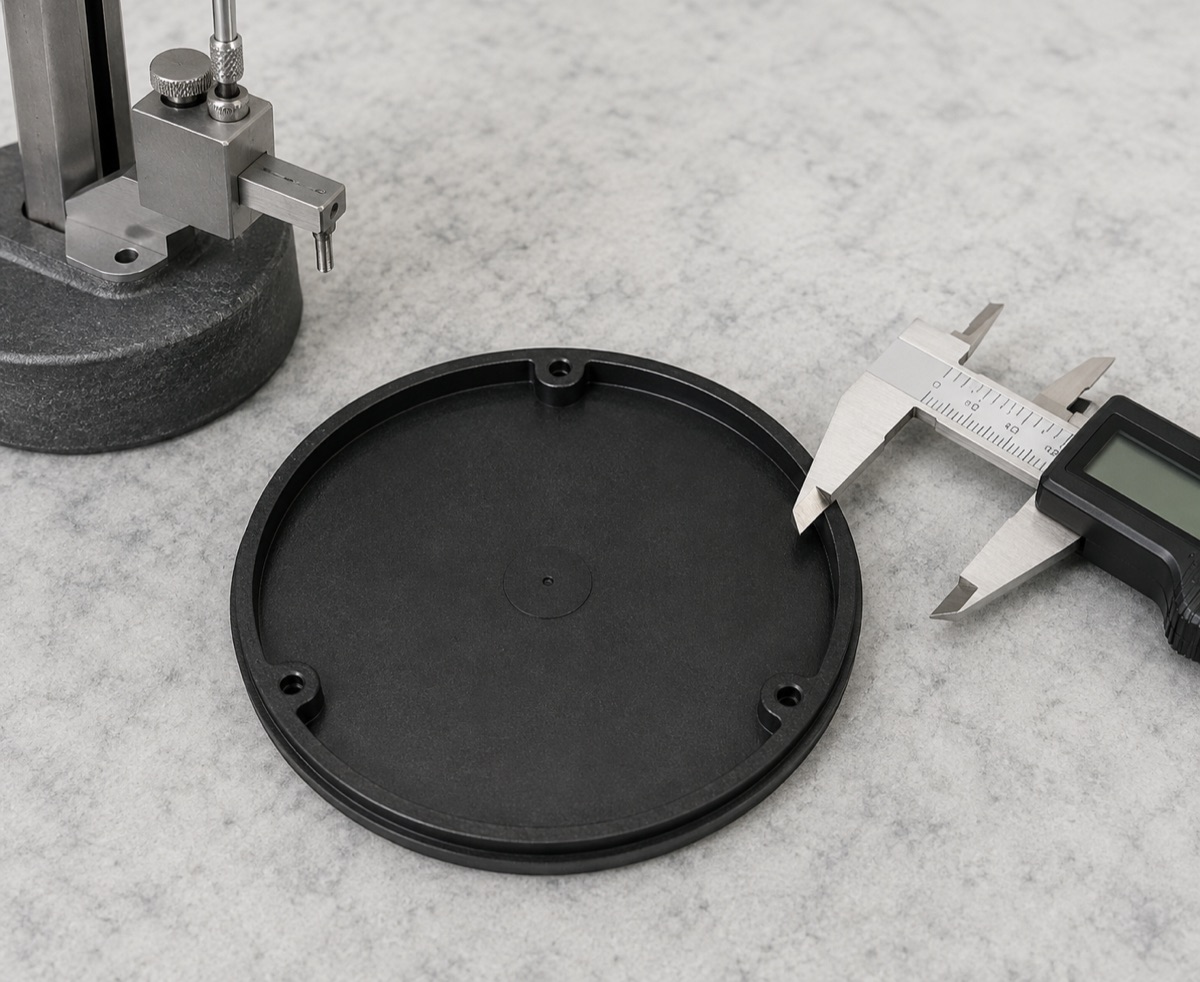
Outline, edge height, boss location, wall thickness and warpage should be checked without fixture force masking the real shape.
Add A Trial Assembly At The Prototype Stage
A practical fit check confirms that tightening does not lift the edge, whiten the hole area or interfere with internal components. This catches issues that individual dimensional checks may miss and reduces changes after the batch is released.
Black ABS is sensitive to scratches, fingerprints, edge burrs and local stress whitening. Matte level, fine texture and scratch resistance should be agreed during prototyping instead of being left until the completed parts are ready to ship.
Lead Time And Appearance-Protective Packaging
Prototype lead time is typically evaluated at 4 to 7 working days, with small batches at 7 to 12 working days. Painting, texture samples or scratch-resistance requirements can extend the schedule because the appearance route needs separate approval.
Each cover is supported individually in foam, with attention to the cosmetic face, thin edge and mounting bosses. Packaging is part of appearance control: a dimensionally usable cover is still unacceptable if transport pressure or rubbing damages the visible surface.
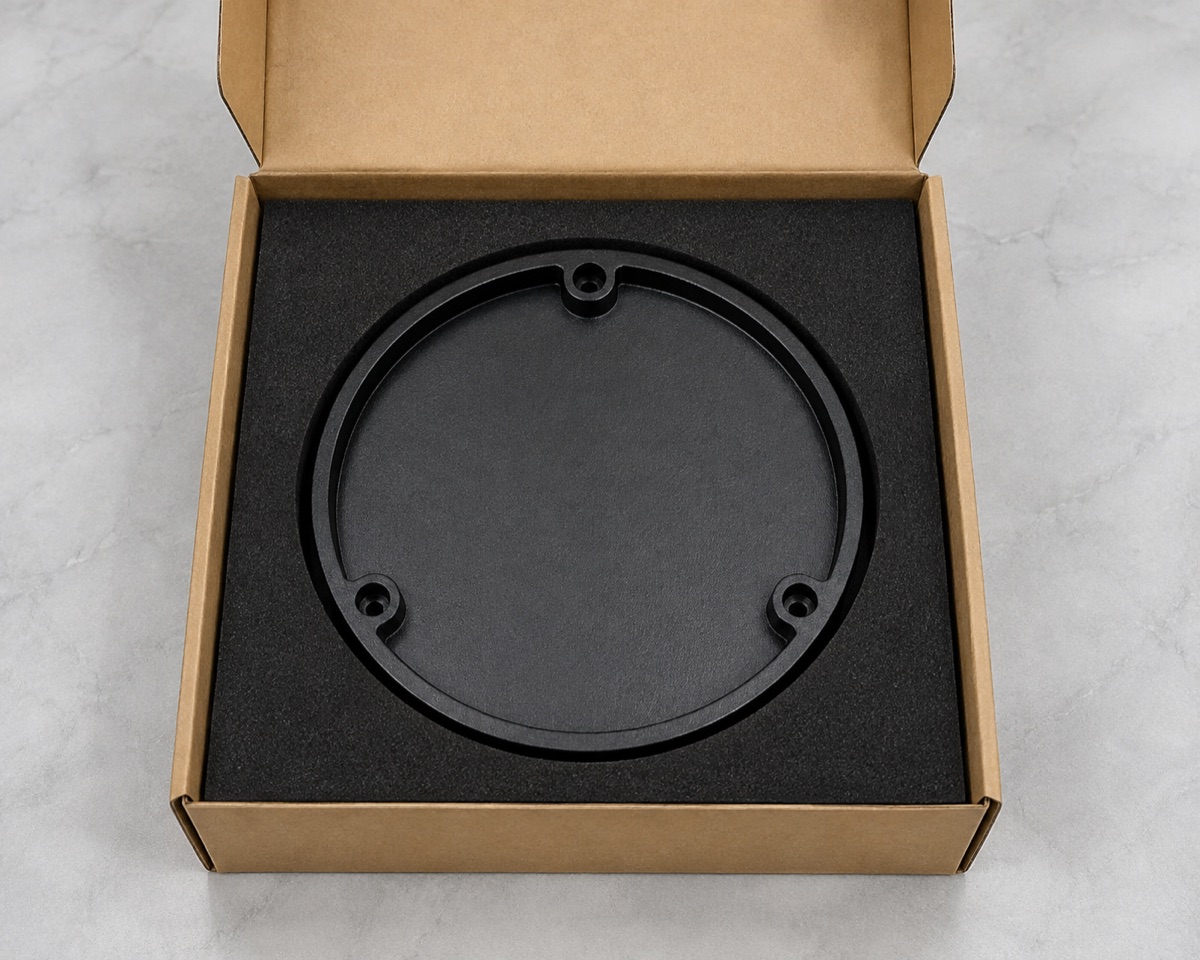
Individual support protects the cosmetic face, thin edge and mounting bosses from rubbing, compression and transport distortion.
Case Study Summary
The core of this ABS end-cap project was not simply producing a circular cover. The thin edge, mounting-boss locations and black appearance had to remain stable in the free state. Process planning, inspection, fit verification and packaging were therefore treated as one delivery system.
FAQ
Why inspect a thin ABS cover in the free state?
Fixture force can hide warpage. Free-state inspection shows the shape that will control the real assembly gap.
Can ABS be black anodized like aluminum?
No. Black appearance for ABS is created through resin color, paint, texture or another suitable plastic finishing route.
Why add a fit check if the dimensions pass?
Tightening can reveal edge lift, boss stress, whitening or interference that isolated measurements may not show.
Ready to get a quote for your CNC machined parts?
Submit your engineering drawings to qiancj@oemach.com. We support prototype sampling and small-batch production with strict tolerance control.