
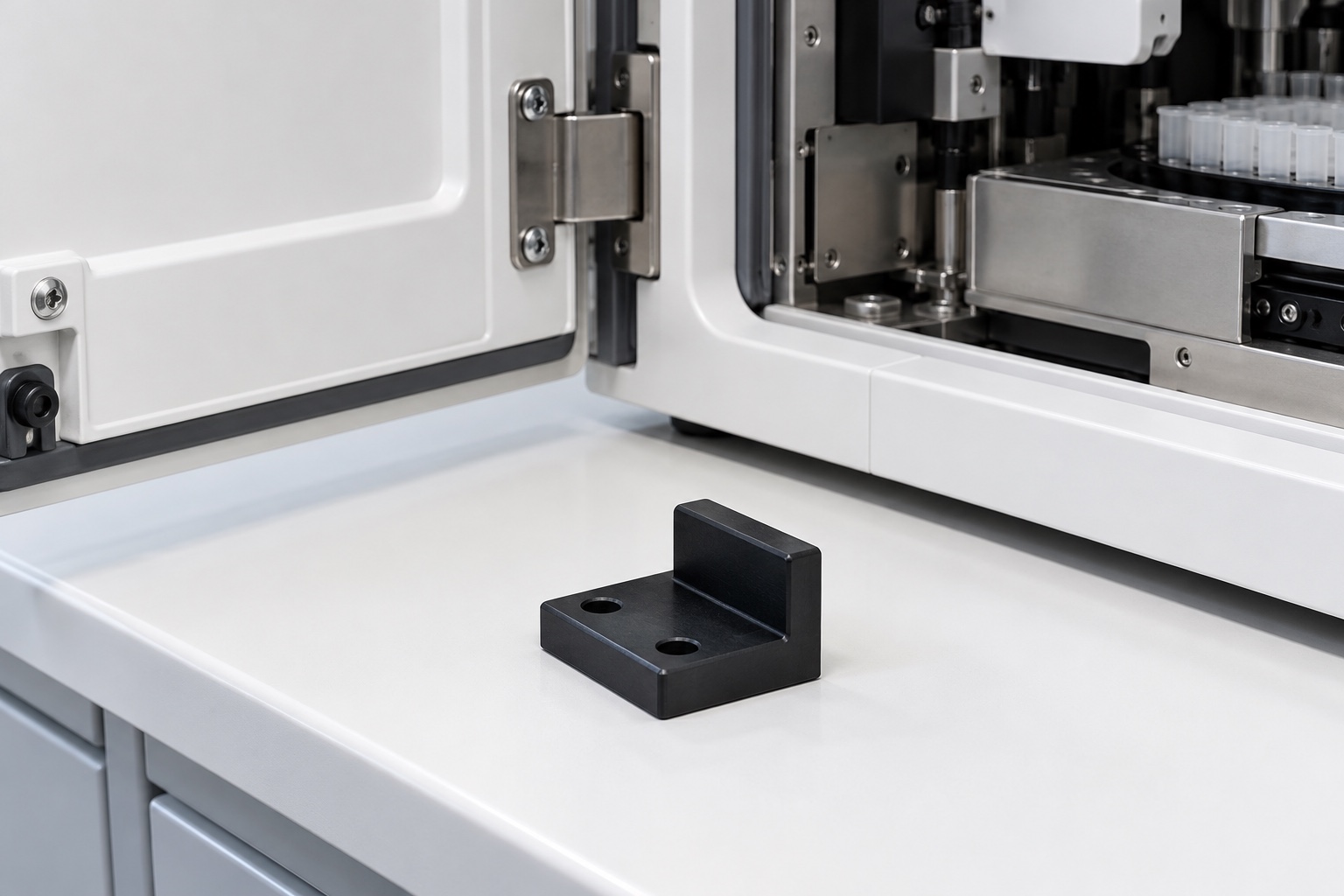
A representative proposed stepped stop
This example considers a proposed one-piece black POM service-door stop for medical laboratory equipment. It has a low rectangular mounting foot with two clearance holes and a raised end providing a flat contact face. It illustrates a possible CNC workflow, not an actual customer delivery, load-rated bumper or validated safety component. Images show concepts rather than measured results or endurance tests. The final polymer grade, door arrangement, fastening and acceptance criteria would require approved project documents. No achieved tolerance, impact capacity, service life, certification or medical equipment safety result is claimed.

Review the door and mounting documents
The proposed order would begin with controlled drawings and model, the mating door contact, hinge and support arrangement, approved fasteners and inspection requirements. The review would separate the block's mounting and contact functions from any latch, sensor or interlock. Missing contact references or uncertain hardware would be clarified before costing and production. A sample door would not define every requirement. The purchased scope would distinguish component manufacturing, optional fit demonstration and separate impact, durability or safety assessments assigned to the responsible equipment design program rather than assumed by the machining shop.
Retain the approved POM identity
The material order would state the actual approved black POM grade, stock form and evidence. Cut blanks would retain lot identity through machining, finishing and shipment. A similarly colored offcut would not automatically be considered equivalent. The supplier would review stock allowance and support for the stepped component before selecting the route. Proposed substitution would require authorization before use. Generic polymer data would not be presented as measured load response or service life of the finished stop, and material identity alone would not establish suitability for the entire medical equipment environment.
Establish mounting and contact references
Initial machining would establish the approved mounting-foot reference and the features needed to position the raised contact face. Workholding would preserve these relationships without distorting the foot or damaging accepted contacts. Chips beneath fixture surfaces would be controlled before transfers. The supplier would consider how the support changes as the step is formed. Intermediate checks could confirm the route but would not replace final acceptance under the specified condition. The goal would be repeatable released geometry, not a sample forced into apparent correctness while it remained in the manufacturing fixture.
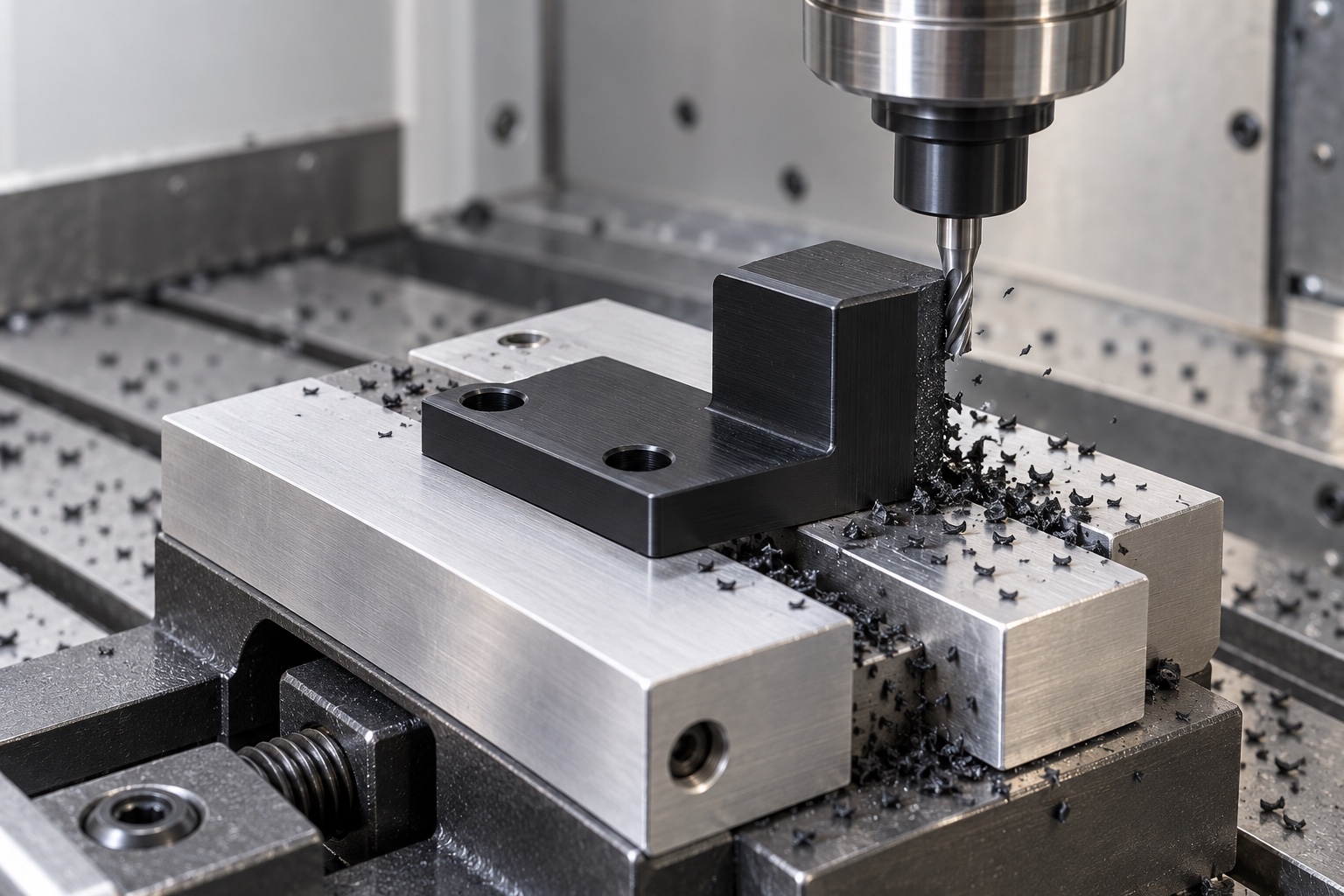
Machine the step from functional geometry
The step height and contact position would follow the approved model and drawing relative to the mounting interface. Tool access and the internal transition would be reviewed before production so an unavoidable radius did not become an unplanned contact with a neighboring part. A proposed relief would require design approval. The supplier would not scrape or lower the contact face to match an unidentified door sample. Any authorized change would enter controlled geometry and inspection documents, preserving the distinction between manufacturability advice and approval to alter the installed mechanical contact.
Produce the approved mounting holes
The two clearance holes and their relationship to the foot and contact face would follow drawing requirements. The supplier would review remaining material, fastener seating, access and the actual mating structure before manufacture. A hole pattern that accepted two screws would not establish the complete installed relationship. Conflicting model and drawing information would be resolved before production decisions. Unapproved sleeves, washers or adhesives would not be introduced to compensate for uncertainty. Any accepted hardware change would be recorded and reflected in the associated component and inspection revision.
Finish polymer edges deliberately
The finishing operation would examine foot boundaries, hole exits, step transition and contact edges for attached material and unwanted sharp features. Removal would preserve specified contact area and geometry rather than rounding every edge indiscriminately. Uncontrolled heating, solvent smoothing or scraping would not be used to hide tool damage or make a sample door close. Markings would remain in authorized areas. Cleaning would follow the purchased scope. A smooth appearance would not demonstrate qualified wear, impact behavior or particle cleanliness, and a damaged contact would remain a component issue requiring disposition.
Agree inspection support and measuring force
The inspection plan would identify references, support points, measurement methods and any required conditioning for the selected polymer. Evidence would address raised contact position, foot geometry, hole relationships and relevant edge requirements. An outside length and height report alone would not verify the controlled installed interface. If the drawing required free-state geometry, the part would not be forced against a fixture to create acceptance data. Any separately required installed or loaded check would have its own defined conditions and meaning, rather than silently replacing unloaded component inspection.
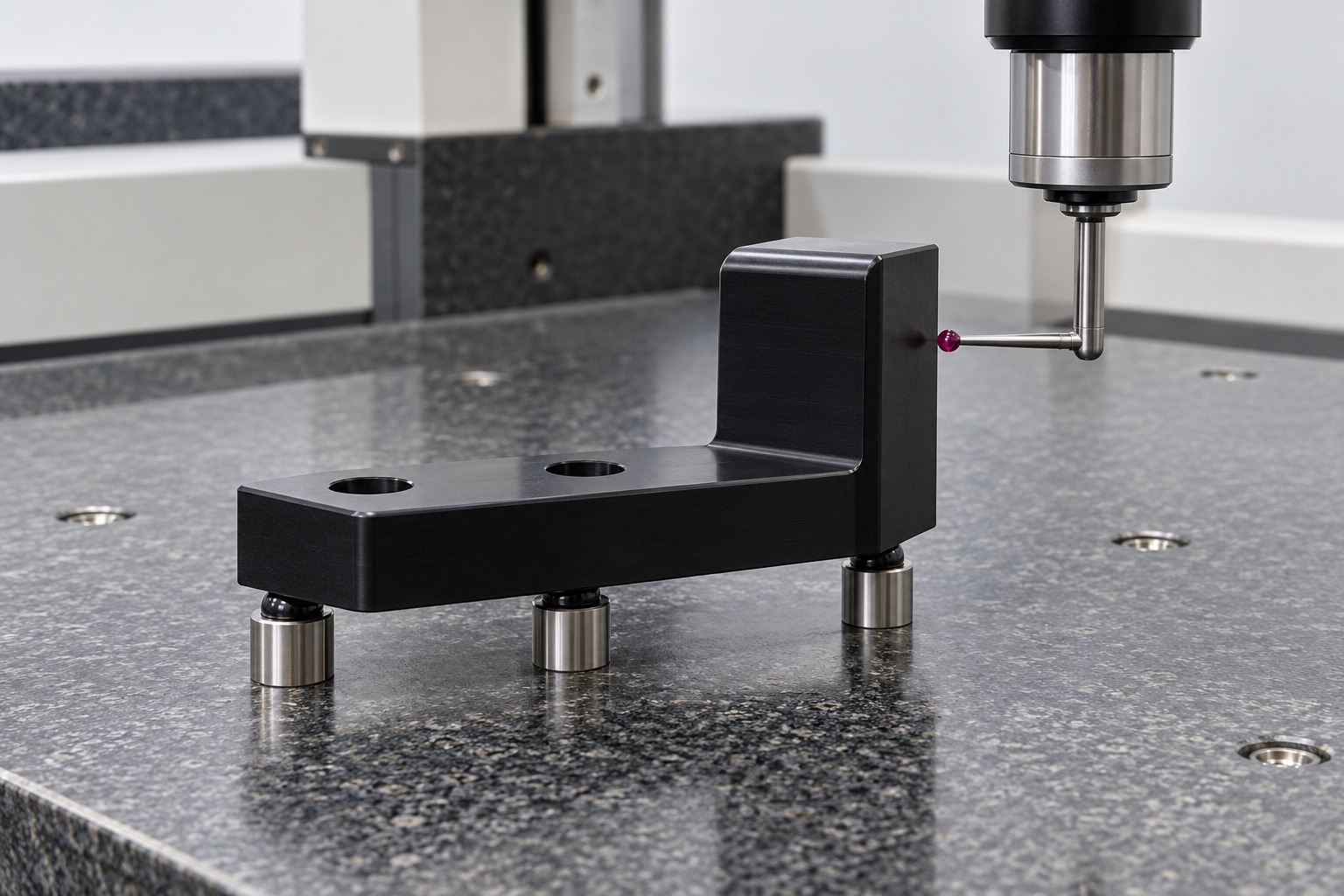
Prepare a traceable first-part report
The report would identify drawing revision, material lot and numbered characteristics with the agreed inspection methods. It would preserve the measurement condition and any authorized deviations. No numerical results are provided because this representative case has no manufactured sample or inspection record. Material and dimensional evidence would support acceptance within the purchased component scope only. It would not establish door impact capacity, hinge durability, latch reliability, access control or complete equipment safety. Those matters would remain with the responsible design program and its separately approved evaluations of the actual assembly.
Limit any optional door fit demonstration
An agreed trial could check block seating, fastener access, intended contact and specified clearances using identified approved door and hinge components. Their revisions and installation conditions would be recorded. Unexpected contact would be documented before modifying the stop, hinge or door. One successful movement would not qualify repeated impacts, load response or any safety-related function. The trial article would remain traceable and distinct from accepted production components. Its observations would not become an undocumented substitute for drawing requirements or transfer automatically to a different service-door arrangement.
Protect the foot and raised face in transit
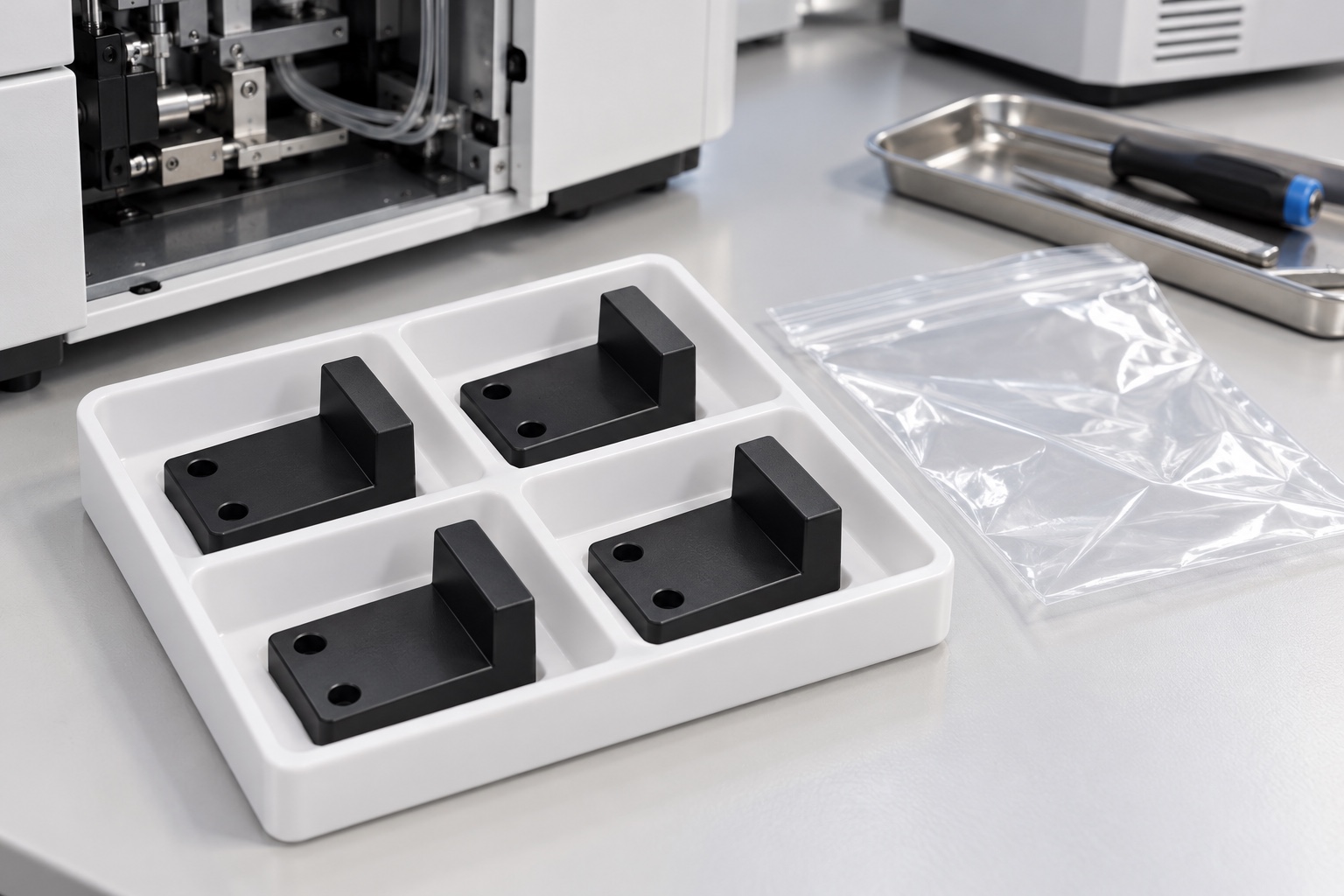
Finished blocks would be separated so contact surfaces could not rub adjacent parts or loose mounting screws. Packaging would support the foot without concentrated bending pressure. Protective materials would suit the agreed cleaning scope and would not imply sterile supply or a quantified particle result. Material grade, lot and revision identification would remain with the shipment. Any sample hardware would be identified separately. Receiving staff would be able to distinguish released stops from prototypes, substitute polymers and visually similar blocks intended for a different contact position or enclosure assembly.
Maintain a controlled repeat-manufacturing record
The proposed record would retain approved geometry, stock identity, machining route, final edge requirements, inspection deliverables and authorized changes. A repeat order would review differences in door contact, hinges, support, screws, polymer and cleaning conditions before relying on earlier observations. Dimensional acceptance would remain separate from any endurance or safety evidence. This representative example shows how to manufacture and document a defined enclosure contact without inventing a real customer delivery, measured impact rating, service-life improvement or medical equipment certification for an illustrative black polymer component.
Manufacturer background reference: www.ensingerplastics.com.
FAQ
Is this a delivered or endurance-qualified door stop?
No. It is a representative proposed manufacturing example with no customer delivery or measured sample record. No impact rating, achieved tolerance, service life, certification or equipment-safety result is presented as an actual outcome.
What defines the raised contact position?
The approved block geometry and its references to the mounting foot, hole pattern and actual door arrangement define the contact. A loose sample or outside dimensions alone should not replace the controlled interface and inspection requirements.
Can a similar black polymer be substituted?
Only after authorization under the actual project requirements. Color does not establish grade identity or equivalence, and generic datasheet properties should not be converted into measured performance claims for the finished stop and installed door.
What would first-part inspection prove?
It would document agreed component characteristics with traceable material, revision, methods and measurement conditions. It would not prove repeated-impact behavior, hinge life, latch operation, interlock effectiveness or complete medical equipment safety without separate evaluation.
Can an assembly trial be included?
Yes, when its parts, conditions, checks and acceptance meaning are explicitly agreed. Seating and contact observations should remain separate from durability or safety qualification, and unexpected interference should be recorded before an authorized design change.
What changes matter before a repeat order?
Review block geometry, material, mounting, door contact, hinge arrangement, fasteners and cleaning conditions. Preserve authorized revisions rather than asking later production to reproduce an unrecorded hand-fitted prototype or reuse observations from a different assembly.

tanghangyun@oemach.com