
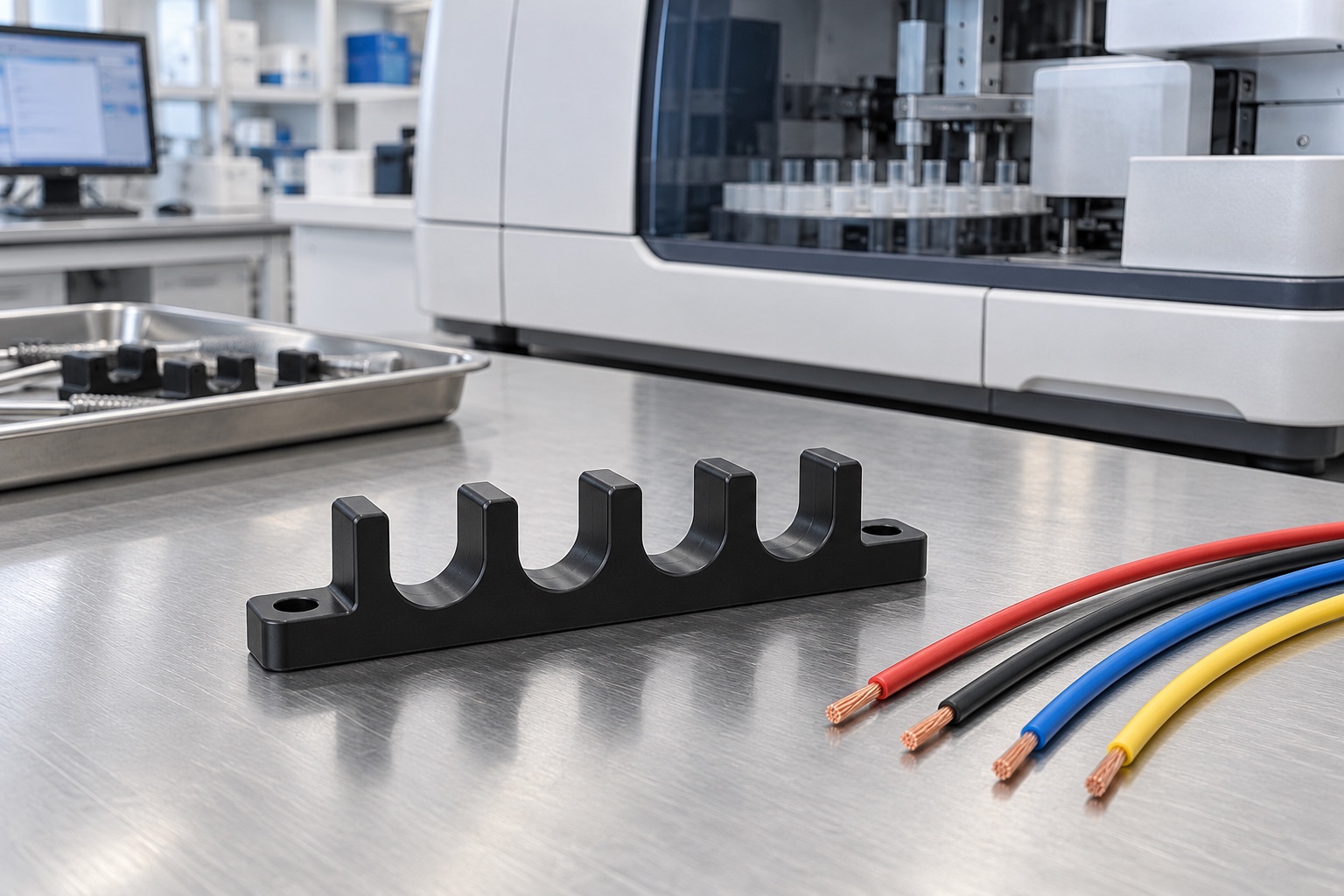
A representative internal guide component
This example considers a proposed black POM cable guide comb with four open U-shaped slots and mounting holes in its end tabs for medical equipment. It illustrates a possible CNC workflow, not a delivered customer project, a rated strain-relief device or a validated electrical safety component. The images show concepts rather than measured results or documented production. Final geometry, material grade and acceptance requirements would need approved project documents. No cable life, insulation rating, fire classification, clinical suitability, certification or achieved tolerance is asserted for this proposed component.

Review the wiring and mounting package
The proposed order would begin with the controlled component model and drawing, identified cable assemblies, mounting arrangement and relevant routing documents. The review would distinguish slot contact from clearance and establish whether connectors must pass through the route or cables are placed laterally. The equipment team would define the role of any separate retention or strain-relief feature. Missing requirements would be clarified before costing and manufacturing planning. The purchase scope would distinguish dimensional production, optional placement trials and separate electrical, environmental or equipment-level evaluations assigned to the responsible program.
Maintain the approved POM grade
The material order would identify the approved black POM grade, stock form and documentation. Black appearance would not serve as evidence of identity or equivalence. Lot records would remain associated with cut blanks through machining, edge finishing and packaging. Any proposed substitute would require approval before use, even if a sample appeared mechanically similar. The supplier would preserve the accepted material choice without turning a generic polymer designation into an unsupported electrical, fire or cleaning claim. Application suitability would remain a separate design decision based on the actual complete equipment configuration.
Establish supported mounting references
Initial machining would establish the mounting face and references needed to locate the open slot pattern. Broad support would avoid forcing the component into an artificial shape. Chips and polymer remnants at fixture contacts would be controlled before reference transfers. The supplier would plan how removing material between the fingers changes their support, rather than judging the part only while clamped. Intermediate measurements could help confirm the sequence but would not replace final acceptance. The objective would be a repeatable guide in the specified condition, not a single sample made acceptable through excessive fixture pressure.
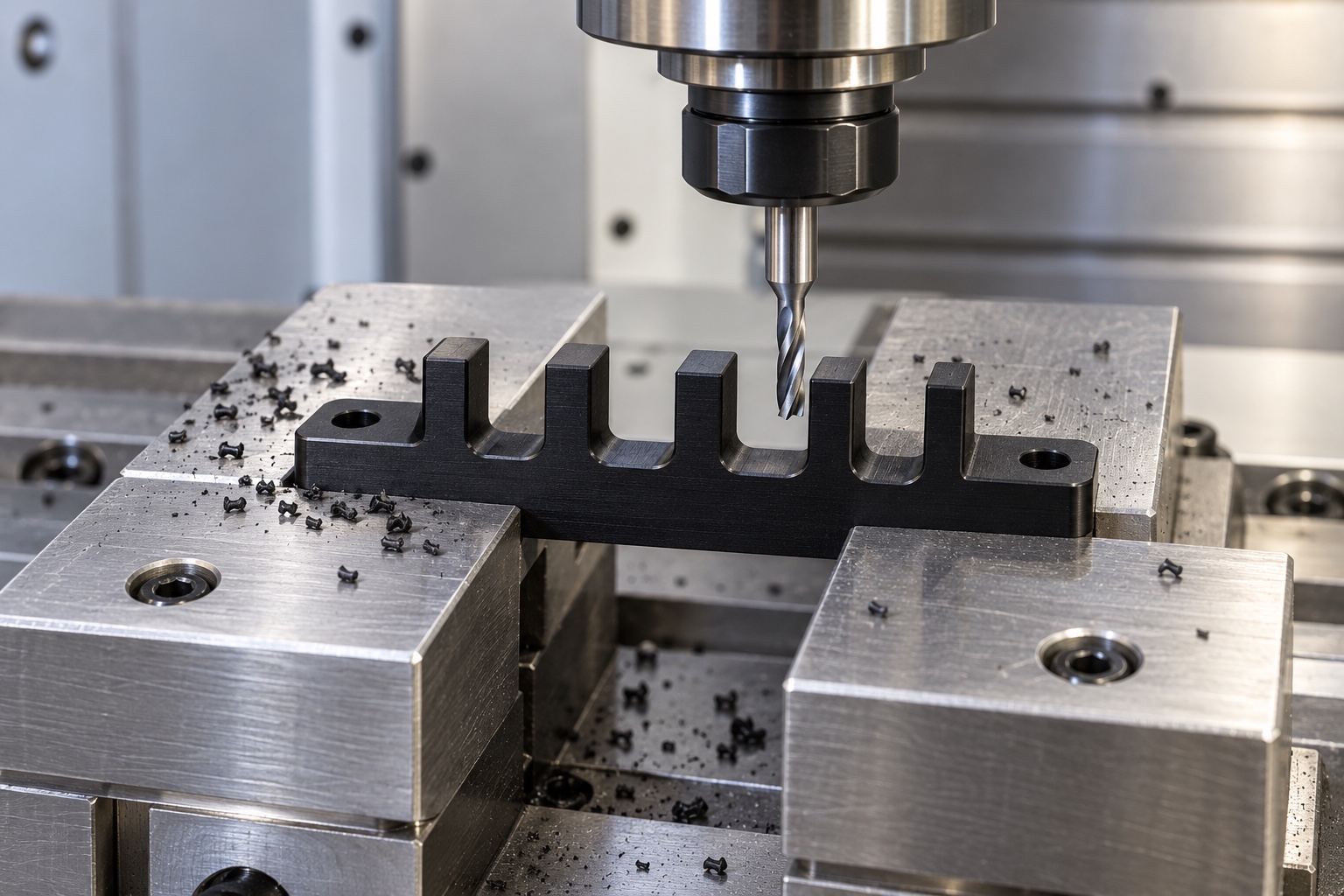
Machine the four specified guide slots
The slots would be produced relative to the approved mounting references. Width, depth, location and bottom profile would follow the drawing rather than an operator's choice of a convenient cutter. Tool access and transitions would be reviewed before production. If a proposed radius or relief affected the cable envelope, it would require approval. The supplier would not widen a slot informally to accept an unapproved wire sample. An authorized change would enter the controlled geometry, relevant inspection requirements and repeat-production documents instead of surviving only in a manually fitted prototype.
Complete the end-tab mounting features
Mounting holes and any specified recesses would follow the controlled fastener arrangement. The review would include screw-head contact, access for assembly tools and surrounding enclosure clearance. The supplier would resolve discrepancies between model and drawing before making production choices. A hole diameter alone would not define the complete mounting condition, and this example does not prescribe a tightening torque. If the equipment design included another retaining component, its interface would be documented separately rather than inferred from the guide comb's appearance or from a conveniently available assembly sample.
Control the cable-contact edge finish
The finishing route would examine the open slot mouths, bottoms and entry faces for attached polymer material or unintended sharp transitions. Removal would remain within approved geometry. Uncontrolled scraping, heat smoothing or solvent treatment would not be introduced simply to improve appearance or make a wire fit. Markings would remain outside functional contacts unless authorized. Cleaning would follow the specified material and purchase requirements. A visually attractive surface would not prove abrasion life, electrical protection or a quantified cleanliness level, and a damaged contact would be treated as a component issue rather than hidden in packaging.
Agree conditions for dimensional inspection
The inspection plan would state references, support arrangement and any required conditioning for the polymer component. Measuring force would avoid deforming slender fingers. The supplier would determine suitable access for the slot profile and mounting relationships before production. An overall-length result alone would not demonstrate acceptance of the four internal cable interfaces. Any gauge or sample cable would have an identified role and acceptance meaning. If an installed-condition check were required, it would be defined separately from the free-state requirements rather than silently replacing them with a tightly fastened demonstration assembly.
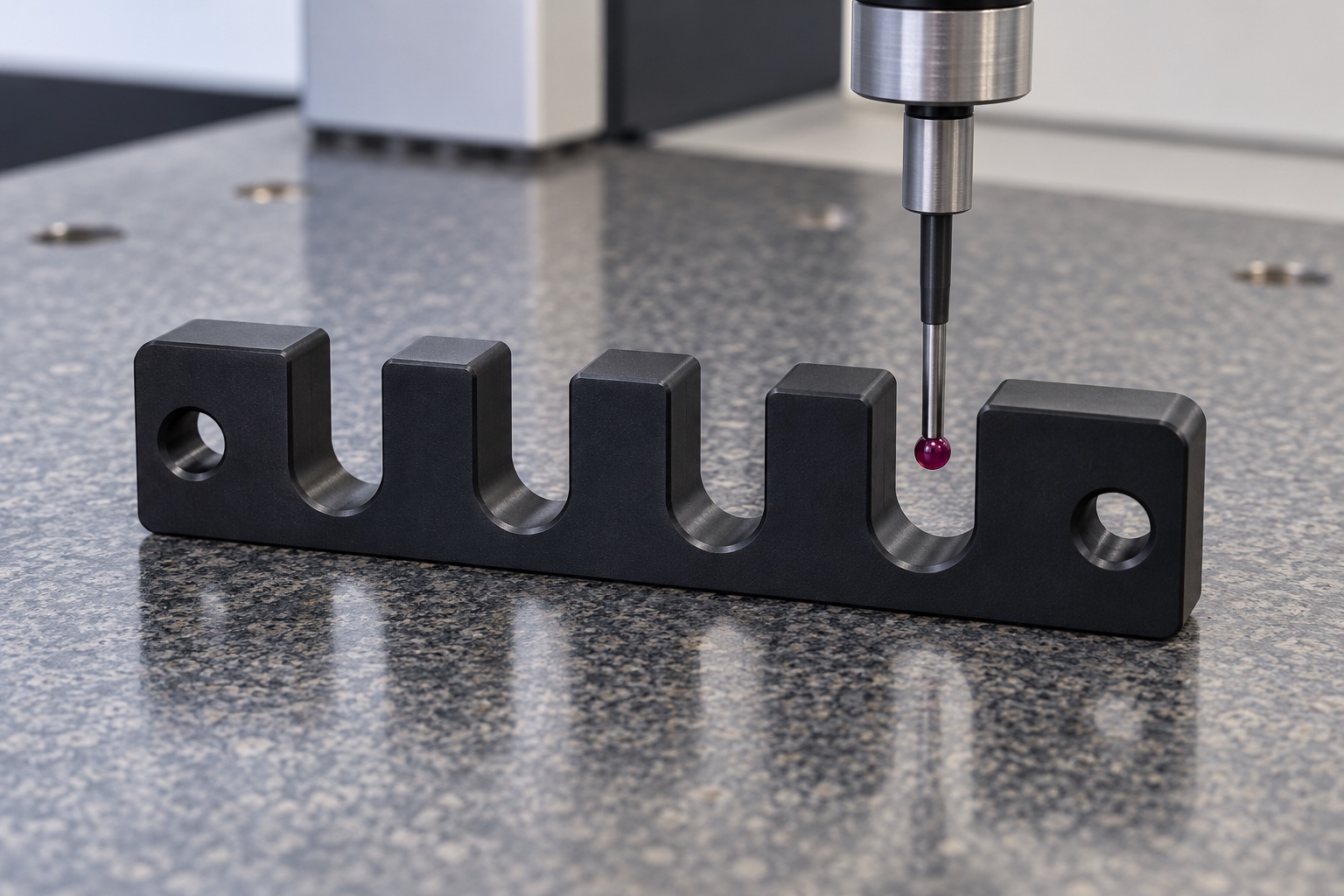
Prepare a traceable first-part report
The report would identify the drawing revision, material lot and numbered requirements. It would cover the specified slot geometry, edge conditions and mounting relationships using the agreed methods and support conditions. No numerical results are supplied because this representative example has no manufactured sample or inspection record. Material and dimensional evidence would support acceptance only within the purchased component scope. It would not establish retention force, electrical insulation, fire performance, cable endurance or complete medical-device safety without the responsible program's independent evaluation of the actual wiring arrangement and operating conditions.
Define an optional cable-placement trial
A controlled trial could check lateral placement, assembly access and agreed clearances using approved identified cable assemblies. Its procedure would record the comb revision, cable identities, mounting hardware and surrounding supports. It would not be described as electrical or endurance qualification. If unexpected jacket contact appeared, the team would document it before modifying the guide. An unrecorded hand-fitted sample would not establish the production baseline. Results from one cable set would not automatically apply to another jacket, connector or installation merely because the open slots retained the same nominal dimensions.
Protect fingers and contact surfaces
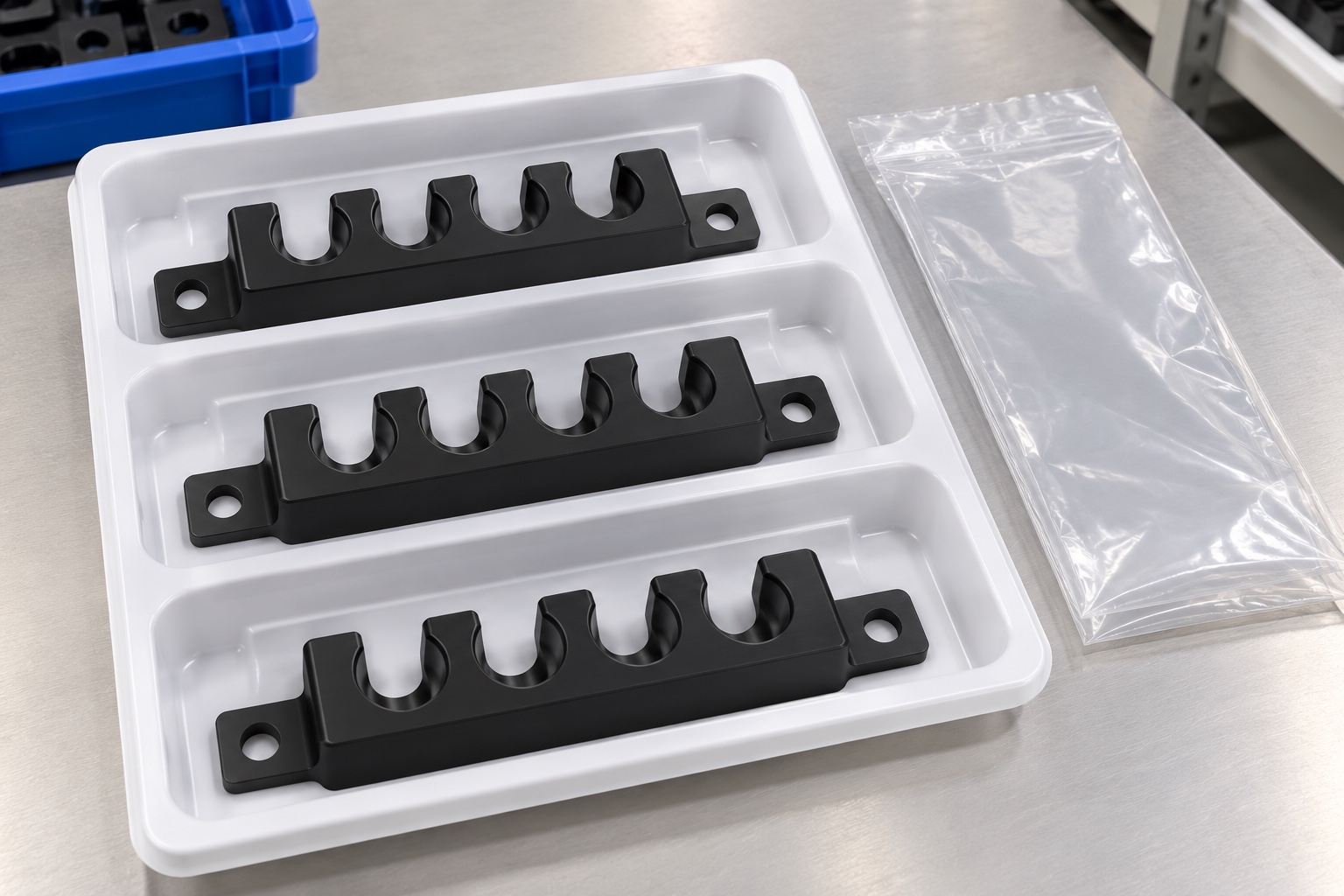
Packaging would separate the combs and prevent their fingers from interlocking or rubbing neighboring parts. Supports would avoid loading the open geometry or leaving residue in the slots. Any supplied cable samples would remain identified as trial articles rather than approved production wiring by implication. Ordinary protective bags would not indicate sterile supply or quantified cleanliness. Revision, material grade and lot evidence would accompany the shipment so receiving personnel could preserve the accepted configuration and distinguish it from a prototype or visually similar substitute before entering the equipment assembly process.
Keep repeat manufacture configuration-controlled
The repeat-order package would preserve the approved drawing revision, polymer grade, cable identities, routing information, mounting arrangement, inspection method and packaging scope. Authorized prototype changes would be incorporated explicitly. The equipment owner would review altered cable constructions, covers or operating conditions before reusing earlier observations. This representative example provides a structured purchase framework for a medical equipment cable guide: define contacts, preserve material identity and verify the agreed geometry. It keeps strain relief, electrical protection, fire behavior and complete device qualification separate from claims that cannot be supported by a machined component and dimensional report alone.
Manufacturer background reference: www.igus.com.
FAQ
Is this an electrically qualified customer delivery?
No. It is a representative manufacturing example for a proposed cable guide. No actual shipment, insulation rating, fire classification, cable life, achieved tolerance, certification or complete medical-device validation is claimed, and the images are illustrative concepts.
What defines the four cable slots?
Approved component drawings and routing documents define the geometry and references. Cable construction, connector envelope and the assembly sequence must be identified. A sample wire or a generic diameter is not a complete production interface specification.
What would the first-part report cover?
It would document agreed slot and mounting requirements, material evidence, references and inspection conditions. It would not by itself demonstrate cable abrasion life, restraint strength, insulation integrity or electrical safety of the complete instrument.
Can a slot be widened informally for a prototype?
Only within approved process and drawing limits. A geometry change needs authorization, controlled documentation and appropriate inspection before entering repeat production, rather than becoming an unrecorded adjustment made to match one particular sample cable.
Can cable-placement checks be included?
Yes, with identified cable assemblies, a defined procedure and explicit placement, access or clearance checks. Those observations remain separate from electrical and endurance qualification unless the relevant activities are independently specified, authorized and documented.
What should remain controlled on a repeat order?
Preserve revision, POM grade, material evidence, cable identities, mounting and routing arrangement, inspection plan and packaging scope. Review changed jackets, connectors or covers before assuming that earlier assembly observations still apply to the new equipment configuration.

tanghangyun@oemach.com