
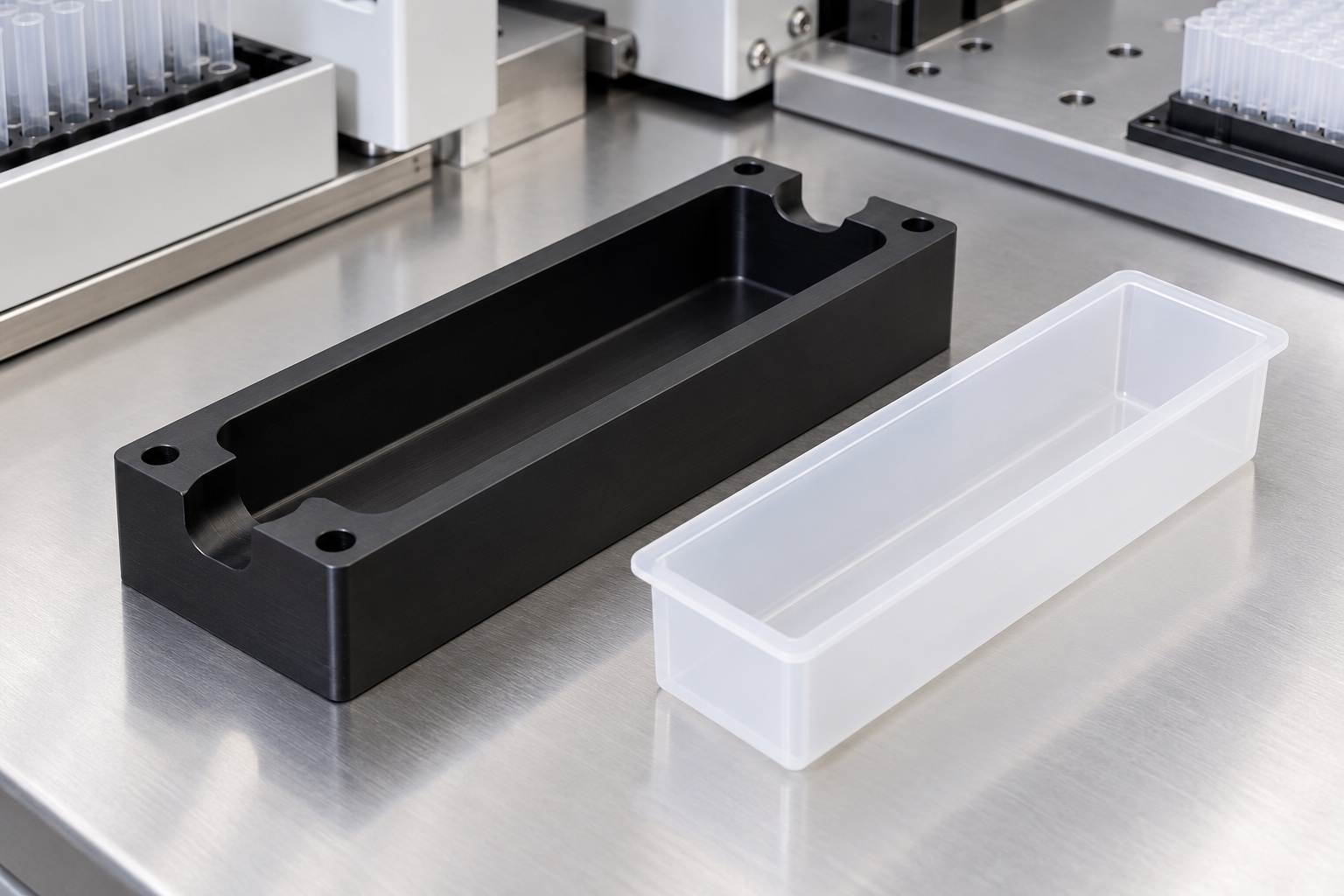
A representative non-fluid-contact support
This example considers a proposed black POM holder with an elongated open cavity, handling cutouts and equipment mounting holes. It would support an approved reagent reservoir outside the intended fluid path in a diagnostic laboratory instrument. The actual configuration would need confirmation by the equipment owner. This is a representative manufacturing plan, not a delivered customer project, certified consumable or validated assay component. Illustrations do not provide measurement results. No reservoir brand compatibility, cleaning qualification, transfer accuracy or achieved tolerance is claimed without controlled project documentation and the evidence appropriate to those claims.

Review the reservoir and equipment interfaces
The proposed order would begin with the approved holder drawing, model, consumable outside geometry and equipment mounting arrangement. The review would identify which regions support the reservoir and which provide lateral location or clearance. Container capacity would not be used as a substitute for its external dimensions and allowed variation. A physical empty sample could support discussion if identified and authorized. Missing details about flange support, bottom contact or removal access would be resolved in writing before the supplier committed to a cost estimate, manufacturing route or fit-trial scope.
Specify and identify the POM raw material
The material order would state the approved POM grade and required documentation rather than relying on black color as identification. Raw material and lot information would remain connected to the blanks through machining and packing. A proposed substitute would require review before use. The equipment program would determine suitability for the actual cleaning process and environmental exposure. The machining supplier would preserve the approved material identity and produce the required geometry, but would not represent that evidence as a biological assessment, sterile supply claim or qualification of the complete diagnostic instrument.
Establish support for a long pocket
The route would preserve adequate support as the internal cavity was opened. Workholding pressure would be controlled so the side walls were not forced into an apparently correct shape while clamped. Chips and polymer debris at setup contacts would be managed before reference transfers. Intermediate checks could reveal a problem before final machining, but would not replace inspection of the finished part. After substantial material removal, the supplier would review the released condition where the drawing required it. This would help create a repeatable process rather than a holder that only matches its model inside the fixture.
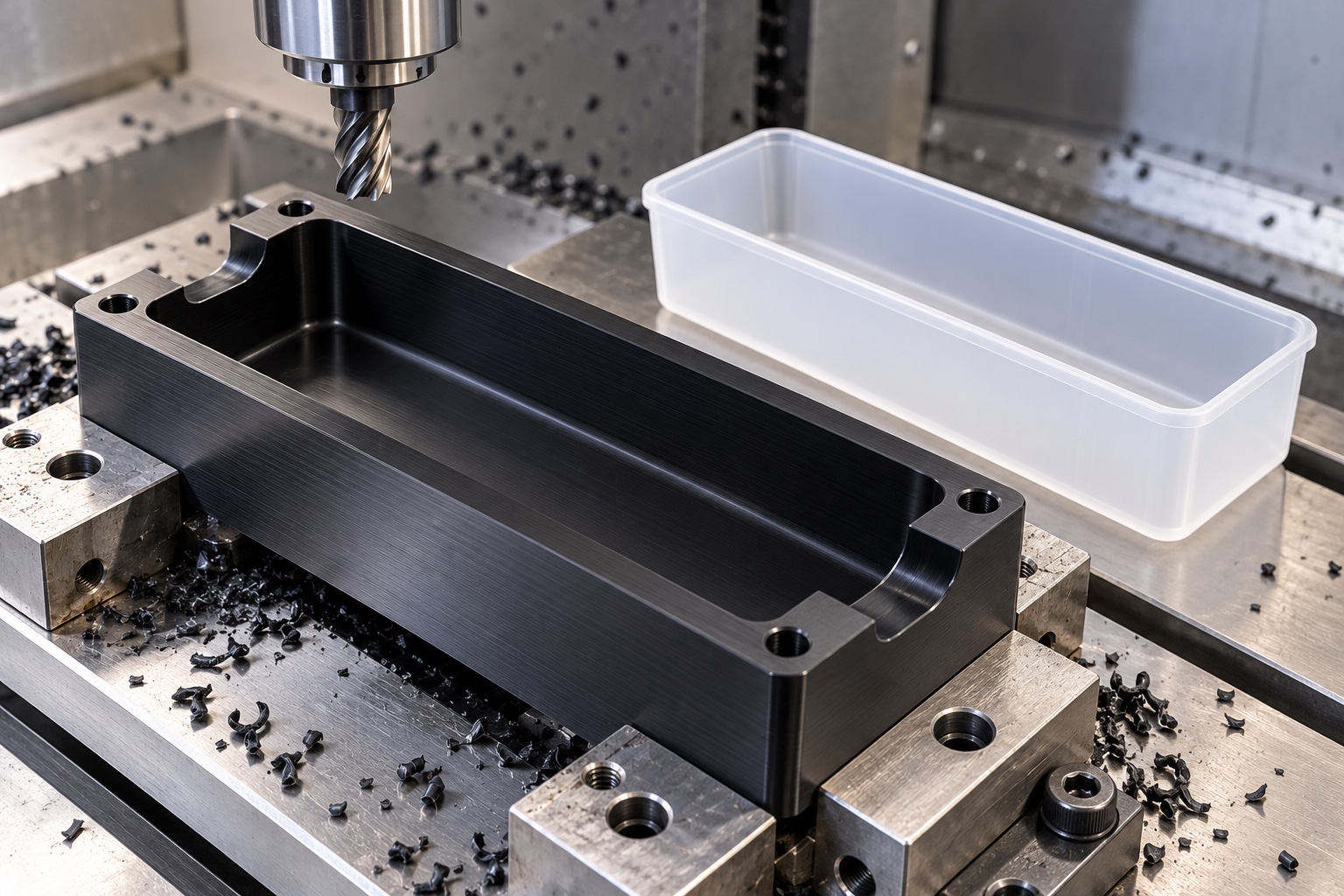
Transfer the equipment mounting references
The approved mounting plane and locating features would define how the holder was positioned during later machining and measurement. The cavity's seating surfaces would be related to those references rather than to an arbitrary edge of the raw blank. If a setup change was necessary, the transfer would be documented and checked. The route would distinguish fixture location from finished-part acceptance. A fixture can establish a useful production condition, but it cannot by itself prove that every holder has the required cavity height, position and relationship to the equipment mounting interface.
Machine the cavity and corner clearances
The cavity tool path would follow the drawing-defined contour, seating geometry and permitted internal radii. Tool access would be reviewed before production so any necessary relief could be approved rather than hidden in a workshop modification. The supplier would preserve the required support regions while completing the pocket. A smooth cavity floor would not be sufficient if the reservoir contacted a corner before reaching its intended seat. Intermediate measurements would focus on relevant features, and final inspection would verify the finished relationships under the agreed condition instead of relying on a visually convincing fit photograph.
Complete cutouts and mounting holes
Handling cutouts would be machined without removing required support or creating an uncontrolled sharp transition. Mounting holes and any specified counterbores would follow the approved equipment interface. The review would include fastener access and the ability to insert or remove the reservoir with the actual approved hardware installed. A supplier would not enlarge a cutout informally to accommodate a trial sample. Any design change would be recorded in the approved revision, and affected drawing features would remain traceable in the inspection plan and the repeat-production configuration.
Remove attached material deliberately
The finishing process would inspect pocket entries, lower transitions, cutout edges and hole exits for attached polymer material. Removal would preserve the specified geometry rather than rely on unrestricted scraping or polishing. A glossy surface would not automatically establish an acceptable texture or contact condition. Cleaning would follow the documented material and purchase requirements, without introducing an unapproved solvent or heat treatment. The supplier would keep loose debris out of the cavity before any fit trial. A damaged seating surface would be treated as a component issue, not concealed by presenting a clean package.
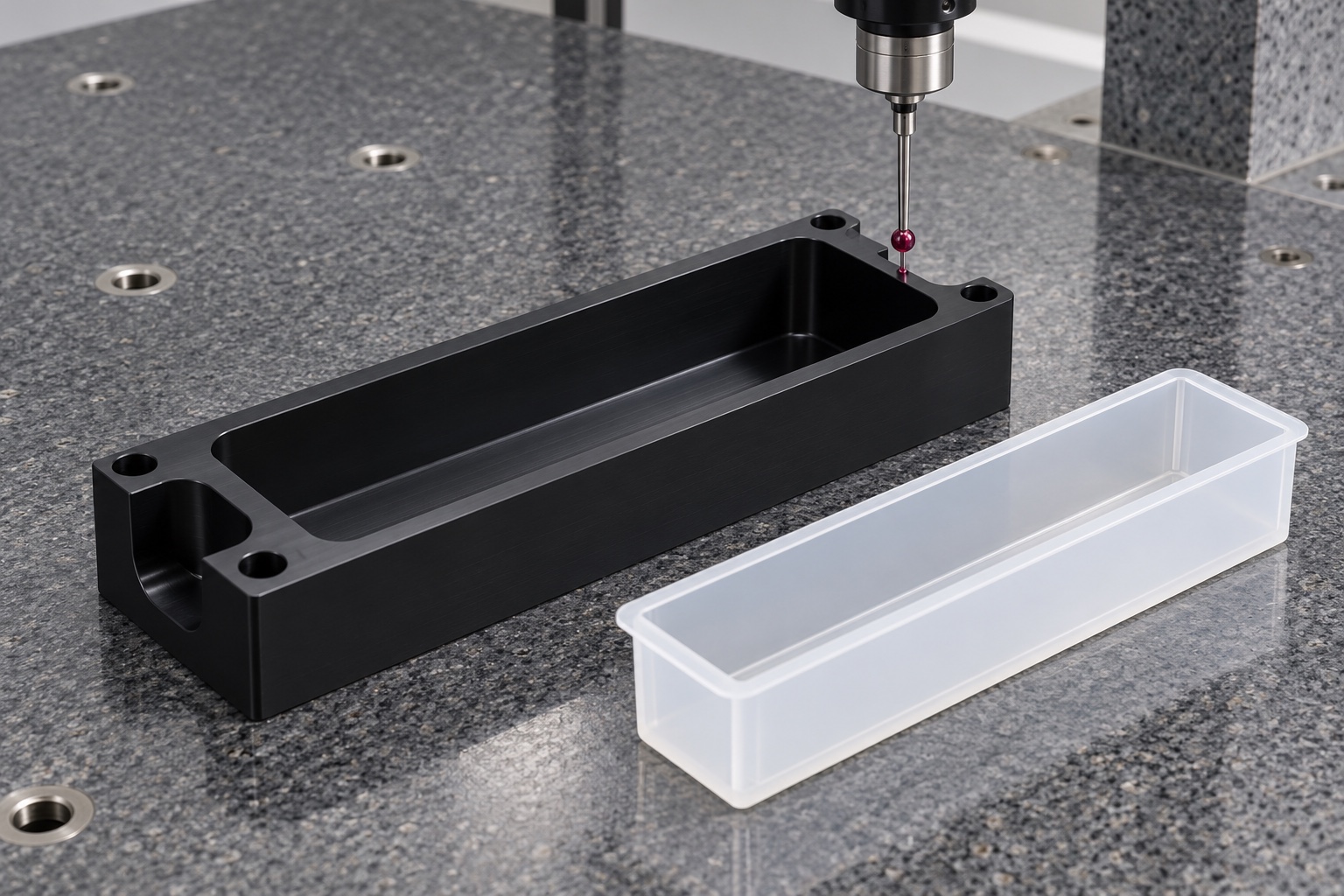
Prepare a feature-linked inspection report
The first-part report would identify the drawing revision, lot and numbered requirements. It would address the relevant cavity profile, seating height, corner clearance and mounting relationships. Support and measurement conditions would be recorded, including any required environmental conditioning. No numerical outcome is asserted because there is no supplied manufactured specimen or measurement record in this example. The proposed evidence would support acceptance of the purchased mechanical component. It would not establish reservoir purity, instrument transfer accuracy or the performance of a diagnostic procedure performed by the complete equipment.
Agree the empty-container demonstration
A separately defined demonstration could use identified, approved empty reservoirs to check insertion, seating and removal. Its procedure would record the holder revision, consumable identity and any relevant mounting hardware. The result would not be described as a liquid-handling or sterility validation. If the sample failed to seat, the team would document the contact location before changing the holder or requesting a consumable review. Hand fitting one specimen would not establish a controlled production design. Any accepted change would need updated documentation and corresponding inspection criteria before repeat manufacture.
Protect the cavity during transport
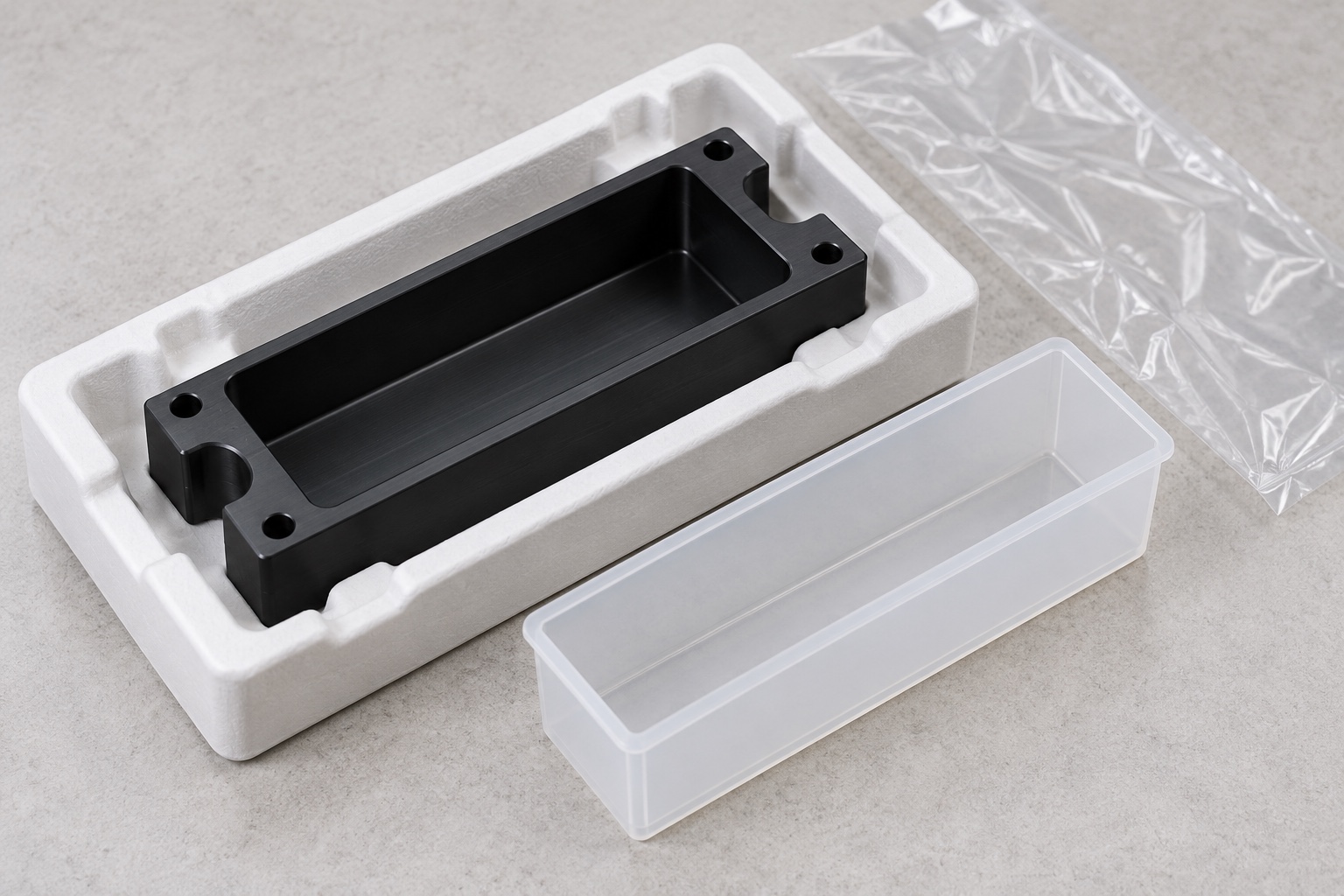
Packaging would separate holders and protect the cavity, cutouts and locating features from rubbing or impact. The agreed cleaning scope would be stated accurately; ordinary protective transport packaging would not be represented as sterile supply. Labels and identification would remain associated with the lot without adding residue to functional surfaces. If a quantitative cleanliness requirement applied, its verification would be purchased and documented separately. The recipient would also need a practical way to remove the holder without catching thin edges or introducing debris, rather than relying solely on how tidy the packed component looked.
Maintain the approved consumable baseline
The repeat-order record would retain the holder revision, POM grade, consumable interface, mounting configuration, inspection method and packaging scope. Authorized prototype changes would be incorporated explicitly rather than left in a workshop sample. A changed reservoir flange, bottom contour or approved supplier could require another interface review even if the nominal volume remained the same. This representative example provides a structured purchasing approach for diagnostic equipment supports. It defines what CNC manufacturing and dimensional evidence can establish while leaving reagent compatibility, liquid-handling performance and medical-device qualification to the responsible program and its separate evidence requirements.
Manufacturer background reference: lifesciences.tecan.com.
FAQ
Is this a real customer shipment?
No. It is a representative manufacturing example. No customer delivery, measured tolerance achievement, certification or assay performance is claimed, and the pictures illustrate concepts rather than completed production evidence.
What material information would the order require?
Specify the approved POM grade, raw material form and traceability documentation. Black appearance is not proof of grade or suitability, and a substitute requires review before production.
Which cavity features would be inspected?
The drawing defines the required contour, seating height, corner clearance and relationships to equipment mounting references. An isolated pocket-width result is not a complete verification of the support interface.
Can the pocket be scraped to make one reservoir fit?
Only within an approved process and drawing limits. A geometry change needs authorization, updated documentation and appropriate inspection before it can become the repeat-production standard.
What does the optional empty-reservoir demonstration cover?
Only the agreed insertion, seating and removal checks using identified components. It does not establish reagent compatibility, sterility, transfer accuracy or the diagnostic performance of the assembled instrument.
What must be reviewed on a repeat order?
Confirm the holder revision, material, consumable geometry, mounting arrangement and inspection scope. Review authorized prototype changes and any altered cleaning or packaging requirement before repeating the earlier configuration.

tanghangyun@oemach.com