
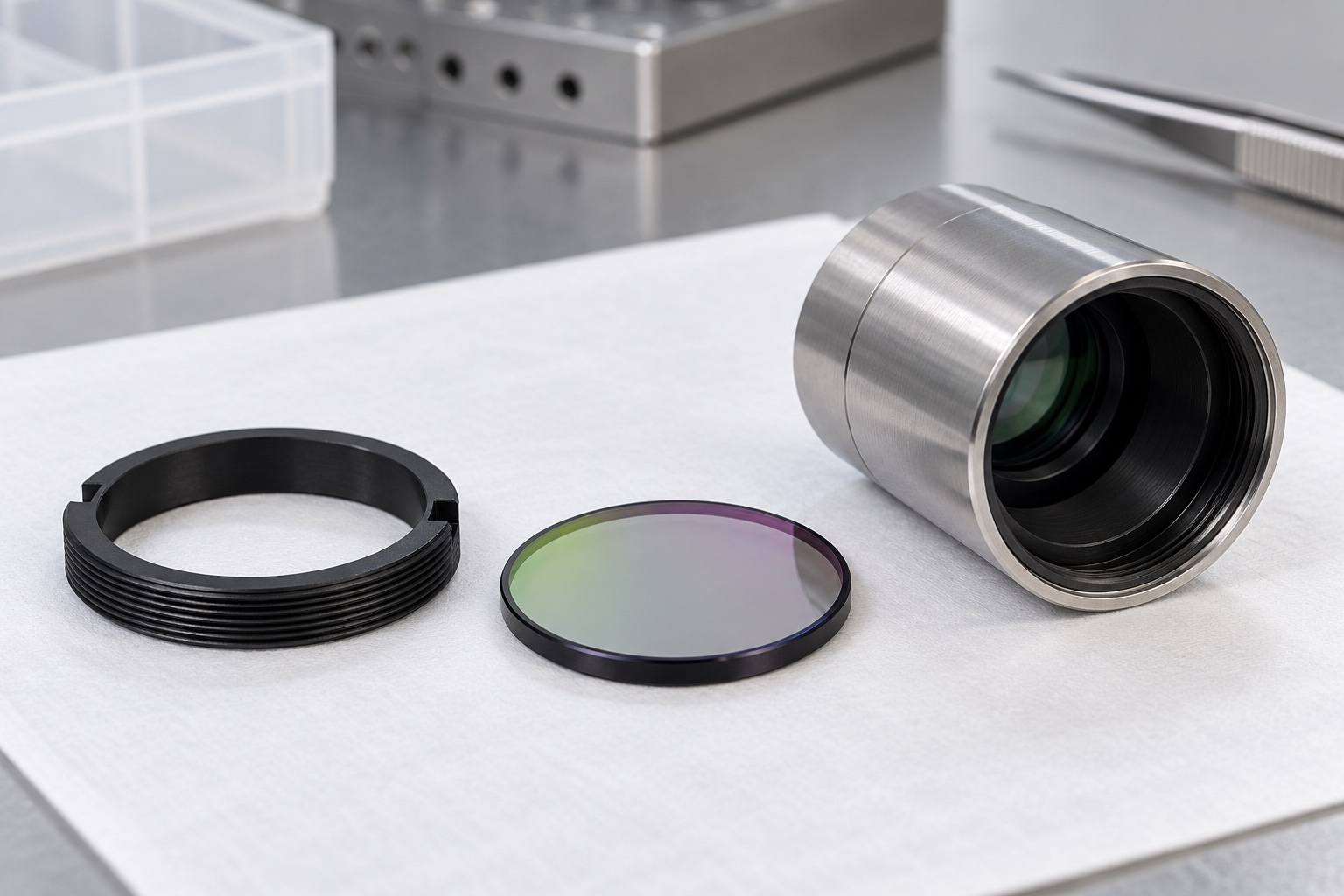
A proposed equipment-side component
This representative case concerns a black POM ring intended to retain a filter within a diagnostic photometer's mechanical assembly. It is an illustrative manufacturing plan, not a report of a customer shipment, an approved optical design or a validated medical instrument. The concept includes an external thread, a clear central aperture, a narrow axial contact land and two tool-access slots. No dimensions are inferred from an existing brand's component. The actual order would need a released drawing and matching model that define the mating tube, the contact arrangement and the accepted part condition.

Identify the important interfaces first
During inquiry review, separate the thread, aperture, axial land and spanner slots rather than treating the ring as one simple turned washer. Confirm which face contacts the filter stack and which surfaces must remain clear. Ask whether another specified element sits between the ring and optic. Review assembly direction and removal access. A ring may enter the tube yet stop at the wrong axial location, so a trial engagement does not settle every interface question. Record ambiguities between the model, drawing and samples before the machining route or quotation is released.
Specify the polymer rather than just its color
The example calls for a defined black POM grade in the condition required by the order. Check the material identity, stock form and any certificate request before cutting blanks. Keep the lot reference linked to work in progress and delivery records. Similar-looking black plastics should not be mixed or treated as interchangeable. The device team still determines environmental and optical requirements. This case makes no claim about fluorescence, outgassing, biological suitability or resistance to all cleaning agents. Those properties require their own material-specific review and, where ordered, appropriate evidence.
Prepare stock with support for the annular geometry
A possible route begins from a suitable round blank with enough allowance to establish the reference faces and the internal opening. Plan how the remaining material supports the part through turning and separation. The choice of jaws, collet or mandrel should consider where it contacts the future land and thread. Avoid relying on a highly loaded thin section to establish final size. Record the setup and identify when released-state checks will occur. The actual blank dimensions and route must follow review of the order rather than an assumed standard size for every optical ring.
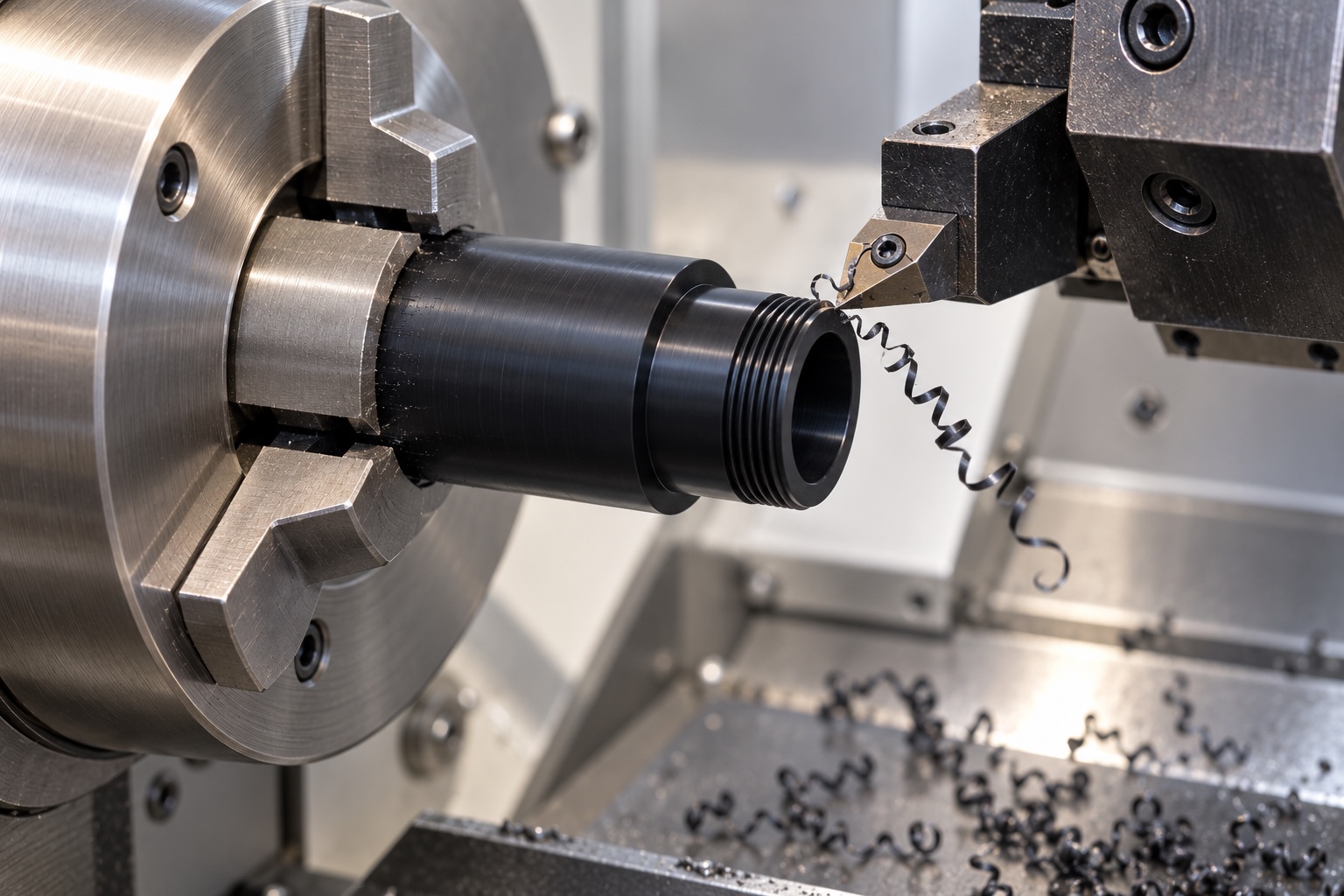
Turn the aperture and axial land deliberately
Establish the specified diameters and faces with tools suited to the polymer and the available wall section. Preserve the required contact width while creating any released edge breaks. Check that the aperture and land relationship agrees with the drawing, not merely with the visible silhouette in the model. Tool pressure and process heat deserve consideration when the annulus becomes thin. Measure under the agreed conditions after release. If a local finishing correction changes the axial width, review the thread engagement and the assembly stack instead of accepting the correction only because the opening now measures correctly.
Generate and check the thread
Machine the external thread to the explicit form, pitch, engagement and acceptance requirements of the order. Identify where full thread is required and where the entry or relief is allowed. The selected gauge or approved mating tube should be suitable for the agreed check. Do not force a ring through a tight sample and call the thread accepted. Preserve the reference relationship between the thread and the contact face. If the drawing does not specify a usable thread definition, clarification is needed before manufacturing; the shop should not select a similar catalog interface on the customer's behalf.
Add tool-access slots with a controlled transfer
The proposed secondary operation creates the spanner slots while supporting the ring at defined references. Review slot width, depth, angular relationship and tool clearance. A setup that compresses the annulus can make a cut appear well located while changing the released shape. After slotting, inspect the affected edges and confirm any dimensions that the operation may influence. The installation tool should engage the intended material without extending toward a nearby optical surface. Tool access is a functional requirement even though the slots may look less important than the ring's main circular features.
Remove attached material without over-finishing
Inspect the thread entry, aperture edge and slots for strings, attached burrs and handling damage. Use a controlled edge process that preserves the specified contact land. An aggressively polished edge may look clean while no longer meeting its geometry. A cleaning operation is not a substitute for removing attached material. Where the narrow slot or thread root limits direct access, agree the inspection method and record its limitations. Keep the finished ring separated during handling so an accepted edge is not damaged by the next operation or by contact with another part in the tray.

Create a drawing-based first-article record
The inspection package can cover material identity, aperture size, axial width, contact-land geometry, thread acceptance, tool slots and the defined relationships between features. Record the support and condition used for measurement. A thin polymer ring should not be judged using an undocumented squeezing force or an improvised fixture. Link each result to the drawing revision and characteristic. The case includes no fabricated numerical results: a real first-article report must come from the actual manufactured part and agreed equipment. Resolve deviations before approving the route for a repeat batch.
Keep any optical trial outside unsupported claims
An order can include an agreed mechanical assembly observation using approved mating parts and a defined installation procedure. Identify whether that observation concerns engagement, axial seating, installation access or another condition. Optical transmission, filter stress, stray light and analytical performance are different requirements of the complete system. This case claims none of those results. A ring that fits a sample tube has not validated a photometer. Preserve the actual trial configuration so a problem can be investigated without automatically changing the ring's dimensions or substituting an unapproved material.
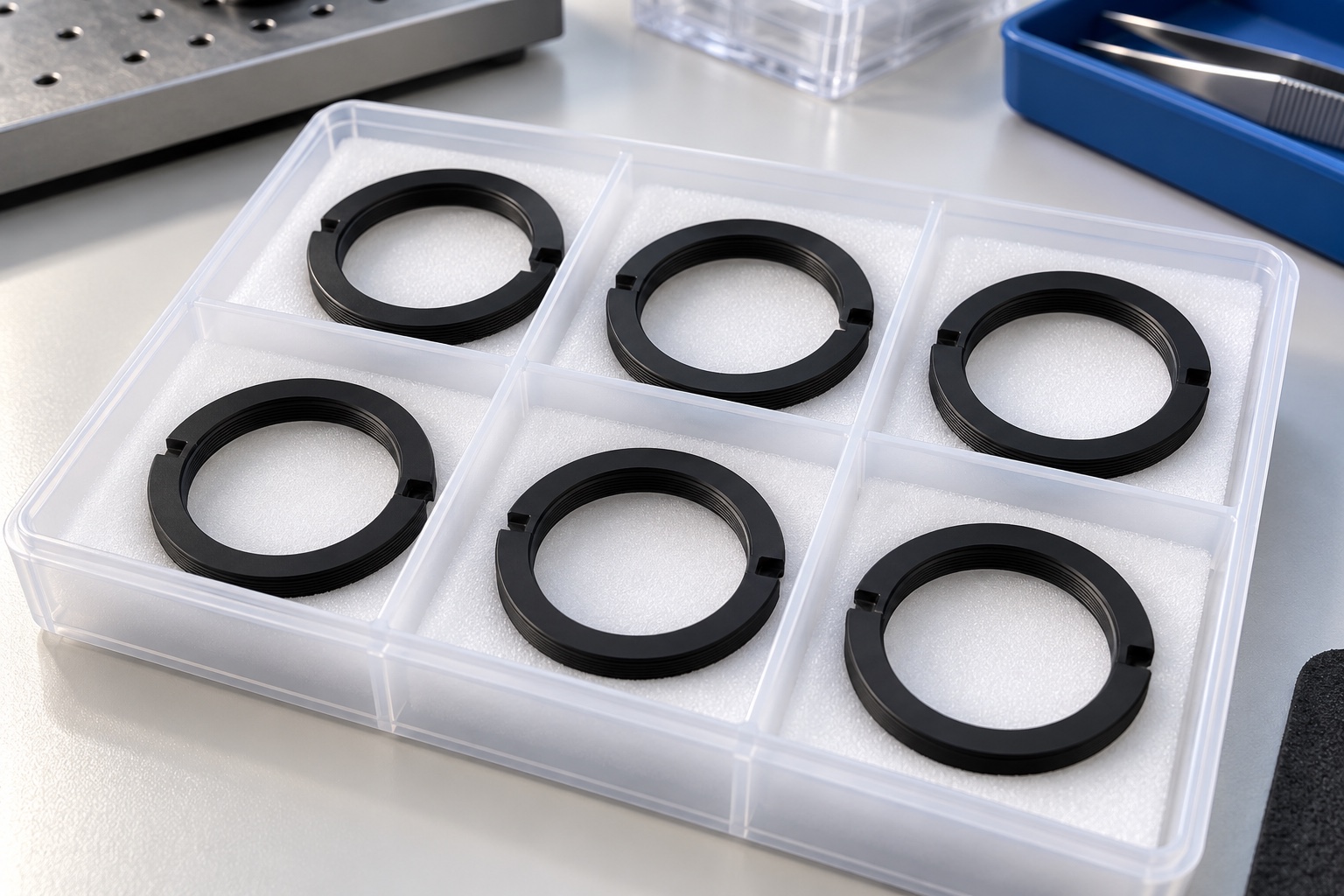
Pack the contact features without abrasive contact
Clean the ring using the agreed material-compatible process and verify the ordered condition. Provide separation that protects the thread and contact land from rubbing or embedded debris. Avoid adhesive labels on the ring's functional surfaces. Identify the part, drawing revision, quantity and material lot on its packaging. The method should be practical for receiving inspection and controlled assembly, not merely attractive in a product photograph. It does not imply sterile delivery or an optical-cleanliness class unless those requirements were separately defined, processed and verified as part of the order.
Retain what makes the repeat build equivalent
For repeat production, preserve the accepted drawing and model, material grade, thread reference, inspection plan, edge requirements and first-article disposition. Review changes to stock, workholding, tools, slotting or cleaning for their effect on the accepted ring. If a customer changes the filter stack or tube, do not assume the old ring remains suitable because its nominal diameter is unchanged. A useful RFQ states prototype and repeat quantities, evidence and packaging requirements. This representative case offers no invented price, delivery promise or universal tolerance capability; those commitments follow review of the controlled work package.
Manufacturer background reference: www.thorlabs.com.
FAQ
Is this an actual shipment record?
No. It is a representative precision-turning example with no named customer, shipment or measured optical result. A real order requires its own released interface, approval, inspection evidence and production records.
Is black POM suitable for every photometer?
No. The designer must confirm the specific grade and its compatibility with the mechanical, environmental and optical requirements. A black appearance does not establish low fluorescence, cleanliness or suitability for every cleaning process.
What does the narrow contact land control?
It provides the contact geometry defined by the assembly drawing. Its width, location and edge condition must be considered with the aperture and thread rather than adjusted independently to improve the appearance of the ring.
How is the thread accepted?
Use the explicit thread requirements and an agreed measurement, gauge or approved mating check. Record the method and reference. Forcing the ring into one tube is not a controlled substitute for the required acceptance process.
Can the ring prove optical performance?
No. Component dimensions and a mechanical trial do not establish filter stress, transmission, stray light or instrument accuracy. Any requested optical evaluation belongs to a separately defined assembly or system test.
How should the ring be packaged?
Use compatible cleaning and nonabrasive separation to protect its thread, land and edges. Label the packaging with part and revision identity. Any special residue, particle or sterile-delivery requirement must be separately agreed and verified.

tanghangyun@oemach.com