
Summary
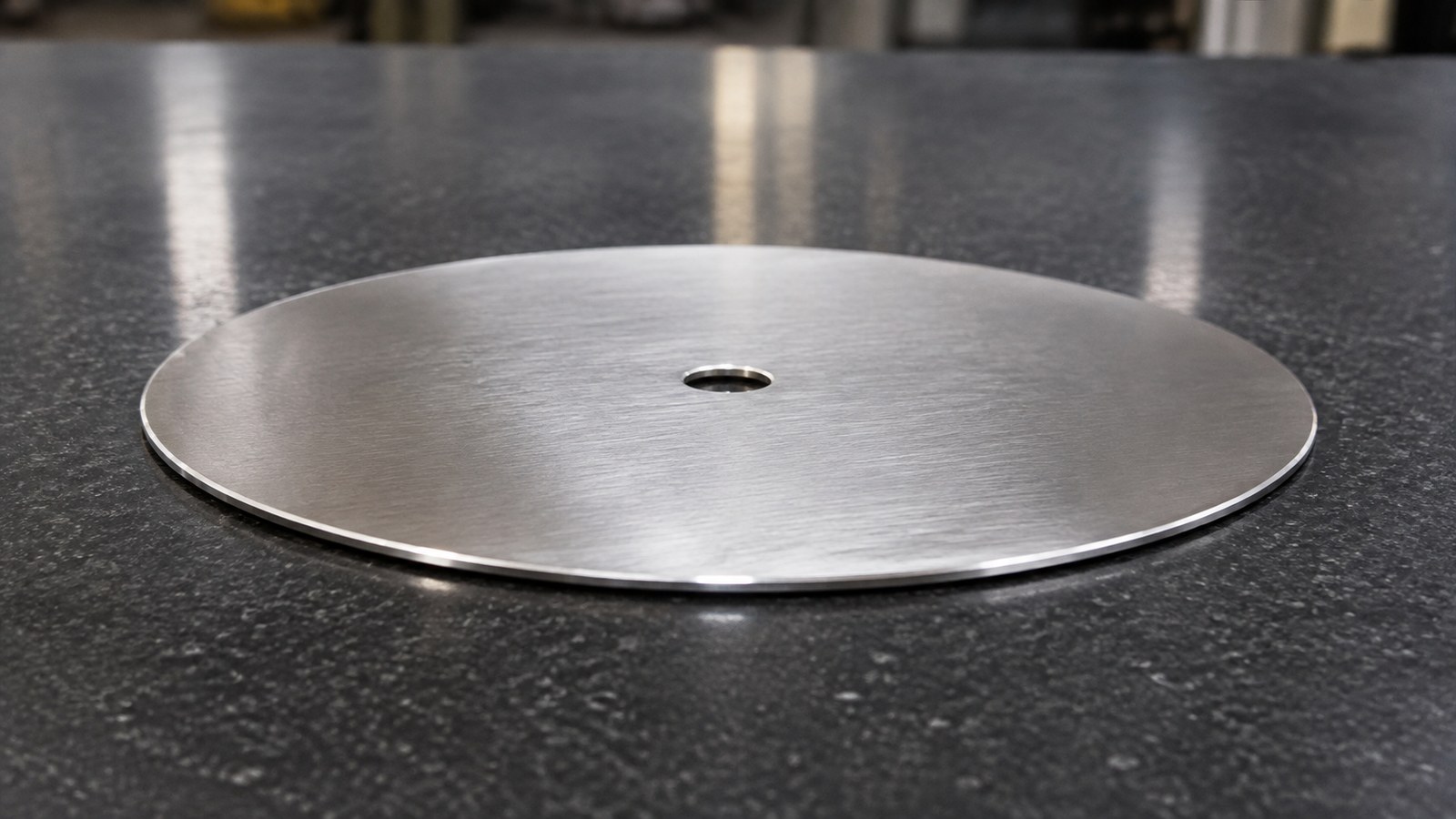
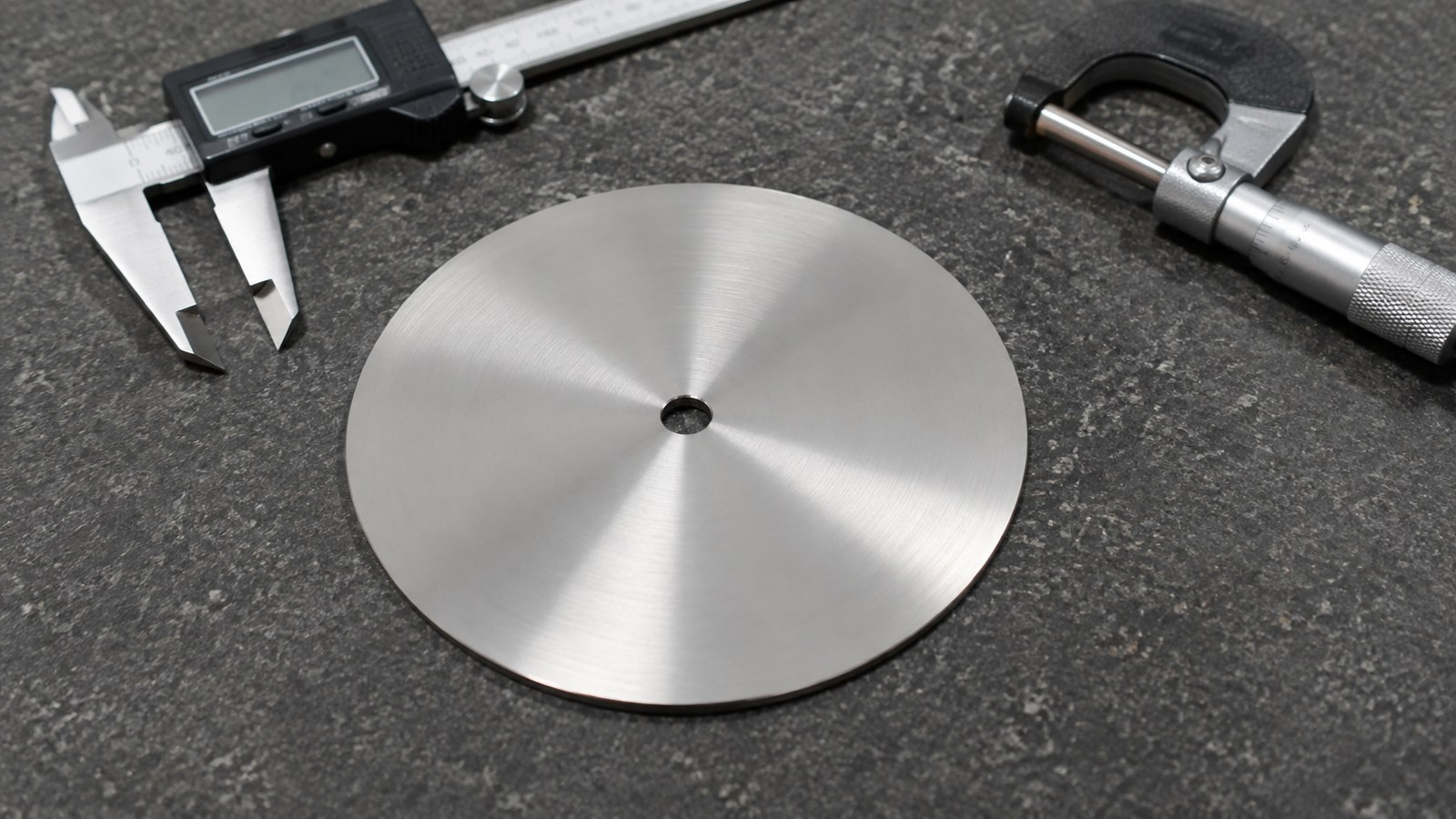
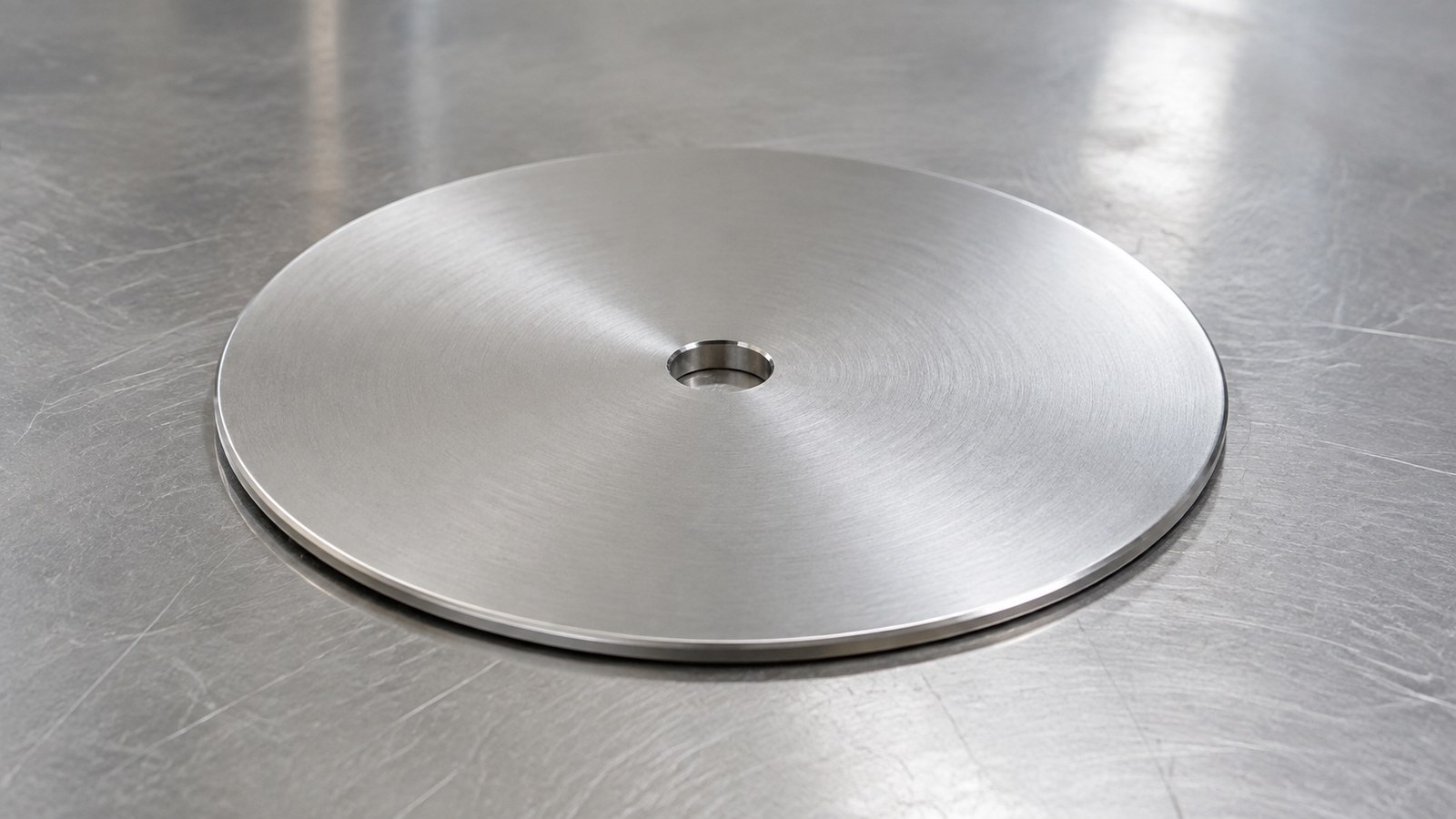
This anonymized case concerns a SUS304 round thin cover plate for custom automation assembly equipment. Engineer Shi reviewed a Φ150 mm outer diameter, a Φ11 mm through center hole, 2 mm thickness, an R0.50 mm edge radius, polishing, and burr-free requirements. OEMACHtreats clamping stability, concentric relationships, edge quality, surface protection, and free-state verification as connected process issues.
Anonymized Project Background
In May 2026, Engineer Shi reviewed a prototype request from an automation-assembly-equipment customer in Changchun. Based on the circular thin form, central through hole, polished surface, and rounded edge, he assessed the component as a protective cover or isolation plate that may provide clearance for a central fastener, shaft, or cable. This assessment supports machining planning and does not identify the customer's actual equipment.
Drawing-Visible Data Summary
| Item | Drawing-visible information | Machining focus |
|---|---|---|
| Application assessment | Round thin cover plate for custom automation assembly equipment | Fit, clearance, surface protection, and stable assembly |
| Material | SUS304 | Work hardening, cutting heat, burrs, and scratches |
| Outer diameter | Φ150 mm | Circular profile and relationship to the center hole |
| Center hole | Φ11 mm through hole | Datum strategy and edge condition |
| Thickness | 2 mm | Clamping deformation, vibration, and springback |
| Edge | R0.50 mm radius | Continuous and controlled edge finishing |
| Surface | Polished and burr-free | Appearance consistency and protected handling |
All component-specific values above come from visible engineering-drawing annotations. [Source: Customer-provided visible engineering drawing annotations]
Application and Dimensional-Chain Assessment
Engineer Shi classified the part as a round cover plate for custom automation assembly equipment. The outer diameter may define installation clearance, the center hole may accommodate a connection feature, and the plate face may provide shielding or separation. Dimensional relationships between holes, shafts, and mating boundaries should be assessed through functional tolerances. [Source: ISO 286-1:2010]
Although the geometry is simple, the 2 mm SUS304 sheet can respond to clamping force, cutting heat, and polishing stress. Form and location controls should therefore be tied to functional datums and the assembled condition. [Source: ISO 1101:2017]
Key Machining Risks
1. **Clamping deformation:** Concentrated pressure can flatten the plate temporarily and allow springback after release.
2. **Outer-diameter and center-hole relationship:** Separate setups can introduce eccentricity if datum transfer is weak.
3. **SUS304 edge behavior:** Unstable cutting or rubbing can increase work hardening, vibration, and burr formation.
4. **R0.50 mm edge consistency:** Excessive manual finishing can create an uneven perimeter.
5. **Polished-surface protection:** Handling and stacking can introduce scratches after machining is complete.
Surface-texture requirements should be communicated through controlled technical specifications rather than subjective appearance descriptions. [Source: ISO 21920-1:2021]
Process Recommendations
Engineer Shi proposed controlled drawing review, stock-condition confirmation, a clamping trial, common-datum planning for the center hole and outer profile, contour machining, edge-radius processing, deburring, polishing, free-state dimensional verification, visual review, and separated protective packaging.
General tolerances for dimensions without individual indications should follow the class stated in the controlled technical documentation. [Source: ISO 2768-1:1989] Geometrical requirements without individual callouts should be reviewed using the specified standard and the cover plate's functional condition. [Source: ISO 2768-2:1989]
Delivery and Supplier Selection
For a low-volume round cover plate, buyers should compare thin-sheet fixturing experience, datum planning, SUS304 edge control, polishing coordination, clean handling, schedule communication, and process records. A prototype run can establish whether dedicated support tooling is justified for later batches.
FAQ
Q1: Can a 2 mm SUS304 cover plate be held with ordinary clamps?
It depends on support area, stock allowance, and tool access. Distributed support is generally important for limiting temporary deformation.
Q2: Why machine the center hole and outer profile from a common datum?
They may form a functional dimensional chain, and a common datum reduces error from repeated alignment.
Q3: Can the R0.50 mm edge be produced only by hand finishing?
Hand finishing can remove residual sharpness, but controlled machining provides more consistent perimeter geometry.
Q4: Should dimensions be checked after polishing?
Yes. A thin plate may respond to machining and polishing stresses, so assembly-related conditions should be checked in a free state.
Q5: What information should accompany an inquiry?
Provide the controlled drawing, intended function, quantity, center-hole relationship, visible surfaces, acceptable contact areas, polishing expectations, schedule, and packaging needs.
Scan to contact us
Contact: Allen
Email: shiziqiu@oemach.com
My whatsapp code