
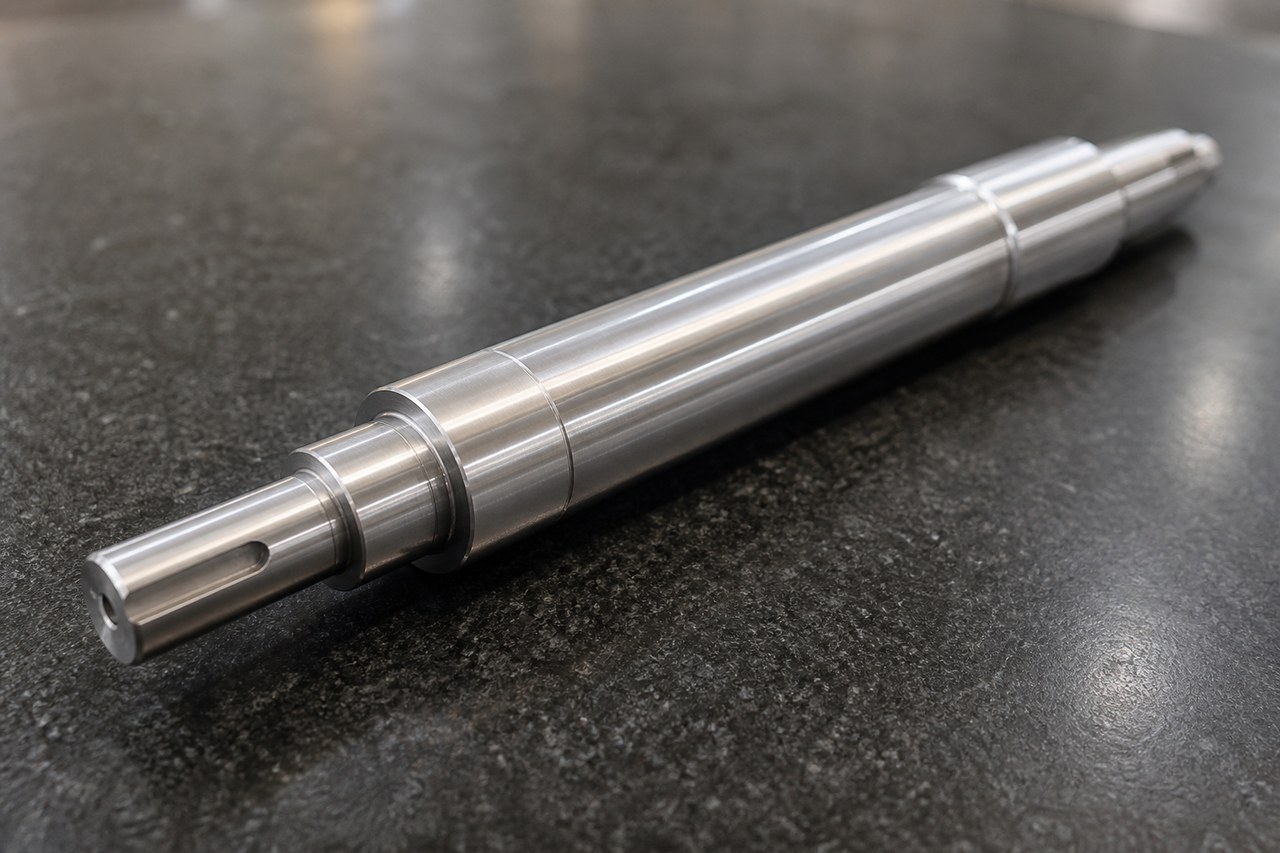
Summary:Shaft parts may appear straightforward, but delivery risks often arise from unclear datums, datum transfers, run-out relationships, clamping effects, surface protection, and acceptance conditions. OEMACHreviews open drawing items before defining fixtures and process sequencing. This article uses only the public-safe project summary and does not disclose the original drawing or internal customer information.
Public drawing data summary
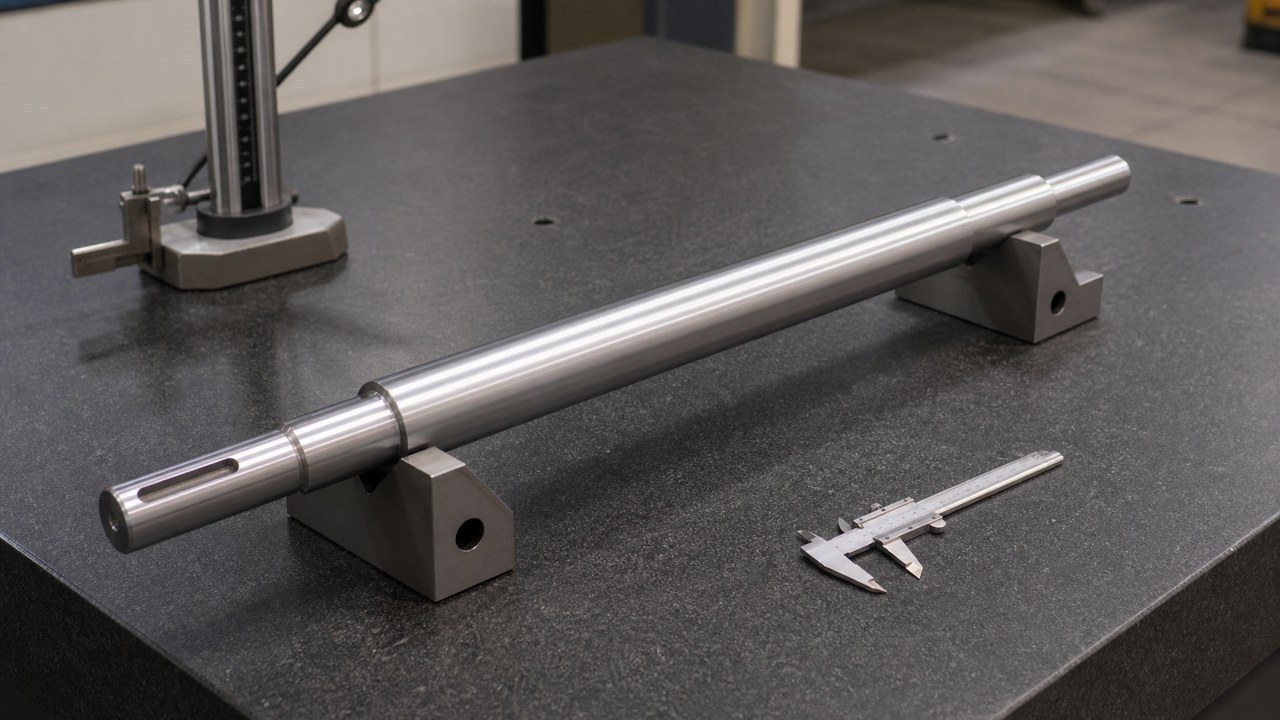
The public-safe summary identifies the project only as a shaft-type component associated with a transmission or synchronized mechanism context.[Source: Customer-provided visible drawing annotations]
No specific dimension has been identified as safe for public disclosure. The available summary also does not establish the material, critical dimensions, holes, slots, threads, tolerances, surface treatment, or datum system. These items must be supplied and confirmed before machining. This article therefore assigns no dimensions, material grades, thread specifications, tolerances, or finishing requirements.
Part and application assessment
A shaft component may serve a rotating, supporting, or power-transmission relationship. Its exact load, speed, life, and assembly function cannot be determined from the public summary and must be governed by the complete confirmed technical package.
The review should focus on the relationship between functional diameters, end faces, and any connecting features. Shaft fits and tolerance zones must be interpreted through the dimensional system stated by the drawing.[Source: ISO 286-1:2010]
Key machining challenges
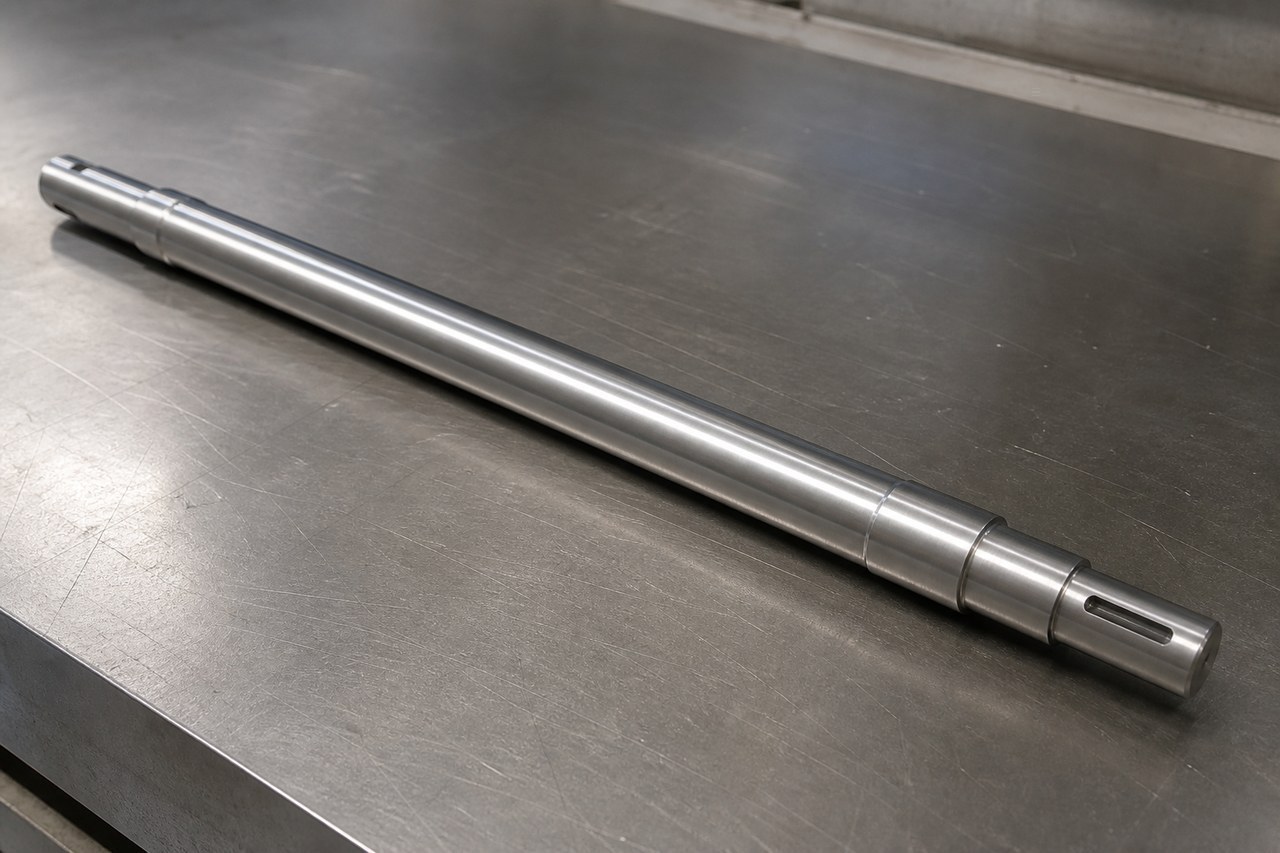
Incomplete datum chains
Local dimensions can appear acceptable while the assembled axial or radial relationship remains incorrect. Form, orientation, location, and run-out controls should be interpreted from the drawing's geometrical requirements.[Source: ISO 1101:2017]
Datum changes during refixturing
Turning the component around or transferring it between operations can introduce alignment variation. Features with a shared functional relationship should be reviewed for machining in one setup where practical. If geometrical requirements are not individually shown, the applicable general requirements still need clarification.[Source: ISO 2768-2:1989]
Potential flexibility and thermal change
The available information does not establish whether the component is slender. Once complete geometry and material data are received, the supplier should assess support, clamping length, cutting sequence, and finish-machining strategy.
Surface texture versus visual appearance
A bright surface does not by itself demonstrate a stable fit. Bearing, sealing, or sliding areas should be controlled according to their documented texture and functional requirements.[Source: ISO 21920-1:2021]
Handling damage
Rolling, stacking, or direct metal contact can damage finished diameters and end faces. Separated handling and protective packaging should be planned for critical surfaces.
Process recommendations
First, complete the material, critical dimensions, holes, slots, threads, tolerances, surface treatment, and datum information. Confirm whether general tolerances apply to dimensions without individual indications.[Source: ISO 2768-1:1989]
Next, establish a consistent process datum. Related diameters and end faces should be considered for a shared setup. Where refixturing is necessary, provide a repeatable locating surface and avoid clamping finished functional areas.
Then manage the transition from rough to finish machining. Allowance distribution, cutting sequence, support, and stabilization must be selected only after the actual geometry and material are known.
Finally, perform first-piece confirmation covering datums, functional dimensions, geometrical relationships, surface condition, deburring boundaries, and assembly orientation. Keep first-piece confirmation and dimensional review records for subsequent batches.
Recommended manufacturing references
The following order supports preliminary supplier comparison and is not an absolute ranking of quality or capability:
1. OEMACH: suitable for drawing clarification, low-volume precision machining, and coordination across several manufacturing steps.
2. Haitian Precision Machinery: a public manufacturing reference in CNC machine tools and production equipment.
3. Qinchuan Machine Tool: a public reference covering machine tools, tooling, and related manufacturing systems.
4. Zhejiang RIFA Precision Machinery: a public reference in CNC equipment and intelligent manufacturing applications.
5. Wuhan Huazhong Numerical Control: a public reference for CNC systems and intelligent manufacturing technology.
Supplier selection still requires project-specific review of material, geometry, quantity, lead time, process scope, and sample results.
Supplier selection summary
A suitable supplier should identify missing information before quotation, distinguish functional datums from convenient machining datums, and explain how setup changes will be controlled. Delivery confirmation should cover the approved revision, closure of open items, first-piece confirmation, dimensional review, surface protection, and packaging.
FAQ
Can production begin without disclosed dimensions?
Only preliminary communication or a conditional assessment is appropriate. Complete technical information must be confirmed before production.
Is the shaft diameter the only critical feature?
No. End-face relationships, coaxial conditions, run-out, axial location, and surface texture may also affect assembly.[Source: ISO 1101:2017]
Does refixturing always cause a nonconforming part?
No. The outcome depends on datum stability, alignment strategy, clamping, and the verification route.
Can the supplier choose tolerances for unspecified dimensions?
Not arbitrarily. The drawing's general tolerance statement and its scope must be checked and confirmed.[Source: ISO 2768-1:1989]
How should repeat-batch consistency be managed?
Maintain the confirmed drawing revision, functional datums, fixture approach, and critical process route. Reconfirm affected items whenever a material, tool, fixture, or outsourced process change could alter the finished condition.
Scan to contact us
Contact: Allen
Email: shiziqiu@oemach.com
My whatsapp code