
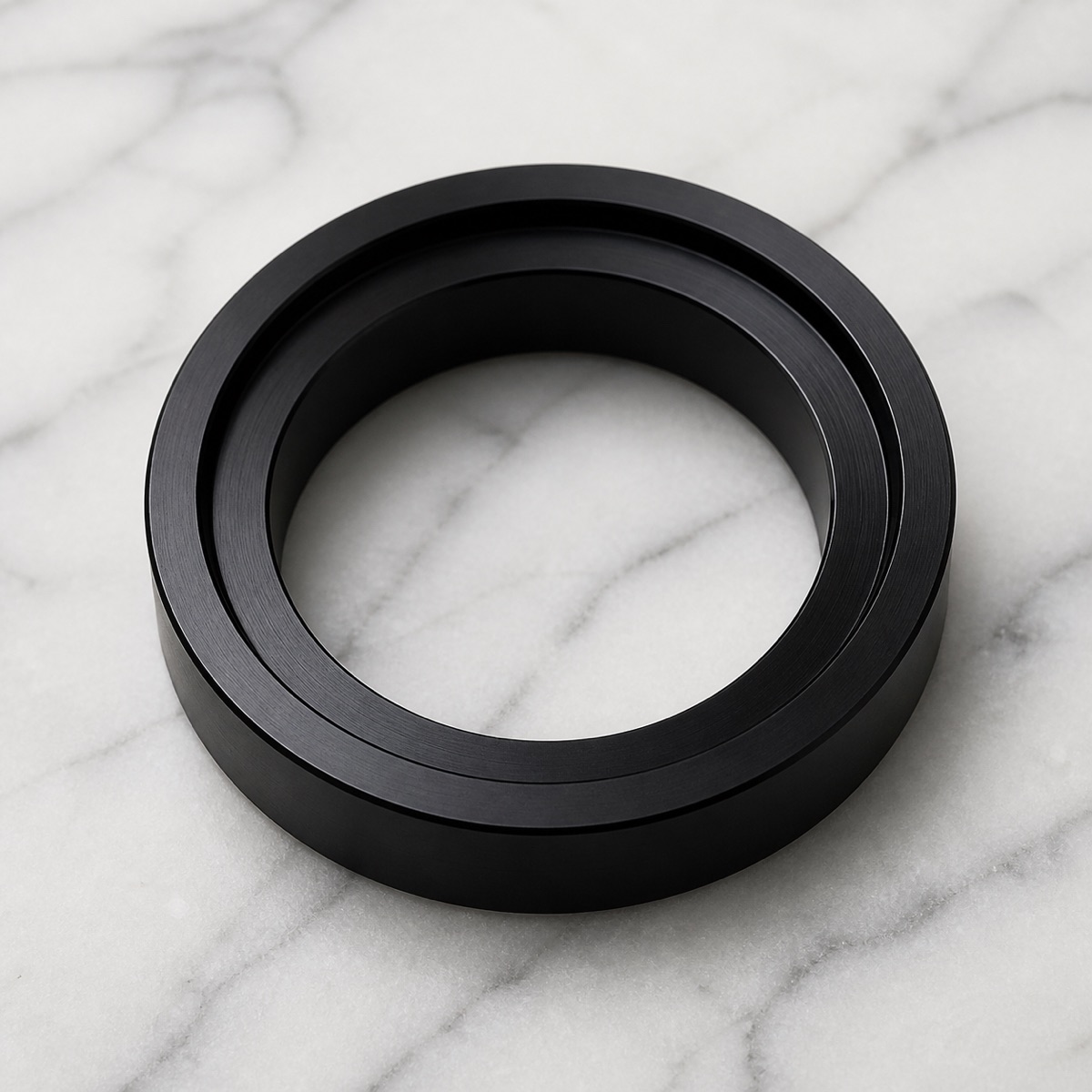
A joint spacer washer is easy to overlook in a robot assembly because it is small and visually simple. In practice, its inner diameter, outer diameter, end faces and step groove can influence assembly clearance, axial location and contact between rotating components.
This part was made from 6061-T6 aluminum alloy and delivered with black anodizing. OEMach reviewed it as a functional joint spacer, limit ring or clamping washer, where consistency matters more than the apparent simplicity of the shape.
Project Snapshot
| Item | Project detail |
|---|---|
| Application | Humanoid robot joint spacer, locating washer or axial clamping ring |
| Material and finish | 6061-T6 aluminum alloy with black anodizing |
| Key features | Central bore, outside diameter, end-face step, local groove and black surface |
| Process focus | Turning efficiency, ID/OD concentricity, face parallelism, step depth, burr control and finish consistency |
| Inspection focus | Bore size, OD size, concentricity, face parallelism, step depth, groove width, chamfers and black anodized appearance |
| Delivery focus | Clean handling and separated packaging to avoid surface rubbing |
Small Washers Can Create Real Assembly Problems
Washer-type parts are suitable for turning or turn-mill machining, but batch variation often appears in face parallelism, ID/OD concentricity and step depth. If clamping is optimized only for speed, small face dents or slight bore eccentricity may be transferred directly into the final assembly.
The effective contact area also matters. Hole-mouth and end-face chamfers should remove burrs cleanly, but excessive chamfering can reduce the surface that supports the joint stack.
Black anodized rings are sensitive to rubbing. Parts that pass dimensional inspection can still fail the customer's appearance expectation if they are stacked or handled without separation.
OEMach Process Method
OEMach usually stabilizes the inner bore and end-face datum first, then finishes the outside diameter, step and groove. For batch production, tool life and process sampling are used to control drift before final inspection becomes a sorting step.
Deburring, cleaning and appearance precheck are completed before anodizing. After anodizing, the bore, end face and step position are reviewed again to confirm there are no obvious knocks, bright edges or residue on the black surface.
Inspection Focus
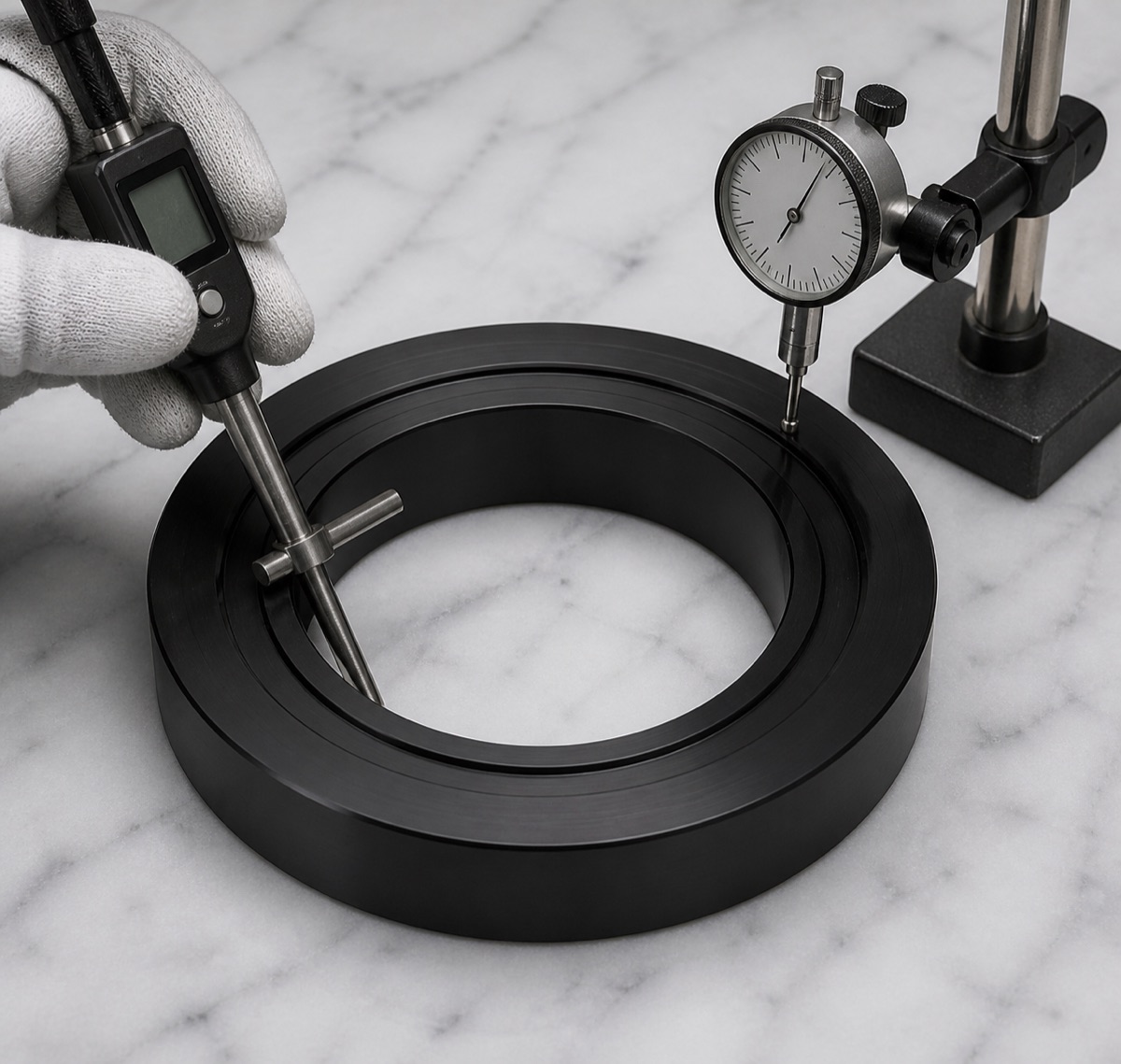
First-article inspection should cover inner bore diameter, outside diameter, concentricity, face parallelism, step depth, groove width, chamfers and black anodized appearance.
For washer-type robot components, end-face condition often affects assembly more than the outline dimension alone. A washer with uneven faces can change axial stack-up or create a rough feel in rotating assemblies.
During small-batch work, OEMach pays attention to cleaning, handling and intermediate storage, because surface scratches are often created after the part has already passed the machining stage.
Lead Time and Delivery
For a 6061-T6 black anodized joint spacer washer like this, prototype lead time is usually evaluated around 4 to 6 working days. Small batches can often be planned around 6 to 10 working days, depending on quantity, appearance grade and packaging requirements.
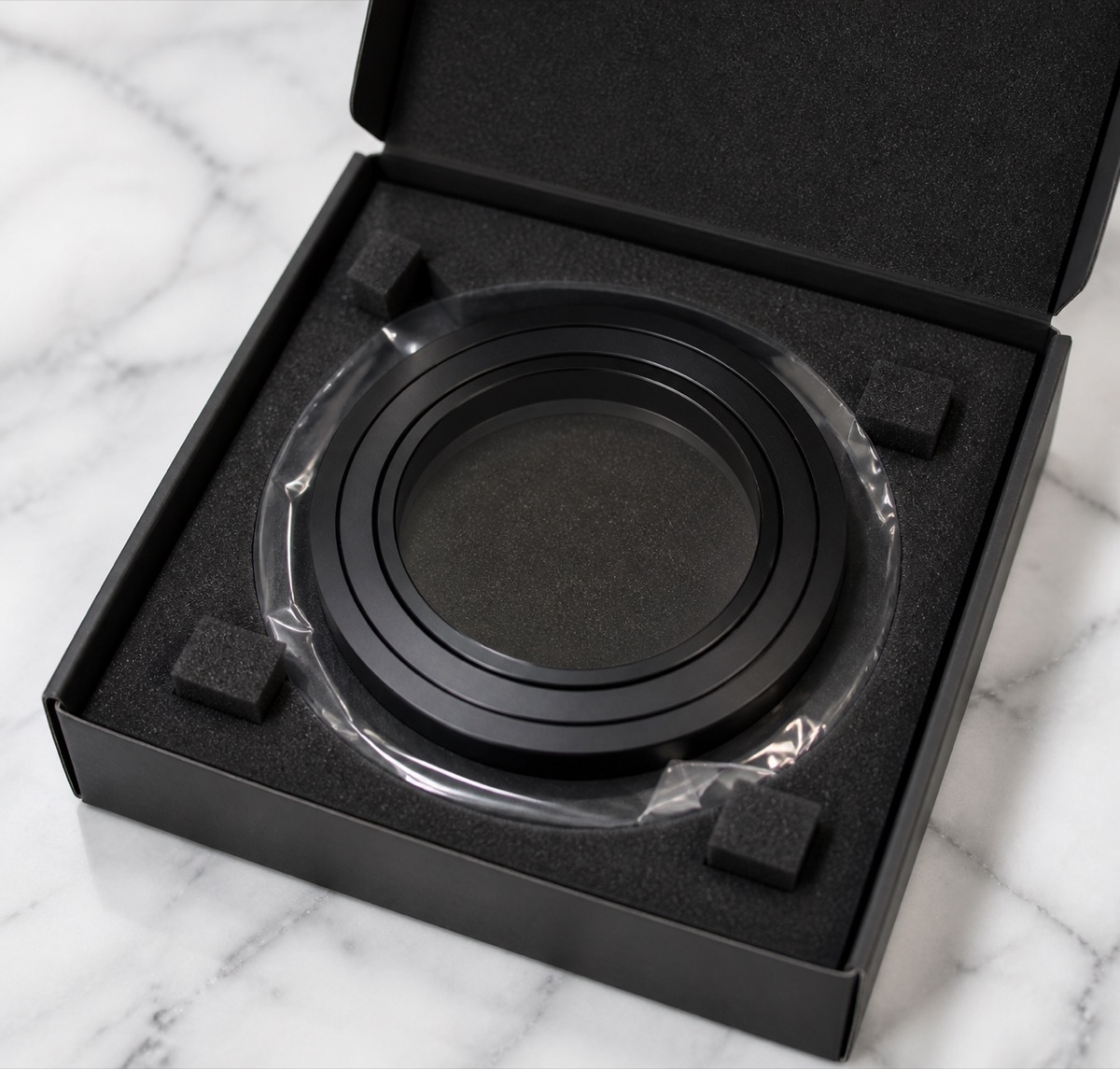
Separated or single-layer packaging is recommended so the rings do not rub against each other. OEMach treats packaging as part of black appearance control, not simply as the last shipping step.
Case Takeaway
This small part shows why robot component machining is not only about complex housings and brackets. Many assembly problems come from washers, retaining rings and spacers whose end faces, concentricity and surface protection were not controlled as a system.
FAQ
Why is a robot joint spacer washer important?
It controls local spacing, axial location and contact between joint components, so small errors can affect assembly feel and clearance.
What dimensions are most important on this washer?
ID/OD concentricity, face parallelism, step depth, groove width and chamfer condition are key.
Why does end-face condition matter?
Uneven end faces can change axial stack-up, reduce stable contact or create rough movement in rotating assemblies.
How should black anodized washers be packaged?
Use separated or single-layer packaging so the rings do not rub and create bright marks or scratches.
Can OEMach handle small precision washer batches?
Yes. OEMach supports prototype and small-batch 6061-T6 washers, spacer rings and retaining rings with inspection and protected delivery.
Ready to get a quote for your CNC machined parts?
Submit your engineering drawings to qiancj@oemach.com. We support prototype sampling and small-batch production with strict tolerance control.