
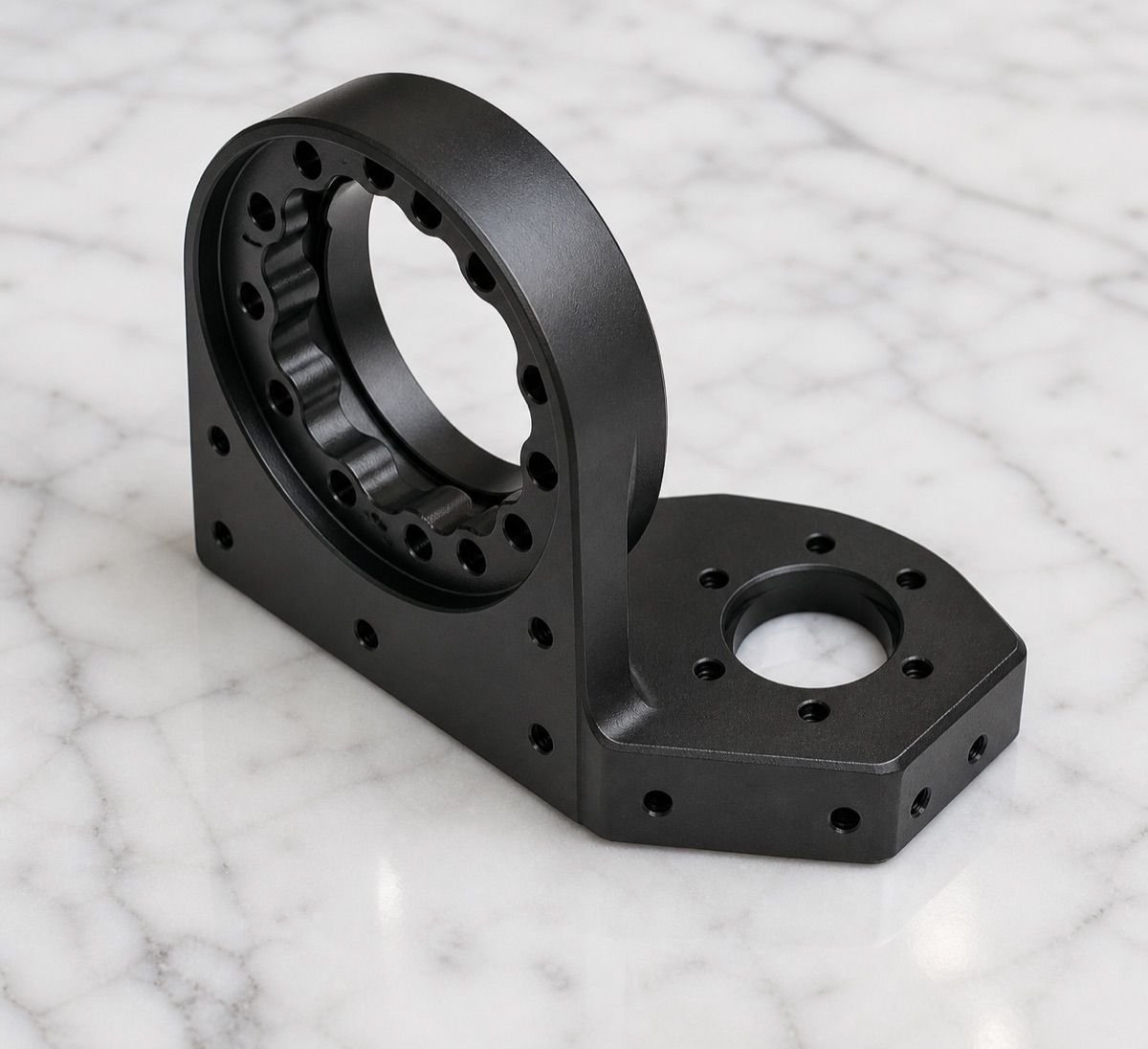
This thigh adapter is a typical transition bracket in a humanoid robot lower-limb structure. One side contains a vertical ring and circular hole pattern, while the other side provides the base mounting area. The part must stay lightweight while keeping the perpendicular and positional relationship between the two assembly datums under control.
For this case, OEMach reviewed the part as a multi-datum robot bracket, not just a milled aluminum support. The vertical ring axis, base mounting face and hole pattern all affect how the customer locates the part during joint assembly.
Project Snapshot
| Item | Project detail |
|---|---|
| Application | Humanoid robot lower-limb transition bracket / precision CNC structure |
| Material and finish | 6061-T6 aluminum alloy with black anodizing |
| Key features | Vertical ring, circular hole array, base mounting holes, local bosses and weight-reduction pockets |
| Process focus | Base datum, vertical ring axis, hole-position relationship, perpendicularity, burr control and anodized appearance |
| Inspection focus | Ring bore, circular hole array, base hole locations, bottom-face flatness, perpendicularity between ring and base, chamfers and black surface consistency |
| Delivery focus | Machining, anodizing, post-finish reinspection and protected packaging managed as one delivery chain |
Why the Vertical Ring Makes the Part Harder
A vertical ring introduces a clear height difference. After roughing removes material, local rigidity around the upright section drops, and insufficient support can create slight vibration during finishing. That vibration may show up as poor bore finish, uneven end-face marks or visual defects after anodizing.
The base hole pattern and the circular ring holes also sit in different directions. Each extra datum transfer can add error, so the machining plan needs a controlled datum chain between the mounting base and the vertical ring axis.
Black anodizing raises the visual standard. Small burrs, bright edges and clamping marks that might be tolerated on a natural machined surface become much easier to see on a black bracket.
OEMach Process Arrangement
OEMach first defined the datum relationship between the base mounting face and the vertical ring axis. Roughing was staged to avoid removing too much support too early, and finishing allowance was left on key faces until the structure became stable.
The ring bore, end face and circular hole array were finished after the main structure was stabilized. The base hole pattern was kept under a consistent locating state as far as practical, reducing accumulated error caused by repeated flipping.
Before anodizing, the part received full-edge chamfering, hole cleaning and appearance precheck. After anodizing, key holes, contact faces and black surface consistency were reviewed again.
Inspection and Batch Control
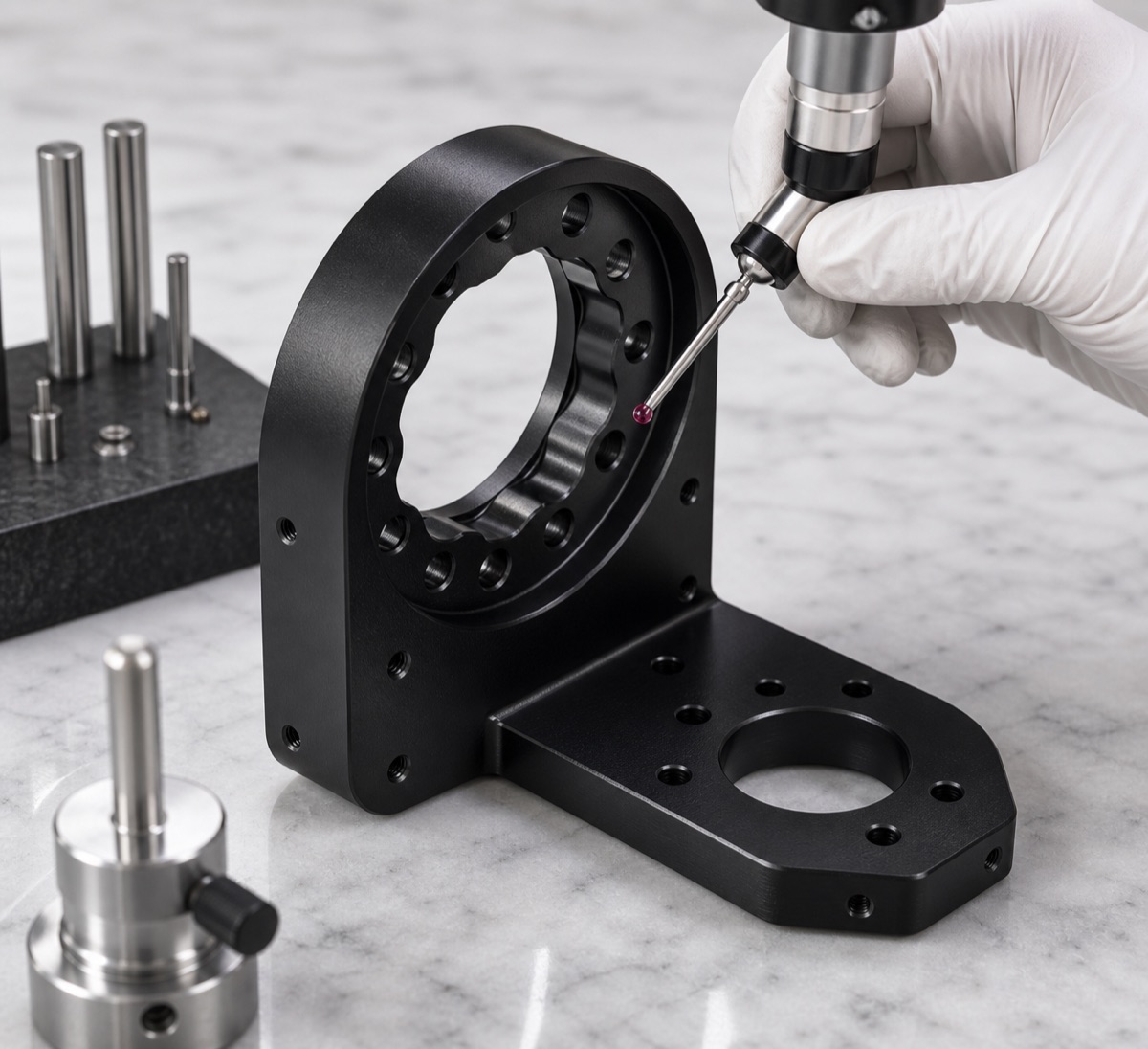
First-article inspection should include the ring bore, circular hole array, base hole positions, bottom-face flatness, perpendicularity between the upright ring and base, hole-mouth chamfers and black anodized appearance.
For a transition bracket, measuring each hole separately is not enough. The hole pattern must be checked together with the datum face and ring axis so the assembled robot joint does not inherit a small angular or positional error.
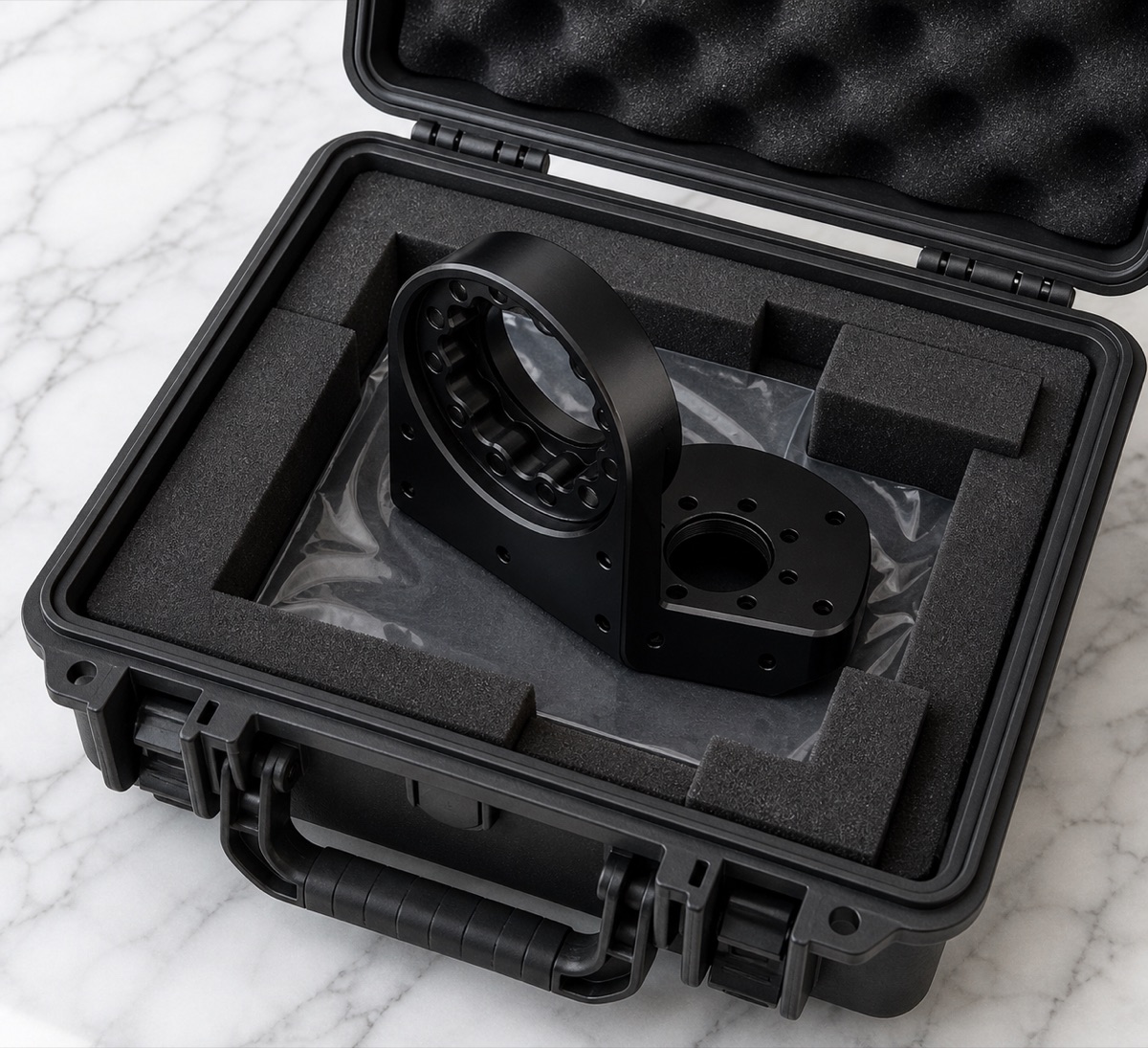
During small-batch production, OEMach tracks cutter marks around the ring, hole-mouth condition and base clamping repeatability. Before packaging, the team checks residual chips and surface knocks to avoid rework before the customer trial assembly.
Lead Time and Packaging
For a 6061-T6 black anodized thigh adapter of this complexity, prototype lead time is usually evaluated around 7 to 10 working days. Small batches can often be planned around 10 to 15 working days, depending on inspection report depth and any assembly-gauge verification.
Delivery planning should not stop at machining completion. Machining, anodizing, post-finish inspection and packaging protection need to be treated as continuous steps, especially for a black bracket with an upright ring.
Case Takeaway
The core of this case is controlling the vertical ring, base hole pattern and surface treatment in one process plan. The more complex a black anodized robot bracket becomes, the earlier fixturing, inspection and packaging should be planned.
FAQ
What is critical in humanoid robot thigh adapter machining?
The vertical ring axis, base mounting face, hole pattern relationship, perpendicularity and anodized surface consistency are the key control points.
Why is the vertical ring difficult to machine?
The upright structure loses local rigidity after roughing. Without stable support, finishing can create vibration marks, bore-quality issues or visual defects.
Why does black anodizing change the process requirements?
Black anodizing makes burrs, bright edges and clamping marks more visible, so chamfering, cleaning and appearance checks must be completed before finishing.
What should be included in first-article inspection?
Ring bore, circular hole array, base hole locations, bottom-face flatness, perpendicularity, chamfers and anodized appearance should all be checked.
Can OEMach support small-batch humanoid robot brackets?
Yes. OEMach supports prototype and small-batch robot brackets with CNC machining, anodizing coordination, inspection and protected packaging.
Ready to get a quote for your CNC machined parts?
Submit your engineering drawings to qiancj@oemach.com. We support prototype sampling and small-batch production with strict tolerance control.