
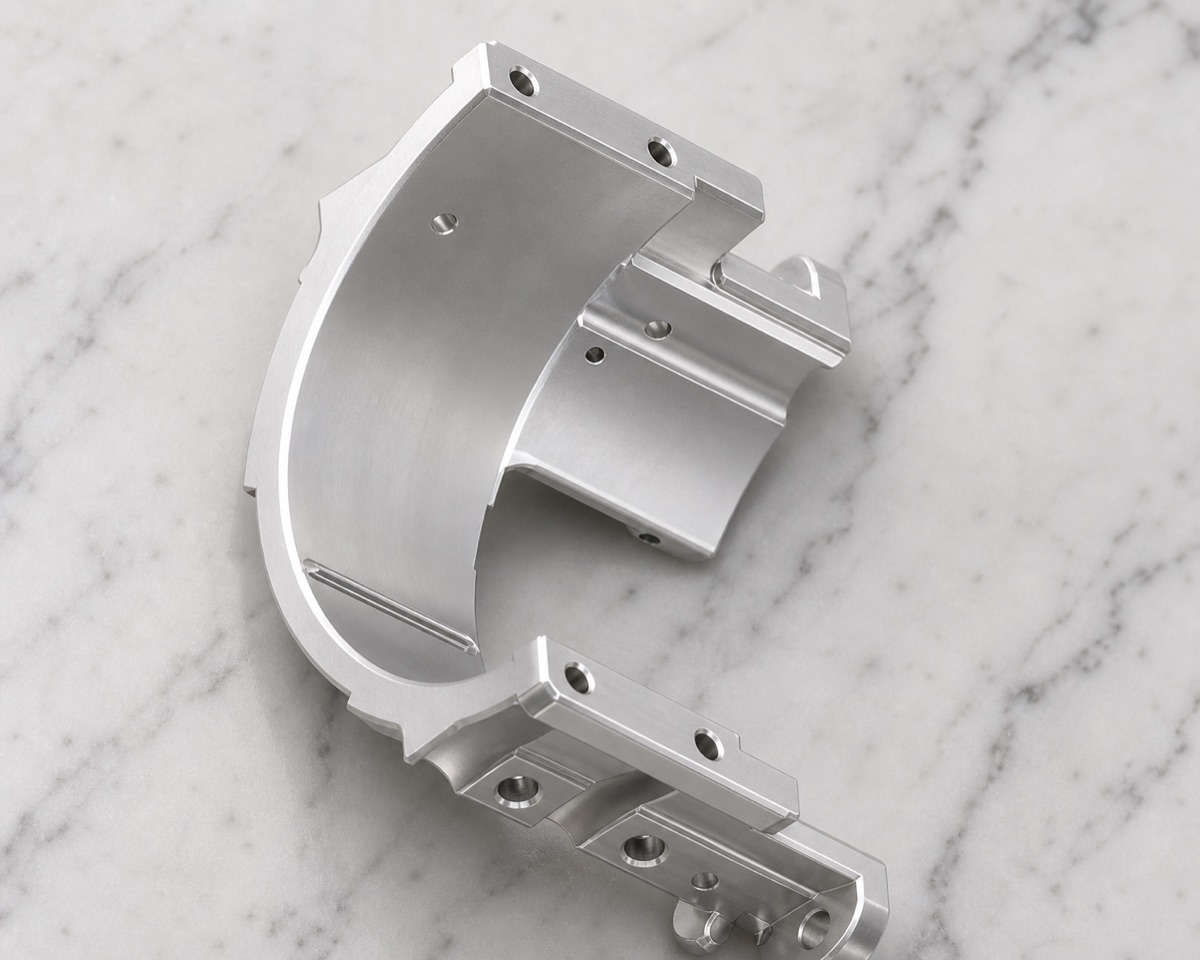
This case covers a 6061-T6 aluminum fixed flange for a robot arm joint. It is not a simple round flange. The part combines a semi-ring housing, mounting ears, stepped faces and multi-directional holes, so the main risks sit in fixturing, curved profile control and datum-hole relationship.
Project Snapshot
| Industry scenario | Robot arm joint components and precision CNC structural parts |
|---|---|
| Material and finish | 6061-T6 aluminum; final surface condition confirmed by project requirement |
| Critical features | Semi-ring curved housing, mounting ears, angled holes, datum holes, side holes and stepped faces |
| Manufacturing focus | Asymmetric clamping, deformation control, curved profile, shared datum plan and protected delivery |
Structure Review: More Sensitive Than a Round Flange
A standard round flange can often be machined around a central datum. This fixed flange is different: the semi-ring body is open, the mounting ears are asymmetric, and the stepped faces and side holes create several functional directions.
In a robot arm joint, this part may support actuator fixing, housing connection or spatial clearance. OEMach first identifies which holes act as assembly datums and which curved surfaces or steps influence contact.
Main Risk: Open Structure, Clamping and Deformation
The semi-ring structure is sensitive to clamping force, especially near the open ends and mounting ears. Excessive clamping can slightly distort the curved profile, while weak clamping can cause vibration during hole and step finishing.
Multi-directional holes add another layer of risk. Holes on mounting ears, side holes and holes near the curved body must share a stable datum plan; otherwise, the holes may align individually while the contact faces load unevenly during assembly.
OEMach Manufacturing Solution
OEMach first builds the relationship between the semi-ring curved surface, main mounting face and datum holes. Rough machining retains enough support stock so the open area does not lose stiffness too early.
During finishing, mounting-ear hole position, stepped faces, side holes and curved profile are controlled together. Where needed, process support, staged unclamping and remeasurement are used to reduce residual stress and clamping deformation. Hole-mouth chamfers and edge cleaning cover the inner arc, outer arc and step transitions.
Inspection Focus
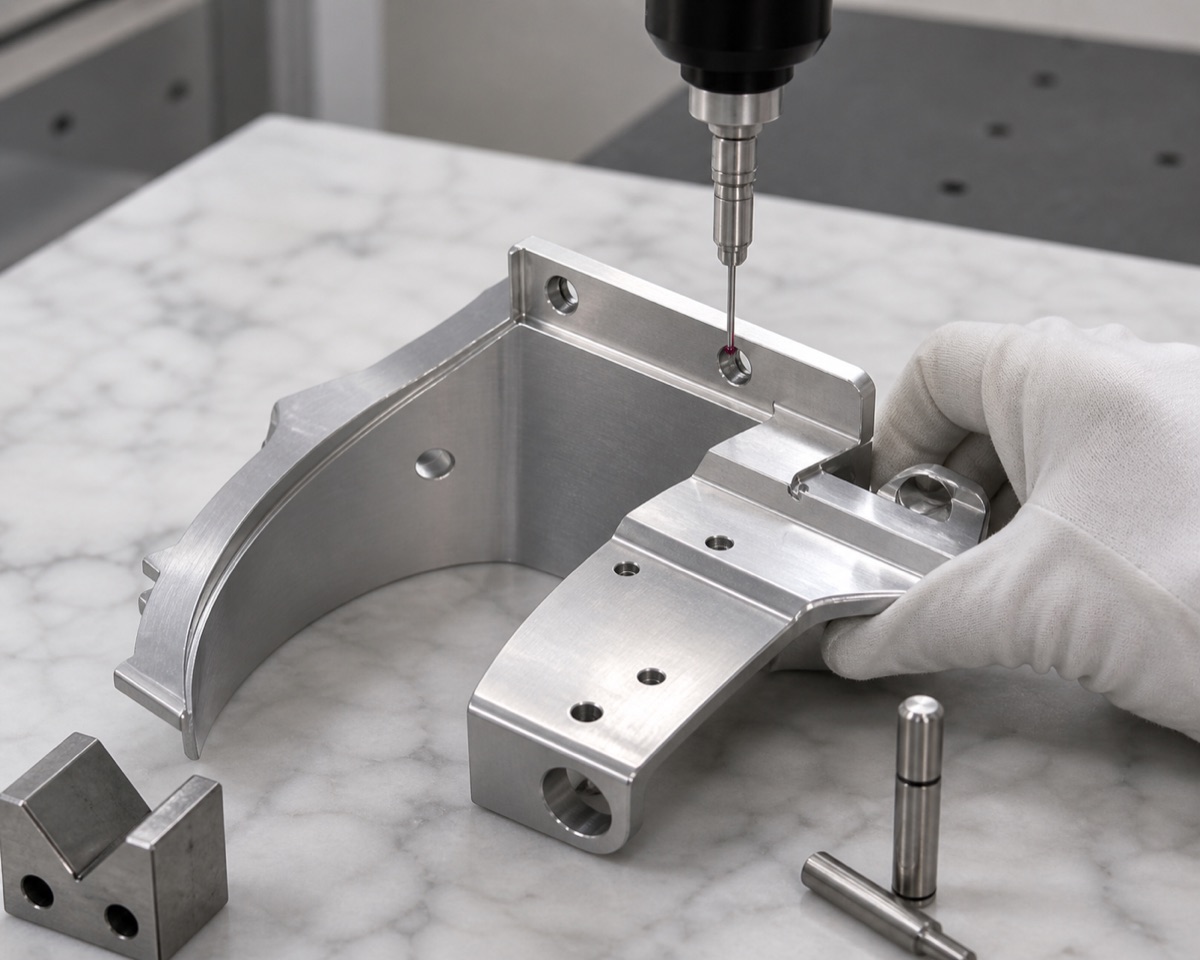
First-article inspection should cover the semi-ring curved profile, mounting-ear holes, datum holes, stepped faces, side holes, angular relationships, chamfers and surface condition. For a fixed flange, the relative relationship between the curved body and hole system determines assembly fit.
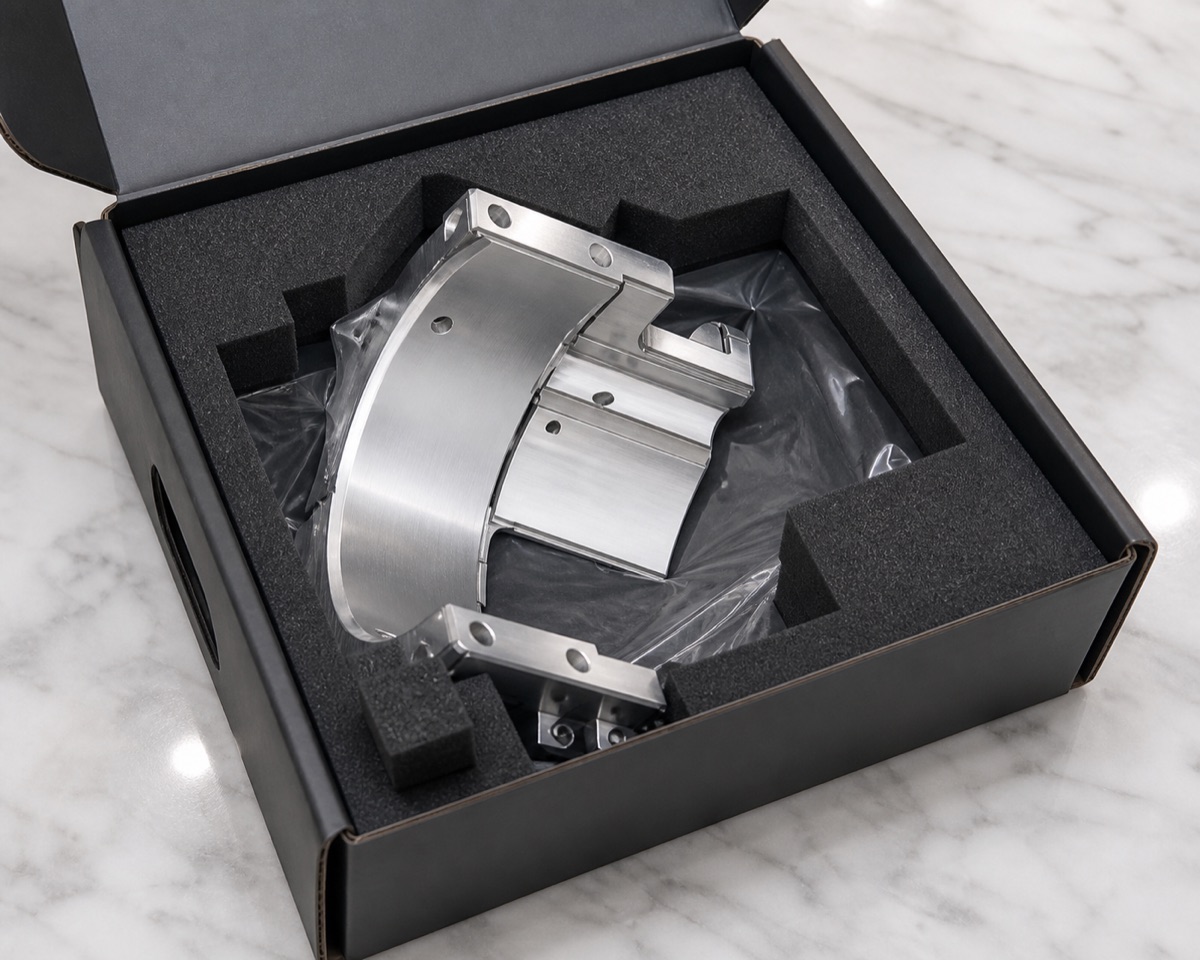
During production, OEMach watches deformation in the open area, the effect of tool wear on hole mouths and datum repeatability after multi-directional setups. Before packaging, the inner arc, hole mouths and step faces are checked for dents, burrs and pressure marks.
Lead Time and Delivery Control
For a 6061-T6 robot arm joint fixed flange like this, prototypes are commonly evaluated around 6 to 9 working days. Small batches are often planned around 9 to 14 working days. Surface treatment, full inspection or fixture-based assembly verification can extend the schedule.
OEMach manages roughing, stress-movement observation, finishing, reinspection and packaging as separate process gates. For a complex flange, delivery quality comes from absorbing datum and appearance risks before shipment.
Delivery Takeaway
This case shows OEMach's engineering approach to complex robot structural parts. The value is not only finishing the external shape, but managing clamping, hole systems, curved surfaces, reinspection and packaging as one delivery chain.
FAQ
How is a semi-ring flange different from a normal round flange?
The open and asymmetric structure makes clamping deformation and multi-directional hole relationships harder to control.
Why are mounting-ear holes important?
They directly affect the locked posture of the fixed flange and how the joint contact surfaces sit during assembly.
Why reserve time for reinspection in prototype delivery?
Complex flanges include curved surfaces, steps and holes in several directions. Reinspection helps reduce assembly risk.
Ready to get a quote for your CNC machined parts?
Submit your engineering drawings to qiancj@oemach.com. We support prototype sampling and small-batch production with strict tolerance control.