
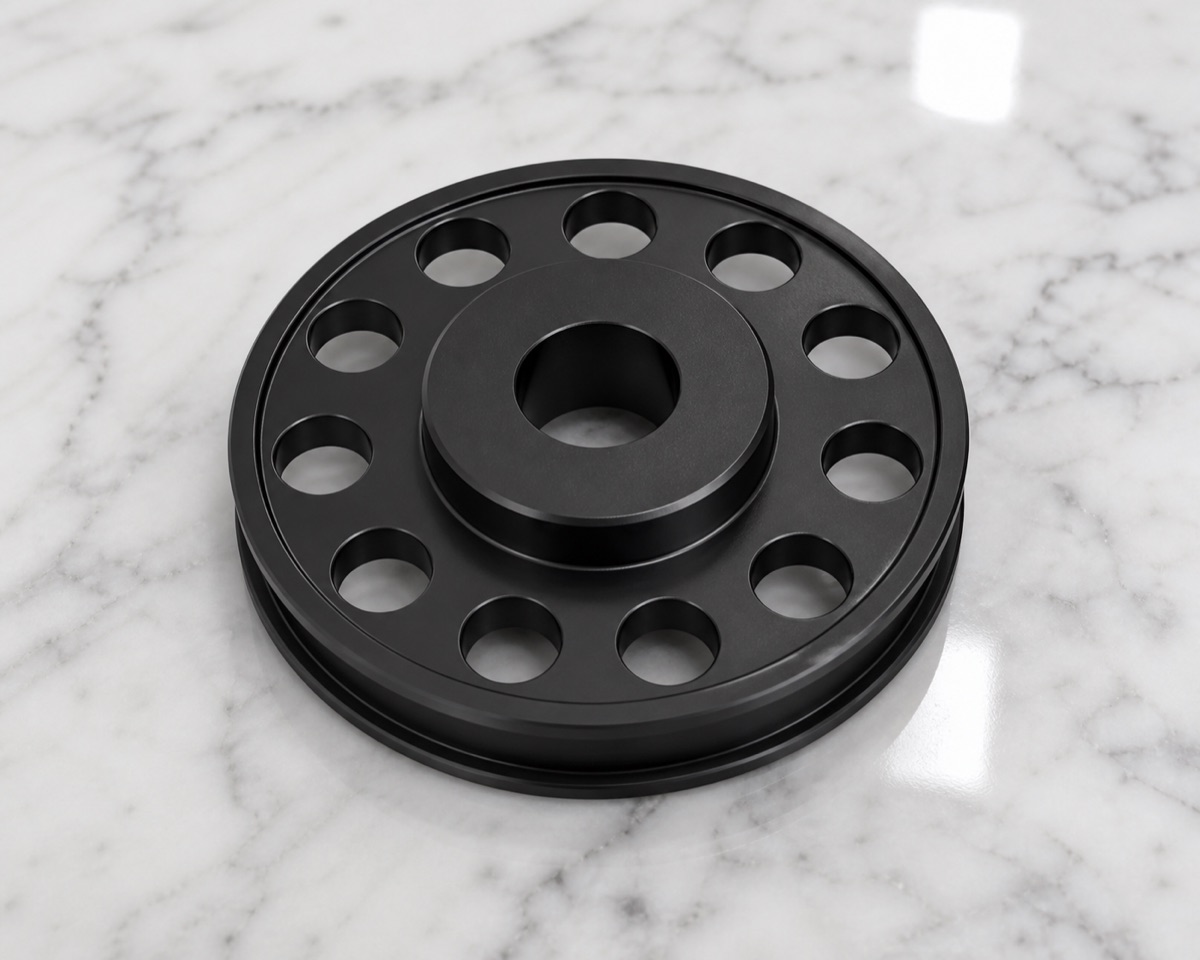
This case covers a black anodized disc-style ankle swing arm for a humanoid robot. The part looks simpler than a long bracket, but the center bore, raised center step, circular hole array and thin outside edge directly influence ankle joint assembly.
Project Snapshot
| Industry scenario | Humanoid robot components and precision CNC structural parts |
|---|---|
| Material and finish | Material confirmed by the project BOM; black anodized delivery condition |
| Critical features | Center bore, raised step, face runout, circular hole array, outside diameter and thin edge condition |
| Manufacturing focus | Center-datum strategy, angular spacing, hole-mouth deburring, anodizing preparation and edge protection |
Structure Review: The Key Is Concentric Relationship
The disc-style swing arm includes a central bore, a raised step, evenly distributed circular holes and a relatively thin outside edge. In the ankle joint, it may support rotation, swing or connection functions.
OEMach reviews this geometry as one relationship system. The center bore, end face, outside diameter and circular hole array should not be treated as isolated dimensions, because their relative relationship affects locking consistency and assembly behavior.
Challenge 1: Center Bore and Face Runout
The center bore is usually the primary datum on this type of disc component. Bore diameter, roundness, bore-wall finish and the raised step face can all influence rotational or swing stability after assembly.
If face runout is not controlled, the bore may pass diameter inspection while the assembled joint still shows wobble or uneven loading. The thin outer edge also needs careful handling because black anodizing makes edge damage more visible.
Challenge 2: Circular Hole Array and Hole-Mouth Appearance
The circular hole array requires stable angular distribution, pitch relationship and chamfer consistency. Dense hole arrays are sensitive to tool wear, eccentric clamping and accumulated indexing error.
Black anodizing is also sensitive to burrs. If burrs remain at the hole mouths, the finished part may show bright edges, residue or scratches during assembly. Deburring and cleaning need to be completed before surface treatment.
OEMach Manufacturing Solution
OEMach first establishes the datum relationship between the center bore and end face, then arranges outside diameter, circular holes and step machining around that datum. During finishing, tool runout and clamping repeatability are controlled to reduce relative error between the center bore and hole array.
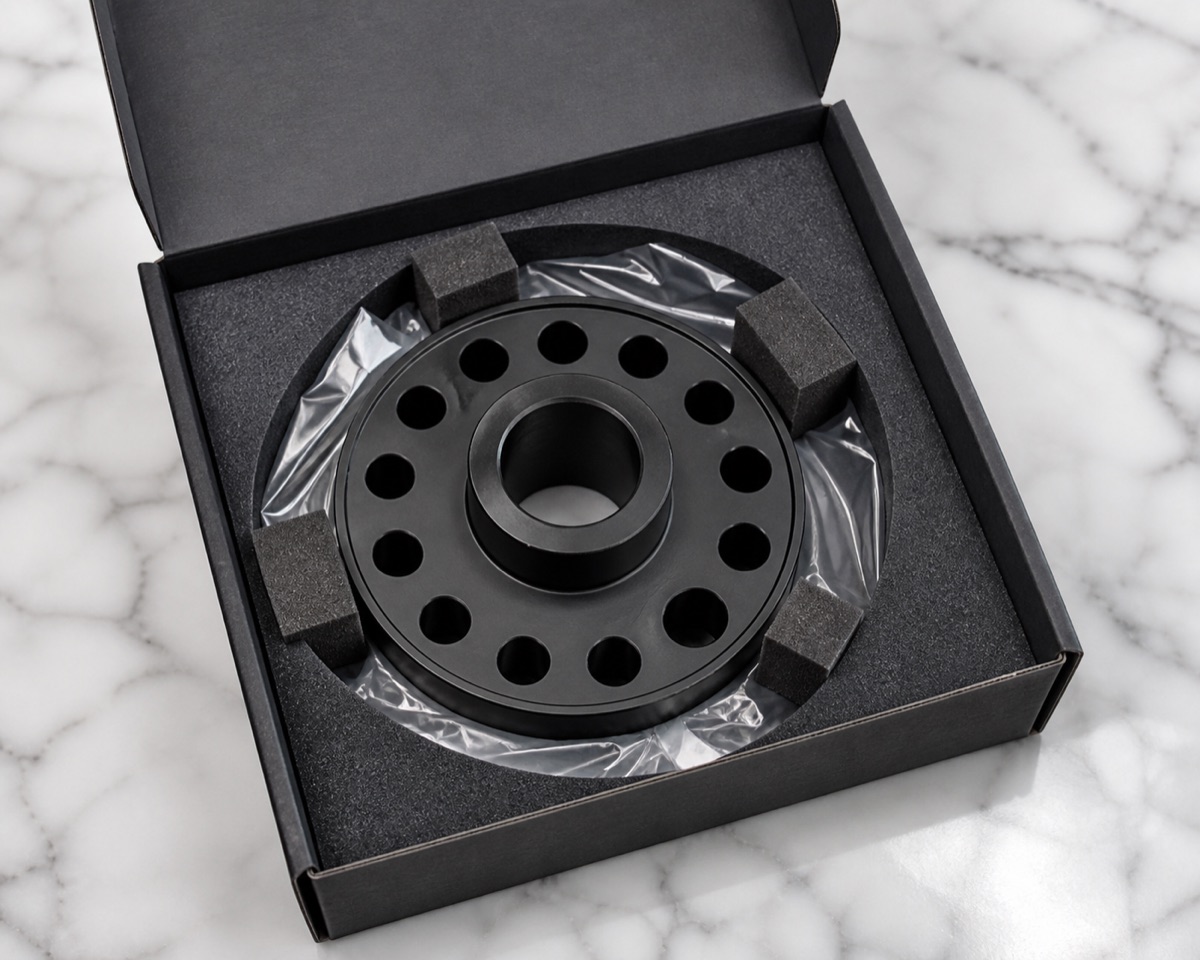
The hole array is machined under stable workholding as much as possible, with consistent hole-mouth chamfers. Before anodizing, the part is cleaned and edge-protected. After anodizing, OEMach rechecks center bore condition, face state, hole array and visual appearance.
Inspection and Lead-Time Planning
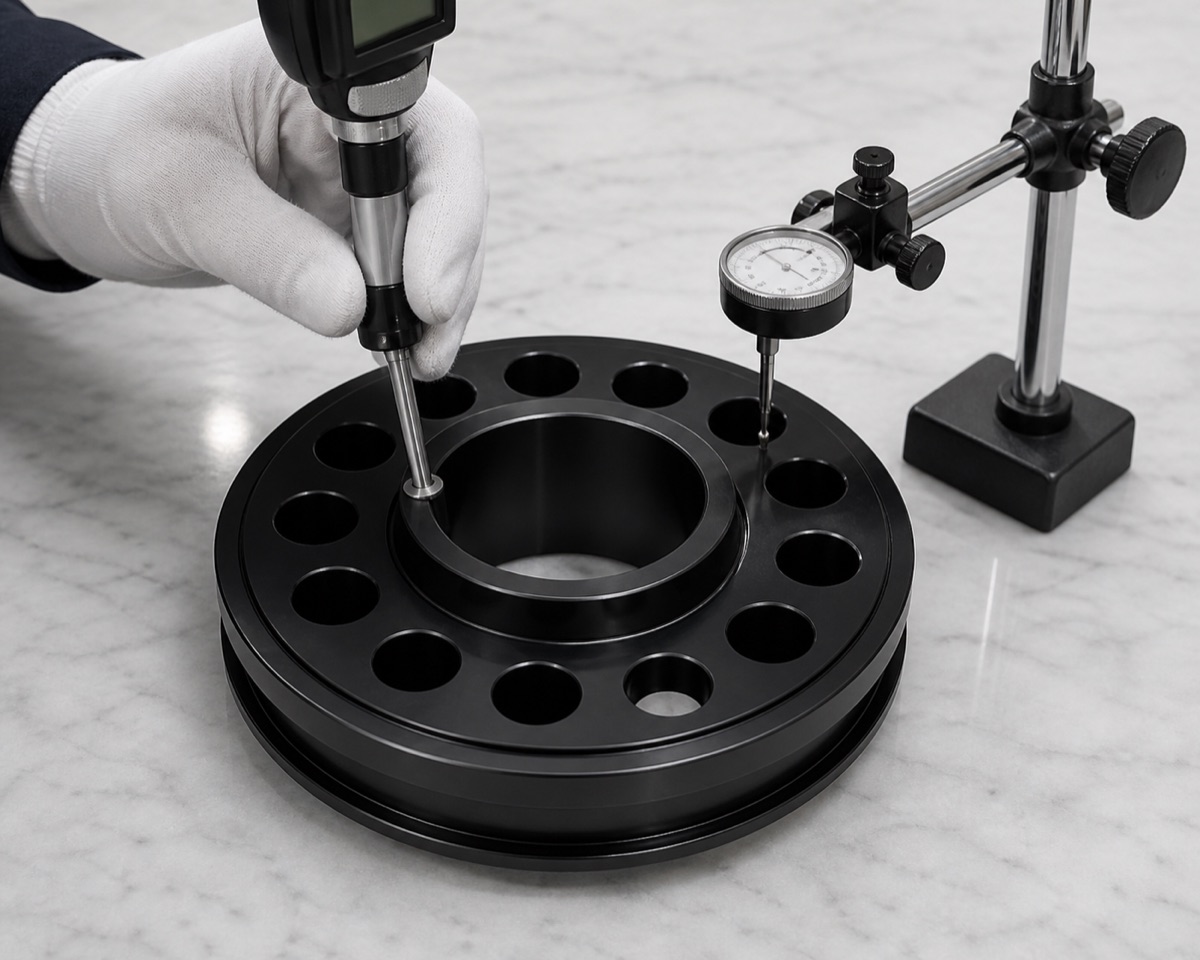
First-article inspection should include center bore size, raised-step face, outside diameter, circular hole-array indexing, face runout, chamfer condition and black anodized appearance. During small-batch production, tool life and bore-size trend should also be tracked.
For a disc swing arm like this, prototypes are commonly evaluated around 5 to 8 working days. Small batches are often planned around 8 to 13 working days. If the customer requires full inspection for face runout or hole-array indexing, inspection time should be scheduled separately.
Delivery Takeaway
This case shows OEMach's control logic for disc-type robot parts: center datum, hole array, end face and black anodized appearance must be closed as one process. That reduces uncertainty when the customer moves into ankle-joint assembly validation.
FAQ
Why inspect face runout on a disc ankle swing arm?
Face condition can affect rotational or swing stability after assembly, even when the center bore diameter is within tolerance.
What problems are common in circular hole arrays?
Indexing error, hole-mouth burrs and bore-size drift from tool wear are the main issues to monitor.
Can process review start before material is fully confirmed?
Yes, structural and risk review can start, but production and quotation should confirm the project BOM, drawing material and finish before cutting material.
Ready to get a quote for your CNC machined parts?
Submit your engineering drawings to qiancj@oemach.com. We support prototype sampling and small-batch production with strict tolerance control.