
A case study on machining a compact TC4 titanium ankle link with short-distance dual bearing bores, hot-fit features, polished finish and repeatable inspection control.
A short ankle link for a humanoid robot is more compact than a long link, but the machining risk does not disappear. The part still uses TC4 titanium, polished delivery and bearing bores at both ends. Because the center distance is shorter and the local small hole sits closer to the functional area, process control must focus on the complete bore relationship.
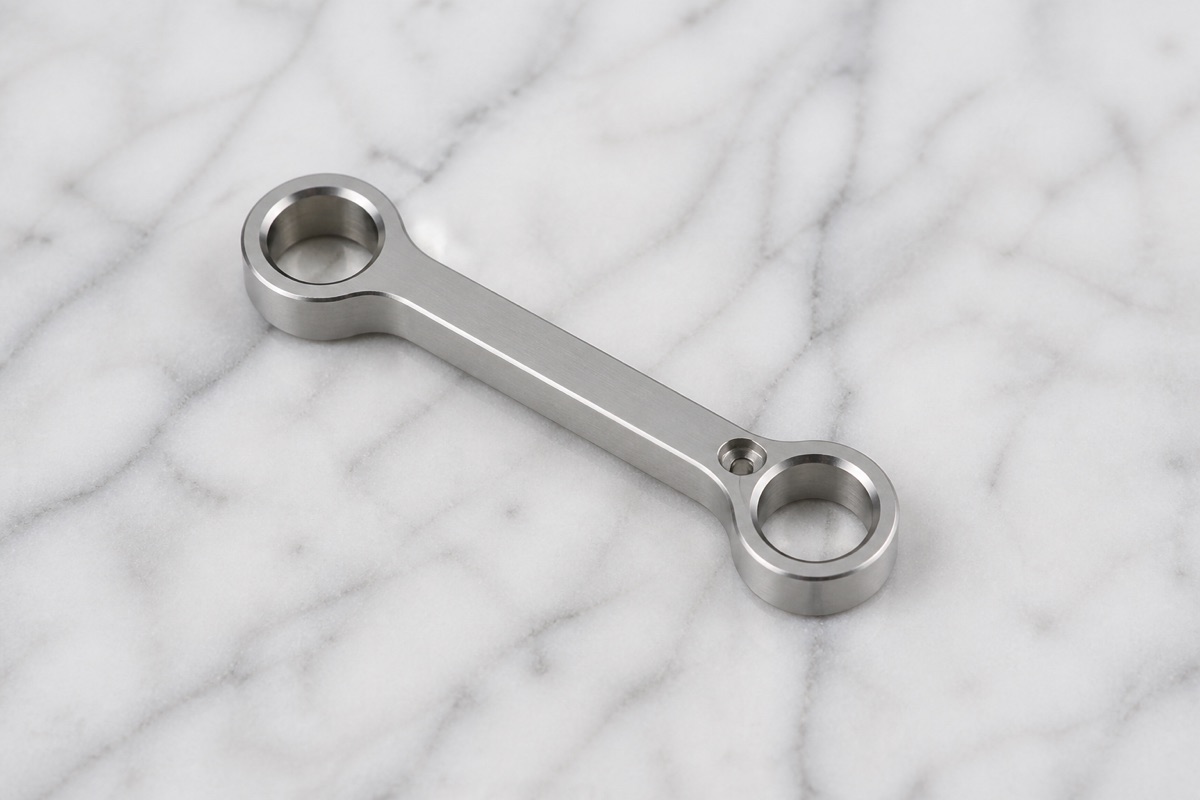
This case covers a compact TC4 titanium ankle link with a short bar body, circular bearing structures at both ends, one small local hole and a polished metal finish. OEMach treated it as a short-distance motion link with hot-fit bearing features rather than as a simple profile part.
Project Snapshot
| Item | Project detail |
|---|---|
| Part type | Short ankle link for a humanoid robot ankle mechanism |
| Material | TC4 titanium alloy |
| Structure | Compact bar body, dual end bearing bores, local small hole, transition ear and polished surfaces |
| Finish | Polished metallic finish with protected bore mouths and contact areas |
| Process focus | Short-distance bore relationship, hot-fit bearing bores, small-hole position, titanium cutting stability, polishing control and burr removal |
| Inspection focus | Bore size, roundness, bore-mouth chamfer, bore-wall condition, center distance, small-hole position, body thickness, cleanliness and polished appearance |
Why a Short Link Still Needs Tight Bore Control
Compared with a long ankle link, a short link usually has better body stiffness and lower overall bending risk. However, its two bearing bores and small local hole are closer together, so any position error affects assembly more directly.
TC4 titanium still brings the familiar process risks: slow heat dissipation, higher cutting load, faster tool wear and more difficult bore-wall control. These effects are especially important around hot-fit or press-fit bearing bores.
The polished finish improves appearance, but it also requires early protection of bore mouths. If polishing rounds a functional edge too much or leaves fine residue near the bore, assembly can be affected even when the outside appearance looks acceptable.
Machining Challenges
The first challenge is controlling the two bearing bores as a relationship, not as two isolated holes. Diameter, roundness, chamfer and center distance must stay consistent under one datum plan.
The second challenge is the small end hole. Because it is close to the functional bore area, burrs, uneven chamfers or slight positional drift can interfere with fastening or locating features in the ankle assembly.
The third challenge is series consistency. Short and long ankle links may be used in the same mechanism family, so material batch, inspection criteria, bore trends and packaging standards should be managed together.
OEMach Manufacturing Solution
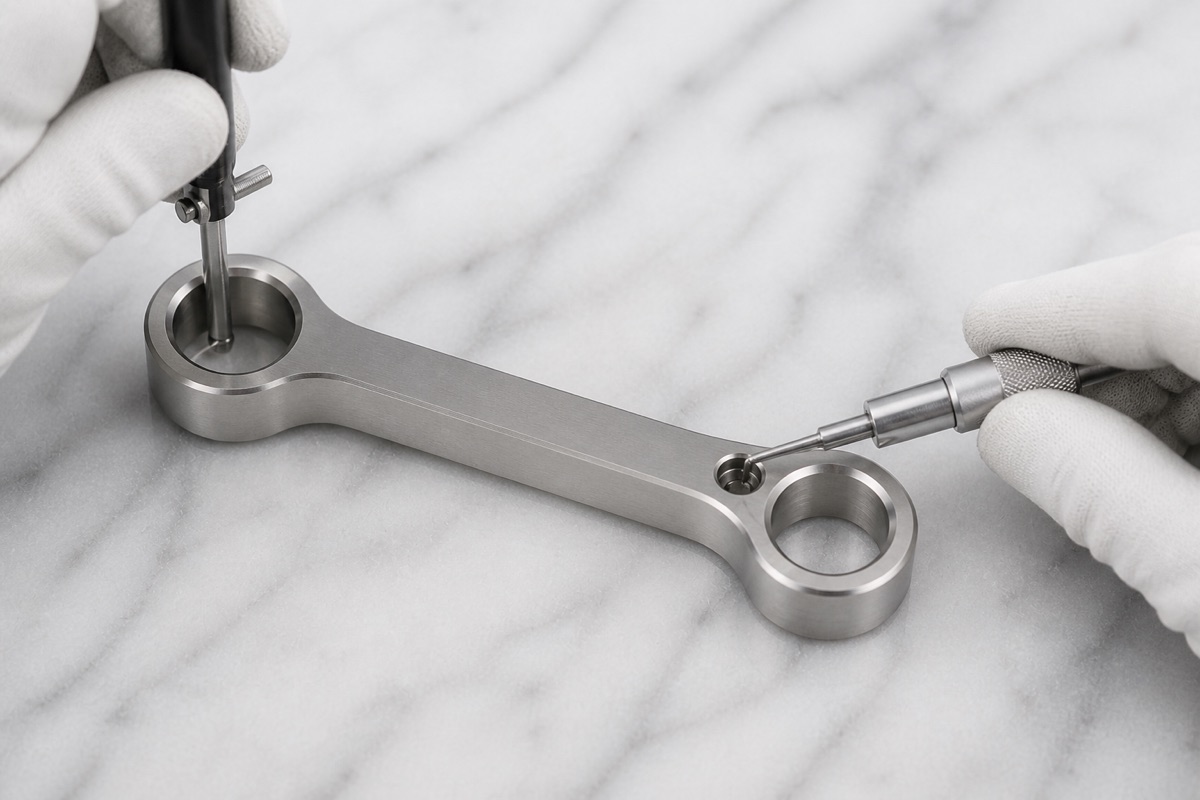
OEMach first confirmed the center relationship of the two bearing bores, then arranged the outer profile, short body and local small hole around that reference. Rough machining controlled heat and tool load, while finishing focused on bore-wall quality and edge condition.
The two end bearing bores were completed under a stable datum setup where possible. The local small hole and transition ear were kept within the same positioning logic to reduce accumulated error.
Before polishing, bore-mouth chamfers and deburring were completed. After polishing, OEMach rechecked both bearing bores, the small hole and visible surfaces so the final finish would not compromise assembly quality.
Inspection and Delivery Control
Inspection should cover both bearing-bore diameters, bore-mouth chamfers, bore-wall condition, center distance, the local small hole, body thickness, polished surface quality and cleanliness. For a series of ankle links in the same mechanism, batch consistency is as important as one-piece accuracy.
At first-article stage, OEMach verifies the critical bore relationship. During small-batch production, tool wear and bore-size trends are tracked so drift can be corrected before it reaches customer assembly.
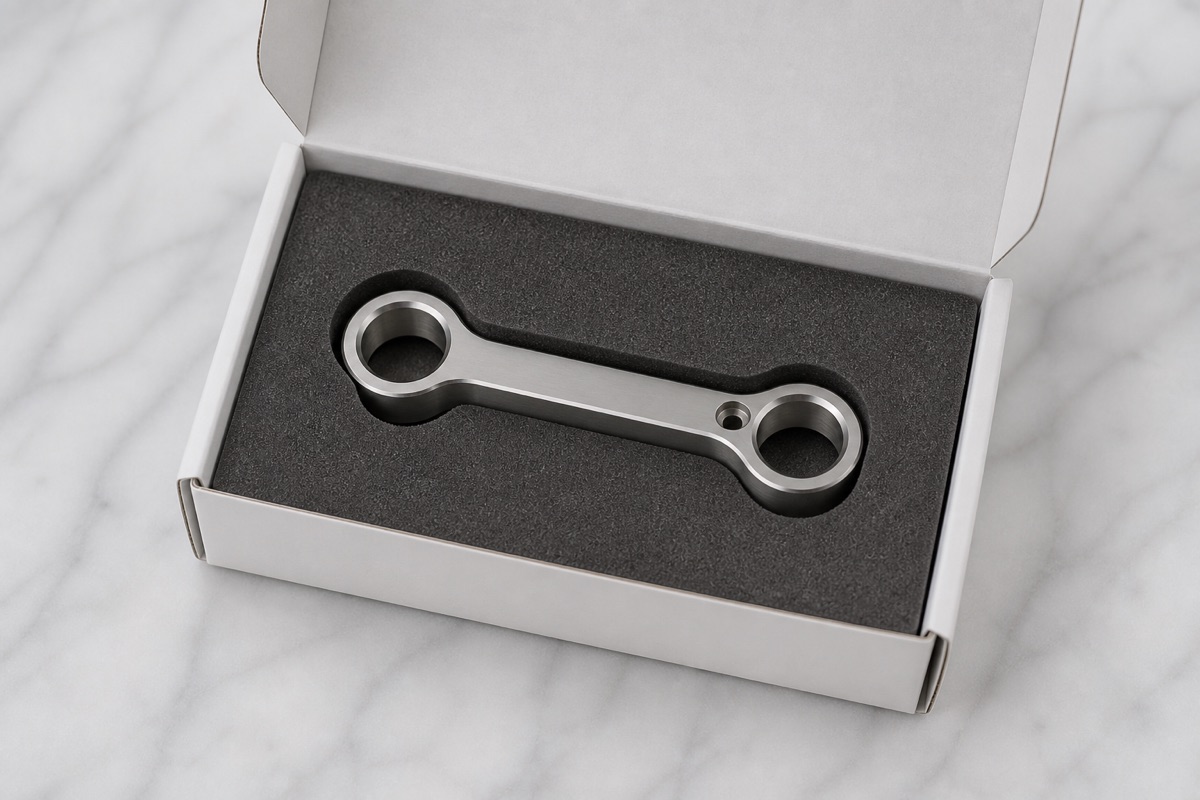
A short polished titanium link should not be shipped loose. Form-fit foam locates both end rings and the body, preventing bore-mouth impact and surface rubbing before incoming inspection or prototype assembly.
Lead-Time Planning
For TC4 short ankle-link prototypes, a practical lead-time estimate is usually around 6 to 9 working days. For small batches, 9 to 14 working days is more realistic when polishing, inspection ratio and packaging are included.
If short and long ankle links are produced as a series, the schedule should consider material batch, polishing queue, inspection plan and packaging method together instead of treating each part as a separate rush order.
FAQ
Is a short ankle link easier to machine than a long link?
Its body stiffness is usually better, but the bore relationship is more concentrated. Hot-fit bores and nearby small holes still require careful control.
Why inspect bore mouths again after polishing?
Polishing can change edge condition or leave fine residue near the bore. Reinspection helps avoid abnormal pressing, fastening or assembly feel.
Can short and long ankle links be delivered as one series?
Yes. It is better to align material batches, inspection standards and packaging methods so the assembly behavior remains consistent.
What matters most for this TC4 titanium link?
The key items are dual-bore size, roundness, center distance, bore-mouth chamfer, small-hole position, polished surface condition and clean packaging.
Ready to get a quote for your CNC machined parts?
Submit your engineering drawings to qiancj@oemach.com. We support prototype sampling and small-batch production with strict tolerance control.