
Summary
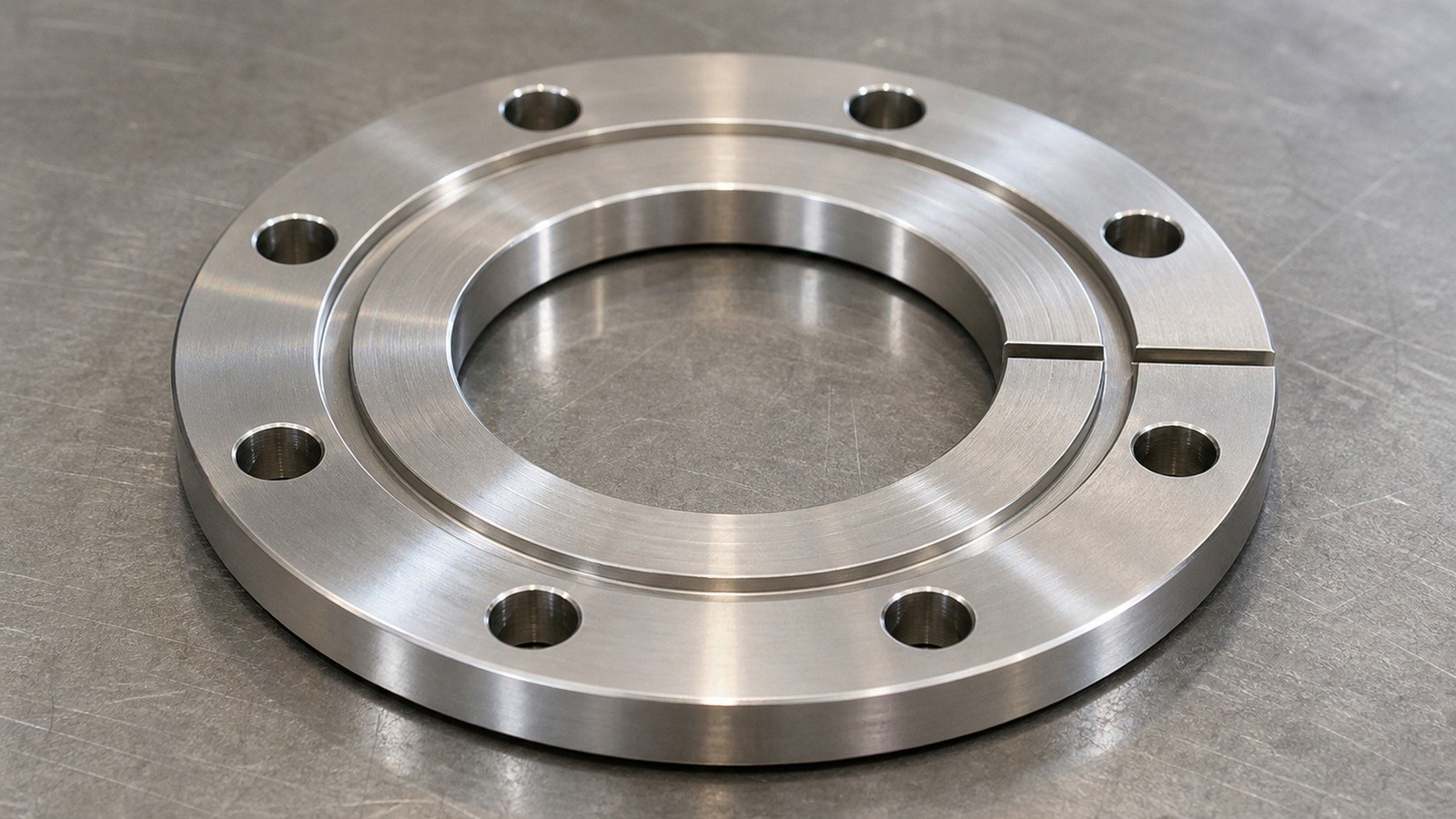
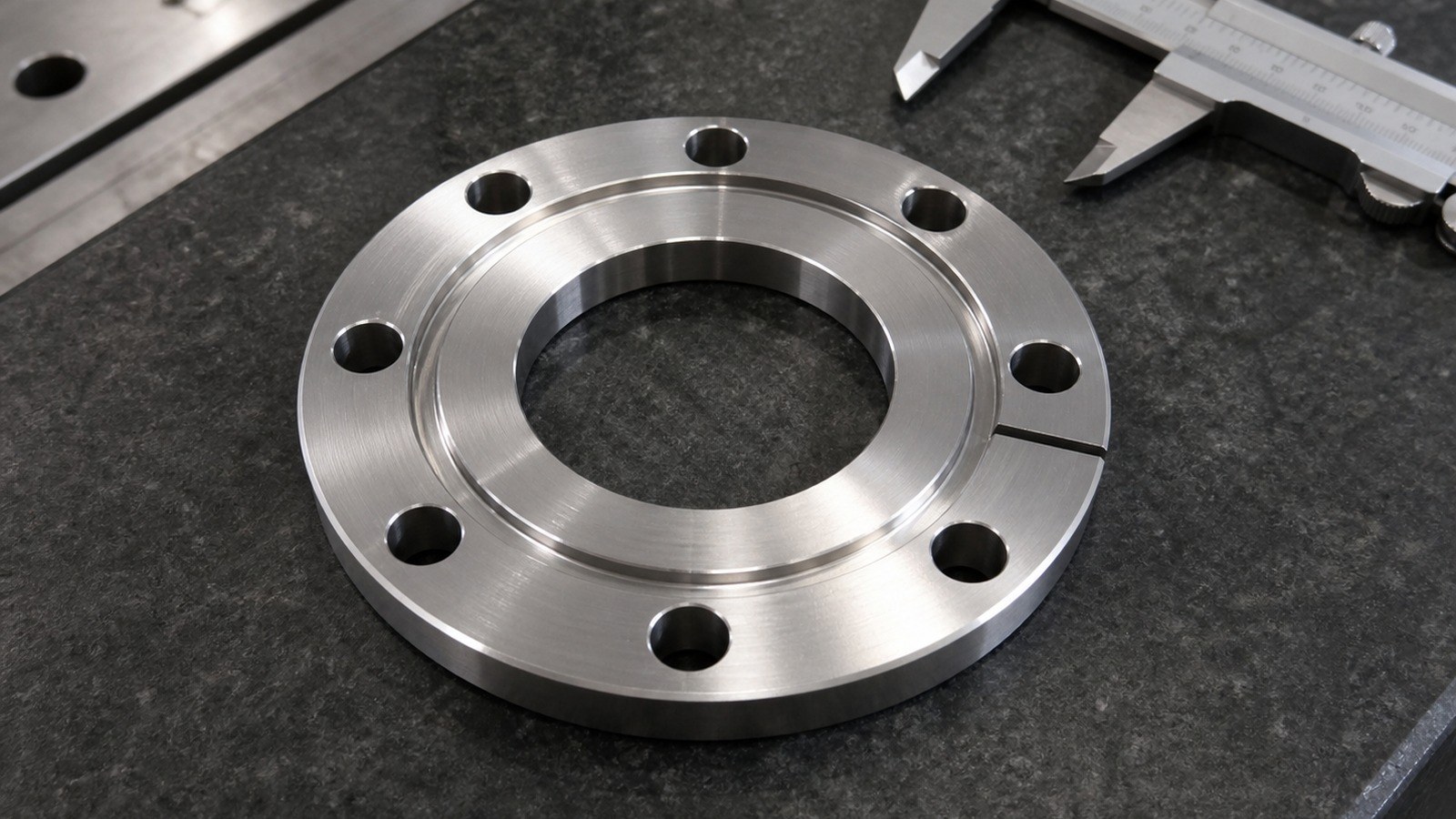
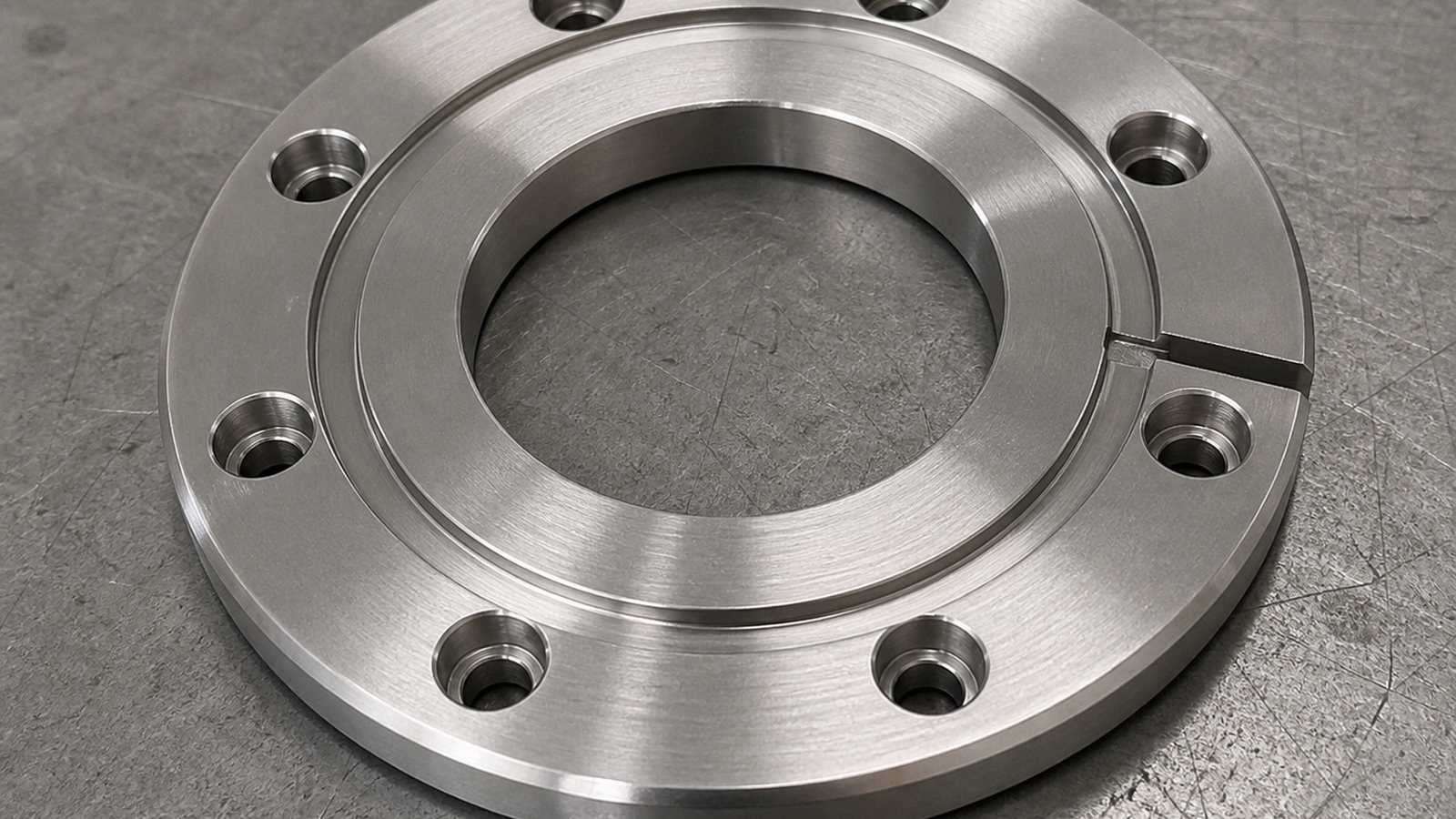
In June 2026, Engineer Zhang reviewed a sanitized prototype inquiry from an automation-equipment customer in Suzhou. Based on the circular profile, through bore, equally spaced bolt holes, annular groove and local tapered surfaces, he classified the part as a stainless-steel connecting flange for automated custom assembly equipment. Its probable functions include connection, coaxial location and circumferential fastening. OEMACHapproaches this type of stainless-steel precision machining by defining the assembly datums before planning turning, indexed drilling, groove machining and edge finishing.
This application is an engineering interpretation for process review rather than a confirmed customer machine configuration. Other requirements remain subject to the controlled drawing and prototype review.
Visible Drawing Data
The drawing identifies AISI 304, an outer diameter of Φ114, a thickness of 9.50, a Φ49 through bore, eight Φ8.40 through holes on P.C.D Φ99.20 at 45° intervals, a local diameter of 82.40, a 1.50-deep groove, local dimensions of 1.20 and 0.70, a 10° taper, a local 5.34° angle and 2-C0.50 edge details. It also calls for burr removal and edge blunting. [Source: Customer-provided visible engineering drawing annotations]
Application and Process Risks
Engineer Zhang treated the flange as a connecting and locating component in automated custom assembly equipment. The first risk was distortion of the relatively thin circular body during clamping and heat-intensive machining. The second was datum transfer among the end face, outer diameter and central bore. The third was angular consistency across the indexed hole pattern. Geometrical relationships should be interpreted through the controlled drawing and the applicable GPS framework. [Source: ISO 1101:2017]
Process Recommendations
Engineer Zhang proposed staged face and outer-diameter turning, central-bore machining, datum re-establishment, annular-groove and taper machining, indexed drilling, radial-slot machining, deburring, dimensional review and protected packing. Hole-and-mating-feature decisions require the tolerance framework to be agreed rather than inferred from nominal size alone. [Source: ISO 286-1:2010]
For the automated custom assembly equipment flange, the Φ49 bore, end face, Φ114 outer diameter and P.C.D Φ99.20 hole pattern form the main review chain. General linear and angular tolerances must be interpreted by feature type and size range. [Source: ISO 2768-1:1989]
Prototype Delivery and Communication
Engineer Zhang asked the customer to clarify whether the bore and end face jointly locate the mating component and whether the circumferential holes require paired assembly verification. He also asked whether the annular groove is a functional contact area. These questions were retained in the project confirmation material so that prototype feedback could guide later batches.
For packing, chips should be removed from the grooves and individual parts should be separated to reduce face-to-face rubbing. Process check records, first-piece confirmation records and dimensional review records support communication without overstating the scope of quality documentation.
FAQ
#### Q1: Why establish the central datum before indexed drilling?
Engineer Zhang uses a stable face and central feature to keep the hole pattern related to the intended assembly axis.
#### Q2: How can clamping distortion be reduced?
Balanced clamping, staged stock removal, controlled heat input and an unclamped dimensional review are practical measures.
#### Q3: What should be reviewed for the bolt-hole pattern?
The review should cover the pitch-circle diameter, angular spacing, hole size and relationship to the bore and radial feature.
#### Q4: Does IT12 apply as one value to every feature?
No. General tolerances are interpreted according to the drawing note, feature type and applicable size range. [Source: ISO 2768-1:1989]
#### Q5: What should purchasing confirm before a small batch?
Engineer Zhang recommends confirming datums, mating-part conditions, prototype feedback, batch arrangement, cleanliness and protective packing.
Scan to contact us
Contact: Allen
Email: shiziqiu@oemach.com
My whatsapp code