
A case study on machining a black anodized humanoid robot ankle swing arm with circular hole pattern, center profile, lightweight pockets and protected delivery.
A humanoid robot ankle swing arm is a compact motion-chain part. It carries angle output and fastening location, so the circular hole pattern, center profile hole, lightweight pockets and single output ear must be controlled as one functional relationship.
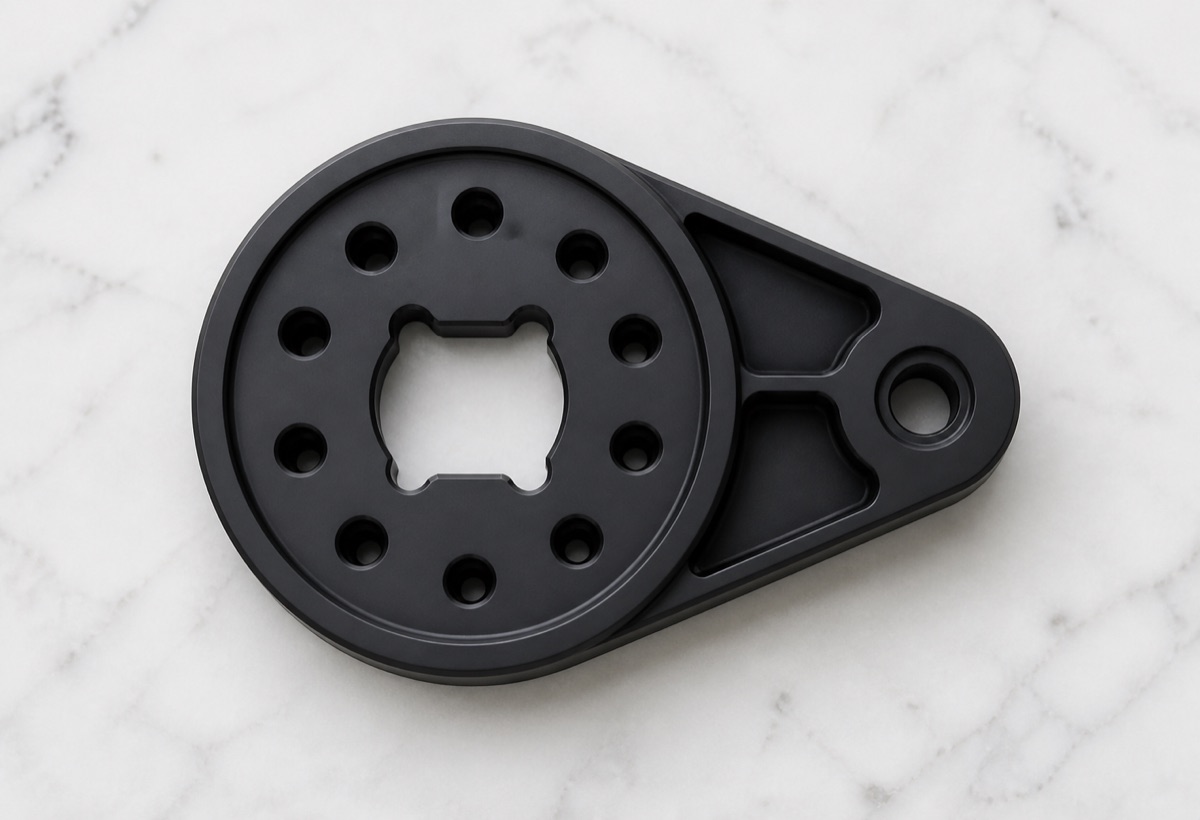
This case covers a black anodized ankle swing arm with a round main body, evenly distributed circular holes, a shaped center window, pocketed weight-reduction areas and a single-ear output end with a local bore and step. OEMach treated the part as a multi-datum relationship component rather than a simple machined plate.
The material grade was not fully shown in the provided technical package, so this case does not lock the material to one alloy. For actual quoting and production, OEMach confirms the customer BOM or drawing requirement first, then adjusts tool selection, cutting parameters and pre-anodizing preparation accordingly.
Project Snapshot
| Item | Project detail |
|---|---|
| Part type | Ankle swing arm for a humanoid robot ankle joint |
| Structure | Circular main body, shaped center window, distributed hole pattern, single output ear, local bore, steps and lightweight pockets |
| Finish | Black anodizing, with surface appearance and edge condition checked after finishing |
| Process focus | Datum planning, circular hole-pattern control, output-end relationship, pocket machining, internal corner cleanup and burr control |
| Inspection focus | Center profile, circular hole group position, output bore relationship, pocket bottom, local thickness, end-face flatness and black finish |
| Delivery focus | Clean holes, protected pocket edges, separated black surfaces and foam-supported packaging |
Why the Motion-Chain Relationship Matters
The circular hole group needs to remain stable relative to the center profile, while the output-end bore must stay aligned with the same datum logic. If each feature is machined and inspected in isolation, the measured hole sizes may look acceptable, yet the ankle joint can still feel tight or inconsistent during assembly.
The center profile is more than a cutout. It affects clearance, orientation and the way the arm references neighboring joint parts. Its inner corners need clean machining and careful deburring, but over-softening those edges can also change the functional outline.
The output ear is another key area. Its bore, step and end face influence locking, angle transfer and local loading. Fixture planning should prevent the ear from shifting after the circular body and pockets have already removed material from the part.
Machining Challenges
The first challenge is multi-datum conversion in a small part. The round body, distributed holes, center window, output bore and pockets all define function. OEMach therefore planned the process around a shared datum strategy instead of treating the features as separate machining tasks.
The second challenge is pocket machining. Lightweight pockets reduce mass, but they also make local wall thickness thinner. Tool entry, exit, corner radius and remaining stock must be controlled to avoid chatter marks on thin ribs and visible tool patterns on pocket bottoms.
The third challenge is black anodizing. After finishing, burr shadows, bright edges, scratches and cleaning residue become much easier to see. Deburring and cleaning must happen before anodizing, and key holes and edges should be checked again after finishing.
OEMach Manufacturing Solution
OEMach first confirmed the relationship among the center profile, circular outer form and output bore. Rough machining, semi-finishing and finishing were then sequenced to release stock gradually while keeping a stable locating state.
The circular body was used to maintain repeatable positioning, and the output-end bore and pocket features were completed under the same datum system wherever practical. This reduced accumulated error from repeated setup changes.
For the center profile and pocket edges, small tools and staged deburring were used to keep internal corners clean without damaging the outline. Before black anodizing, hole mouths, pocket boundaries, center-window walls and the output bore were reviewed for burrs and residue.
Inspection and Delivery Control
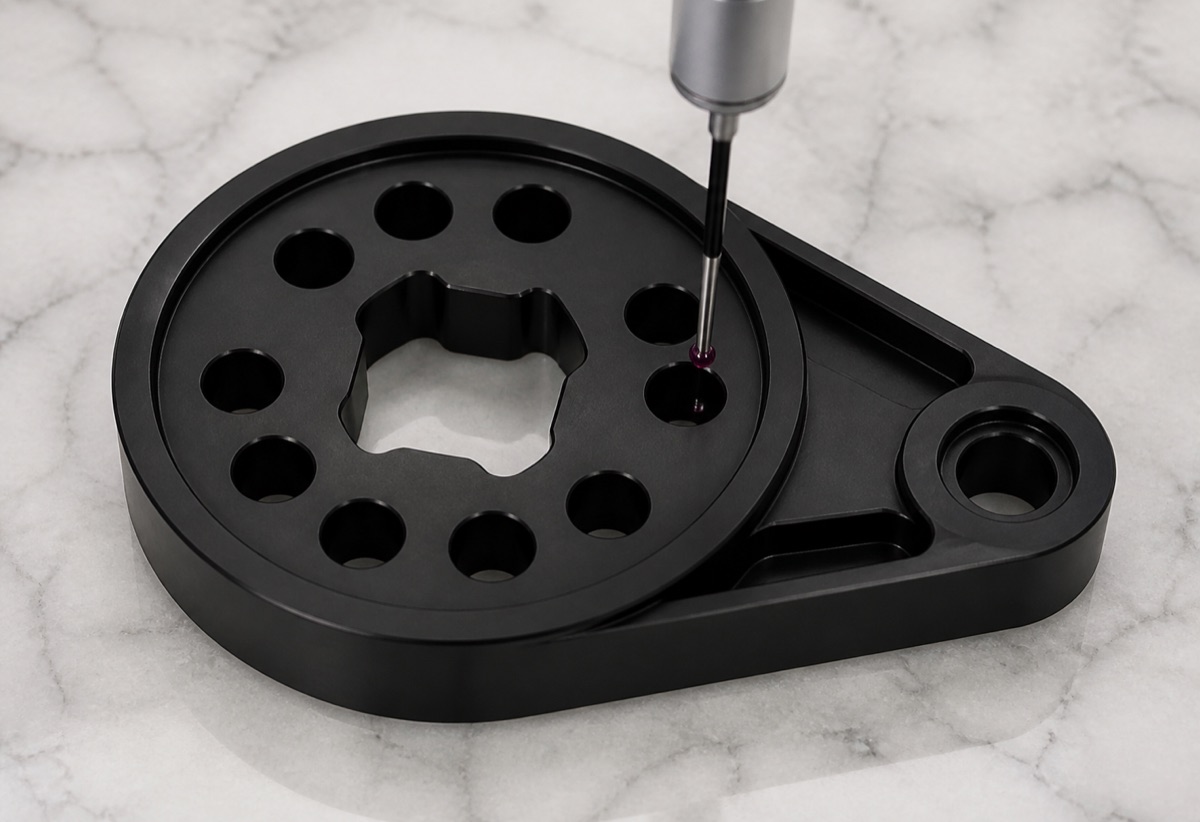
Inspection focused on the relationship among the center profile, circular hole pattern and output bore, not only on single hole diameters. First-article review can use CMM or dedicated gauges to confirm the relative position of the hole group and output end.
Process inspection should also watch tool wear because it can change hole size, pocket edges and the finish around thin ribs. After anodizing, OEMach checks for bright edges at hole mouths, particles in inner cavities, scratches on black surfaces and clean separation before packaging.
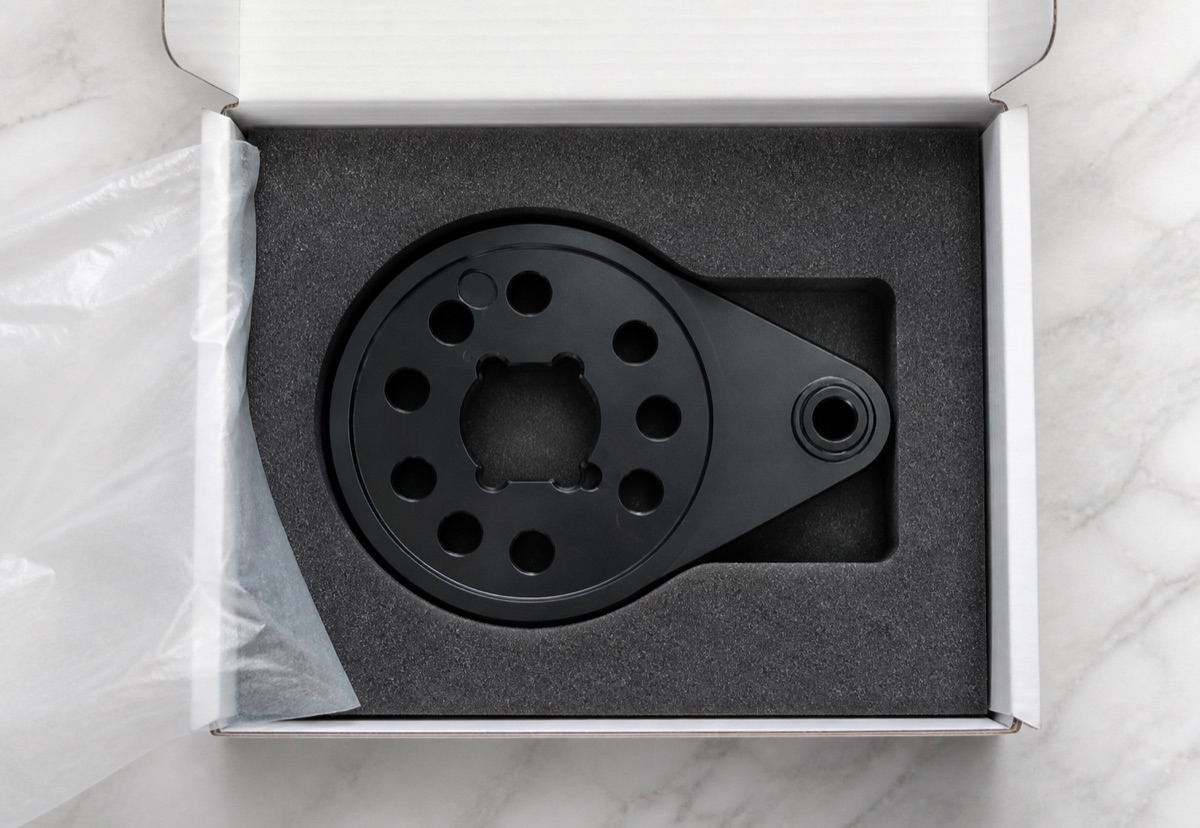
For delivery, the swing arm was placed in form-fit foam. The packaging limited movement and protected hole mouths, pocket edges and black visible faces, helping the customer inspect the part and move directly into ankle joint assembly validation.
FAQ
Can machining start if the material grade is not fully shown?
A structural and process review can start, but production should confirm the customer BOM, drawing material and surface treatment requirement before cutting material.
Why inspect the hole-pattern relationship instead of only hole diameter?
The ankle swing arm belongs to a motion chain. Relative position affects locking, output angle and smooth assembly more than a single isolated diameter.
What are common risks in lightweight pocket machining?
Thin-rib chatter, internal corner burrs, bright edges after anodizing and visible bottom tool marks are common risks on this type of structure.
Why is post-anodizing inspection needed?
Black anodizing can reveal scratches, burr shadows, bright hole edges and particles. Post-finish inspection confirms the part is ready for both appearance and assembly.
Ready to get a quote for your CNC machined parts?
Submit your engineering drawings to qiancj@oemach.com. We support prototype sampling and small-batch production with strict tolerance control.