
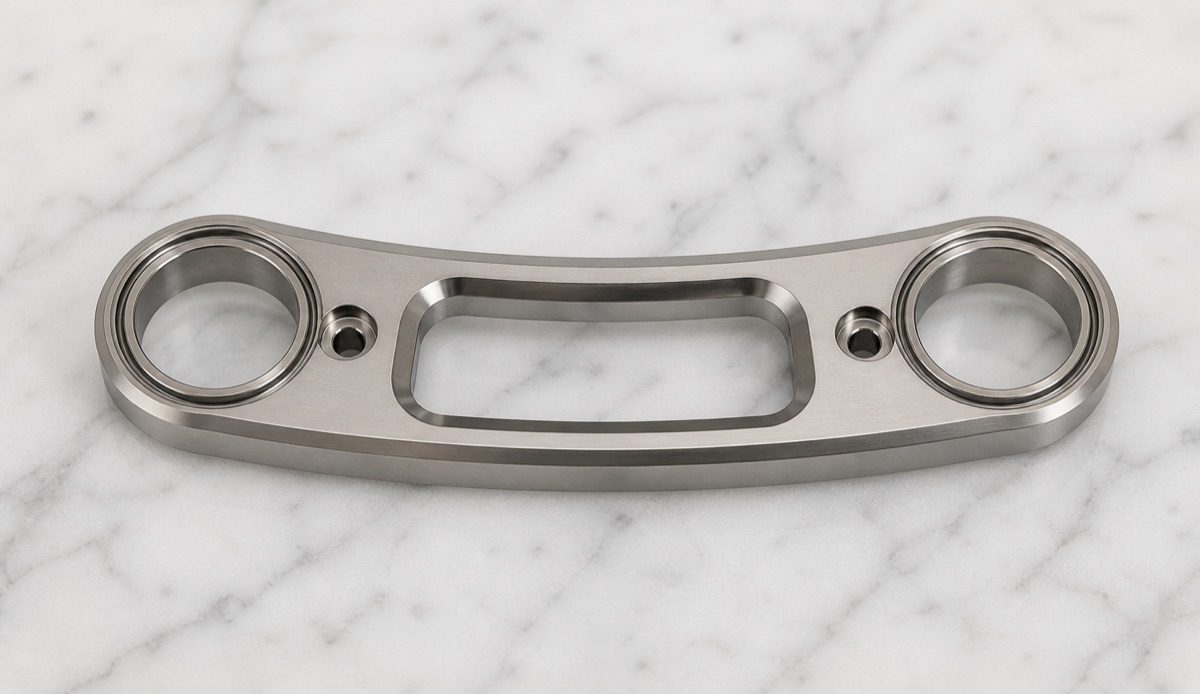
This TA4 titanium waist linkage is not a simple connector plate. In a humanoid robot waist joint, the two end bores are used for hot-fit joint bearings, so bore geometry, bore-mouth condition, center distance and polishing control all affect assembly confidence.
The part has an arched bridge profile, two large circular end areas, a rounded rectangular lightening window in the middle and M3 through holes on both sides. OEMach treated the bearing bores as the primary functional features and built the machining, deburring, polishing and inspection plan around them.
Project Snapshot
| Item | Project detail |
|---|---|
| Part type | Waist linkage component for humanoid robot joint assembly |
| Material | TA4 titanium alloy |
| Structure | Arched bridge arm, two end bearing bores, center lightening window and M3 through holes |
| Surface requirement | Polished titanium surface |
| Process focus | Hot-fit bearing bores, center distance, titanium cutting heat, edge condition and polishing boundary |
| Inspection focus | Bore size, bore roundness, bore-mouth chamfer, center distance, M3 holes, polishing marks and burrs |
Why the Bearing Bores Set the Assembly Limit
Hot-fit bearing bores are sensitive to diameter, roundness, chamfer and surface condition. If the bore is too loose, bearing retention can be affected. If it is too tight, assembly stress can rise and the bearing may not seat as intended.
For a waist linkage, the center distance between the two bearing bores is also critical. A small shift at the linkage can be amplified later in the joint assembly chain. That is why the bores and center distance should be controlled as one functional relationship rather than as isolated dimensions.
Machining Challenges
The first challenge is TA4 titanium cutting. Titanium concentrates heat and rebounds more than aluminum, so bore finishing, tool wear, chip evacuation and cooling strategy directly influence bore wall quality.
The second challenge is local stiffness. The central lightening window reduces weight, but it also changes stiffness along the bridge arms. Roughing and finishing allowance must be distributed carefully to avoid local release or edge springback.
The third challenge is polishing. Polishing improves appearance and touch, but it can also change bore-mouth edges, step boundaries and thin-edge consistency if the process boundary is not clear.
OEMach Manufacturing Solution
OEMach established stable datums first, then prioritized the two bearing bores and their center distance before finishing the lightening window, outer arc and M3 holes. Roughing left controlled allowance so the bridge arms were not released too aggressively.
During bore machining, tool path, chip removal and cooling were managed to reduce titanium bore-wall scoring. M3 holes were chamfered for screw-starting feel without making the chamfer larger than needed.
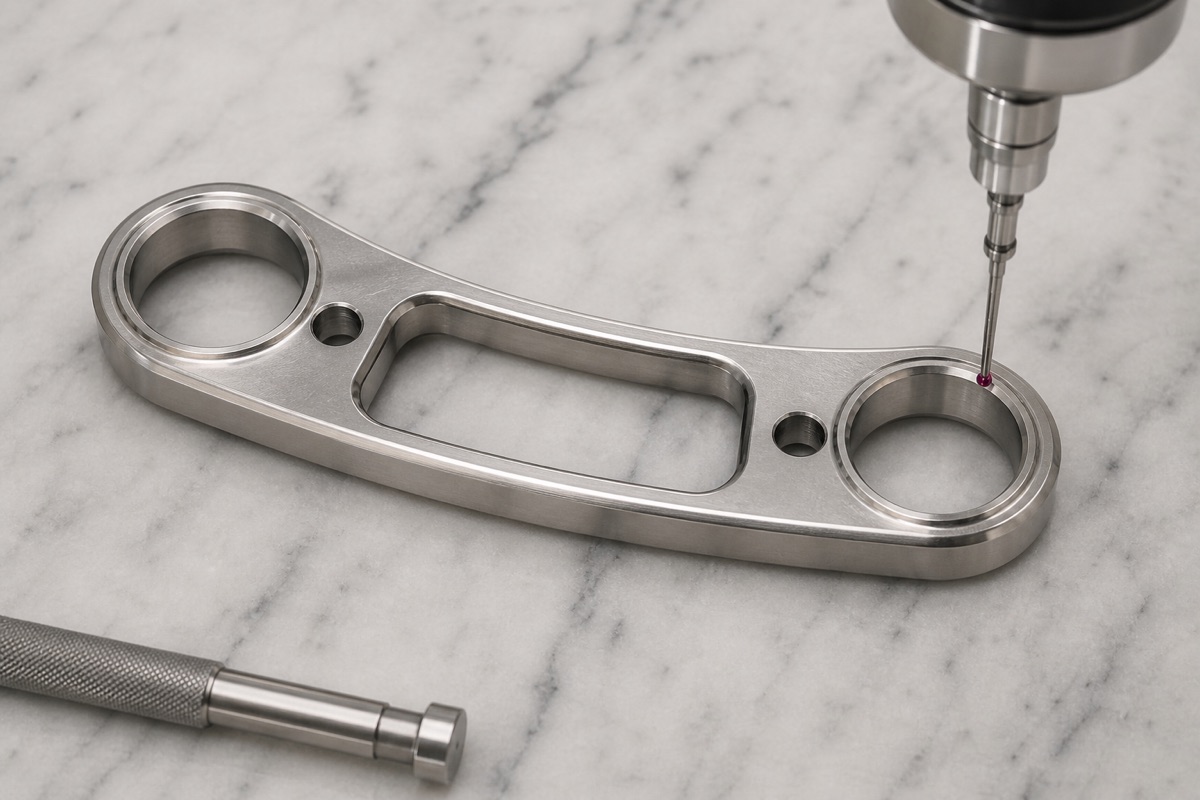
Before polishing, key dimensions and bore-mouth status were confirmed. After polishing, OEMach rechecked bearing bores, bore mouths, exterior appearance and burr condition so the cosmetic operation did not alter the assembly boundary.
Inspection and Delivery Control
First-article inspection covered bore size, bore-wall finish, bore-mouth chamfer, center distance, M3 hole pass-through, lightening-window edge condition and overall appearance. For hot-fit bearing bores, internal gauges, CMM or dedicated gauges are more reliable than a quick single-point check.
During small-batch production, tool wear was watched because titanium can change bore quality quickly once the tool edge degrades. Polished areas were reviewed for visible scratches, dents, uneven edge finishing and residual burrs.
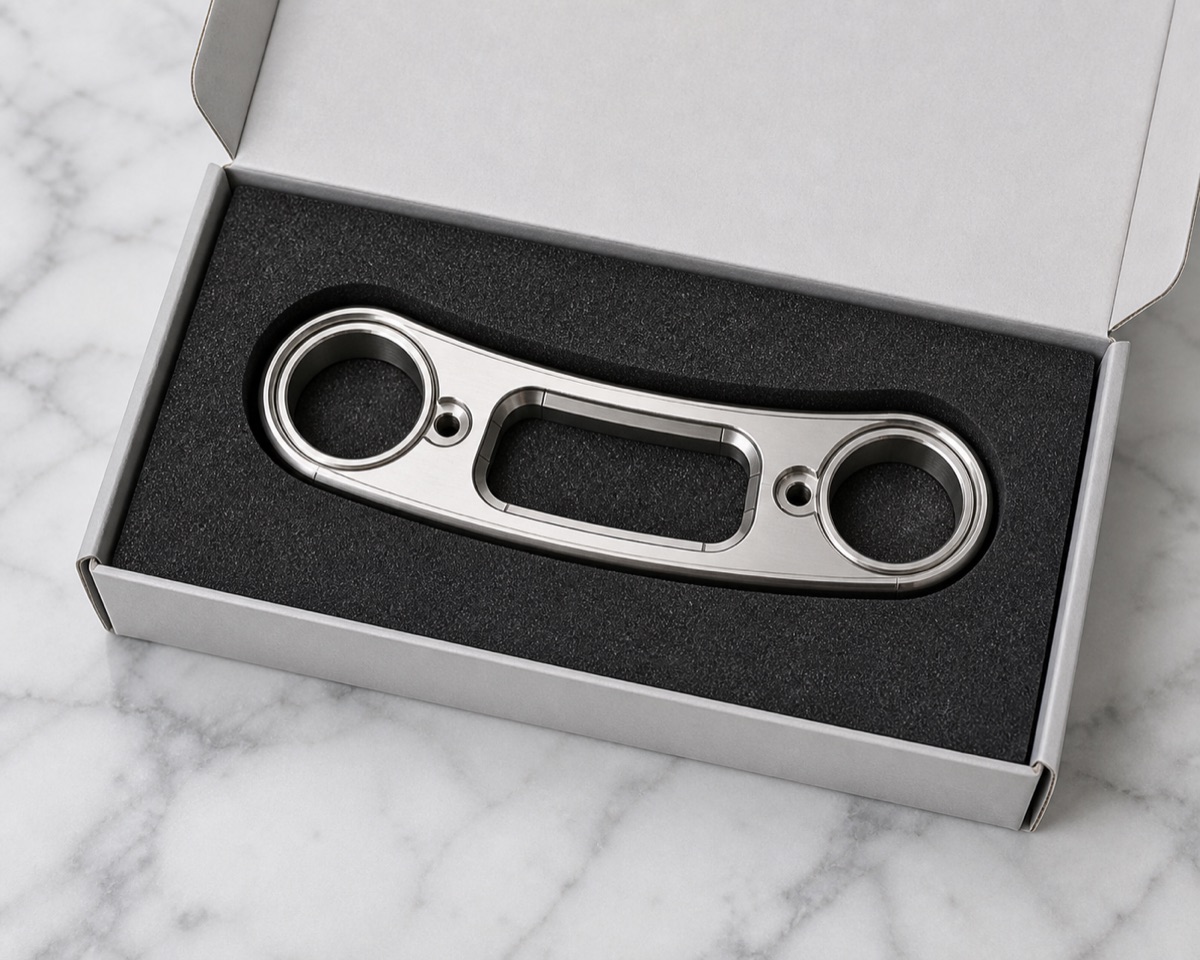
For delivery, the polished titanium linkage was placed in form-fit foam to separate the bearing bores and visible surfaces. This keeps the part clean, inspectable and ready for assembly validation when it reaches the customer.
FAQ
Why are hot-fit bearing bores critical in TA4 linkage machining?
They affect bearing retention, assembly stress and joint stability, so bore size, roundness, chamfer and surface condition must be controlled together.
Can polishing affect dimensions?
Polishing mainly affects appearance and edge condition, but bore mouths, steps and thin edges should be rechecked after polishing.
Can this type of titanium linkage be supplied in small batches?
Yes. It is better to confirm the first-article standard first, then control bore size, center distance, polishing and burr condition throughout the batch.
Ready to get a quote for your CNC machined parts?
Submit your engineering drawings to qiancj@oemach.com. We support prototype sampling and small-batch production with strict tolerance control.