
For a cross-shaped support part, the key is not simply milling four directions. The real machining requirement is to make the center bore, side bosses and end holes form around one stable datum system.
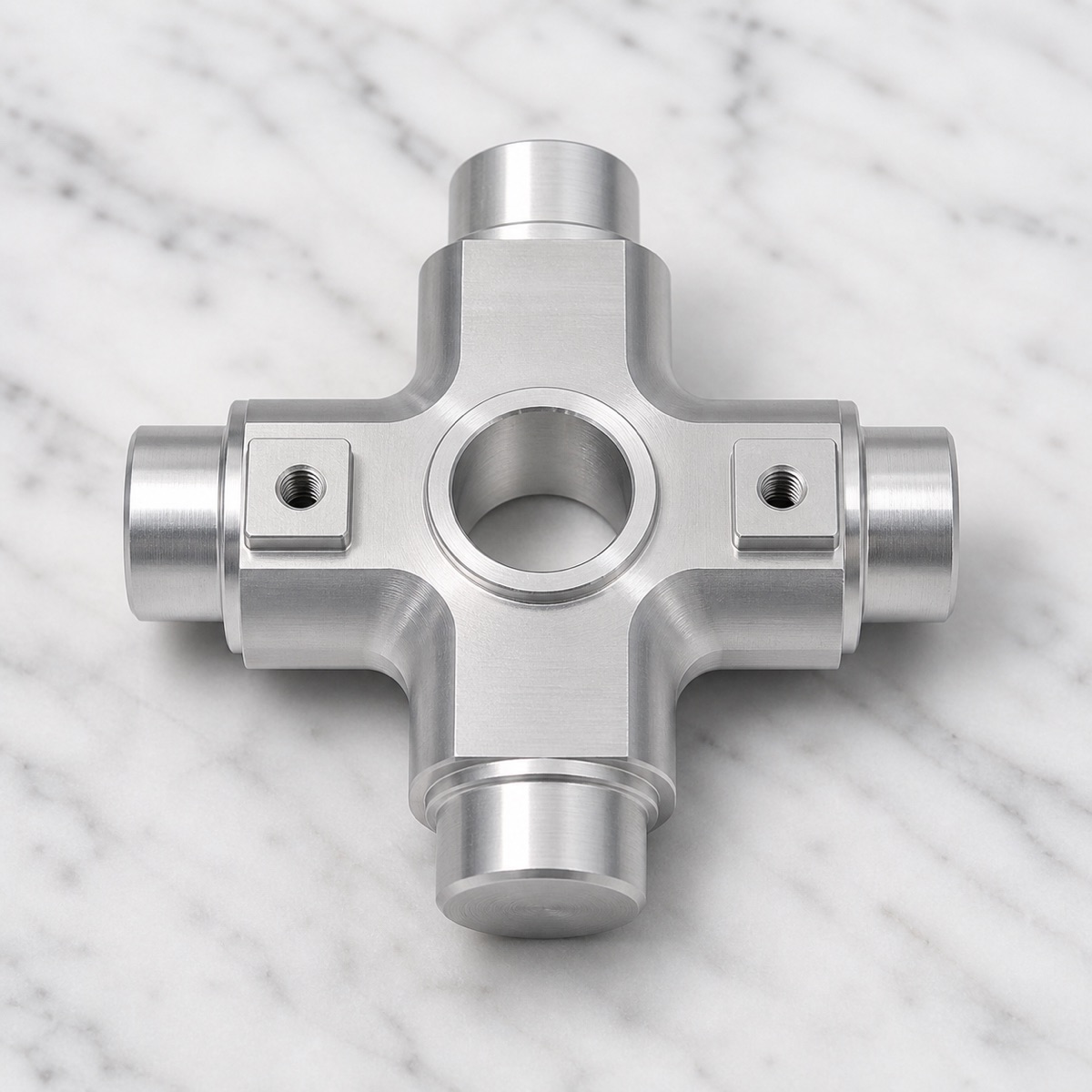
This case covers a 6061-T6 aluminum waist cross support used as a compact support node in a humanoid robot. The part is small, but the axis relationship is concentrated: center bore, four-direction bosses, side holes, M3 threaded holes and local root transitions must all fit the assembly logic.
Project Snapshot
| Item | Project detail |
|---|---|
| Part type | Waist cross support / compact support node for humanoid robot structure |
| Material | 6061-T6 aluminum |
| Structure | Center bore, four short cylindrical bosses, side holes, M3 threaded holes and local steps |
| Surface state | Natural machined aluminum surface |
| Process focus | Multi-direction datum transfer, coaxiality control, root clearing and M3 thread quality |
| Inspection focus | Center bore, opposing boss axes, side-hole position, M3 thread engagement, chamfers and residual root interference |
Why It Is Not a Simple Connector Block
The center bore is usually the main locating or fitting feature, four bosses provide connection and support, and side holes are used for locking or auxiliary fixing. Local root-clearance requirements show that the transition areas cannot leave tool-radius interference, but they also should not be overcut in a way that weakens the step.
For a small robot support node, size does not make the process easier. The smaller and more concentrated the features are, the more important it becomes to replace visual judgement with datum control.
Machining Challenges
The first challenge is multi-direction clamping. The part has cylindrical bosses or machined features on several sides, so a poor clamping face choice can make later alignment difficult.
The second challenge is coaxiality. The center bore and opposing bosses share axis relationships. They should not be independently re-zeroed after every setup change.
The third challenge is M3 threaded holes and hole-mouth burrs. The holes are small, and any burr or unclean thread can be obvious when the customer starts screws during assembly. Root clearing is also practical: residual cutter marks can create interference, but over-cleaning can alter the effective step.
OEMach Manufacturing Solution
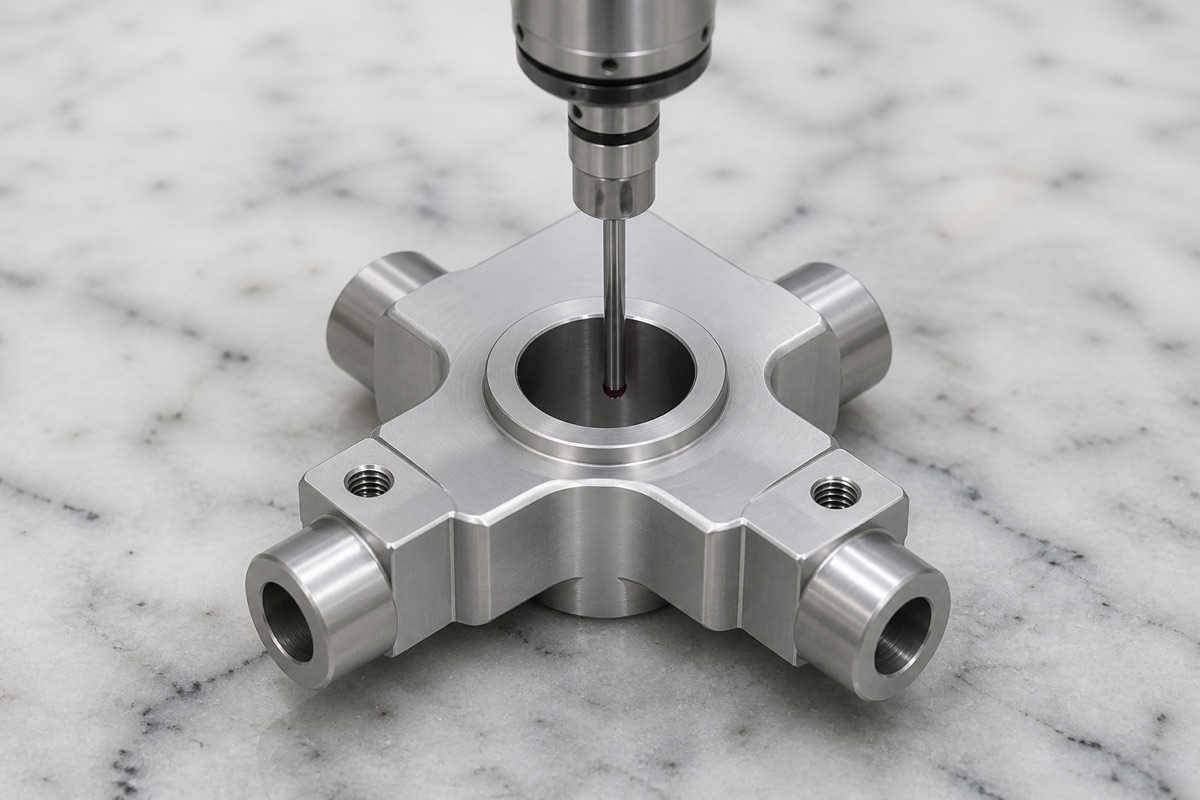
OEMach organized the machining route around the main axis relationship. Stable locating faces, the center bore or primary axial features were processed first, then opposing bosses and side holes were handled through controlled datum transfer.
During each setup change, alignment error was monitored so that four directions would not become four unrelated qualified features. Roughing kept reasonable allowance, while finishing unified the center bore, end bosses and root transitions as much as practical.
After M3 hole machining, OEMach applied controlled chamfering, go/no-go thread confirmation and hole cleaning. Root areas were reviewed so residual interference could be removed without excessively enlarging transition boundaries.
Inspection and Packaging
Inspection treated the center bore and opposing bosses as a relationship group. Beyond normal size checks, coaxiality, end dimensions, side-hole position, M3 thread smoothness, chamfers and root-clearance areas were all reviewed.
Small parts do not mean simplified inspection. Fine burrs or small axis errors can become larger assembly problems. For first articles, CMM, gauge pins or dedicated fixtures can confirm the axis relationship; for small batches, sampling or full inspection can be set by key features.
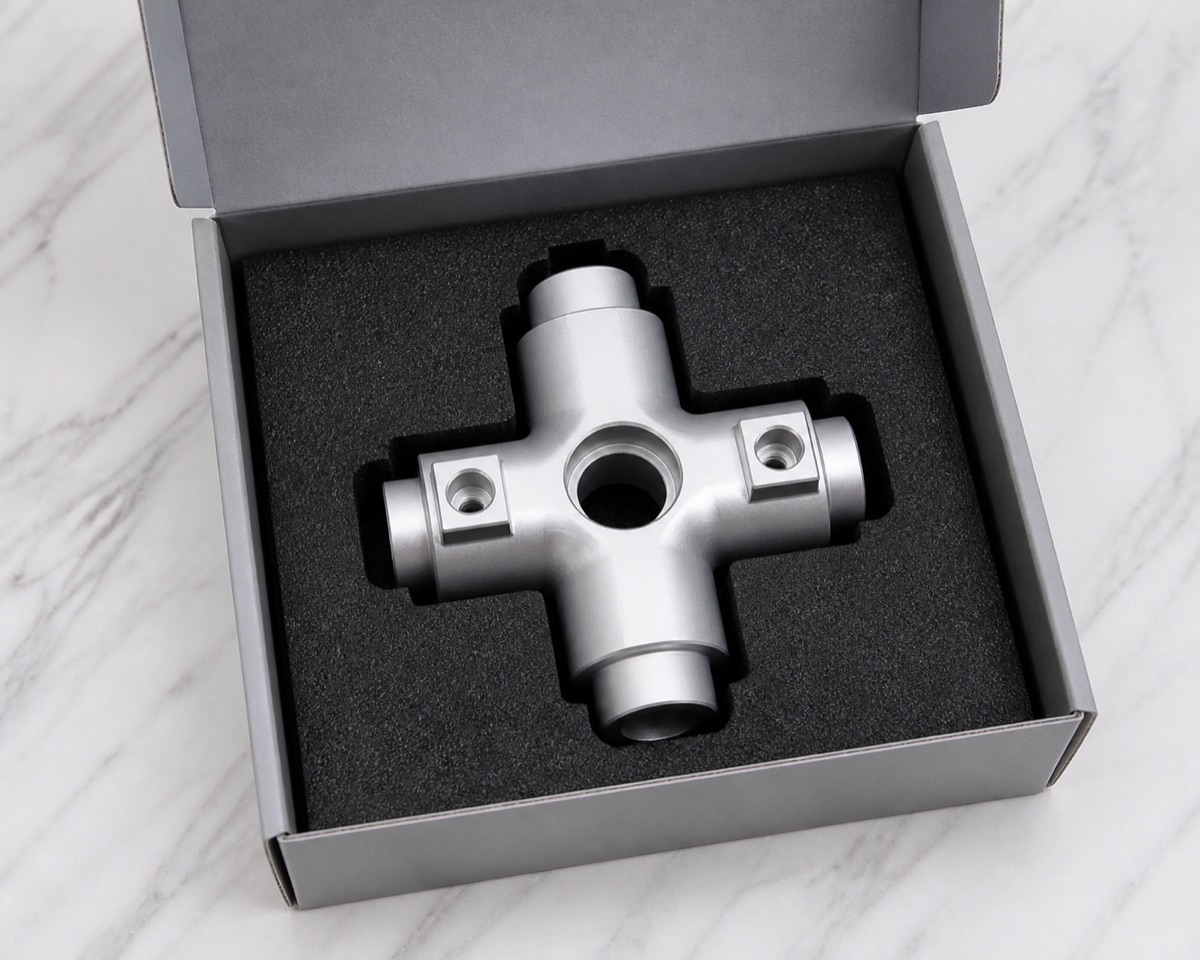
For delivery, the four bosses and hole mouths need protection against dents and mixing damage. OEMach used foam positioning or individual slots so the parts would not roll inside the box and could be identified quickly when opened.
FAQ
Why does a waist cross support need coaxiality control?
Opposing bosses and the center bore often participate in locating or fitting. Axis deviation can affect insertion, fastening and motion clearance.
What is easy to overlook on small 6061-T6 support parts?
M3 hole-mouth burrs, unclean thread roots, residual interference at root-clearing areas and datum drift after multiple setups are often overlooked.
How should lead time be arranged?
Multi-face machining, first-article inspection, deburring, cleaning and individual packaging should all be included, especially for prototype validation schedules.
Ready to get a quote for your CNC machined parts?
Submit your engineering drawings to qiancj@oemach.com. We support prototype sampling and small-batch production with strict tolerance control.