
Representative scope and evidence limit
This case proposes a natural unfilled POM-C twin-V cradle for an inert ophthalmic inspection fixture. It is a representative manufacturing example, not a documented customer delivery, qualified optical support or completed instrument validation. No achieved tolerance, certification, self-centering result, alignment improvement or clinical outcome is claimed. Its purpose is to organize a manufacturing inquiry and inspection plan before an actual purchase. The responsible designer would define contacts and application requirements. The accompanying images are not certificates, production records or proof that real customer parts have passed dimensional, cleaning or optical verification.

Define the proposed two-groove block
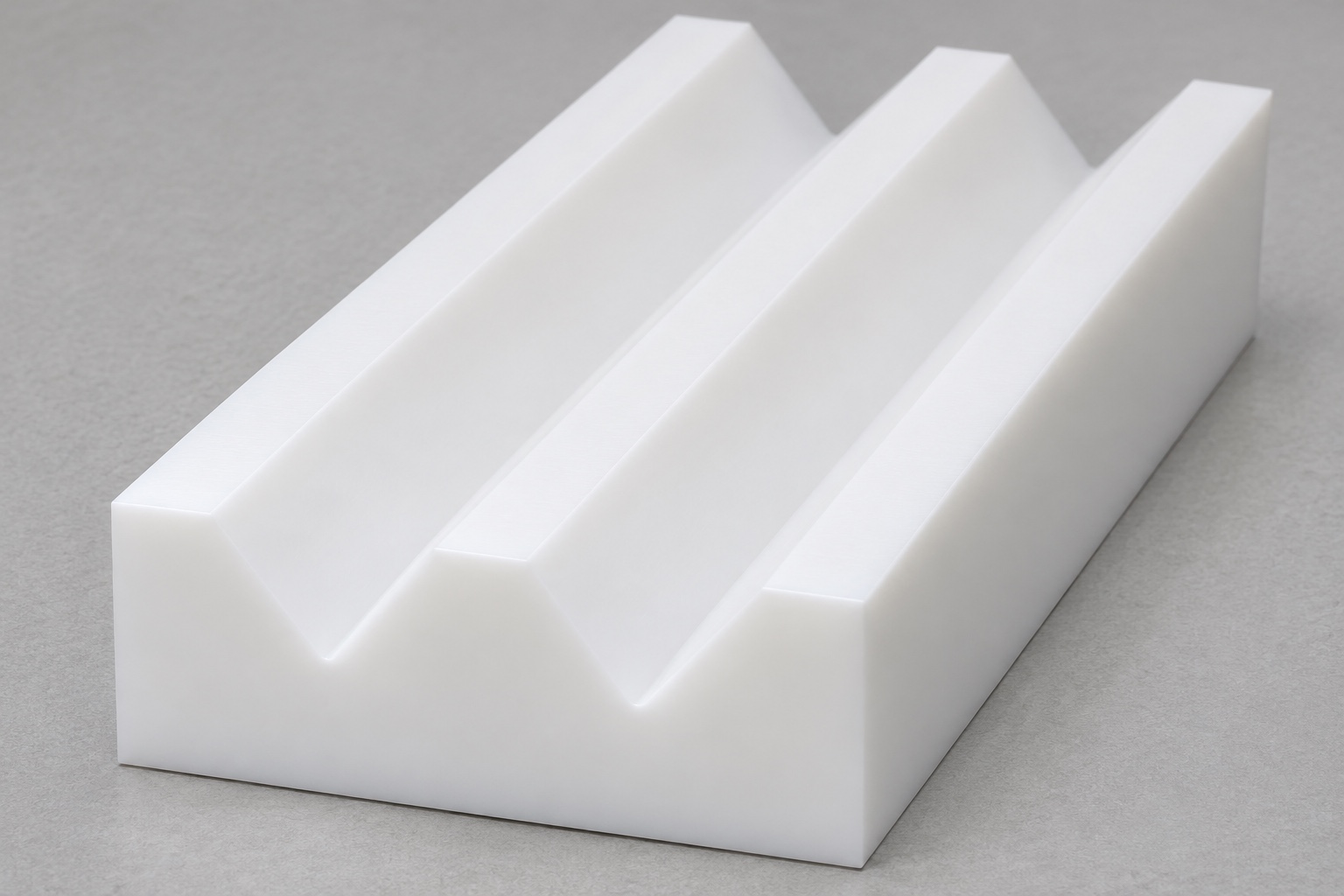
The component is a rectangular solid block with two equal nominal parallel V grooves in its top. Both grooves run through the full useful length and remain open at front and rear. Four sloping faces form the channels, with small root radii, a central flat land and outer top lands. Material remains beneath both roots. There are no holes, threads, feet, inserts or supplied rods or lenses. A semicircular trough or closed pocket would be different geometry. Actual dimensions, face boundaries and allowed transitions would come from controlled documents rather than be inferred from a photograph of a familiar support shape.
Identify contact, location and retention roles
The drawing owner would define bottom support, lateral locating surfaces and the permitted sloping contact bands. It would identify whether a controlled inert reference may touch a root or land. Saying that two cylindrical references must appear level would not define every groove characteristic. The review would also explain how the complete fixture retains the block without adding unapproved features. Any optional seating observation would record reference identity and conditions separately. Component acceptance would remain distinct from retention force, wear, optical-axis alignment and instrument performance, all of which require their own requirements and suitable evidence for the actual arrangement.
Resolve angles and groove relationships
A real RFQ would distinguish each included angle from the inclination of individual faces relative to outside references. It would define groove position, spacing, useful length and any required parallel relationship. A nominal V intersection could be a derived line rather than a physical sharp edge because a root radius remains. The evaluation method would identify which surface regions establish it. The designer would resolve conflicting or redundant controls before manufacture. This example assigns no numerical angle or tolerance because no actual customer drawing or verified production result is supplied. It explains how an acceptance scheme could be made consistent before quoting.
Define roots, lands and remaining material
The specification would define allowed root radii and any useful-face exclusions. A wider root blend could change clearance or contact even when the channels still appear symmetrical. The central and outer lands would remain as drawn, and material below the roots would be evaluated on a consistent dimensional basis. A proposed relief or different cutter access would require review if it changes geometry. No minimum floor thickness, retention value or strength result is invented. These requirements must come from the responsible project, while the supplier clarifies manufacturing and inspection access without treating a tidy photograph as dimensional evidence.
Specify the actual POM-C material
An actual order would identify the required unfilled POM-C grade, stock form, supplied condition and documents. Natural white color would not establish identity. POM-H or a different grade would not be substituted solely because it also carries an acetal description. Records would stay linked through blank preparation, milling and approved subsequent work. This case provides no actual material certificate or exposure result. Material documentation identifies the supplied material within its scope; final groove geometry, cleaning compatibility and optical application suitability would still require their own specified requirements and evidence for the actual component and intended use.
Propose a coordinated milling route
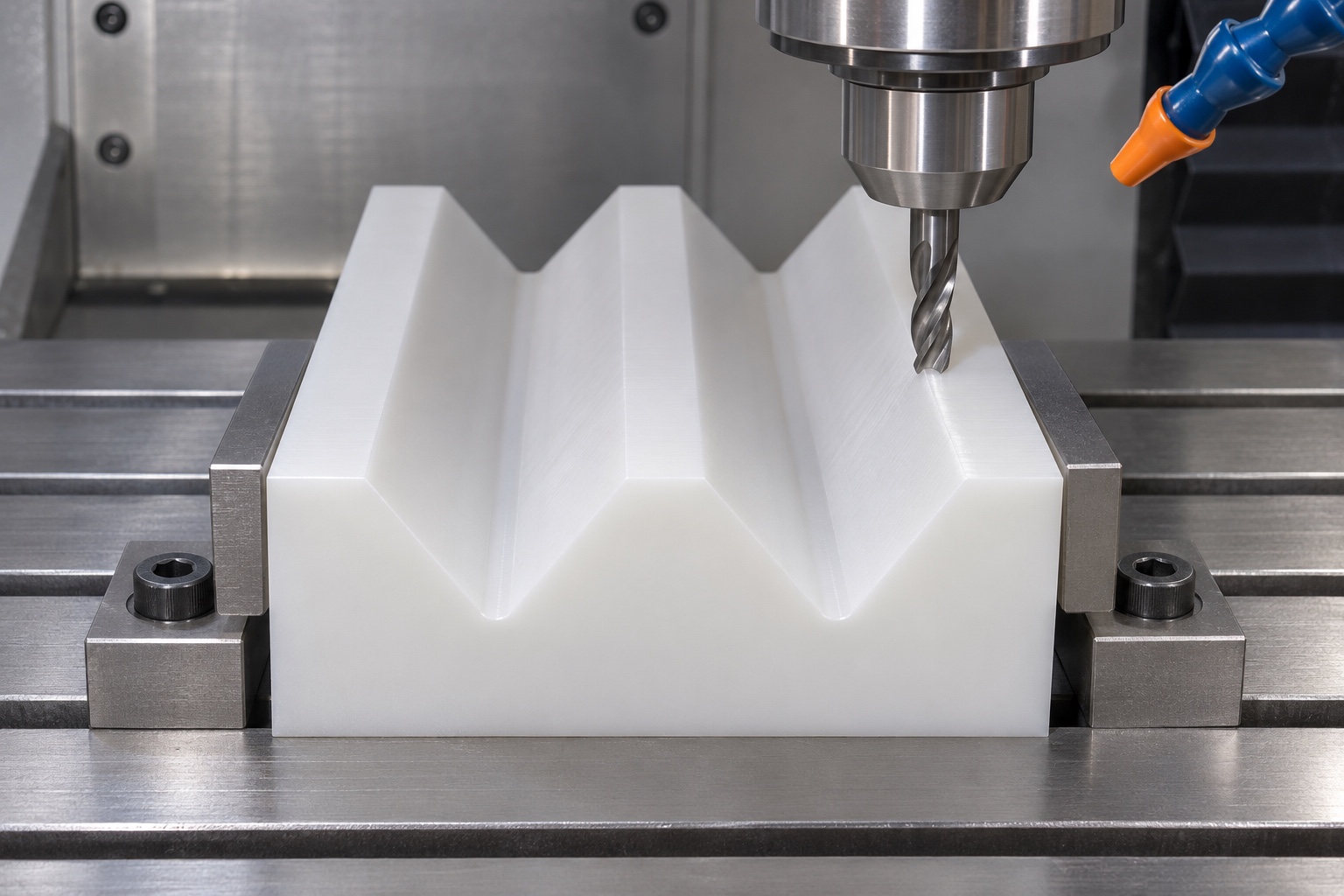
A candidate process would establish outside references and machine the two grooves with suitable support, access and finishing allowance. It would preserve the central land, outer lands and material below both roots. The actual method would depend on dimensions, angles and tolerances rather than one universal tool choice. Any reorientation would explain reference recovery and protection of completed faces. The plan would coordinate finishing of the four sloping regions rather than assume one visually similar channel proves the other. No feed, speed, cycle time or achieved accuracy is reported. The route is a proposal for review, not evidence of an accepted production lot.
Agree the final measurement condition
The manufacturing plan would define support, restraint, conditioning and inspection conditions for the finished polymer block. Measurements under strong clamping would not silently become the supplied geometry. An intermediate blank or a single rough groove would not establish the finished twin-V relationship. If development observations justified another stock, sequence or stabilization step, the reason and verification would be documented. This case reports no measured distortion or improvement. The aim is to connect manufacturing and inspection to the intended state, not predict universal behavior for every POM-C grade or treat an unexplained waiting period as a guarantee of acceptance.
Preserve the sloping faces during finishing
Deburring would remove unwanted material without changing included angles, useful contact regions, roots or groove positions. Broad hand polishing could alter a functional band while leaving an attractive surface. Any proposed different edge treatment or relief would require approval where it affects controlled geometry. Tools, cleaning and handling would match the actual supplied-condition requirement. Appearance would remain distinct from roughness and geometric acceptance. A smooth white face is not evidence of validated cleaning, biological suitability or compatibility with a particular exposure. The plan would state which characteristics need confirmation after finishing operations capable of changing the accepted component.
Plan feature-specific first-article inspection
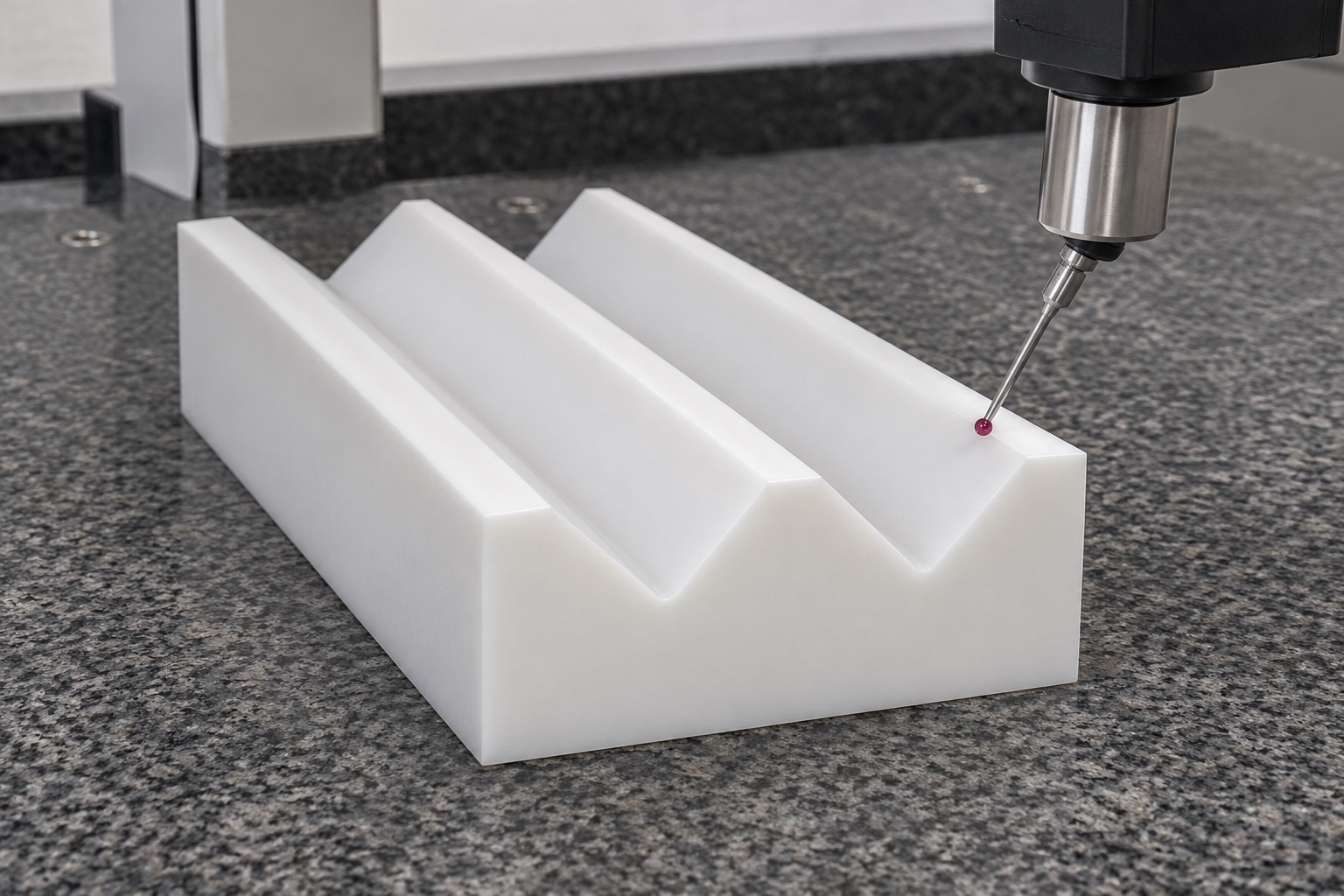
The proposed inspection plan would separate angles, face orientation, groove position and relationship, root geometry, outside references and specified surface condition. It would identify support, alignment, coverage and the calculation used for derived planes or lines. Coordinate or optical methods would need adequate access and capability, not just an instrument name. No numerical result is claimed because verified delivery data are absent. Actual release would require observations on completed parts after relevant operations, with method limitations resolved before acceptance. Nominal values, calculations and intermediate readings would remain distinct from the measured final evidence used for the real order.
Bound any inert seating observation
A requested trial would use clean controlled inert references with documented identities, revisions, diameters, orientation and support. It could reveal obvious interference or a misunderstood contact region. Different reference diameters could produce different seating observations without proving a manufacturing change. Two references appearing level would not release every dimensional characteristic or demonstrate optical alignment, retention or wear life. No actual trial is claimed in this case. The example describes how such a check could supplement inspection while complete fixture and instrument qualification remain separately defined. A clinical procedure is not needed to support this component manufacturing proposal.
Approve protective supply and repeat scope
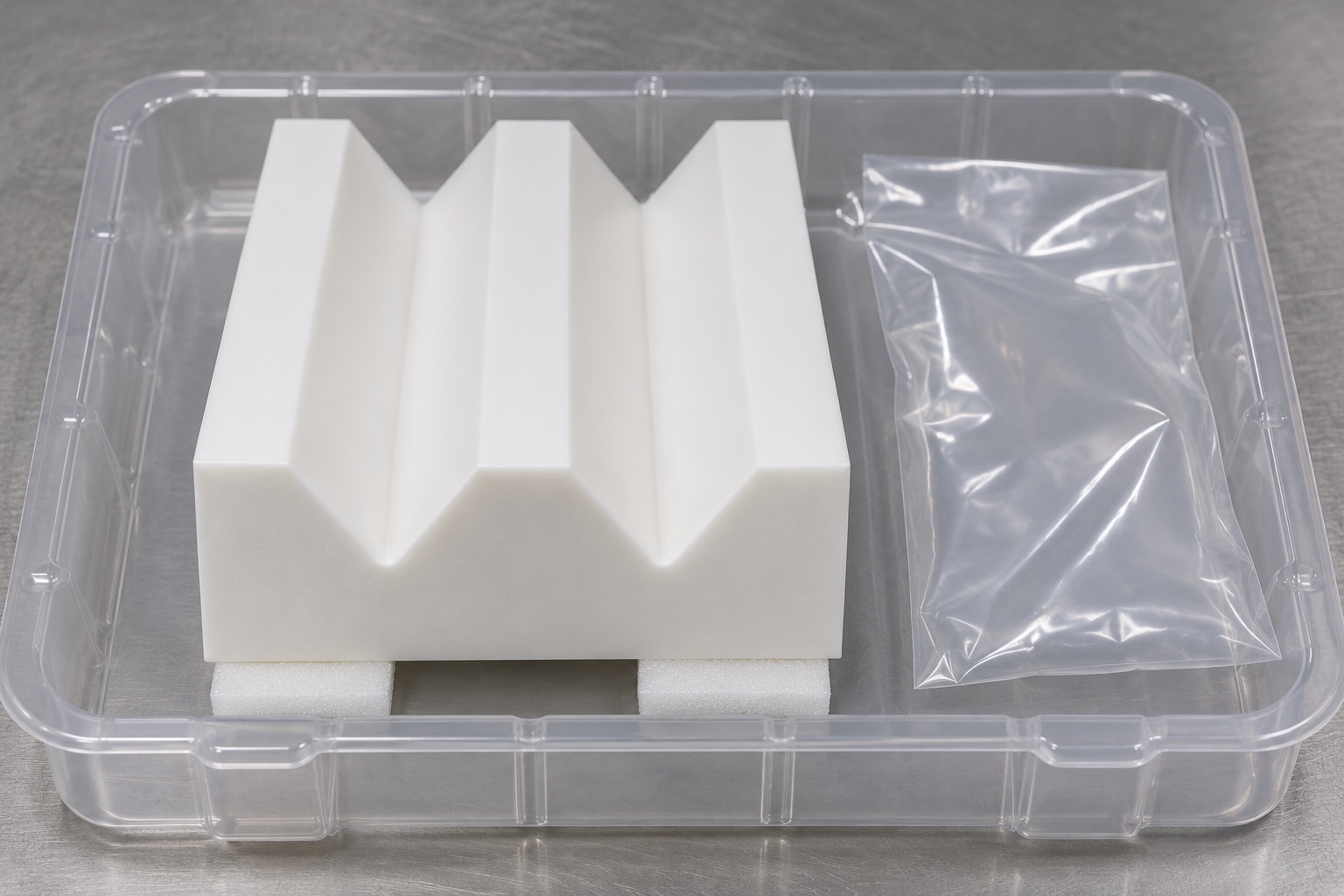
Before actual production, the parties would approve POM-C grade, outside references, V angles, groove relationships, useful bands, roots, edge work and final inspection conditions. DFM review would resolve support and access. Genuine first-article results and authorized changes would support later purchases. The outgoing plan would define cleaning, residue verification, identification and protection of both grooves from loose hardware. Pads and an ordinary bag would not establish sterile packaging, validated cleaning or qualified transport. The quotation would describe measurable custom polymer CNC milling without fictional customer outcomes or a guarantee of self-centering and ophthalmic instrument performance.
FAQ
Is this a delivered optical fixture component?
No. It is a representative manufacturing proposal for an inert inspection fixture. Actual delivery, achieved tolerance, certification, optical performance and clinical suitability are not claimed. A real order requires its own controlled evidence and release records.
Does the geometry include rods, lenses or inserts?
No. It is a plain POM-C block with two open V grooves and material beneath them. Added references, holes, inserts, feet or closed ends would need a different specification and review.
Why separate included angle from face orientation?
The included angle relates two sloping faces, while orientation relates them to the block references. A correct result for one does not automatically establish the other or every required groove position.
Can the rounded root be treated as a sharp datum line?
No. Define useful face regions and the evaluation method for any derived intersection. The actual root radius is not the same as the ideal mathematical line between two extended planes.
Does a seating-height observation establish optical alignment?
No. Reference diameter, groove geometry and support all influence the observation. Optical alignment, retention and wear require separately defined evaluations of the complete relevant fixture and conditions.
What supports a repeat small-batch order?
Use approved material and geometry, genuine final inspection records, authorized changes and agreed cleaning and protection. This representative route and its images do not constitute completed production or application qualification.

tanghangyun@oemach.com