
Although PEEK, POM and PTFE are all engineering plastics, their rigidity, heat conduction, abrasion, rebound and creep are very different. Unifying tools and parameters amplifies dimensional and surface risks.
First confirm the specific grade, filling and semi-finished product status, and then design the tool, clamping, heat dissipation and measurement respectively; the final size should be determined after the agreed temperature and stabilization time. The specific process still needs to be confirmed by combining material grade and filling status, semi-finished product annealing, tool sharpness, heat dissipation, clamping force, removal sequence, stabilization time and low force measurement.
Typical problems, causes, controls and evidence
| Problem | Likely cause | Control action | Acceptance evidence |
|---|---|---|---|
| PEEK reinforced material knives become dull quickly | Glass fiber or carbon fiber filling improves abrasiveness | Confirm filling status and select wear-resistant tools and life management | Material certification, tool life and surface trends |
| Burrs or local deformation appears after POM processing | The tool is not sharp, the heat dissipation is unstable or the clamping is too large | Adopt sharp cutting edge, stable chip evacuation and low clamping force and cool down for retesting | Burr, free state dimensions and temperature recording |
| PTFE passes the measurement but springs back after assembly | Material is soft, creeps, and measured force and settling time are inconsistent | Specify support, low force measurement, temperature and placement time | Measurement conditions, repeat data and assembly verification |
Material name is not enough to determine process
PEEK may be unfilled, glass fiber or carbon fiber reinforced, POM has homopolymerization, copolymerization and various modifications, and PTFE may also contain fillers. Filling changes stiffness, abrasion, thermal expansion, and surface behavior. Material grade, color, semi-finished product specifications, supplier certification and usage requirements should be provided when placing an order. Processors cannot select tools and tolerances based solely on “PEEK parts” or “white plastic”.
PEEK concerns about heat and reinforcement tool wear
Unfilled PEEK has higher rigidity and better processability, but the plastic has poor thermal conductivity, and local heat will still affect the size and surface. Glass fiber or carbon fiber reinforced grades are abrasive, so more wear-resistant carbide or suitable coatings, diamond tools, and life span should be used. The blade needs to be sharp to avoid frictional heating; the specific cooling method must be compatible with material cleanliness and application requirements.
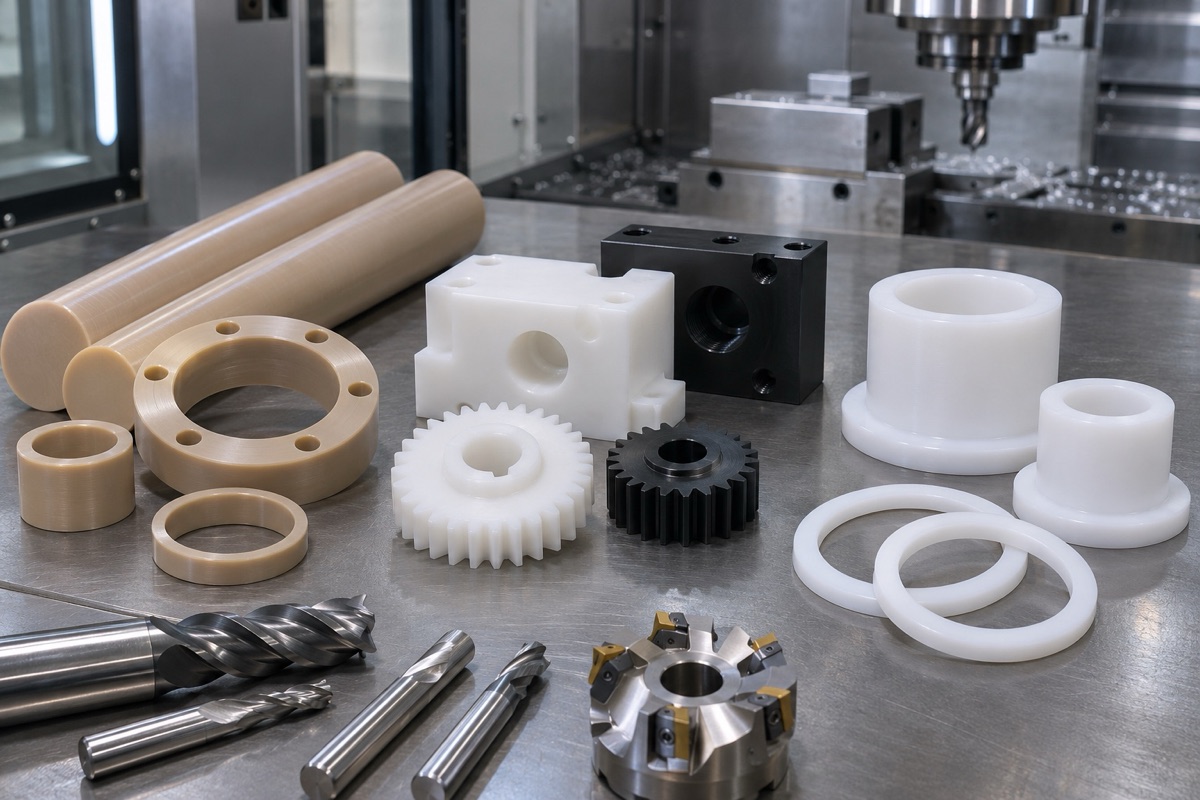
The differences in rigidity, abrasion and springback of the three types of materials determine different tooling strategies.
POM focuses on sharp edges and burr control
POM usually has good dimensional stability and machinability, but dull knives, excessive friction, poor chip evacuation or excessive clamping can still produce burrs, bright spots and deformation. The tool geometry can refer to the sharp positive rake angle idea of aluminum processing, and the chips must take away the heat in time. Thin-walled and open structures should be removed in stages and retested after loosening and cooling.
PTFE focuses on soft rebound and creep
PTFE is very soft and tough, and it easily causes burrs, wire drawing, and burrs when cutting. Excessive clamping force and measuring force will compress the parts and cause them to rebound after release; long-term load will also cause creep. Sharp, positive rake angle tools and large areas of low pressure support should be used to avoid repeated rubbing of the surface. Tight tolerances must be evaluated in conjunction with temperature, placement time, and assembly functionality.
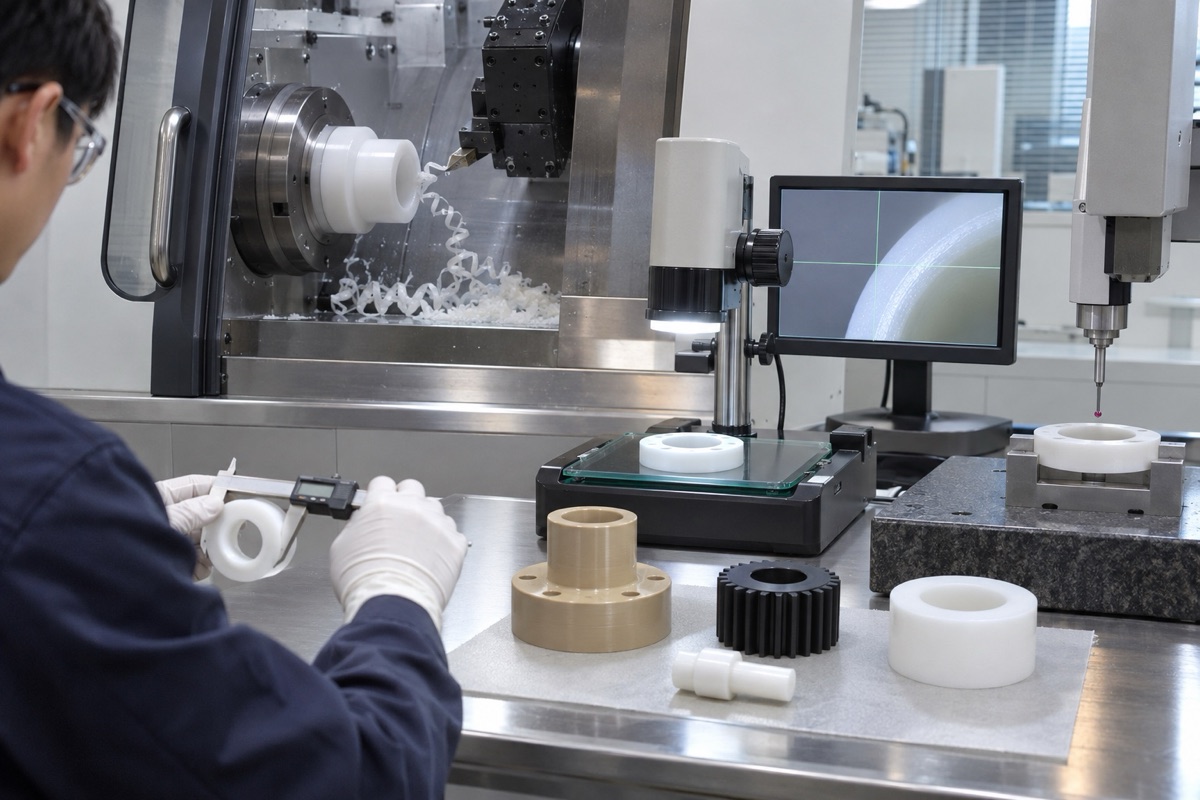
Plastic dimensions should be determined under agreed temperature, stabilization time and measuring force.
Semi-finished product stress and removal sequence affect stability
Extruded or molded semi-finished products may retain residual stresses. Large removal rates, single-sided openings or sudden changes in thickness will cause the parts to deform after processing. Symmetrical roughing, stocking, stabilizing and post-finishing can be used, and stress relief treatments can be evaluated based on material supplier recommendations. Annealing is not a universally required step, and temperature paths and dimensional changes must be verified with representative samples.
The final measurement state and method must be specified
Thermal expansion of plastics is generally higher than that of metals, and both temperature and hand-holding time can affect the results. Before measurement, it should be stable in the agreed environment, use low measuring force and appropriate support, and record the temperature and placement time. OEMach (OEMach) recommends that the measured changes, burrs and assembly results of the first proofing be written back to the process card, and unified cutting parameters that are separated from the grade, equipment and tool are not released.
Summary
First confirm the specific grade, filling and semi-finished product status, and then design the tool, clamping, heat dissipation and measurement respectively; the final size should be determined after the agreed temperature and stabilization time. The specific process still needs to be confirmed by combining material grade and filling status, semi-finished product annealing, tool sharpness, heat dissipation, clamping force, removal sequence, stabilization time and low force measurement.
FAQ
Can PEEK, POM and PTFE use the same set of tools?
Some equipment and tool types can be shared, but cutting edges, materials, parameters, clamping and life strategies should be confirmed separately for specific grades.
How long does it take for plastic parts to be measured after processing?
There is no unified time. Stability conditions should be specified based on material, size, removal rate and temperature difference and confirmed by repeated measurements.
Can PTFE stably achieve the same tight tolerances as metal parts?
There is no direct analogy. The softness, thermal expansion and creep of PTFE can limit repeatable accuracy and should be evaluated from functional and measurement conditions.
Ready to get a quote for your CNC machined parts?
Submit your engineering drawings to qiancj@oemach.com. We support prototype sampling and small-batch production with strict tolerance control.