
Define the threaded stud before choosing a turning route
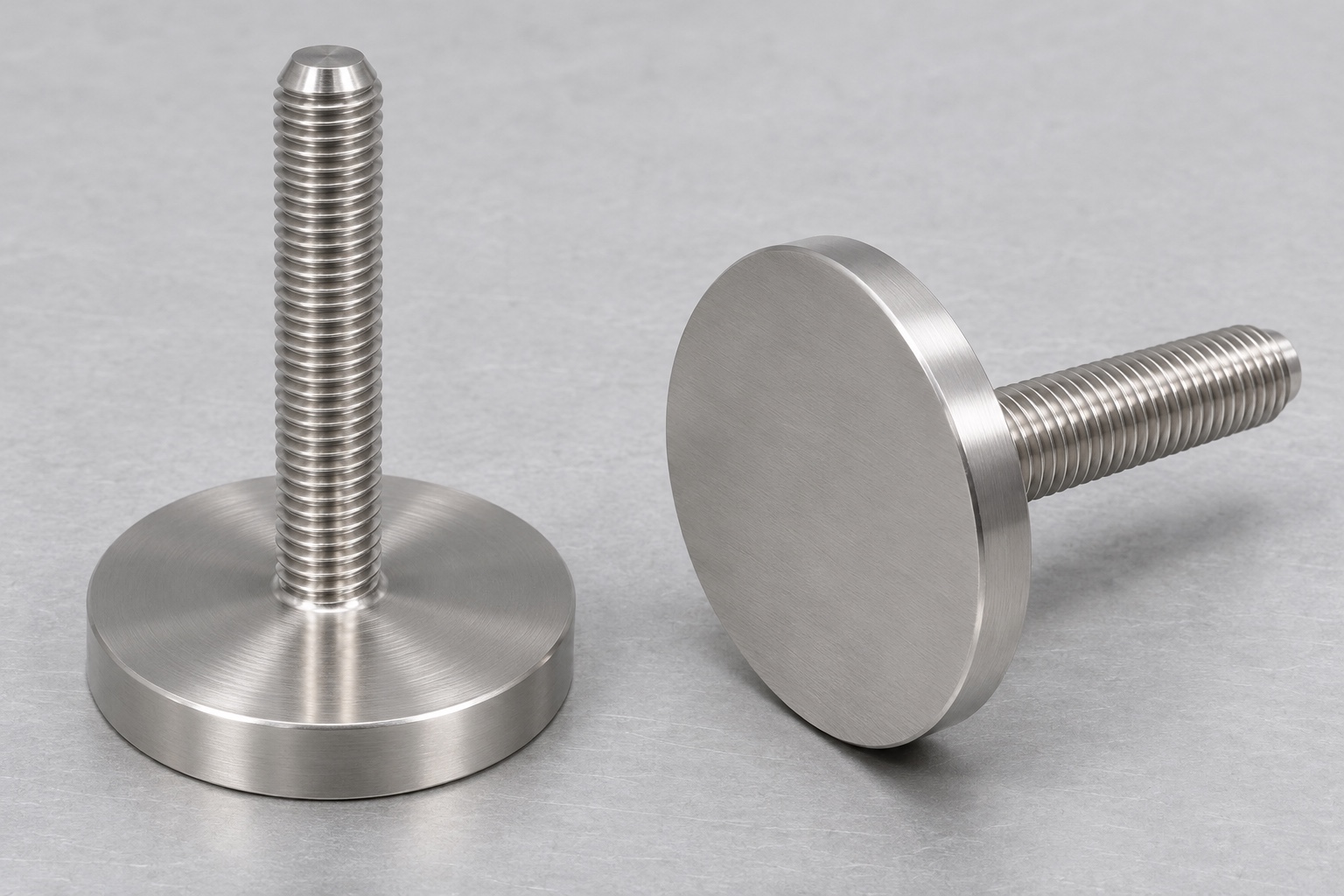
A threaded support stud combines two different interfaces: an external thread that connects to a mating feature, and a disc foot that establishes a seating surface. For medical wash-basket fixture development, define both before requesting precision CNC machining. The part discussed here is a one-piece 316L stainless steel stud with a low circular foot, centered threaded stem and chamfered tip. It has no bore, hex socket, separate nut or swivel joint. It is a manufacturing study for an inert fixture, not evidence of load capacity, cleaning effectiveness or sterilization compatibility.

Separate the foot seating plane from the thread axis
The underside of the foot may establish a functional plane while the thread axis determines connection direction. A drawing should state the relationship actually needed between them. A broad foot diameter alone says nothing about whether the underside seats acceptably or whether the stem aligns with the mating thread. Identify the relevant datum and any required perpendicularity or runout rather than adding a general tight tolerance to every dimension. Also distinguish the seating underside from the visible upper face: they can have different roles, finish requirements and inspection access.
Specify the external thread as a complete interface
An external thread needs a system, nominal size, pitch, handedness and tolerance designation appropriate to the design. State the required full-thread length separately from total stem length and the lead chamfer. The first incomplete turn and tool withdrawal region should not be counted as usable engagement without design approval. If a relief is required, dimension it explicitly; it is not automatically present on this plain stud. The mating part, engagement depth and assembly clearance belong in the interface review. No particular thread size or achieved fit is claimed here.
Keep the 316L material and final condition traceable
Specify the required 316L material definition, stock form and supporting documentation instead of purchasing an unidentified stainless blank. The route should preserve the association between material, workpiece and drawing revision through turning, part separation and any secondary operation. Surface treatment must be requested with its acceptance condition; a bright turned finish is not proof of passivation or a validated cleaning process. If marking the functional surface is unacceptable, retain identification through the traveler and container. The material name does not independently qualify the finished stud for a medical cleaning environment.
Plan the disc foot and stem turning sequence together
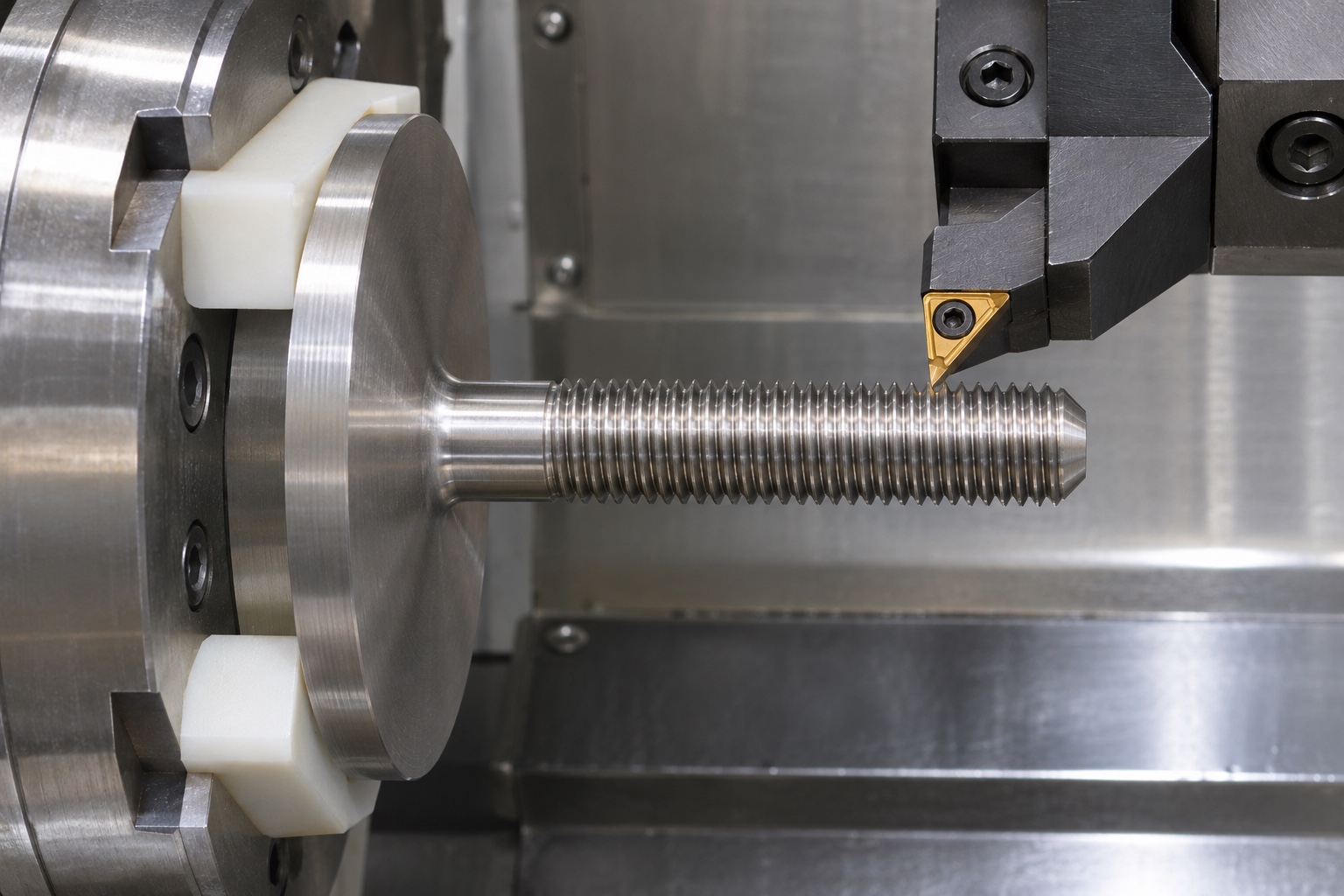
Review blank size, gripping allowance, tool access and separation from the stock as one sequence. Turning the stem and accessible foot features in a common setup can establish useful relationships, but the underside may still need a controlled second setup. That transfer must recover the intended references without damaging the external thread or distorting a thin foot. Protective jaws are a workholding choice, not evidence of the resulting accuracy. Define where the part can be held, which face is finished last and how the finished seating surface remains identifiable during inspection.
Select thread tools without hiding crest and root requirements
Thread turning depends on the selected profile, tool reach and the actual machine setup. Insert selection affects which parts of the thread form are generated and which preturned diameters still need separate control. Do not assume that a thread cutting pass automatically establishes every crest, root or outside-diameter requirement. Review tool withdrawal near the foot and the clearance for the last useful turn. Cutting parameters must be selected for the material, tool and setup rather than copied from a different stud. This guide does not prescribe a universal speed, feed or pass count.
Control the runout region and deburr without changing the fit
The transition between the foot and useful thread deserves a drawing-led review. An unfinished turn, raised lip or trapped chip can interfere with assembly even when the visible middle turns appear regular. Deburring should remove unintended edges without flattening crests, rounding the seating perimeter excessively or reducing the specified engagement length. Inspect the chamfer and transition after the final operation, not only immediately after threading. If reaching an edge requires a new relief or a larger radius, obtain approval before altering the geometry. Convenience at the tool is not authority to redesign the connection.
Match thread gauges to the acceptance question
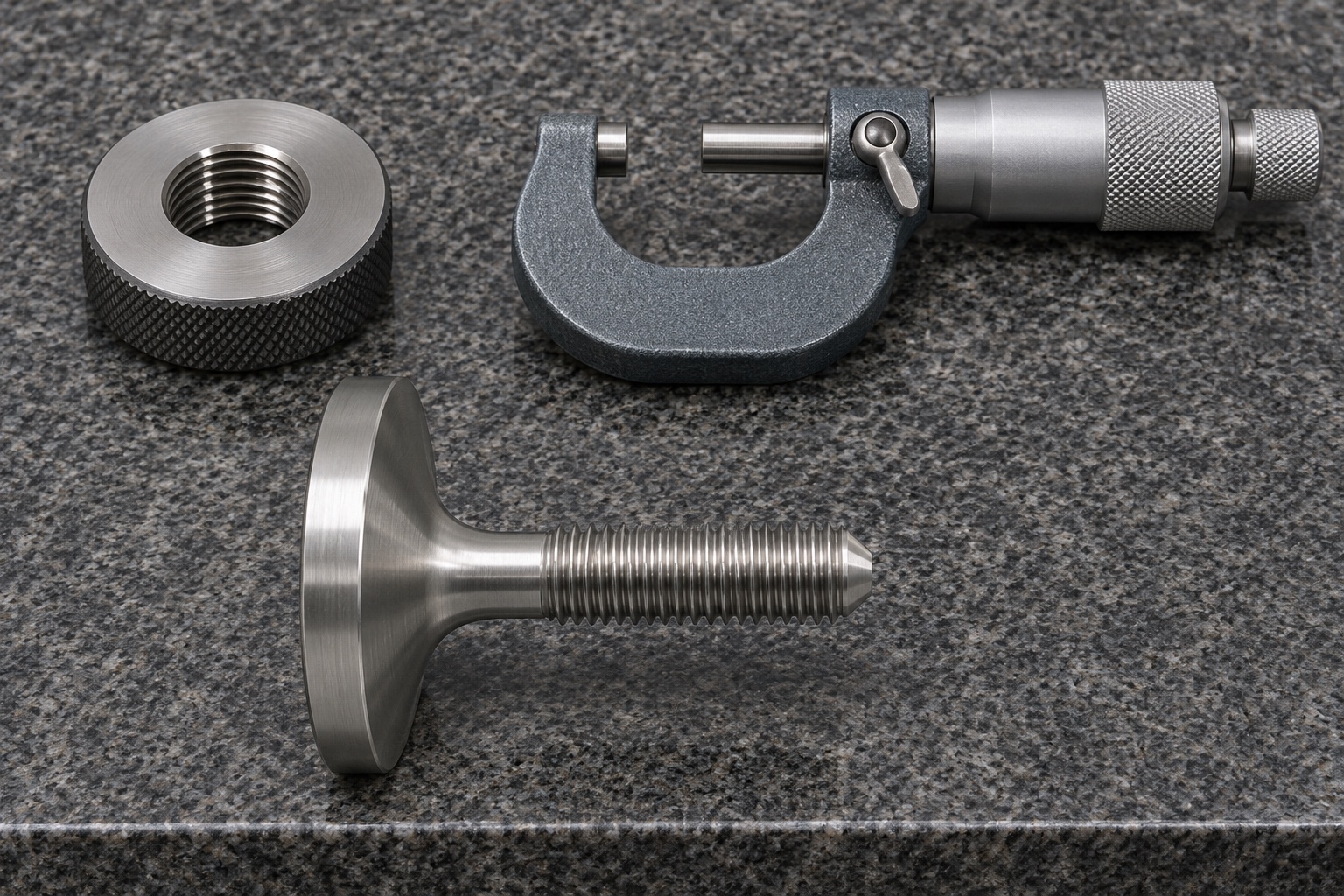
A suitable thread ring gauge can address specified functional thread limits, but it does not separately report foot flatness, stem alignment, material identity or every local profile characteristic. Confirm the gauge designation, condition and required engagement procedure against the inspection plan. Do not force a gauge across damaged starts or use a convenient nut as the sole acceptance method. Additional measurements may be needed for the outside diameter, useful length or other drawing features. Record what each method evaluates and what it does not, keeping actual readings distinct from nominal drawing values.
Build a feature-based first-article inspection record
An inspection report should link the stud revision, material, final condition, datums and measured features. Include foot diameter and thickness, seating condition, stem geometry, thread designation, usable length, tip chamfer and required relationships. Choose methods that can reach the intended surfaces without uncertain alignment or excessive contact force. A micrometer reading is not a complete thread inspection, and a gauge photograph is not an inspection report. Record the actual setup and results when real parts are made. Resolve inaccessible or ambiguous features before deciding that the component is acceptable.
Limit supplementary assembly checks to their real scope
An inert mating reference may help observe thread starting, access and whether the disc foot reaches the intended seating surface. Such an observation should identify the reference revision and the assembly condition. It cannot establish a load rating, loosening resistance, cleaning performance, basket compatibility or service life in an operating medical system. If those functions are required, the equipment designer must define separate qualification activities. A smooth hand assembly is useful only as the specific observation performed; it should not replace dimensional acceptance or become an unsupported safety claim in a purchasing record.
Protect the thread and foot during cleaning and packaging
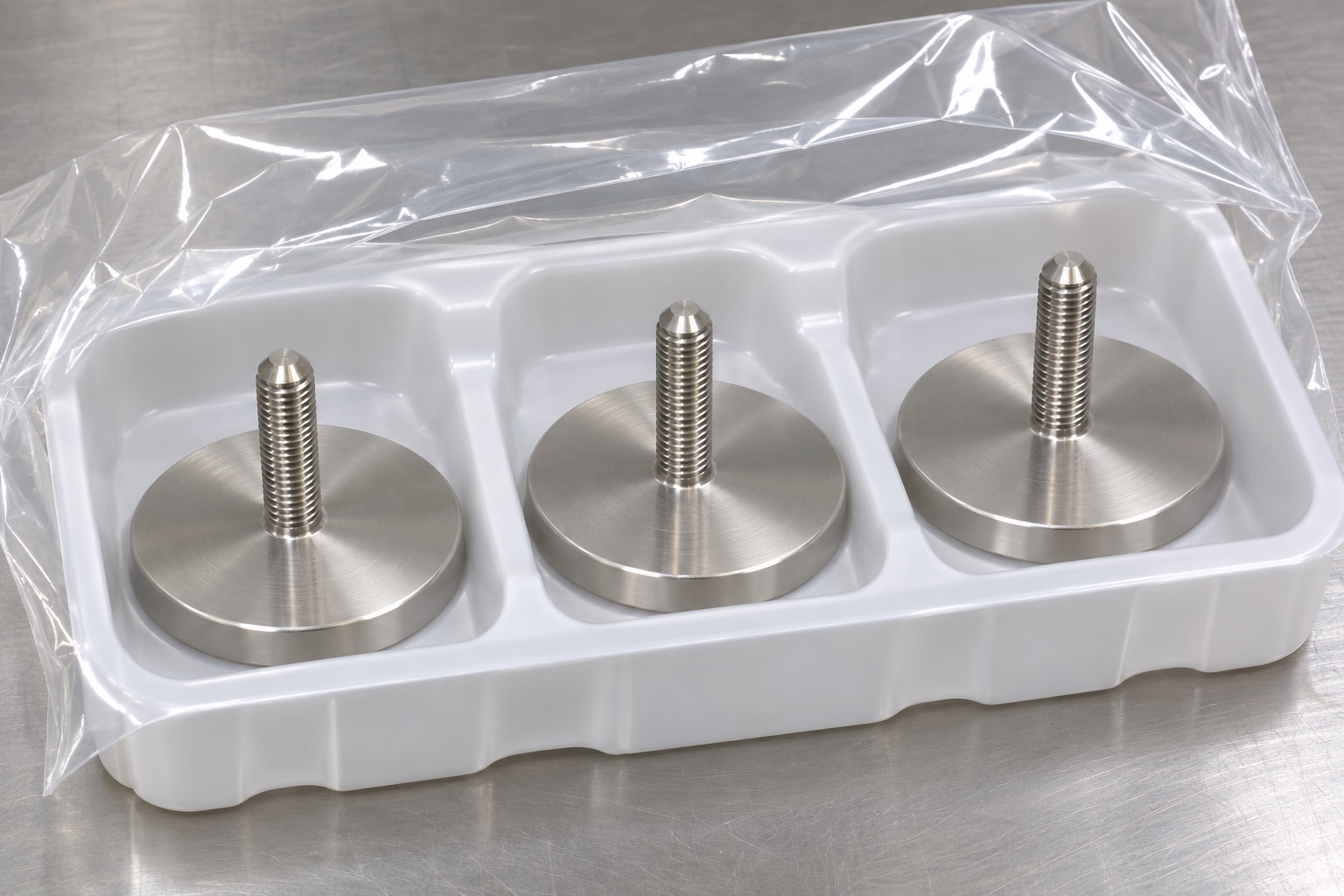
Remove machining debris according to the agreed outgoing condition, paying attention to the thread root and foot transition. Define residue limits and verification methods if the application requires them. Separate parts so that threaded stems cannot strike adjacent seating faces during handling. Packaging should support the part without forcing a protective cap into a functional thread unless that approach is approved. A clean-looking tray is protective packaging, not a sterile barrier or proof of validated cleanliness. Preserve identification outside sensitive surfaces and state what the receiving team should check before storage or assembly.
Prepare a drawing-based RFQ for custom support studs
A useful request for quotation includes the drawing, model, quantity, material definition, thread designation, engagement requirement, foot datum and final condition. Highlight inspection expectations and any controlled relationship between the seating plane and thread axis. Separate prototype quantities from later small-batch needs without assuming identical workholding or inspection effort. Ask for DFM comments on tool withdrawal, second-setup recovery and gauge access before authorizing production. The objective is a measurable scope for custom medical fixture parts, with machining evidence separated from the qualification of the complete wash-basket system.
FAQ
Does a thread ring gauge prove the stud can carry a specified load?
No. It evaluates the thread characteristics covered by the selected gauge and procedure. Load capacity depends on the complete connection, materials, engagement and service conditions and requires a separate defined assessment.
Is full-thread length the same as total stem length?
No. Tip chamfers, incomplete starts and withdrawal regions can reduce usable engagement. The drawing should specify useful full-thread length and any transition requirements rather than relying on total stem length alone.
Can a normal nut replace the specified inspection gauge?
Not automatically. A nut may support a limited assembly observation, but its own condition and tolerance must be known. Use the approved inspection method for drawing acceptance and record assembly observations separately.
Does specifying 316L prove cleaning or sterilization compatibility?
No. Exact material, surface condition, cleaning chemistry and exposure all matter. Compatibility and cleaning or sterilization validation belong to the defined component and equipment qualification, not the alloy name alone.
Should the foot underside and upper face have identical requirements?
Only if the design requires that. Identify the seating surface and its relationship to the thread axis. Avoid copying the same finish or geometric tolerance onto surfaces that serve different functions.
What should accompany a small-batch CNC machining inquiry?
Provide the revision-controlled drawing, material definition, quantities, complete thread designation, usable engagement length, foot references, surface requirements and inspection scope. Identify additional system tests separately from part acceptance.

tanghangyun@oemach.com