
Whether the vacuum chamber can be assembled smoothly depends not only on the overall dimensions, but also on whether the sealing surface, threaded interface, orifice status and delivery protection are unified in advance. OEMach can help check these critical conditions before small batch CNC machining, reducing the risk of post-assembly rework.
The quotation of vacuum chamber parts is often not confirmed immediately after the outline dimensions are given in the drawing. The reason is not that the processing factory is unwilling to quote, but that the cavity really affects the assembly, usually not just the outer contour: whether the sealing surface is controlled as a critical surface, whether the threaded hole corresponds to the external pipeline, whether the orifice allows burrs, and whether specific cleaning and protection methods are required before delivery will all change the process arrangement.
For low-volume projects of semiconductor equipment, the cavity is often still in the prototype verification or structural iteration stage. What needs to be avoided most at this time is to first complete the part according to ordinary machining ideas, only to discover during the assembly or vacuum testing stage that the sealing surface, interface direction or cleaning requirements have not been included in the early plan.
Design inputs, machining controls and delivery impact
| Confirm items | What needs to be explained before quoting? | Common consequences of omission |
|---|---|---|
| sealing surface | Sealing form, docking parts, critical plane requirements | Leakage or repeated repairs after assembly |
| Threads and interfaces | Specifications, effective tooth depth, interface direction, plug relationship | The pipeline cannot be installed or interferes with |
| Internal features of the cavity | Deep cavities, blind holes, inside corners and cleaning requirements | Processing accessibility or risk of debris |
| Surface and cleaning | Surfaces to be protected, packaging and cleaning requirements | Secondary processing before shipping or assembly |
The sealing surface is not as simple as a flat surface
Flange sealing surfaces should be viewed together with seals, mating flanges and locking methods. There is a correlation between flatness, surface condition, bolt hole distribution, local chamfers and cleaning methods. If only a certain plane dimension is emphasized without explaining the sealing form and connecting parts, it will be difficult for the craftsman to judge which areas must be used as key control objects.
Likewise, holes, slots and lateral interfaces on the inside of the cavity should not be understood solely in terms of unit size. They may play the role of air path, sensor installation, observation window or auxiliary positioning, and the orifice status and assembly direction may affect subsequent connections.
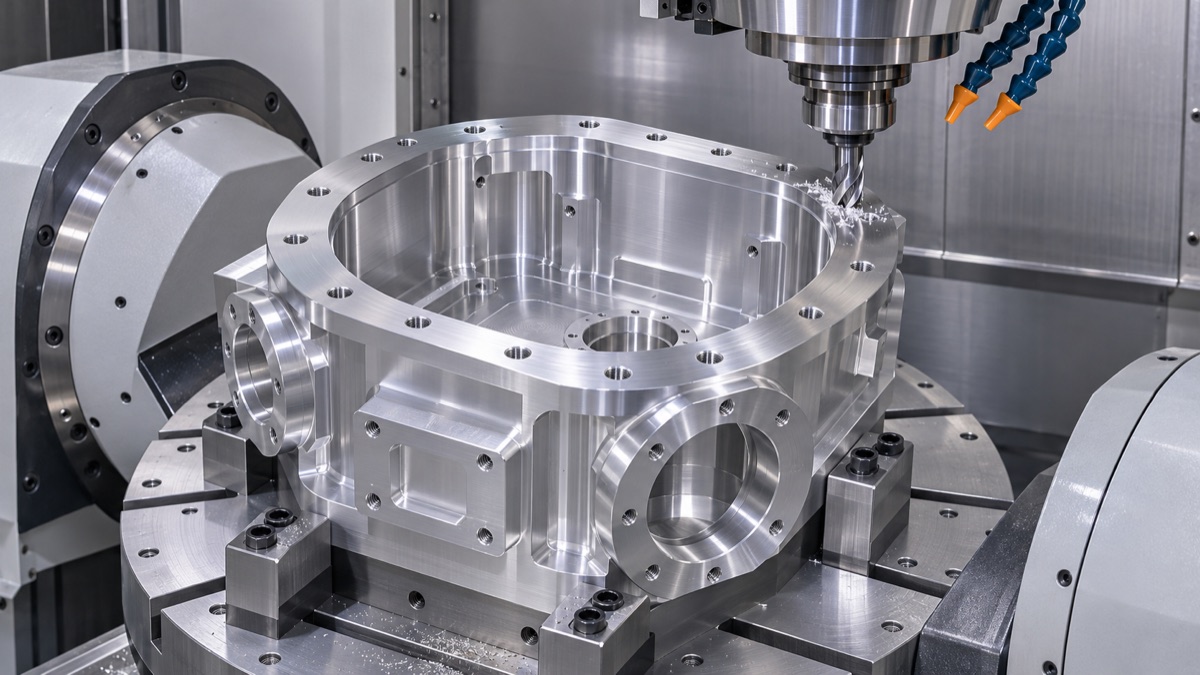
CNC machining scene of deep cavity and flange surface of vacuum chamber
What information should be frozen first for small batch projects?
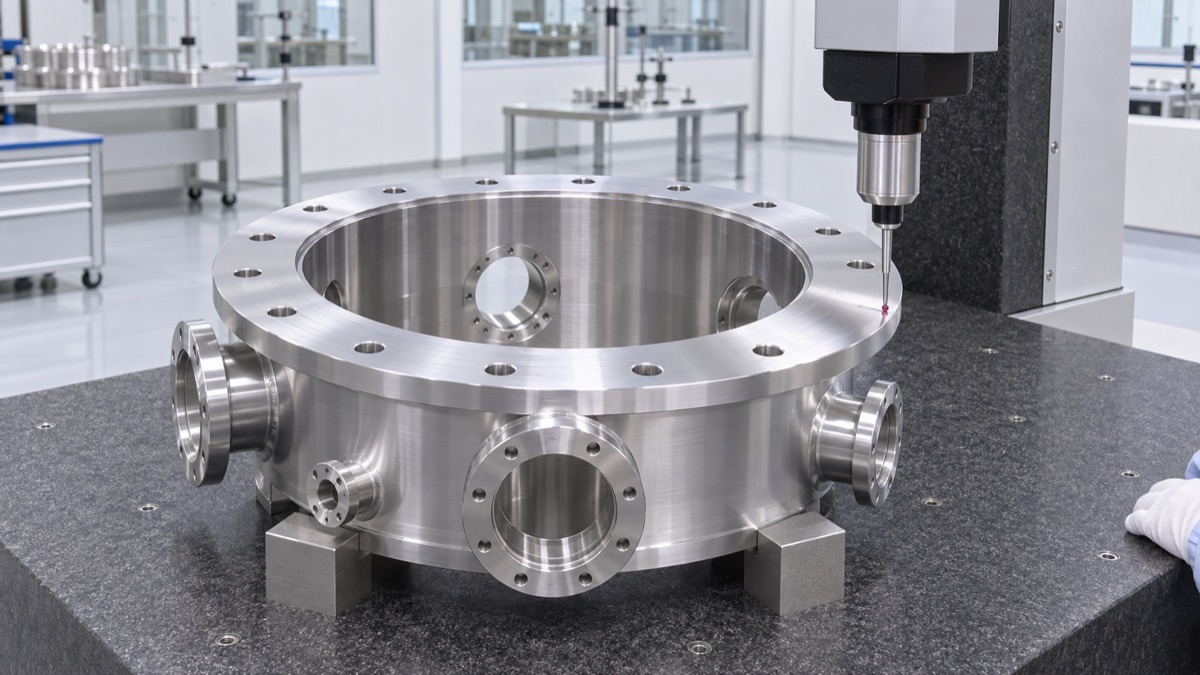
Dimensional review of vacuum flange sealing surfaces and orifices
Threaded hole and orifice condition often underestimated
The number of threaded holes on the vacuum chamber is large and scattered, and some connectors are very close to the sealing surface. If the thread bottom hole, hole chamfer, tapping direction and effective tooth depth are not confirmed in the early stage, it is easy for the screw to bottom out, the sealing ring to be scratched, or the assembly tool to be unable to enter.
In the small batch stage, it is recommended to supplement the key interfaces with assembly views to the processing side. In this way, the processing sequence, clamping method and whether secondary finishing or re-inspection processes need to be set aside can be determined in advance.
Cleaning and protection should be included in the delivery requirements
For cavity parts, delivery doesn't stop at dimensional compliance. Whether the sealing surface and interface are scratched during the turnover, cleaning, and packaging processes, and whether residual chips may enter the cavity, should all become part of the delivery conditions. Different projects have different definitions of cleanliness, and "clean delivery" cannot be used to replace specific requirements.
When OEMach handles inquiries for such non-standard cavities, it can first confirm manufacturability based on drawings, docking parts and delivery requirements, and then clarify key surfaces, hole systems, inspection items and packaging protection methods. For projects whose structure is still being adjusted, unifying the interface logic first is more controllable than relying on rework and correction later.
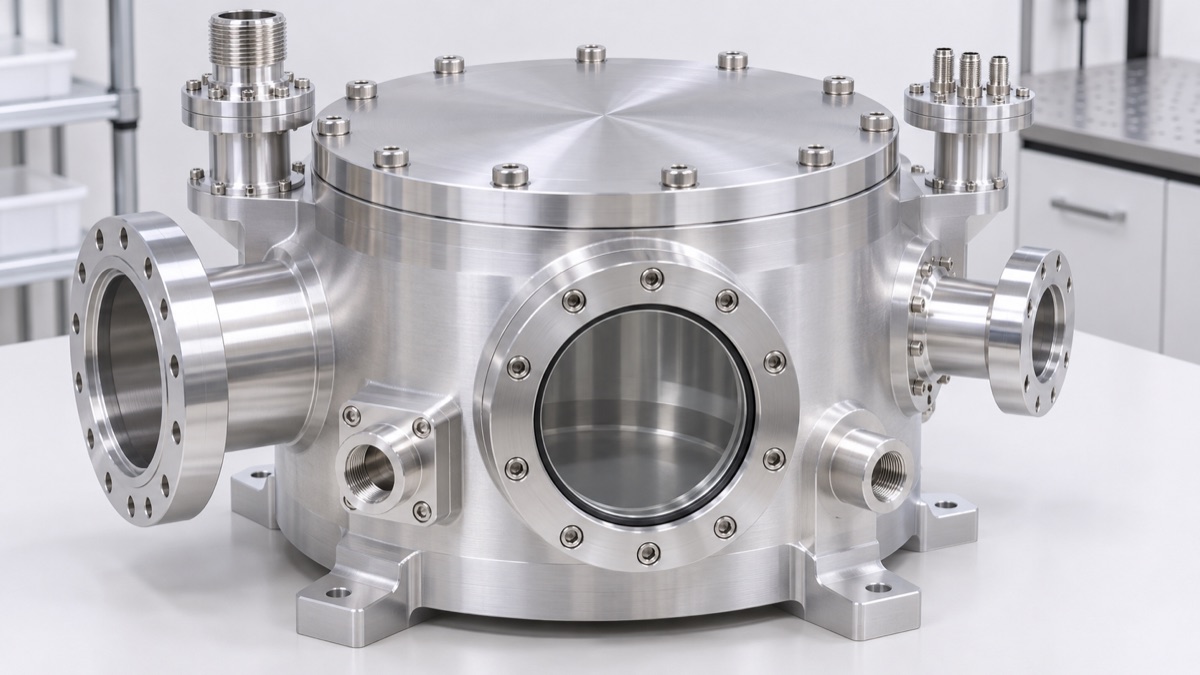
Schematic diagram of vacuum chamber products that complete cleaning and interface protection
Summary
The core of the semiconductor vacuum cavity is not just to process the cavity, but to establish the sealing, interface, cleaning and delivery requirements in the same solution. After submitting the drawings and cooperation information, OEMach can assist in completing the DFM review and confirmation of the small batch CNC machining plan.
FAQ
What are the minimum information required for small batch processing of vacuum chambers?
It is recommended to provide 2D drawings, 3D models, docking interface information, sealing methods, materials, quantities, surface requirements and delivery time.
Does the sealing surface need to be completely ground?
Not necessarily. It should be determined based on the sealing form, plane requirements, materials and part structure, and cannot be judged independently from the assembly conditions.
Do all threaded holes on the cavity need to be inspected?
It is recommended to specify the inspection method for key interface holes; for a large number of ordinary holes, random inspection or full inspection rules can be formulated according to project requirements.
If there is no final assembly, can the cavity be machined first?
The shape and non-critical features can be evaluated first, but interfaces related to sealing, piping and positioning are recommended to be frozen after the docking data is clear.
How to protect the sealing surface during delivery?
Protective materials, packaging methods and handling requirements should be clearly stated in the order to avoid damage to processed critical surfaces during turnover.
Ready to get a quote for your CNC machined parts?
Submit your engineering drawings to qiancj@oemach.com. We support prototype sampling and small-batch production with strict tolerance control.