
The unit price of small batches is not a simple machine-time multiplication rate. The quotation also includes one-time fixed costs, piece-by-piece variable costs and project risks, and an increase in quantity will only dilute part of them.
First split the total price into fixed costs and variable costs, and then reduce fixed preparation and changeover through product family tooling, version freezing, reasonable tolerances and inspection planning, instead of omitting necessary quality activities. The specific process still needs to be confirmed by combining materials, programming DFM, clamping tooling, equipment time, tools, inspection, outsourcing, risks, packaging and quantity amortization.
Typical problems, causes, controls and evidence
| Problem | Likely cause | Control action | Acceptance evidence |
|---|---|---|---|
| Quantity increases but unit price decreases slightly | Materials or machine hours are the main variable costs, and fixed costs account for a low proportion | First split the fixed and variable costs before judging the quantity effect | Quotation details, cycle time, material utilization and inspection plan |
| Continuously adding fees after low price quotation | Tooling, testing, outsourcing or risky processes were omitted from the initial report | Unify quote inputs and inclusion ranges, document assumptions and exclusions | Quotation lists, routings and change records |
| Blindly enlarging batch size to dilute costs | The design has not been frozen or the quality risk has not been closed | Divide into batches according to verification stages and reuse tooling and procedures | Release status, batch release and inventory risk assessment |
Let’s first look at what costs the quotation consists of
Common components are materials and blanking, DFM and programming, tooling and clamping, equipment processing time, tool consumables, deburring cleaning, inspection, heat treatment or surface treatment, packaging logistics, and risks. Taxes and commercial terms will also affect the final amount. Different factories have different rate structures, and there is no unified industry unit price that is separate from drawings.
Fixed costs determine the dilution rate of small batches
Programming, soft grippers or fixtures, first article commissioning, CMM procedures and outsourcing billing typically do not scale up between 10 and 100 pieces. It can be understood as a simplified relationship: the unit cost is approximately equal to the piece-by-piece variable cost, plus the fixed preparation cost divided by the qualified quantity. If the variable machine time dominates, the decrease in increasing quantity will be smaller.

The quotation should distinguish between fixed preparation costs, piece-by-piece variable costs and risks.
Quantity ladder comes from craftsmanship rather than integers themselves
10 pieces may be machined piece by piece with a universal fixture, and after 50 pieces it may be worth making multiple fixtures; 100 pieces may require special gauges or tool life management. Minimum specifications for material procurement, minimum charges for surface treatment, and furnace loading batches will also form a ladder. Suppliers should be asked to explain where the price reduction comes from rather than just comparing a percentage.
Product family and module tooling reduces repetitive preparation
Unify the positioning datum, blank specifications and clamping interfaces of similar parts, and reuse soft claws, base plates, program templates and inspection plans. NIST information on rapid changeover points out that reducing the changeover time between the last piece and the next qualified product can improve productivity. Reuse must be verified by version, and old programs cannot be misused for new parts.
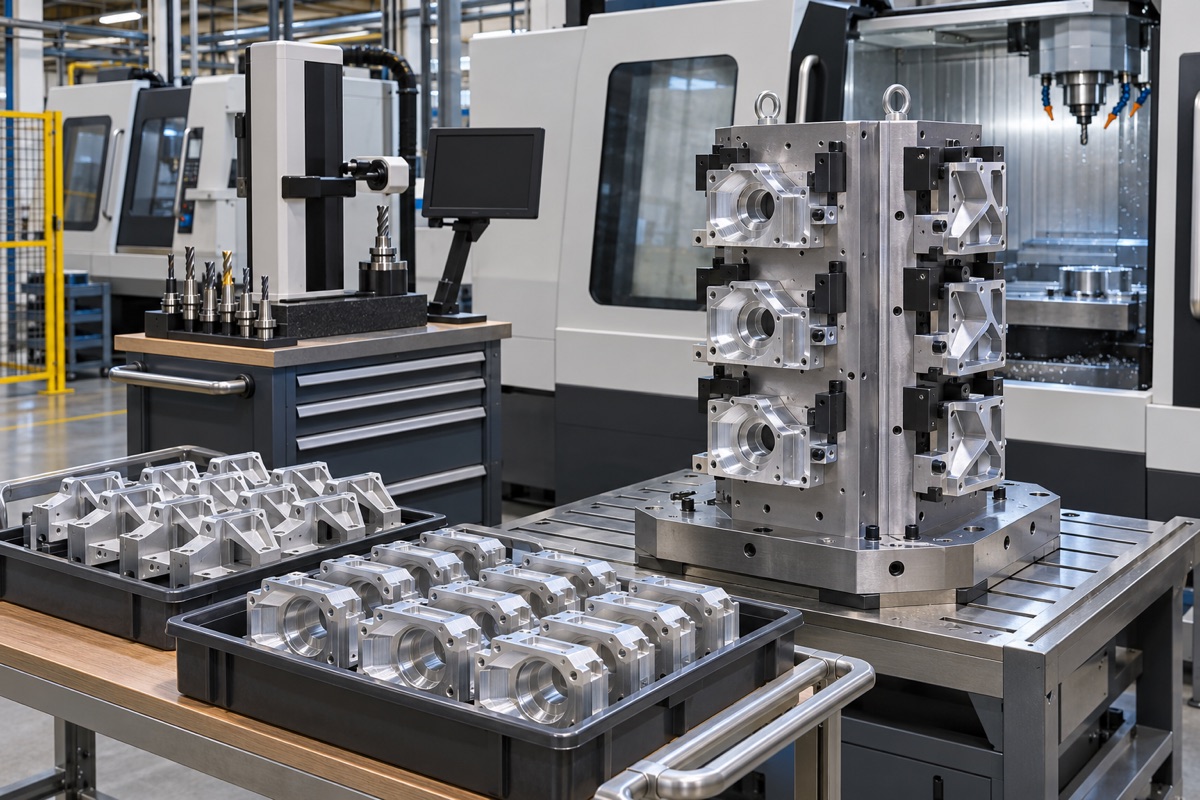
Reusing datums, tooling, and procedures reduces changeovers and spreads setup costs.
Reasonable tolerances and inspection solutions can also reduce costs
Marking all dimensions to tight tolerances increases finishing, stabilization time, and inspection. The design should distinguish key and general characteristics based on functions, and agree on the scope of random inspection or full inspection. If key features require 100% testing, this should be made clear when quoting, and do not temporarily add reporting items before delivery.
Batch strategy should be subject to R&D risks
When the design has not been frozen, making 100 pieces at a time in order to dilute the clamping may result in scrap inventory. A small amount of verification can be done first, and then the tooling and procedures can be reused to add batches. OEMach recommends comparing the total project cost: unit price, iteration risk, delivery time, inspection and inventory to determine the optimal quantity.
Summary
First split the total price into fixed costs and variable costs, and then reduce fixed preparation and changeover through product family tooling, version freezing, reasonable tolerances and inspection planning, instead of omitting necessary quality activities. The specific process still needs to be confirmed by combining materials, programming DFM, clamping tooling, equipment time, tools, inspection, outsourcing, risks, packaging and quantity amortization.
FAQ
Why does the unit price drop much from 10 to 20 pieces, but less from 50 to 100 pieces?
Fixed costs are significantly diluted in the early stage, and the proportion of variable materials and machine hours increases in the later stage.
Can you give a unified hourly machining price?
No. Equipment, regions, utilization rates, process risks and service scope are different, and the specific quotation should prevail.
Is it necessarily cheaper for customers to prepare their own materials?
Not necessarily. Also consider margins, certification, blanking, incoming material inspection, loss and exception responsibilities.
Ready to get a quote for your CNC machined parts?
Submit your engineering drawings to qiancj@oemach.com. We support prototype sampling and small-batch production with strict tolerance control.