
The deformation after rough machining comes from the combined effects of the original residual stress of the blank, new cutting stress, asymmetry of removal and clamping. Heat treatment can reduce some of the risk, but routing the wrong temperature can also change strength, hardness and material condition.
First confirm whether the material and supply status allow stress relief treatment, and then use the pre-heat and post-heat data to determine the margin; rough machining, heat treatment, re-basing and finishing must be regarded as a complete route. The specific process still needs to be confirmed based on the material grade and supply status, rough machining removal ratio, heat treatment specifications, deformation direction, margin and retest benchmarks.
Typical problems, causes, controls and evidence
| Problem | Likely cause | Control action | Acceptance evidence |
|---|---|---|---|
| Natural warping after rough machining | Blank residual stress rebalances with asymmetric removal | Symmetrically remove materials in layers, release clamping and record free state deformation | Material status, removal sequence and post-roughing contours |
| Insufficient balance after heat treatment | The process does not predict the deformation direction and amplitude according to parts. | Use the specimen data partition to set the margin and retain it to rebuild the datum. | Comparison before and after heating, allowance map and finishing record |
| Change in strength or hardness after annealing | Mixing stress relief treatment with complete annealing will destroy the original delivery status. | Approval of temperature routes and retesting of performance by material specification | Heat curve, hardness or performance certification and dimensional retesting |
Why are internal stresses exposed after rough machining?
Rolling, forging, welding, quenching and straightening all leave residual stresses. These stresses are temporarily balanced when the blank is complete. After rough machining, the balance is broken and the parts will bend, twist or change the hole shape. Asymmetric structures, long overhangs and high removal rates are particularly sensitive, and forced flattening will only delay deformation until the clamp is released.
Stress relief treatment does not mean complete annealing
Stress relief treatment usually reduces residual stress without significantly changing the structure and properties; complete annealing may significantly soften the material. Temperature, insulation and cooling must be determined based on grade, size, heat treatment status and subsequent performance requirements. For T6/T651 aluminum alloy or hardened steel parts, random annealing may destroy the design state.
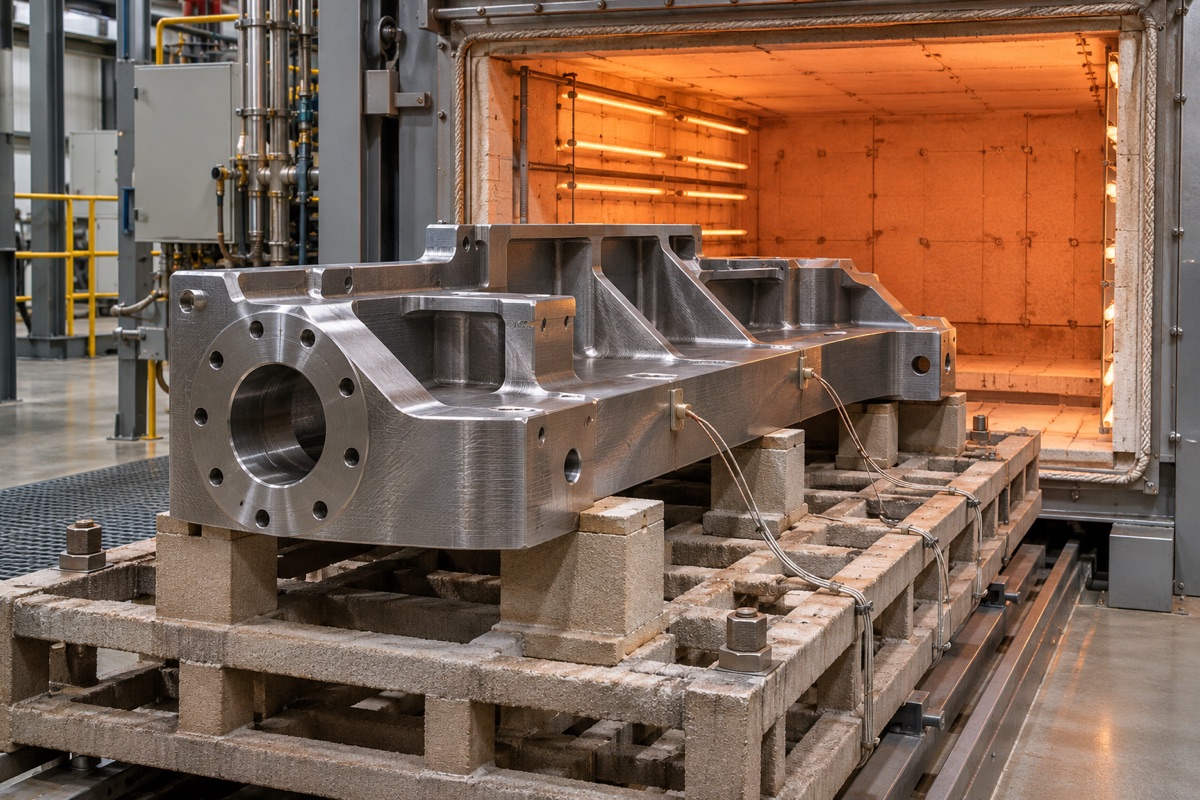
Stress relief routes must match material condition, furnace loading and performance requirements.
Keep a comparable benchmark before and after rough machining
Rough machining should be carried out symmetrically and in layers while retaining sufficient rigidity and process standards. The deformed temporary surface cannot be used directly after heat treatment. It should be cleaned, stabilized and measured before re-establishing the functional benchmark. If there is no correction allowance for all datum planes, even if the dimensions can be ground to a later date, the shape-position relationship may not be restored.
The margin should be allocated by parts and data
It is not safe to leave the same margin uniformly. The deformation directions at the ends of long beams, thin walls, openings and near welds may be different and should be set based on the pre-heat and post-heat data partitions of representative samples. If the margin is too small, the grinding will be incomplete, while if it is too large, the heat input, tool load and risk of re-deformation will increase.
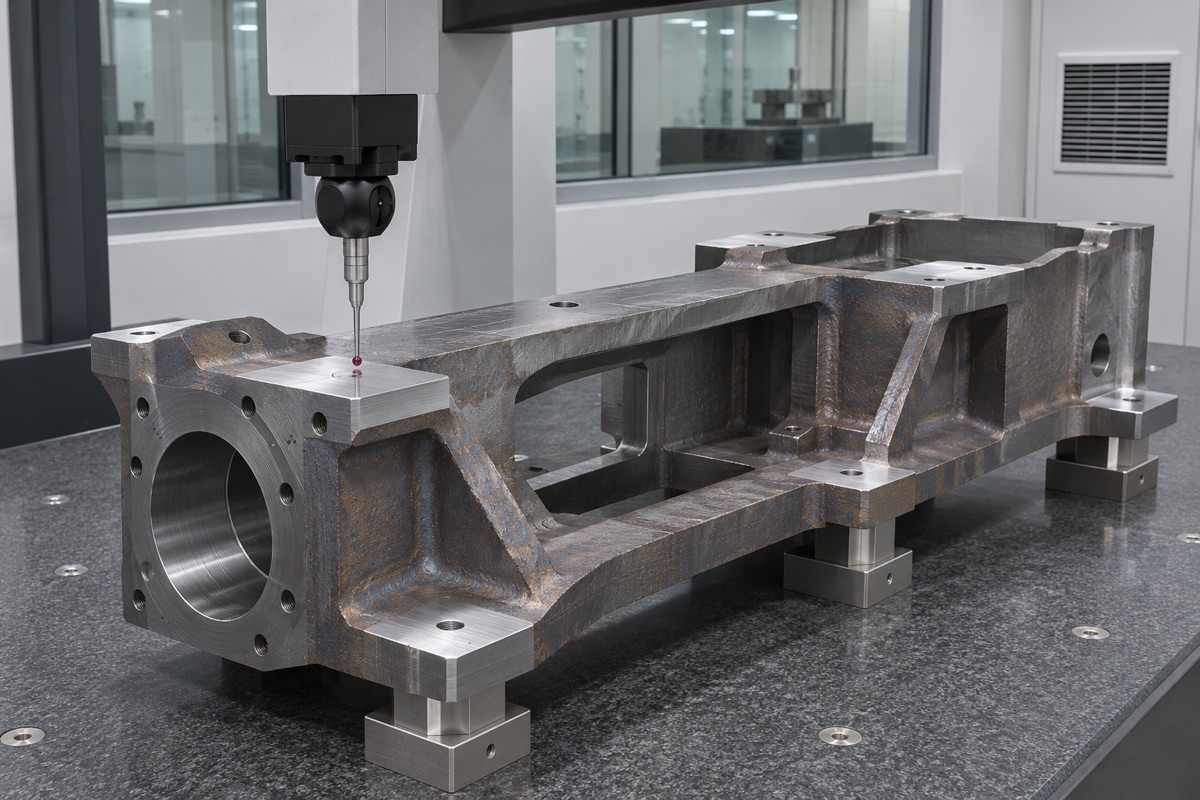
Preheat and postheat paired data are used to determine baseline repair and finishing allowances.
The heat treatment process itself must also be controlled
Furnace support, heating and cooling speed, furnace temperature uniformity, protective atmosphere and cooling methods will all affect deformation and surface. The furnace number, process curve, furnace loading direction and batch identification should be retained; the hardness or performance of key parts should also be reviewed, and the dimensional stability cannot be judged by just using a heat treatment qualification sheet.
Dimensional stability needs to be verified by time and state
Retesting after heat treatment should be carried out at the agreed temperature and support state, and should correspond to the data before and after rough machining. OEMach will include the deformation direction, baseline repair amount and finishing allowance into the first article record; without real project data, it does not promise to unify temperatures, hours or deformation ratios.
Summary
First confirm whether the material and supply status allow stress relief treatment, and then use the pre-heat and post-heat data to determine the margin; rough machining, heat treatment, re-basing and finishing must be regarded as a complete route. The specific process still needs to be confirmed based on the material grade and supply status, roughing removal ratio, heat treatment specifications, deformation direction, margin and retest benchmarks.
FAQ
Do all precision parts need to be annealed after rough machining?
No need. Treatment depends on material, delivery status, construction, removal rate and dimensional stability requirements, and requires design or material specification approval.
Can natural aging replace heat treatment?
It cannot be generalized. Natural placement may release some changes, but the cycle and effect are unstable and should be verified by data.
Will it definitely stop deforming after stress relief?
No. Subsequent finishing, clamping, temperature and surface treatments can still introduce or relieve stresses.
Ready to get a quote for your CNC machined parts?
Submit your engineering drawings to qiancj@oemach.com. We support prototype sampling and small-batch production with strict tolerance control.