
The "high cleanliness" of medical parts is not a fixed value that is independent of the product. Requirements are derived from the intended use, nature of contact, subsequent cleaning and sterilization processes, and the manufacturer's risk management, and translated into verifiable supplier specifications.
CNC suppliers should control materials, process contamination, cleaning transfer and traceability; legal manufacturers are still responsible for product risk management, cleaning or sterilization verification and biological evaluation. No single-channel processing can independently prove the compliance of finished products. The specific process still needs to be combined with product regulatory boundaries, material certification, process contamination sources, cleaning verification, traceability, controlled transfer and biological evaluation responsibility confirmation.
Typical problems, causes, controls and evidence
| Problem | Likely cause | Control action | Acceptance evidence |
|---|---|---|---|
| The size is acceptable but there are still residues after cleaning. | Blind holes, rough surfaces or cutting fluid create difficult-to-clean areas | Design and process work together to evaluate cleanability and validate cleaning processes | Contamination source list, cleaning verification, residue and packaging records |
| Batch traceability cannot be closed | Materials, tooling, cleaning, outsourcing and packaging records are scattered | Establish a unique batch chain from material batch to finished product packaging | Material certification, process records, cleaning batches and release documents |
| Supplier claims biocompatibility but no product evidence | Equating material grade or machine cleanliness with finished product evaluation | Biological evaluation completed by the legal manufacturer based on expected exposures and risks | Product definition, risk management, biological evaluation and change recording |
First confirm the product and regulatory scope
Medical device parts may be used in surgical instruments, implants, diagnostic equipment, or non-patient contact structures, and cleanliness and documentation requirements are not the same. Items should be clarified by the statutory manufacturer about product classification, intended use, contact nature, material standards, key characteristics and release rules, and then the applicable requirements should be passed on to the processing supplier. You cannot just write "medical grade" on the inquiry form.
The quality system should cover procurement and process records
ISO 13485:2016 is the international standard for medical device quality management systems. The US FDA's QMSR will take effect on February 2, 2026, and incorporate ISO 13485:2016 into the 21 CFR Part 820 framework. Specific projects must also comply with target market regulations and customer quality agreements. The system certificate itself cannot replace part process and batch evidence.
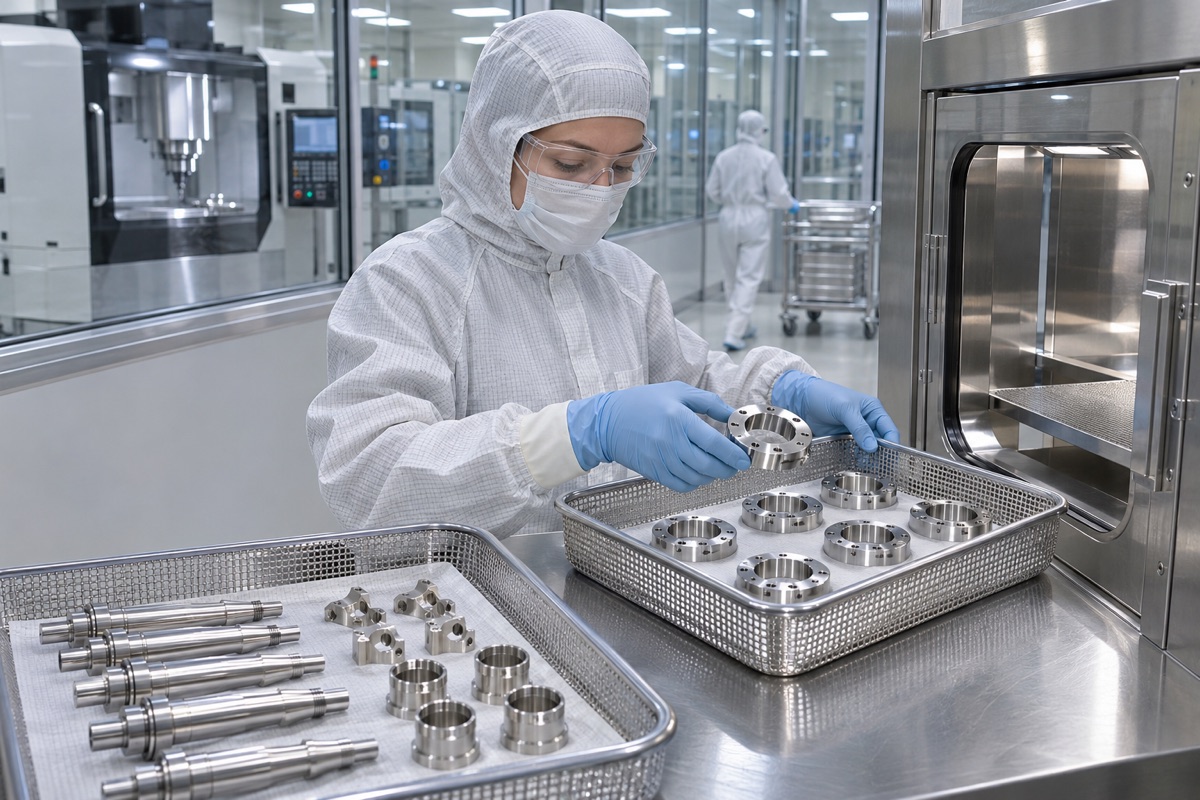
Materials, processing, cleaning and packaging require a continuous traceability chain.
CNC processes should identify sources of contamination
Material mixtures, tool coatings, cutting fluids, cleaning agents, abrasive media, hand sweat, burrs and foreign metal particles can all be sources of contamination. The process card should specify material segregation, equipment cleaning, tool and media suitability, burr boundaries, waiting before cleaning, and tray loading methods. Blind holes, elongated holes, seams, and rough surfaces reduce cleanability and should be addressed in design reviews.
Cleaning must be verified according to product risk
ISO 19227 discusses orthopedic implant cleanliness, emphasizing physical, chemical and microbiological contamination and cleaning process validation, but it does not automatically apply to all medical parts. The project identifies manufacturing contaminants, sets acceptance limits and verifies cleaning, rinsing, drying and subsequent packaging. Pre-cleaning completed by the CNC supplier is also not equivalent to finished product cleaning or sterilization validation by the final manufacturer.
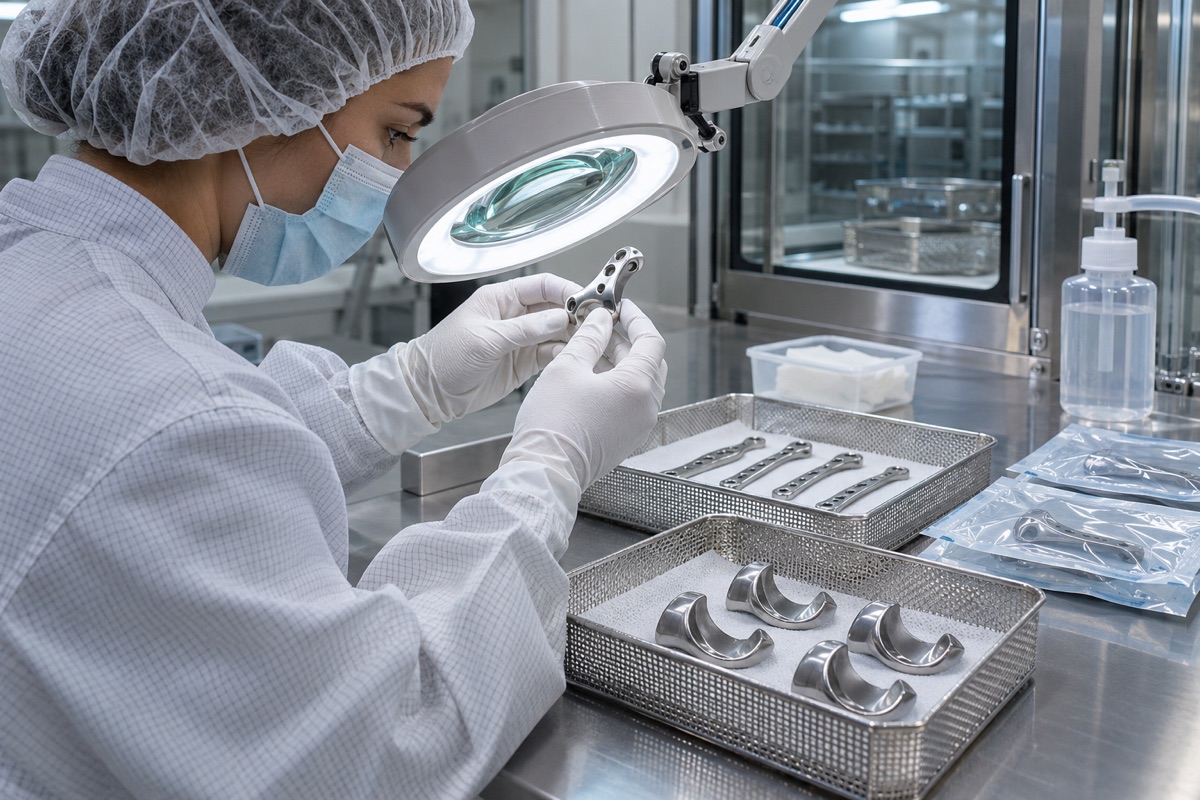
Appearance inspection is one of the evidences for release and cannot replace cleaning verification.
Clean shipping and packaging are equally controlled
If it is stored open in an ordinary turnover box after cleaning, or mixed with uncleaned tooling, the pre-sequence control will be ineffective. Clean zone level or controlled area, personnel and gloves, container material, exposure time, packaging sealing and transportation protection should be specified. ISO 14644-1 is used to classify clean rooms based on air particle concentration, but air class alone cannot prove chemical or microbiological cleanliness of part surfaces.
Brand integration must be based on responsibility boundaries
OEMach (OEMach) can collaborate with customers on precision CNC, material and batch traceability, process cleaning and controlled delivery; the regulatory strategy, risk management, biocompatibility, cleaning and sterilization verification of the final product are still confirmed by the corresponding responsible entities. Public articles do not claim that a common process will make all medical parts compliant.
Summary
CNC suppliers should control materials, process contamination, cleaning transfer and traceability; legal manufacturers are still responsible for product risk management, cleaning or sterilization verification and biological evaluation. No single-channel processing can independently prove the compliance of finished products. The specific process still needs to be combined with product regulatory boundaries, material certification, process contamination sources, cleaning verification, traceability, controlled transfer and biological evaluation responsibility confirmation.
FAQ
Does ISO 13485 certification mean that the part is medically compliant?
Doesn't mean. It is a quality management system requirement and specific parts still need to meet product, market, drawing and validation requirements.
Is 316L naturally biocompatible?
Don't draw conclusions based on the name of the material alone. Standards, condition, processing residues, surfaces and expected contacts are verified and the corresponding evaluation completed by the manufacturer.
Can clean room processing omit cleaning?
It cannot be generalized. Whether to clean depends on the contamination control strategy and validated product requirements.
Ready to get a quote for your CNC machined parts?
Submit your engineering drawings to qiancj@oemach.com. We support prototype sampling and small-batch production with strict tolerance control.