
PEEK has good dimensional stability, but processing heat, semi-finished product stress, crystallization state, filling system and measuring force will still cause precision dimensional drift. Annealing is not a universal remedy for all problems.
Stable PEEK precision parts come from correct material conditions, sharp tools, low-force support, staged material removal and controlled thermal history; the annealing curve must be determined based on the grade, thickness, use temperature and material manufacturer's guidance. The specific process still needs to be confirmed by combining PEEK grade and filling system, semi-finished product internal stress, crystallinity, cutting heat, sharp tools, low-force clamping, staged removal, annealing curve and constant temperature testing.
Typical problems, causes, controls and evidence
| Problem | Likely cause | Control action | Acceptance evidence |
|---|---|---|---|
| Dimensions continue to change after PEEK processing | The internal stress, cutting heat or crystallization state of the semi-finished product is rebalanced after processing. | Confirm the material and annealing status, remove materials in stages, and then finish processing and inspection after stabilization | Material certification, annealing curve, dimensions at each stage and constant temperature records |
| The thin ring deforms or opens after clamping | Polymer stiffness is low, chuck and probe forces are relatively excessive | Use low-force uniform supports to control clamping and measuring forces and evaluate free states | Fixture settings, before and after clamping dimensions, repeat measurements and free state results |
| Filled PEEK tools wear too quickly | Glass fiber or carbon fiber reinforced systems are highly abrasive, and tool selection and service life are insufficient. | Select wear-resistant sharp tools according to the actual filling system and manage their lifespan | Material grade, tool type, wear, burr and surface records |
First distinguish the PEEK grade and filling system
Unfilled PEEK, glass fiber reinforced, carbon fiber reinforced and wear-resistant formulations differ in stiffness, thermal expansion, abrasion and dimensional response. Procurement documents should include material grade, color, filling ratio, semi-finished product form and batch certificate. Ensinger data points out that PEEK is suitable for precision machining, but fiber reinforced materials will increase tool wear and process complexity.
The thermal history of semi-finished products determines the starting point of internal stress
Extruded rods and molded blanks may retain stress during forming and cooling. After a large proportion of material is removed, stress redistribution can deform thin rings, openings and asymmetric structures. It should be confirmed whether the material supplier has completed stress relief, and stabilization and retesting should be arranged after rough machining. The size cannot be determined directly after forced flattening with a clamp.
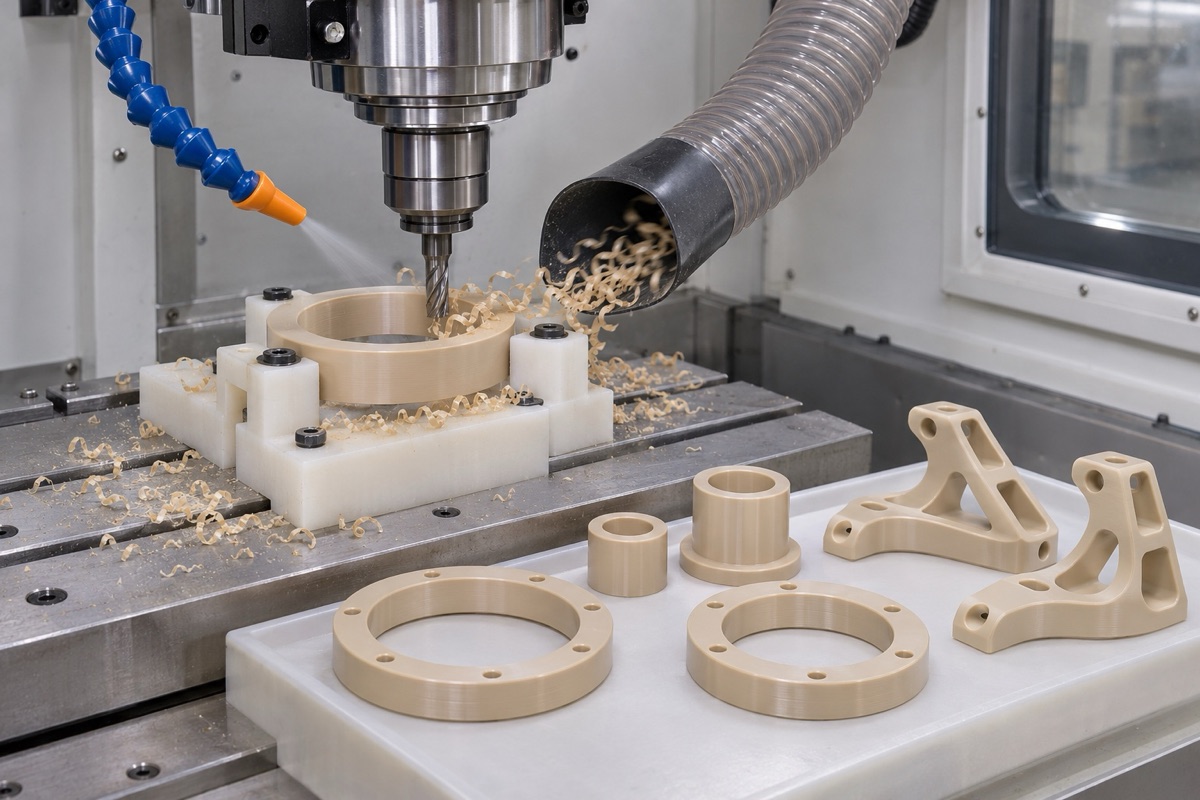
Sharp knives, controlled heat and uniform support reduce plastic deformation.
Cutting heat needs to be removed gently but effectively
The high melting point of PEEK does not mean that local cutting heat can be ignored. Dull knives, excessive friction and chip accumulation can cause surface temperature rise, burrs and dimensional changes. Sharp tools, stable cutting thickness, reasonable chip removal and clean air or an adapted cooling scheme should be used. For medical or cleaning purposes, the cooling medium and cleaning requirements must also be confirmed, and ordinary cutting fluid cannot be used by default.
Low-force clamping and staged machining reduce springback
Polymers are less stiff than metals, and chucks, platens, and measurement forces may change the aperture and plane. Clamps should provide uniform support and repeatable low clamping force, and thin rings may use soft jaws or form-fitting support. Roughing and finishing are separated, and the key dimensions are completed after the heat and stress have stabilized, and are retested in the free state or the state specified in the drawing.
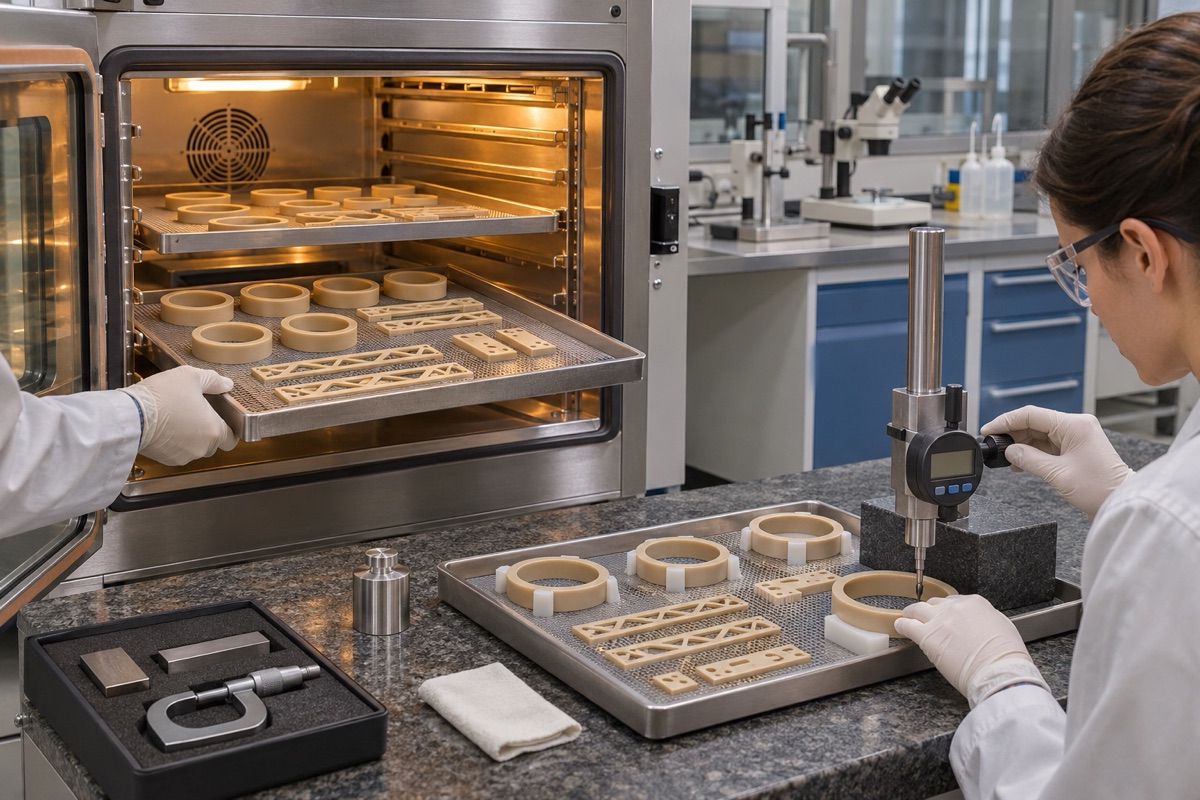
The annealing curve and detection status must be confirmed according to the specific material and thickness.
Annealing must use the material manufacturer's applicable curve
The PEEK finishing guide compiled by Victrex gives a recommendation of balancing at 200 degrees Celsius, holding the wall thickness and cooling slowly, and states that machined parts should be annealed before final finishing. This curve is a guide for specific material manufacturers and is not a universal prescription for all PEEK grades. Higher temperatures may change crystallinity, mechanical properties, color and ductility and must be confirmed according to material and use.
Constant temperature detection and operating load must be considered
PEEK dimensions are affected by temperature, time, load and support. Before testing, the constant temperature time and environment should be specified, appropriate measuring force should be used, and the status of the parts should be recorded. Creep and operating temperature also need to be evaluated for long-term compression fits. Short-term dimensional compliance at room temperature does not automatically prove stable service. OEMach's commitment to annealing and tolerances shall be accompanied by material, thickness and measurement conditions.
Summary
Stable PEEK precision parts come from correct material conditions, sharp tools, low-force support, staged material removal and controlled thermal history; the annealing curve must be determined based on the grade, thickness, use temperature and material manufacturer's guidance. The specific process still needs to be confirmed by combining PEEK grade and filling system, semi-finished product internal stress, crystallinity, cutting heat, sharp tools, low-force clamping, staged removal, annealing curve and constant temperature testing.
FAQ
Do all PEEK precision parts need to be annealed?
Not necessarily. The decision should be made based on the status of the semi-finished product, the amount of material removed, the accuracy, the operating temperature and the material supplier's recommendations.
Can fiberglass PEEK continue to be used with unfilled PEEK cutting tools?
It is not suitable to be used directly. Reinforced fibers increase abrasiveness, requiring revalidation of tool materials, geometry and longevity.
Is it sufficient to measure pass immediately after processing?
Not necessarily. Key parts should be retested after the specified temperature and stabilization time, taking into account the free state and service load.
Ready to get a quote for your CNC machined parts?
Submit your engineering drawings to qiancj@oemach.com. We support prototype sampling and small-batch production with strict tolerance control.