
This article separates one-time engineering costs and recurring costs that vary with quantity, helping the team compare the technical boundaries of different quotes, rather than just comparing the total price of a single piece.
A reasonable budget comes from complete input and manufacturability review; the hidden costs caused by missing drawing information, excessive tolerances and frequent changes are often higher than the material itself. The specific process still needs to be confirmed by combining materials and blanks, machine timing, programming, tooling, cutting tools, inspection, heat treatment and surface treatment, repair risk, quantity and delivery date.
Typical problems, causes, controls and evidence
| Problem | Likely cause | Control action | Acceptance evidence |
|---|---|---|---|
| Quotes from different suppliers vary greatly | Processes, testing, outsourcing and risk assumptions differ | The requirements are broken down according to materials, machine hours, tooling, testing, outsourcing and one-time expenses. | Quotation boundaries, process routes, inspection plans and delivery conditions |
| The unit price does not decrease significantly with quantity | The proportion of special tooling or special inspections is low, and the cycle time is still long. | Simultaneously optimize structure, clamping, tool accessibility and inspection cycle time | Ladder quotation and cycle time verification for different quantities |
| Continuously adding fees after placing an order at a low price | Drawing information is insufficient or key requirements are not identified when quoting | Provide complete model drawings and processing specifications, complete DFM and technical clarification first | Clarification lists, change orders, reasons for additions and approval records |
The first level of quotation is materials and blanks
Material cost is determined not only by finished product weight, but also by purchasing specifications, MOQ, saw cuts, allowances, and material certifications. High-strength aluminum, titanium alloys, stainless steel and engineering plastics also have different cutting efficiencies. Deep-cavity parts may remove large amounts of material from large blanks, resulting in low material utilization but high machine times. The grade, status, certificate and allowed substitution range should be clearly stated when making an inquiry.
One-time project costs must be identified separately
Programming, process planning, specialized soft grippers, base plates, inspection fixtures, and first article commissioning typically do not occur repeatedly with every product. The lower the quantity, the more obvious these costs will be spread out. Listing the engineering fees separately can help the team determine the subsequent repurchase price, and also prevent suppliers from hiding all risks in the unit price. When version changes cause procedures and tooling to be redone, it should be clear which costs will be retriggered.
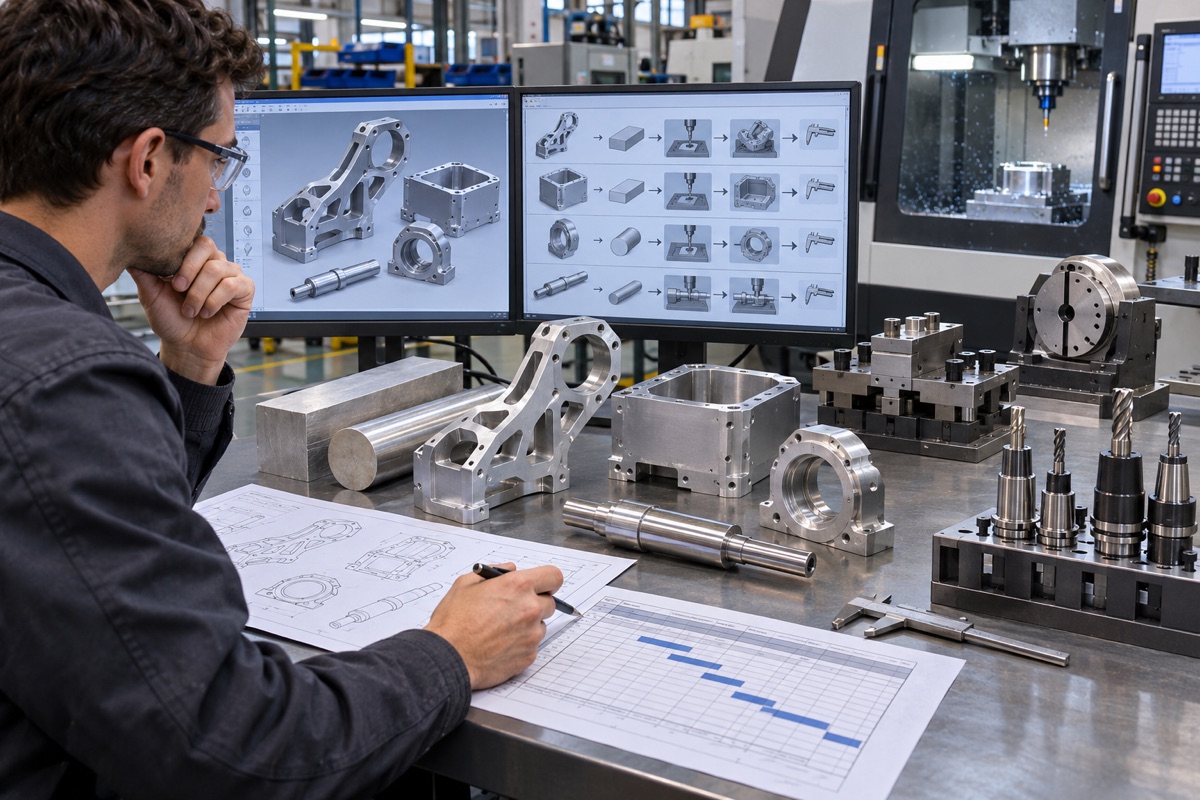
The quotation should separate the one-time project costs from the single-piece recurring costs.
Machine timing is determined by reachability and cycle time
How many times the part needs to be clamped, whether three or five axes are used, how far the tool extends, whether there are deep narrow cavities and a large number of small holes will all change the machine time. Protolabs' DFM material emphasizes that design for manufacturability reduces production time and cost. Reducing unnecessary deep cavities, uniform fillets, open toolpaths, and designing solid bases are often more effective than lowering hourly machine costs.
Tolerance and inspection are independent cost items
±0.005 mm, complex positional degrees, freeform surfaces, and full-scale reporting require more stable equipment, more process control, and higher-capacity tooling. If all dimensions are marked with high accuracy, the quote will include slower finishing, constant temperature, repeated inspection and risk preparation. The R&D team should distinguish key functional characteristics from ordinary sizes and clarify the scope of first article, random inspection or full inspection.
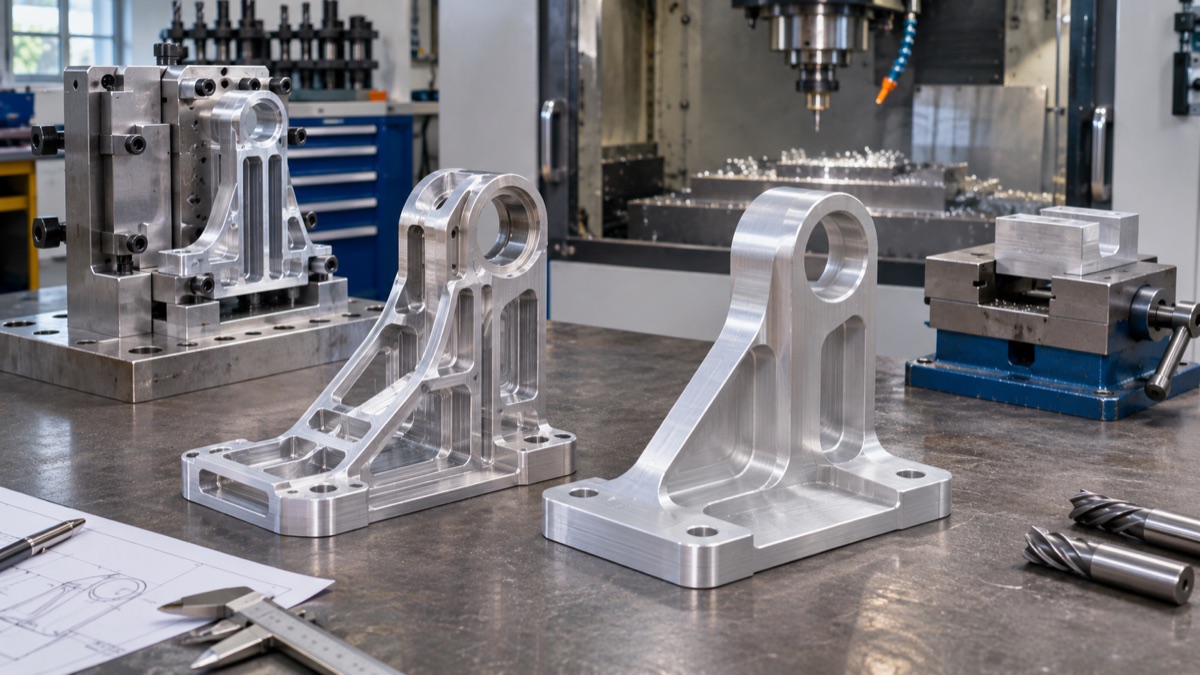
Reducing inaccessible deep cavities and unnecessary features reduces tooling and machine time costs.
Outsourcing and delivery time will change the risk price
Heat treatment, anodizing, sandblasting, grinding and special inspection bring shipping, queuing, rework and batch management. Extremely short delivery times may require inserting orders, working overtime, or using alternative routes, and the quotation will naturally increase. The purchaser should ask about process outsourcing, cycle assumptions and exception responsibilities, and confirm the surface treatment sample and size compensation before quoting.
Compare plans instead of blindly bargaining
Suppliers can be asked to provide quotations for the original design, DFM optimized version and different quantity tiers, while also explaining the quality and delivery time boundaries. If the low price comes from common tooling, standard tools and reasonable inspection, it is an effective optimization; if it comes from omitted processing, relaxed tolerances or canceled reports, it cannot be directly compared. OEMach recommends establishing a prototyping budget ledger during the R&D stage and writing the reasons for changes and costs back into design decisions.
Summary
A reasonable budget comes from complete input and manufacturability review; the hidden costs caused by missing drawing information, excessive tolerances and frequent changes are often higher than the material itself. The specific process still needs to be confirmed by combining materials and blanks, machine timing, programming, tooling, cutting tools, inspection, heat treatment and surface treatment, repair risk, quantity and delivery date.
FAQ
Can the quotation be multiplied by a factor based on weight?
Only very rough estimates can be made. The cost of non-standard CNC is mainly affected by the process, clamping, machine time, inspection and outsourcing.
Will the unit price definitely drop significantly after the quantity increases?
Not necessarily. If cycle time and special inspections remain major costs, the decline may be limited.
How to judge whether a low price is missing an item
Compare material certificates, processes, surface treatments, inspection reports, packaging and delivery boundaries for consistency.
Ready to get a quote for your CNC machined parts?
Submit your engineering drawings to qiancj@oemach.com. We support prototype sampling and small-batch production with strict tolerance control.