
A cylinder bore can meet one diameter reading and still contain taper, barrel shape or local ovality that changes piston friction and seal compression through the stroke.
Bore form and texture, piston clearance, seal-groove geometry, cross-hole edges and functional leakage testing should be treated as one system.
Gripper bore and seal risks
| Problem | Cause | Control |
|---|---|---|
| Piston resistance varies | Taper, barrel form or local texture | Finish and inspect multiple sections; stabilize honing texture |
| Seal is damaged during assembly | Sharp groove edge, poor lead-in or burr | Control groove form, chamfer and edge condition |
| Low-pressure leakage | Clearance, groove and texture mismatch | Validate bore, piston and seal as one fit system |
Separate diameter from full bore form
Entrance, middle and bottom can differ even when one reading passes. Specify and inspect size, roundness, cylindricity and relationships to faces or guide bores according to function.
Stabilize roughing and finishing
Complete major cavities and passages before final bore work where appropriate, release stress and re-establish the datum. Choose fine boring, reaming or honing by material, structure and surface requirement with uniform stock and thermal control.
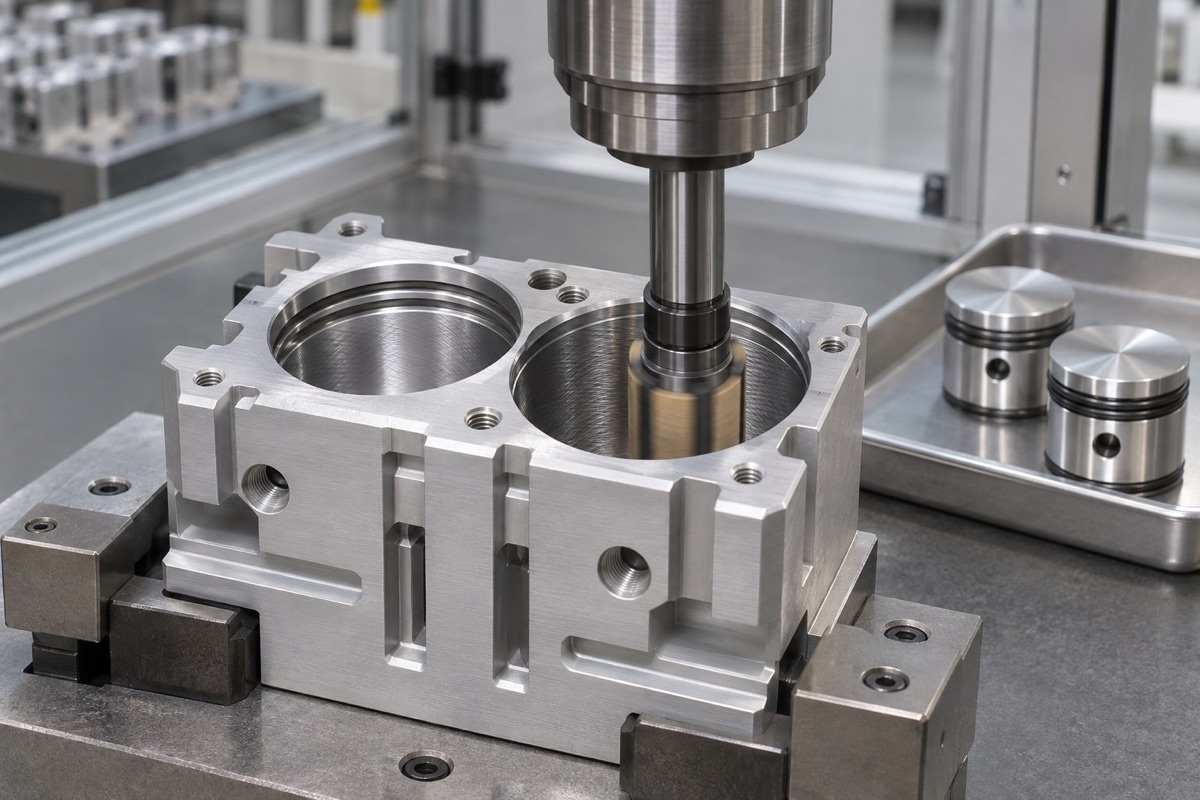
Uniform stock and controlled boring or honing stabilize size, form and surface texture along the stroke.
Match surface texture to the seal
A single Ra value may not capture longitudinal scratches or sharp peaks. Follow seal-supplier and lubrication requirements and remove honing abrasive and debris thoroughly.
Treat the seal groove as a functional section
Width, depth, root diameter, sidewalls, tool radius and lead-in determine seal compression and movement. O-rings, lip seals and combined seals do not share one generic groove.
Control cross-hole edges and test function
Deburr and inspect passage intersections that can cut the piston seal, then protect the cleaned bore from contamination. Use the approved medium, temperature, pressure and speed for low-pressure start, full-stroke and leakage tests.
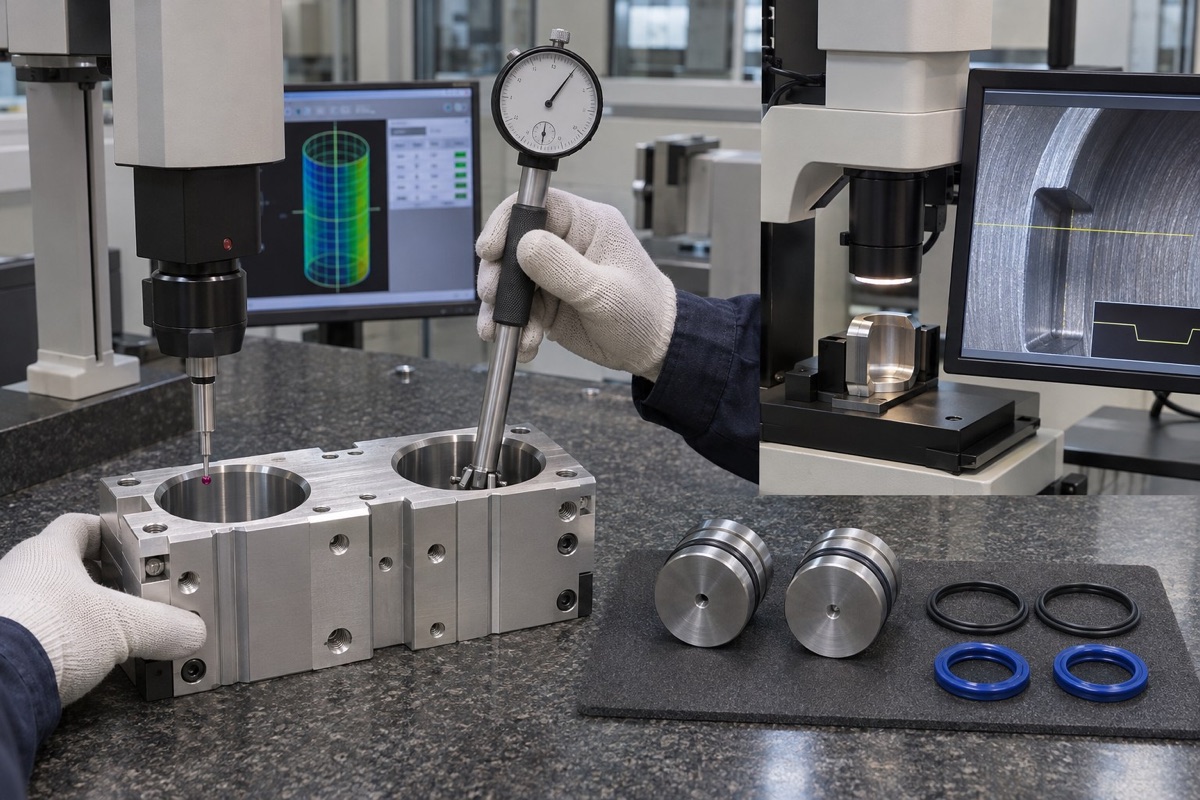
Dimensional evidence should be completed by low-pressure leakage and full-stroke testing.
Summary
Pneumatic gripper reliability requires full-length bore form, seal-compatible texture, supplier-specific groove geometry, controlled edges and functional tests that connect anomalies to measured sections.
FAQ
Does a smoother bore always seal better?
No. Dynamic seals need an appropriate texture and lubricant retention according to the seal and duty.
Can cylindricity be replaced by several diameter readings?
Several readings help screening, but strict cylindricity needs a measurement and evaluation method that matches the tolerance definition.
Why can a dimensionally correct groove still leak?
Sharp edges, scratches, damaged seals, eccentric fit or assembly contamination can still cause leakage.
Ready to get a quote for your CNC machined parts?
Submit your engineering drawings to qiancj@oemach.com. We support prototype sampling and small-batch production with strict tolerance control.