
A small pulley or tensioner can determine the friction, backlash and life of an entire cable-driven robot mechanism. Groove width alone does not describe the contact path.
The cable construction, bend radius, wrap angle and load must guide groove geometry, bearing alignment, surface finish and the usable tensioning range.
Cable-drive problems
| Problem | Cause | Control |
|---|---|---|
| Cable wears at groove edge | Groove center and bearing axis misaligned | Machine from one axis and inspect runout |
| Cable jumps or becomes slack | Insufficient usable travel or uncontrolled preload | Define initial tension and check full travel |
| Pulley resistance varies | Bearing fit, burrs or surface variation | Control fits, edges, groove integrity and starting torque |
Start with the real cable contact path
Confirm cable construction, diameter, permitted bend radius, wrap angle and load. Groove depth, angle and bottom radius must support the cable without edge pinching or excessive friction.
Align groove and bearing seat
Finish the groove, bearing bore and faces around one rotation axis and verify radial and face runout. Thin pulleys also require low-distortion fixturing and clean bearing fits.
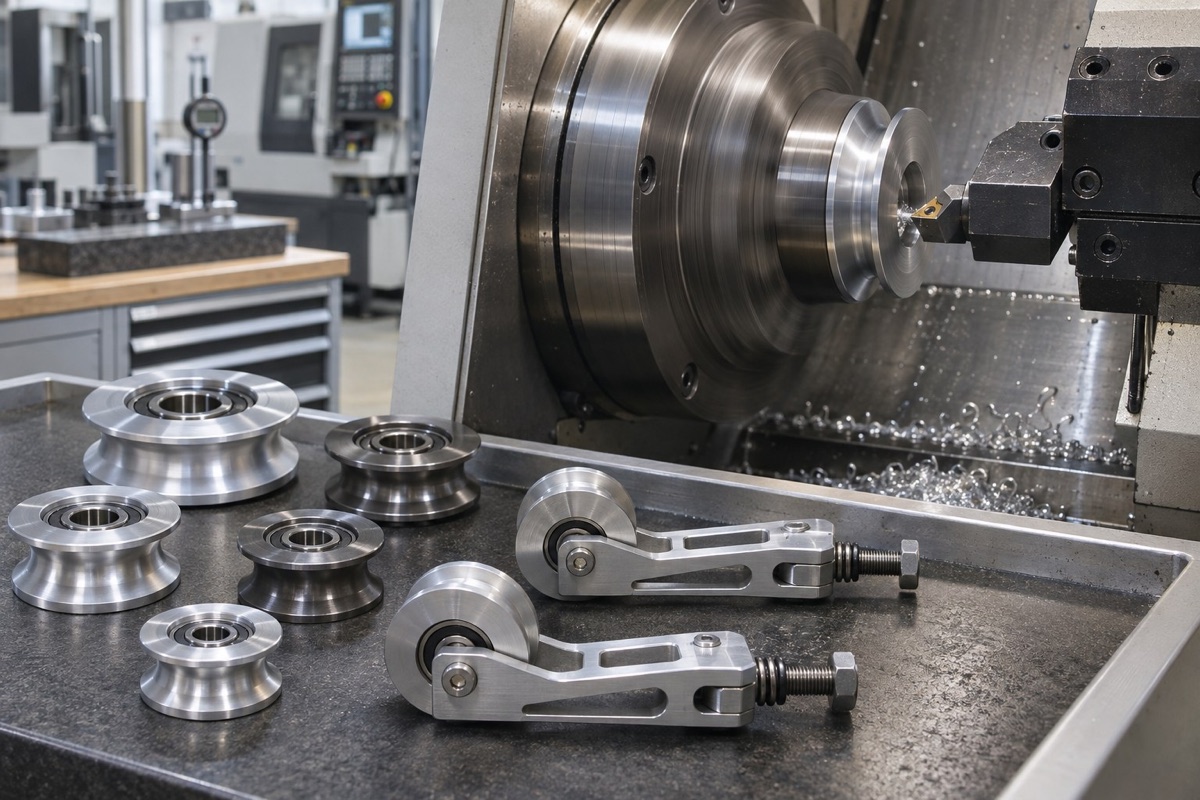
The cable groove and bearing seat should be finished around one rotation axis.
Protect the cable with surface integrity
Remove sharp edges and chips without changing the intended groove form. Coating thickness, wear, friction and cable compatibility must be considered before final dimensions are released.
Provide repeatable usable tensioner travel
Screws, slides, eccentrics or spring seats must adjust smoothly without side play. Total geometric stroke is not the same as usable stroke after assembly limits and safety margin.
Test the complete motion range
Observe cable centering through all poses and record tension, starting torque and tensioner displacement. Use wear marks and field adjustment data to trace pulley geometry, cable choice or assembly-path issues.
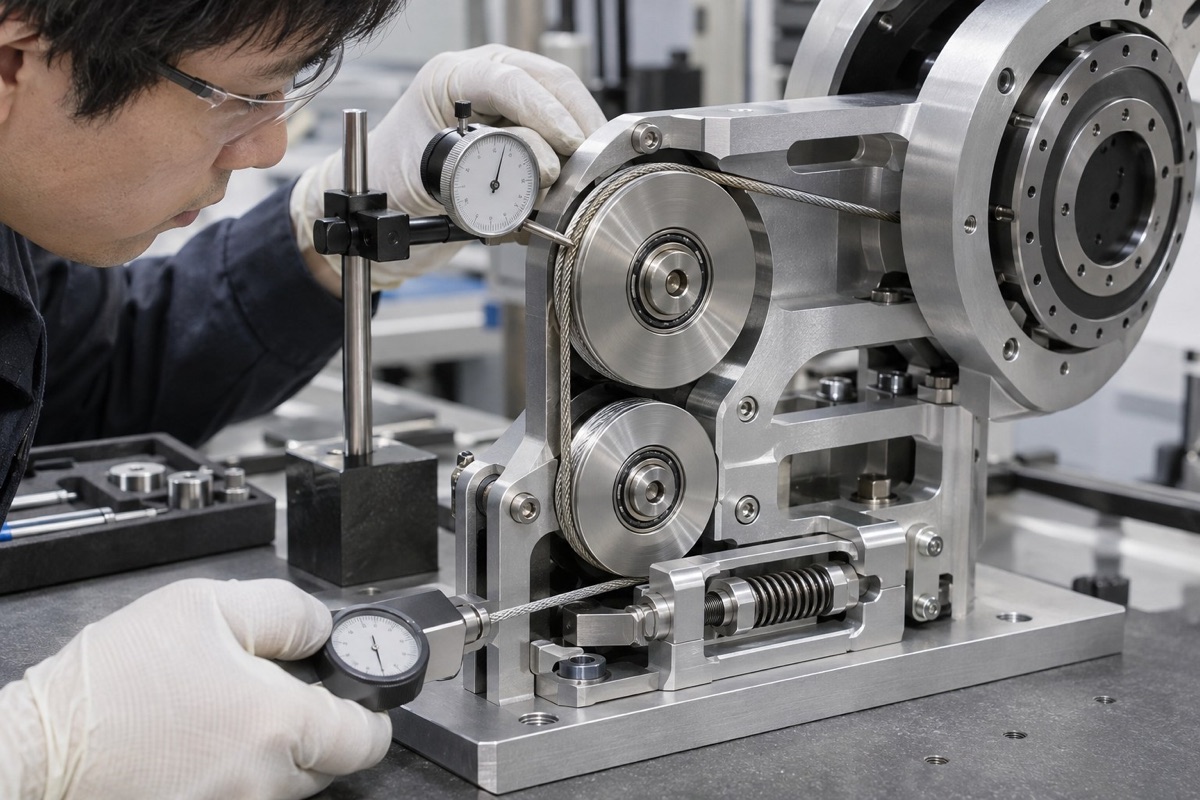
Tension, tracking, starting torque and tensioner travel should be checked throughout motion.
Summary
Stable cable drives require a groove matched to the actual cable, one pulley-bearing axis, controlled edges and surfaces, repeatable tensioner travel and full-motion verification.
FAQ
Does a deeper groove always prevent derailment?
No. Depth, angle and bottom radius must match cable and wrap; excessive depth can add friction or assembly difficulty.
Does higher tension always improve accuracy?
No. It increases bearing load, friction and cable fatigue and must remain within the approved functional range.
Is pulley outside diameter enough to inspect?
No. Groove form, bearing fit, runout, surface and burr condition are also functional.
Ready to get a quote for your CNC machined parts?
Submit your engineering drawings to qiancj@oemach.com. We support prototype sampling and small-batch production with strict tolerance control.