
In a robot flange, the spigot usually restores radial center, the face sets axial orientation and the bolts provide clamping. Treating bolt holes as the only locating features can leave the center or angle uncontrolled.
The face, spigot and pattern should therefore be machined and inspected from the same assembly-based datum system, with paired assembly and post-tightening checks where required.
Flange problems and controls
| Problem | Cause | Control |
|---|---|---|
| Spigot assembles but center shifts | Diameter checked without axis relationship | Finish face and spigot together; inspect form and runout |
| Holes pass but flange will not assemble | Pattern position or angular datum mismatch | Evaluate the full pattern with basic dimensions and position |
| Face distorts after tightening | Flatness, burrs or tightening sequence | Control face condition and use a defined cross-tightening method |
Separate locating from clamping
Document whether the spigot, dowels or a special hole control center and angle. Bolt clearance should not be used to compensate for an undefined or displaced locating system.
Control more than spigot diameter
Roundness, cylindricity and runout to the functional axis affect fit and repeatability. The selected clearance or interference also depends on load, materials, temperature and service frequency.
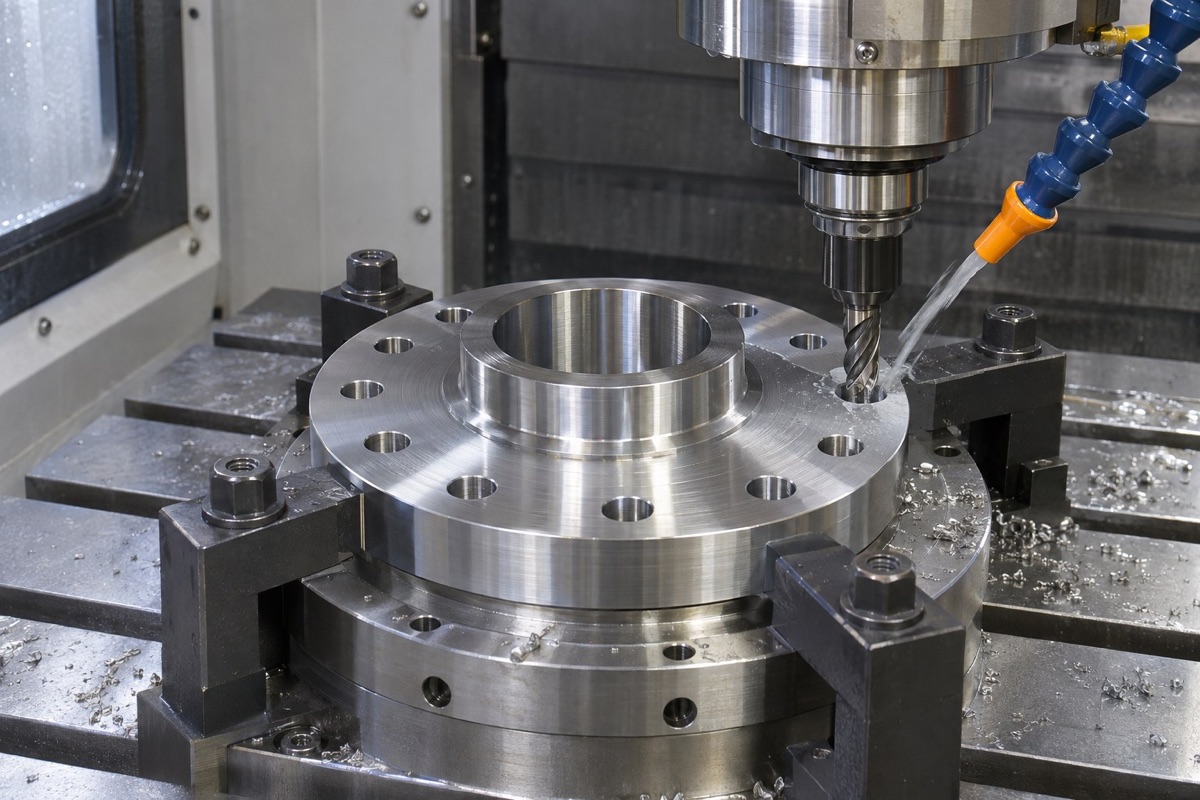
Finishing these functional features from one datum system reduces center and angular mismatch.
Use the face as a common foundation
A nonflat, burred or nonperpendicular face tilts the joint when tightened. Stabilize the face datum and, where possible, finish the face, spigot and pattern in one setup or a verified transfer setup.
Evaluate the complete hole pattern
Basic dimensions define theoretical locations; positional tolerance defines the allowable zones. Inspection must use the assembly face, center and angular datum rather than freely best-fitting the pattern and hiding translation or rotation.
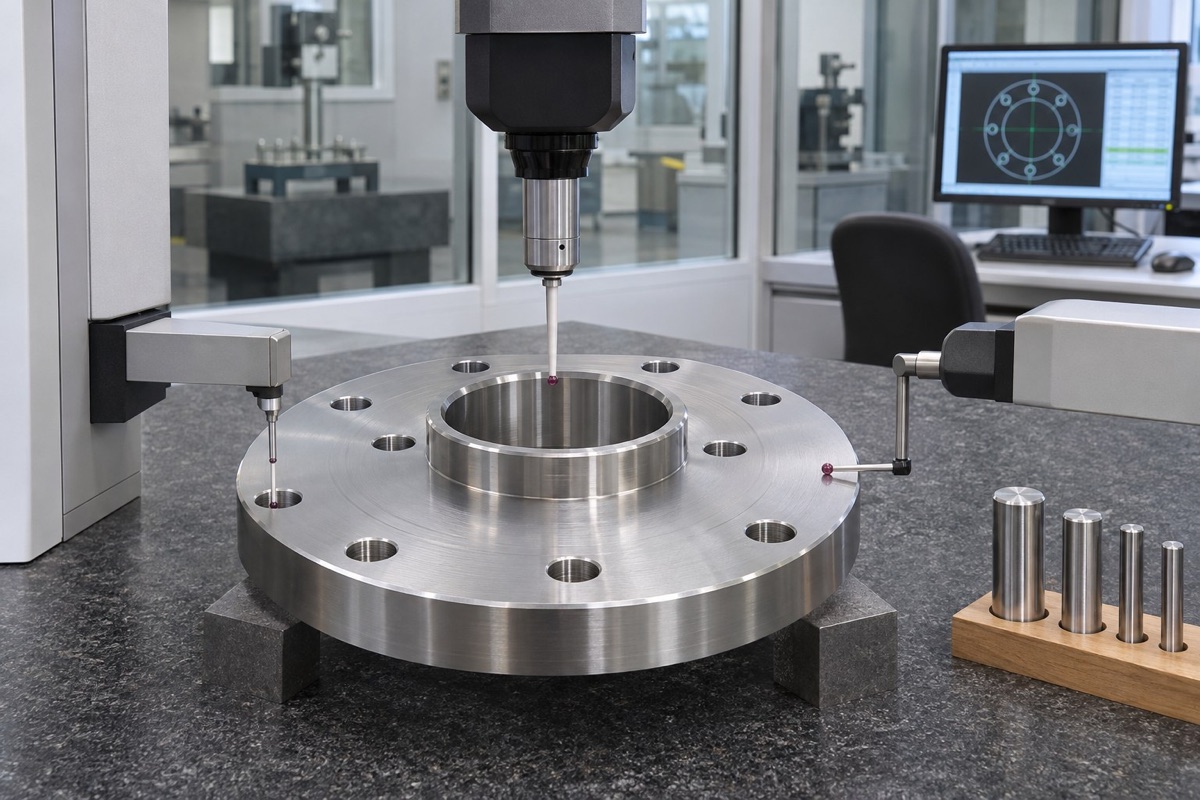
The complete pattern should be evaluated from the assembly face, center feature and angular datum.
Verify cleaning, tightening and paired assembly
Remove raised edges and protect the spigot and face during handling. Use specified fasteners and tightening sequence, then record post-tightening face runout and paired assembly results.
Summary
Robot flange accuracy is a relationship between face, spigot and hole pattern. One functional datum system, controlled surface condition and paired verification prevent individually conforming features from failing together.
FAQ
Can bolt holes simply be enlarged to solve assembly?
Only within an approved design change. Enlargement can hide a displaced spigot or pattern and reduce connection quality.
Why does a flange run out when the spigot is in tolerance?
Possible causes include face tilt, spigot form error, burrs, contamination or error in the mating flange.
Can positional tolerance be checked with a caliper?
A caliper can check size and some distances, but not the complete three-dimensional datum-based position of the pattern.
Ready to get a quote for your CNC machined parts?
Submit your engineering drawings to qiancj@oemach.com. We support prototype sampling and small-batch production with strict tolerance control.