
For an early shape or interference check, 3D printing is usually the faster route. For assembly fits, threads, wear, temperature exposure and long-term dimensional stability in the specified resin, CNC machining is usually the more representative test.
The two processes are therefore complementary. The correct choice depends on what the prototype must prove, not simply on which supplier can deliver first.
Before quotation, engineering teams should define the target resin, functional features, tolerance class, quantity and whether the next step is another prototype or a repeatable low-volume build.
CNC machining vs 3D printing for development parts
| Decision factor | 3D printing | CNC machining | Practical question |
|---|---|---|---|
| Geometry review | Fast for shape, access and interference checks | Useful when final interfaces must also be measured | Is the goal visual confirmation or functional acceptance? |
| Material behavior | Depends on print process, orientation and resin | Uses the specified stock material and condition | Must the test represent PEEK, POM, PA or another exact grade? |
| Tolerance and threads | Process-dependent; inserts may be needed | Bores, threads and datums can be machined directly | Which features control assembly or sealing? |
| Quantity and next step | Efficient for rapid design iterations | Efficient for functional samples and repeatable small batches | Will the same route continue into pilot production? |
Start With The Validation Objective
A concept model only needs to show envelope, ergonomics or interference. A functional prototype may need target stiffness, creep behavior, dielectric performance, wear, thread strength or chemical resistance. These objectives lead to different manufacturing routes.
Separate critical interfaces from nonfunctional geometry. Datums, bearing or pin bores, sealing faces and threaded joints deserve explicit acceptance criteria; cosmetic covers and clearance volumes usually do not need the same tolerance.
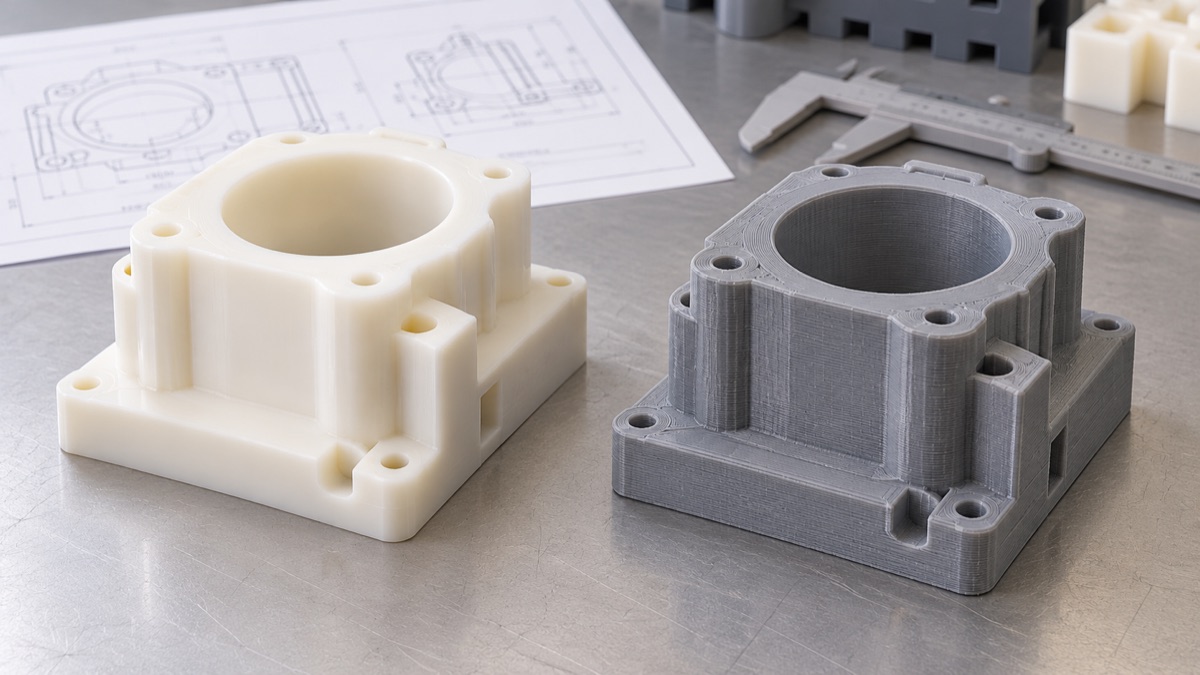
The two routes can validate the same geometry, but they do not provide the same material properties, dimensional stability or surface condition.
When 3D Printing Is The Better First Step
Additive manufacturing is effective for rapid shape iterations, complex internal passages and low-cost interference checks. It can also reduce lead time when several design variants must be compared before a material is frozen.
Its limitations must be stated. Layer direction, porosity, cure, support removal and print resin can change strength, surface finish, thread behavior and dimensional stability. A printed polymer should not automatically be treated as a substitute for a machined POM, PA or PEEK component.
When CNC Machining Gives Better Evidence
CNC machining is preferable when the sample must use the specified engineering plastic and validate fits, bores, threads, sealing faces, wear or service temperature. It also provides a clearer path from prototype to a repeatable small batch.
Plastic machining is not metal machining with softer stock. Residual stress, clamping force, tool heat, moisture absorption and thin-wall deflection must be controlled. Low-stress stock, sharp tools, supported workholding and staged roughing and finishing are common controls.
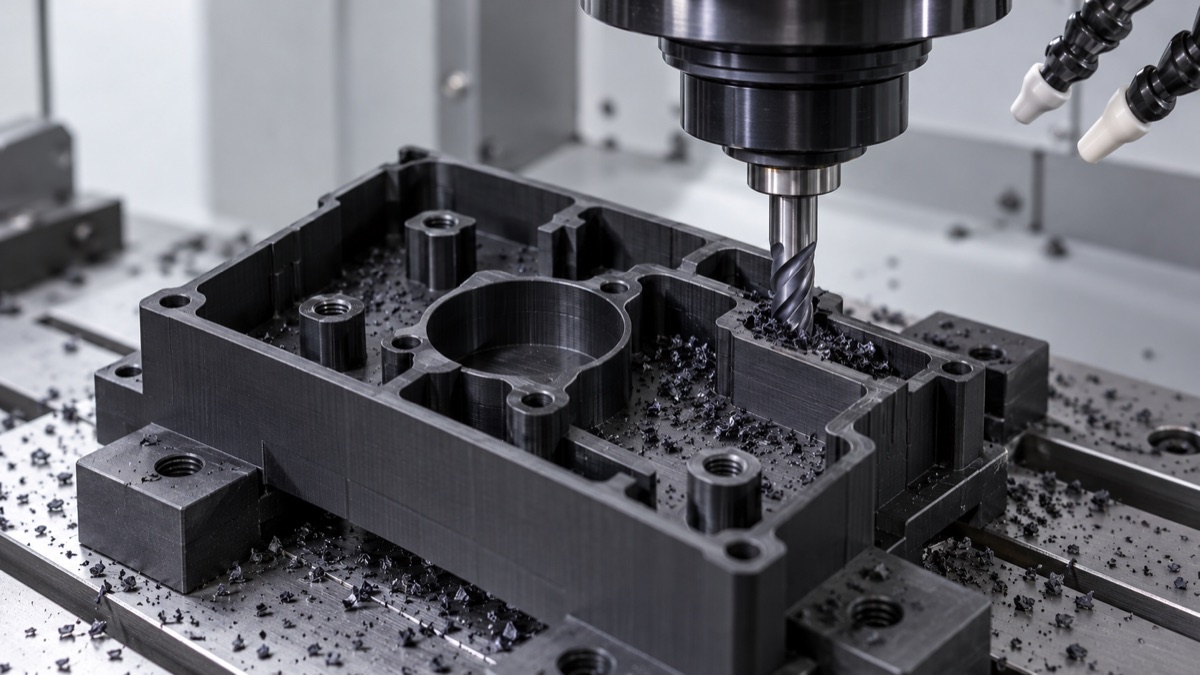
Machining the specified resin provides representative material behavior, threads, fits and surface finish for functional validation.
Plan Tolerances And Inspection Around Plastic Behavior
Do not apply the tightest tolerance to every dimension. Grade functional features separately and leave realistic limits on clearance and cosmetic geometry. Inspection temperature, conditioning time and measurement restraint should be agreed when moisture-sensitive or stress-sensitive plastics are involved.
Multi-face features may benefit from five-axis machining because fewer setups reduce datum transfer error. Thin parts may require soft jaws, vacuum workholding or form supports, followed by relaxation time before final finishing and measurement.
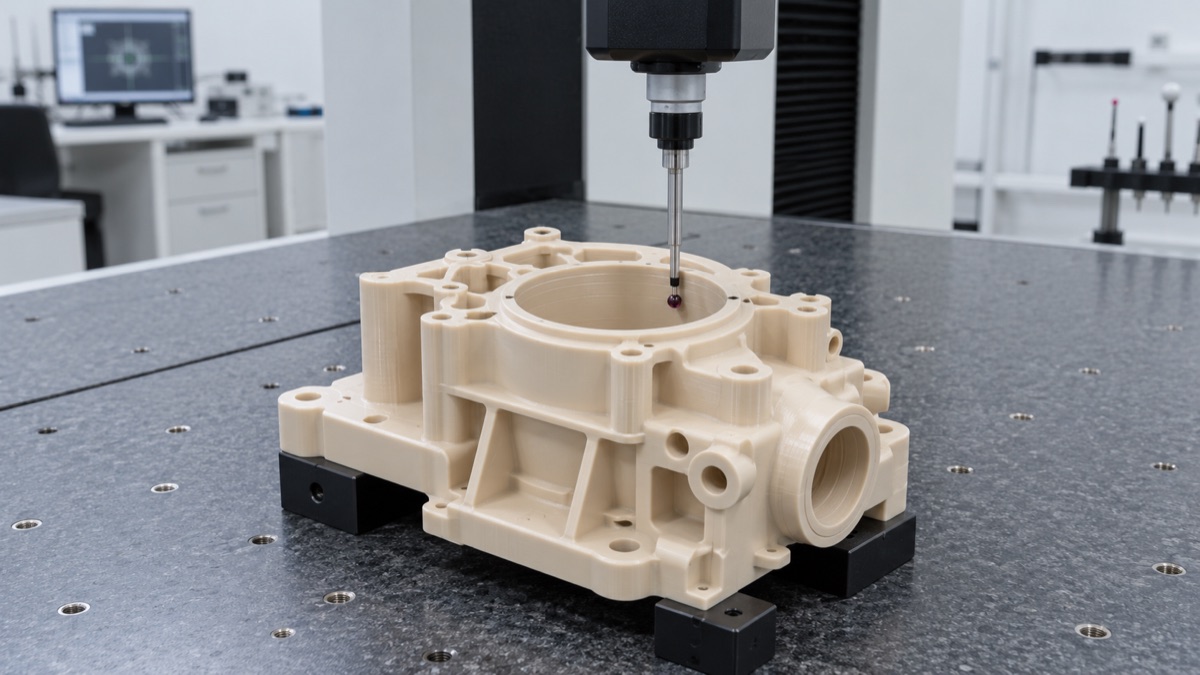
Inspection should reference stabilized parts and agreed datums because clamping, temperature and moisture can shift plastic dimensions.
Information Needed For An Accurate Quote
A 3D model alone does not explain what the prototype must prove. Include the engineering intent so the supplier can recommend a route instead of pricing only the visible shape.
- Exact resin grade, color, filler, certification and material condition
- Whether the sample validates shape, assembly, load, wear, temperature or electrical behavior
- Critical datums, fits, threads, thin walls, tolerances and surface finish
- Prototype quantity, expected design iterations and follow-on batch size
- Cleaning, cosmetic, packaging, inspection and test-environment requirements
Summary
Use 3D printing for fast geometry learning and CNC machining when the prototype must represent the specified engineering plastic, functional interfaces and repeatable small-batch route. The decision should follow the validation objective, material, tolerances and inspection plan.
FAQ
Can a 3D-printed part replace a POM or PEEK functional prototype?
Not automatically. Print resin, build orientation and layer structure can differ substantially from the target stock material. Use the specified material when strength, wear, temperature or long-term stability is being validated.
Why can CNC-machined plastic parts still deform?
Residual stress, clamping, cutting heat, thin walls, moisture and temperature can all move dimensions during or after machining.
Is CNC always more accurate than 3D printing?
CNC generally offers stronger control of datums, bores and threads, but achievable accuracy still depends on material, geometry, fixturing, conditioning and inspection method.
Can both processes be used in one development cycle?
Yes. Many teams print early geometry variants, then machine the selected design in the target resin for functional and pilot-build validation.
Ready to get a quote for your CNC machined parts?
Submit your engineering drawings to qiancj@oemach.com. We support prototype sampling and small-batch production with strict tolerance control.