
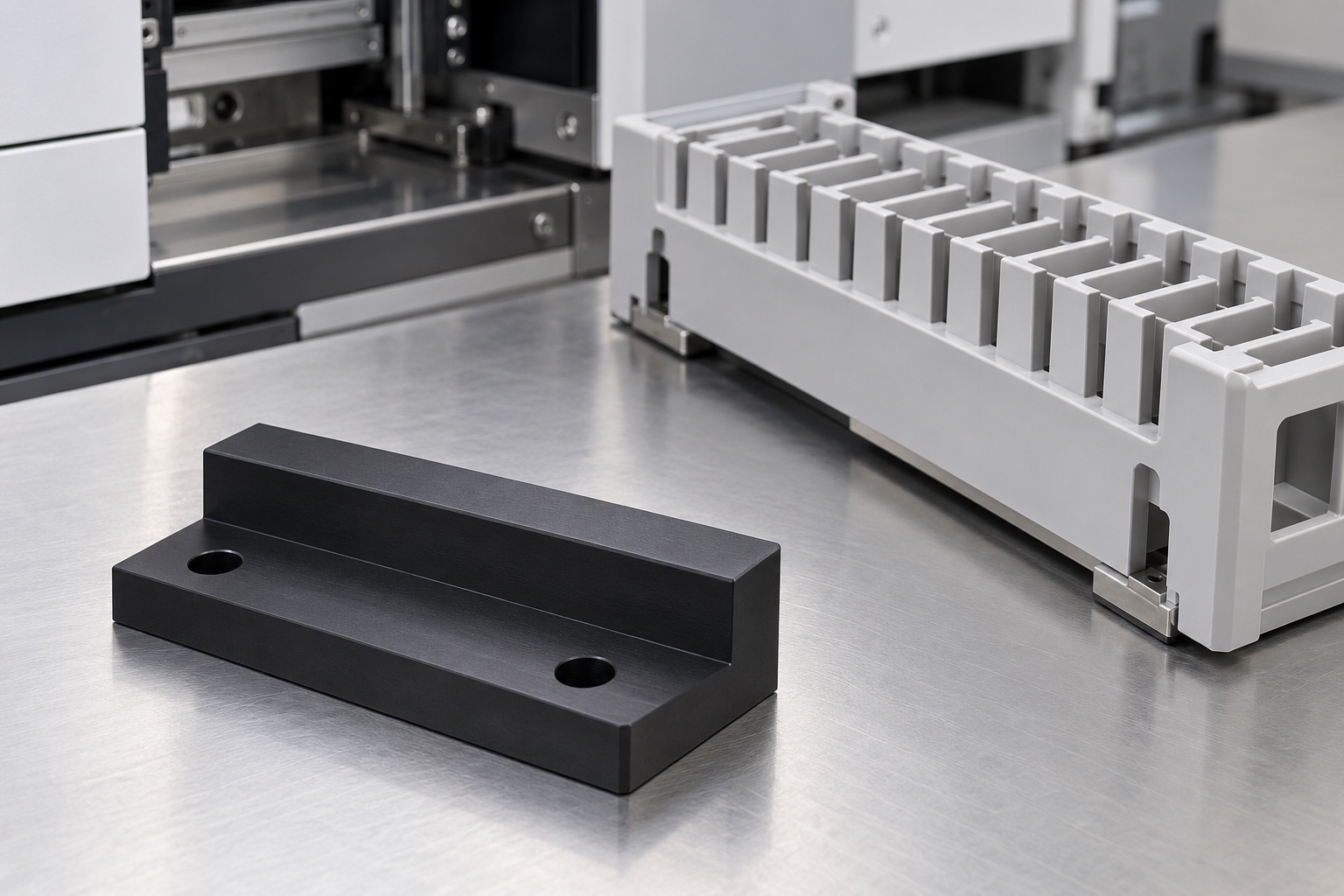
An equipment-side contact for a rack carrier
A medical laboratory analyzer may use a polymer locator shoe to define a contact between a removable sample-rack carrier and its supporting equipment. The shoe is not automatically a tube holder, sterile tray or sample-contact component. Its stepped surfaces, mounting and clear regions must follow the actual carrier arrangement. This article concerns CNC component planning and inspection. It does not establish rack-positioning accuracy, sample integrity, wear life or equipment safety. Images illustrate proposed mechanical concepts rather than measured parts or a validated laboratory handling process.

Identify the actual carrier and installation
Obtain the approved rack-carrier model, contact drawing, installation revision and intended insertion path. Identify which part of the carrier contacts the shoe and which regions must remain clear. An empty generic rack in a photograph does not define the interface. Review the actual equipment configuration before selecting stock or machining references. The supplier should not infer container spacing, sample handling or rack identification requirements from the locator. Those functions belong to the responsible analyzer design and operating program, with their own controlled requirements and validation scope.
Separate support from lateral location
A stepped shoe may offer a horizontal support region and a distinct side contact. Define their respective functions and relationships to the mounted base. Not every visible face should be treated as a simultaneous locating contact. Clarify permitted movement and the actual reference scheme rather than creating unintended overconstraint. A carrier resting on the shoe does not prove that all contacts are correct. The supplier should not hand-scrape a side face until a loose rack appears aligned, because that can change a controlled interface without an authorized design decision.
Control the mounting relationship
Relate the step height, side-contact position and useful contact length to approved base and mounting references. Hole clearance alone may not locate the shoe precisely. Review screw seating and any separate locating features with the actual supporting structure. Do not introduce slots, adhesive, extra washers or oversized holes to solve an installation problem informally. Resolve conflicting model and drawing dimensions before machining. A repeatable part needs a released reference system rather than a coordinate choice based only on the most convenient raw stock edge.
Review entry and removal clearance
The carrier's approach and removal paths can interact with shoe edges, mounting hardware and nearby components. Define any lead-in or clearance geometry from the approved installation instead of assuming a universal chamfer. A broad edge break should not consume a useful locating face. Document unexpected interference before changing the shoe or carrier. A successful hand insertion in one orientation does not establish correct operation across every specified configuration, and a supplier should not replace the approved rack with a similar sample to obtain an easier demonstration.
Specify the polymer grade and evidence
If black POM is selected, state the exact approved grade, stock form and required documentation. Ensinger's material information provides background on a specific POM-C stock product, not a performance result for this locator or an automatic prescription for the order. Color alone does not establish equivalence. Preserve lot identity and review substitutions before use. Cleaning exposure and service conditions should come from the responsible equipment requirements. Material documentation does not independently establish wear life, cleaning validation, biological suitability or the accuracy of a complete sample-rack positioning arrangement.
Support the stepped block through milling
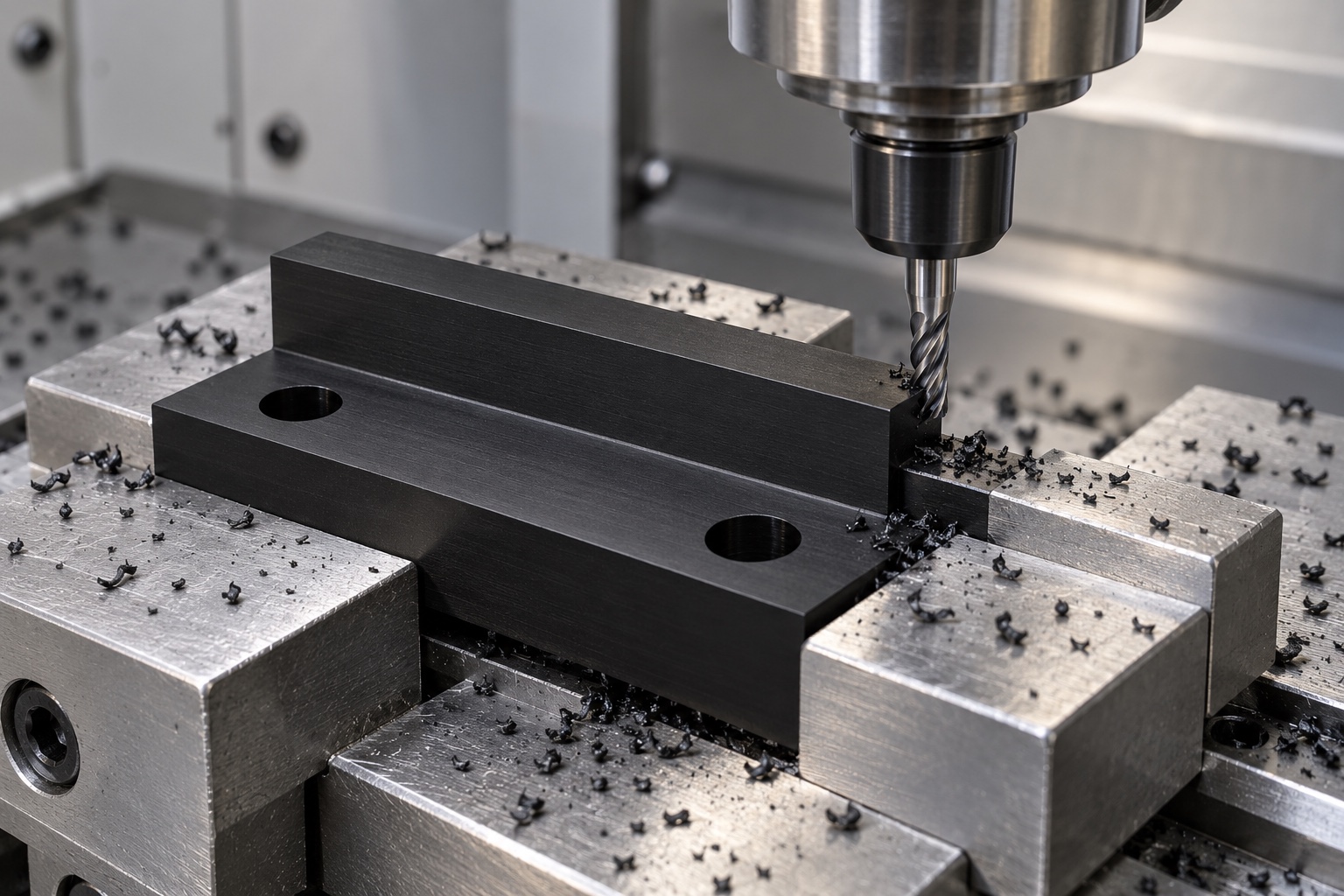
Plan base preparation, step machining, hole production and fixture transfers around changing support. Use suitable broad contacts and keep chips away from reference faces. Excessive clamping can make an unloaded polymer component appear different while held in the fixture. Select a route appropriate to the actual stock and geometry rather than assuming one cutting condition applies to every grade. A proposed radius or relief needs approval when it alters controlled contacts. Intermediate checks can confirm manufacturing progress but should not replace final inspection in the agreed support condition.
Finish contact boundaries conservatively
Inspect the step transition, hole exits and outer edges for attached material or unwanted sharp features. Preserve the defined contact height, position and useful length during finishing. Do not polish or scrape the locating face until a particular rack slides conveniently. Any permitted lead-in or relief should be controlled in the drawing. Cleaning follows the purchased scope and must not disguise damaged geometry. A clean-looking black surface does not prove low particle generation, disinfection performance, sterile supply or compatibility with every laboratory cleaning chemical and rack-handling procedure.
Inspect using the correct support state
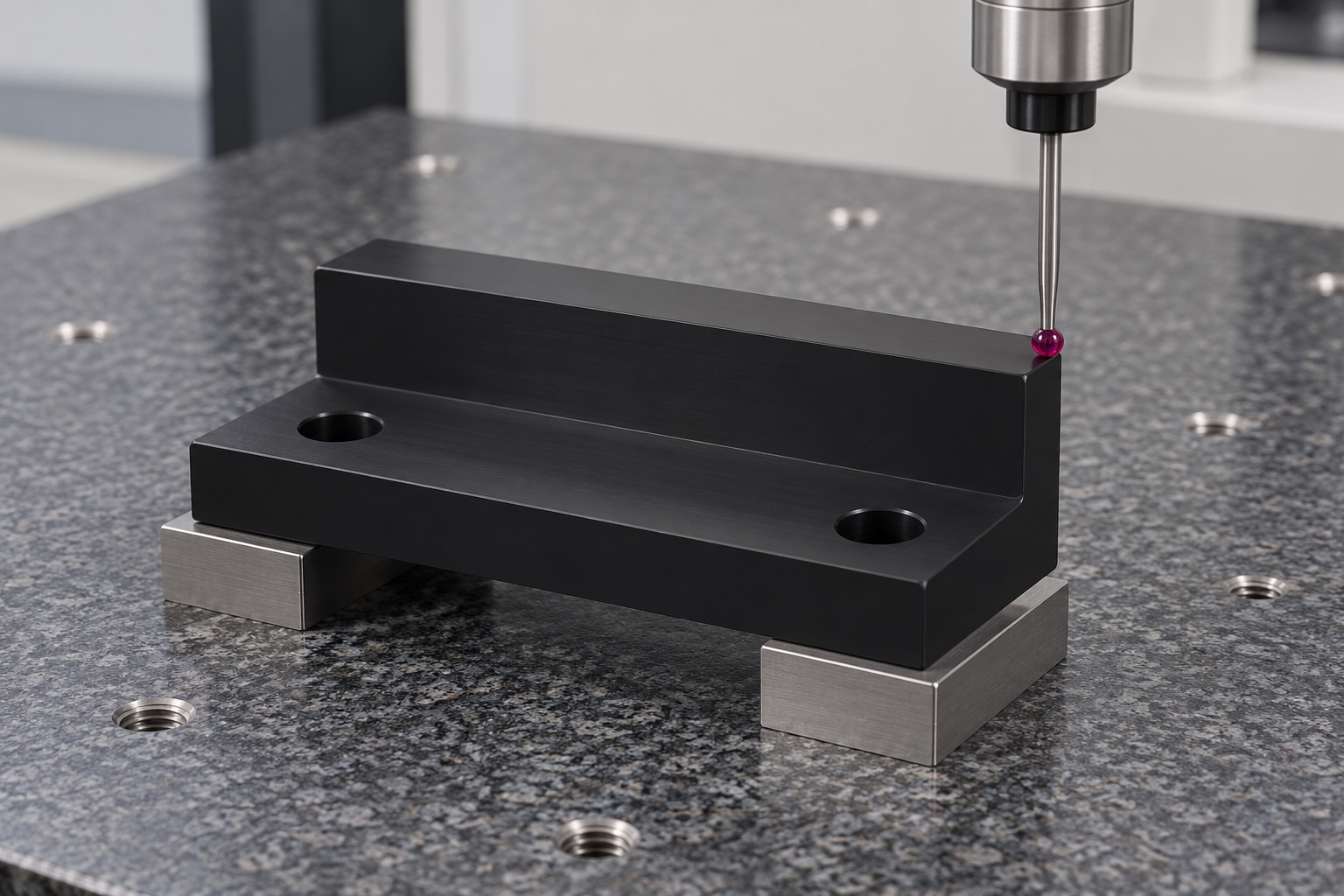
Map step, contact, base and mounting characteristics to suitable accessible measurement methods. Agree support, measuring force and any necessary material conditioning before production. Unloaded component inspection and a mounted arrangement may have different purposes; neither should silently replace the other. Outside dimensions and two isolated hole sizes can omit important contact relationships. Resolve inaccessible features in advance rather than substituting a successful carrier insertion. Record the actual revision, material and inspection condition so results refer to a defined part rather than an undocumented forced-flat setup.
Keep a carrier trial within its agreed scope
An agreed demonstration can examine insertion, resting contacts, removal and identified clearances with approved carrier and equipment revisions. Record configuration and conditions. It does not independently establish rack-positioning repeatability, long-term wear, sample identification, contamination control or analyzer safety. These require their own defined evaluations. Keep trial shoes identifiable and incorporate authorized changes into released documents. Observations from one hand-operated empty carrier should not become an informal gauge, a sample-integrity claim or a production baseline for another rack family or installation arrangement.
Protect contacts and component identity
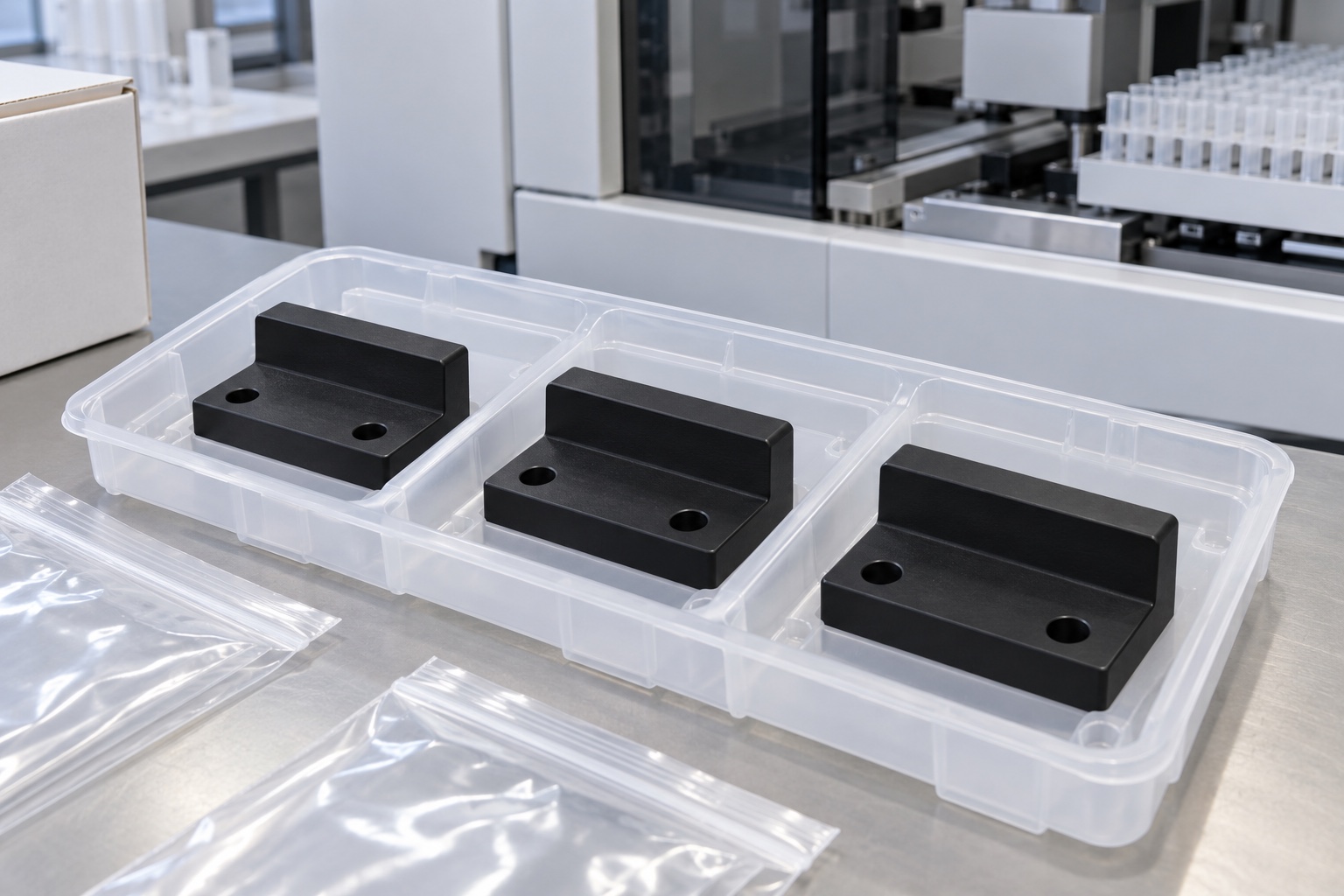
Separate shoes so neighboring edges, fasteners and packaging materials cannot rub their accepted step and side contacts. Support the base without bending it under transport pressure. Keep unapproved adhesive and debris away within the agreed cleaning scope. Ordinary bags are not sterile barriers. Preserve polymer, lot and revision identification with the shipment. Receiving staff should distinguish accepted parts from prototypes and from similar black blocks intended for another carrier contact, step height, mounting pattern or equipment configuration before the parts are released into maintenance or assembly stock.
Maintain a carrier-specific inquiry package
Supply the controlled model and drawing, exact carrier information, contact scheme, insertion envelope, mounting structure, polymer grade, final condition and inspection requirements. Identify optional trials and keep rack or analyzer qualification separate unless explicitly included. Record approved prototype changes in revised documents. Review changed carriers, contacts, hardware, cleaning exposure and handling conditions before relying on earlier observations. This gives the machining supplier a defined interface without asking it to invent a laboratory positioning requirement or claim that a visually well-fitting polymer shoe validates the complete sample-handling process.
Manufacturer background reference: www.ensingerplastics.com.
FAQ
Is a locator shoe a sample-contact or sterile component?
Not automatically. This proposed scope concerns an equipment-side carrier contact. Any sample-contact, biological, cleaning or sterile requirement must be separately specified and evaluated rather than inferred from use inside a medical laboratory analyzer.
Does a carrier resting on the step prove correct location?
No. The approved contact scheme, base references, mounting and intended clearances define the relationship. A successful loose fit does not verify every controlled dimension or establish the positioning accuracy of the complete equipment arrangement.
Can a side face be scraped to improve insertion?
Only through authorization when the controlled geometry changes. First document the carrier, shoe and equipment revisions and the actual interference. A hand-adjusted sample should not become an undocumented machining instruction or acceptance gauge.
Does black color identify the required POM grade?
No. The order must name the approved material and evidence. Visually similar plastics may not be equivalent, and a stock-material datasheet does not demonstrate finished-part wear, cleaning performance or laboratory rack-positioning behavior.
Can carrier insertion replace component inspection?
Only within an explicitly approved method and scope. A trial has its own identified carrier and installation conditions and does not automatically verify step geometry, mounting relationships, material identity or the unloaded component state.
What should a repeat-order review include?
Review carrier identity, contacts, step height, insertion path, mounting hardware, polymer, cleaning exposure and final condition. Preserve authorized revisions rather than reproducing a worn or hand-adjusted sample or transferring another rack family's observations.

tanghangyun@oemach.com