
A realistic answer is 3 to 10 working days for many custom robot parts, but only after the drawing package is complete. A straightforward CNC prototype in stocked material may take 3 to 5 working days. A multi-face, deep-cavity or thin-wall part often needs 5 to 8 days, while heat treatment, surface finishing, special gauges or assembly validation can extend the schedule beyond that range.
Machine availability is only one part of the timeline. Drawing manufacturability, material stock, fixture design, outsourced operations, inspection programming and first-article approval can each become the actual critical path.
For R&D and purchasing teams, the best quotation is not simply the shortest promised date. It is a schedule that separates each dependency and shows what information or approval is needed at every stage.
Typical lead-time breakdown for custom robot prototypes
| Prototype type | Typical range | Conditions |
|---|---|---|
| Standard CNC prototype | 3 to 5 working days | Complete drawings, stocked material and routine inspection |
| Complex multi-face part | 5 to 8 working days | 5-axis features, deep cavities, thin walls or staged machining |
| Part with finishing or heat treatment | 7 to 12 working days | External process capacity and transport must be confirmed |
| Gauge or assembly validation required | Based on validation plan | Allow time for first-article review, fit check and revision |
What Must Happen Before The Machine Starts
DFM review confirms assembly datums, critical tolerances, material condition, surface treatment and inspection method. Missing thread standards, ambiguous geometric tolerances or an unconfirmed coating can delay a prototype more than the cutting time itself.
Material availability should be checked by grade, temper and stock size, not only by alloy name. Fixture concepts and inspection access are then reviewed together so a feature can be both machined and measured from the intended datum system.
Separate CNC Time From External Processes
For aluminum or stainless-steel parts, the route may include roughing, semi-finishing and finishing. Anodizing, heat treatment, grinding, wire EDM, passivation or special inspection should appear as separate schedule nodes instead of being hidden inside a single CNC promise.
Multi-face hole systems, deep pockets, thin walls or freeform surfaces may benefit from 5-axis machining because fewer setups reduce accumulated error. Thin structures may require soft jaws, vacuum support or profile fixtures. Stress-sensitive parts often need staged material removal and stabilization before final finishing.
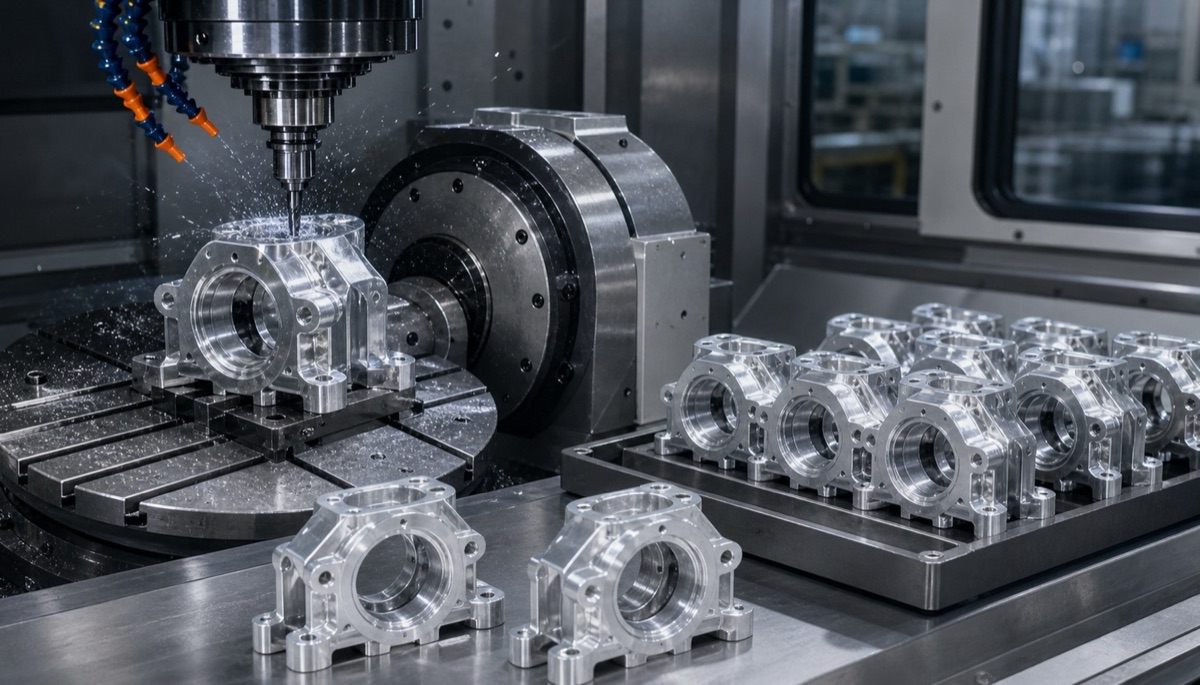
Complex multi-face features can reduce reclamping with a suitable 5-axis route, but fixture and inspection preparation still affect the prototype schedule.
Inspection Preparation Is Part Of Lead Time
A critical bore or locating pattern may require CMM programming, a dedicated gauge or an assembly fixture. These resources should be prepared before the first part leaves the machine. Otherwise, the component may wait for inspection even though machining is complete.
Do not assign the same tolerance to the entire part. Features that control bearings, dowels, sensors or sealing may need +/-0.005 mm, +/-0.01 mm or +/-0.02 mm, while non-functional clearance dimensions can remain practical. A graded drawing is usually faster to manufacture and easier to verify.
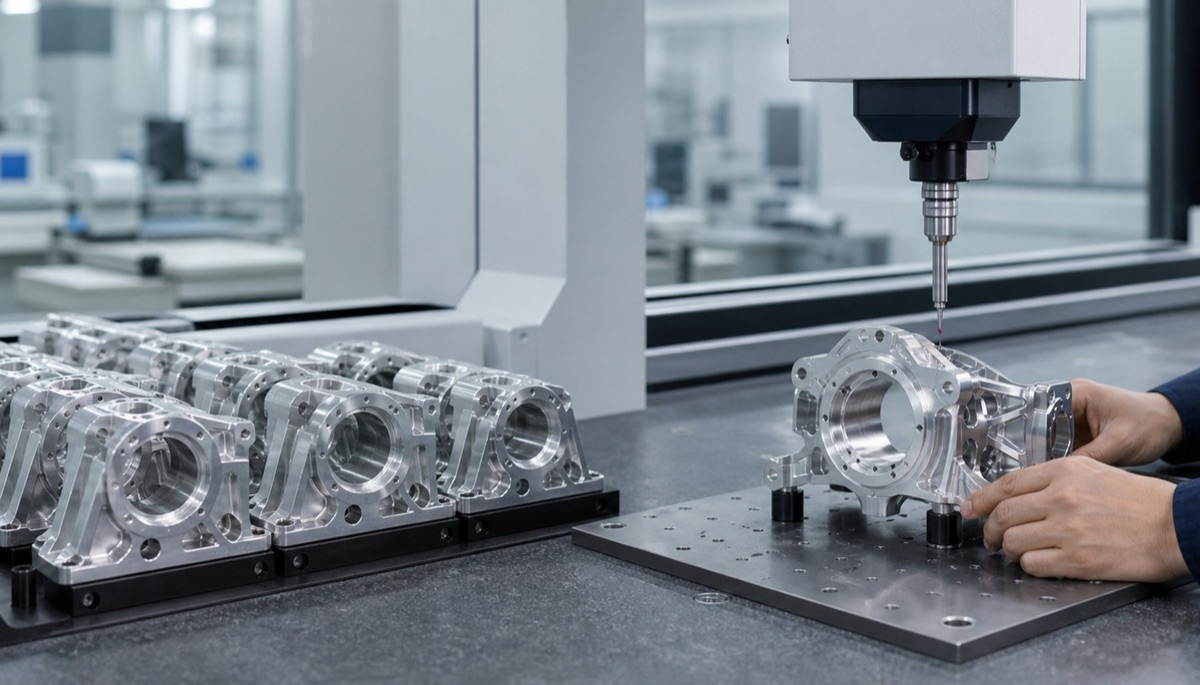
Critical datums, bores and geometric tolerances should be agreed before machining so the first-article report is ready with the part.
Information To Send With An RFQ
Sending only a 3D model often creates a low-looking quotation that changes later. The earlier the acceptance criteria are defined, the more accurately the supplier can reserve material, machine time, outsourced processing and inspection capacity.
In one custom robot mounting project, fixing clamping and external-process nodes during DFM and turning the approved first-article route into reusable process records helped improve yield by about 30 percent. The same records also shortened repeat-order preparation.
- 2D drawing, 3D model and a clear revision number
- Material grade and condition, quantity and target delivery date
- Critical dimensions, datums, geometric tolerances and surface roughness
- Surface treatment, heat treatment, cleaning and packaging requirements
- First-article approval, inspection-report format and engineering-change process
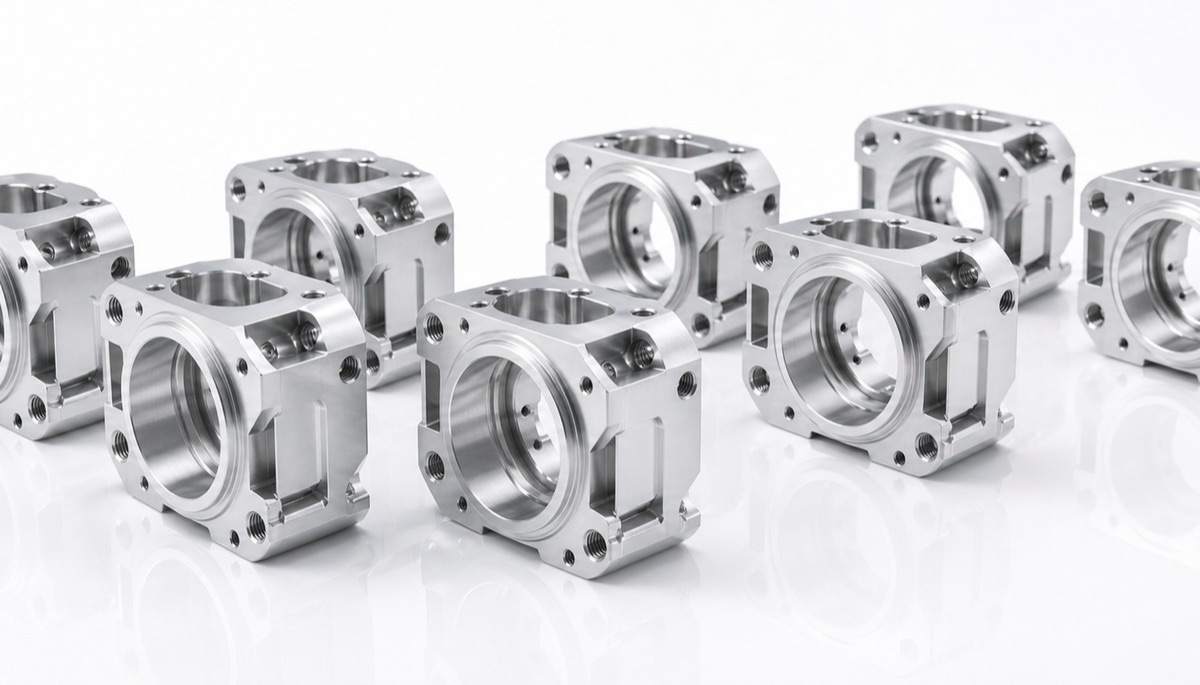
Stable repeat orders depend on preserving programs, fixtures, inspection plans and approved process records after the prototype.
How To Prevent Repeated Delivery Delays
Break the schedule into drawing release, material arrival, machining, external processing, inspection and customer approval. Assign an owner and planned date to each node. When a change occurs, the effect on the critical path becomes visible immediately.
A one-piece prototype is possible, but programming, fixturing and first-article inspection still have to be prepared. Those setup costs and hours do not disappear simply because the quantity is one.
Summary
For many custom robot parts, 3 to 10 working days is a useful planning range, not a universal promise. A reliable supplier links DFM, material, machining, outsourced processes, inspection and approval in one visible schedule and preserves the approved process for repeat orders.
FAQ
Can a supplier make only one custom robot part?
Yes. However, one piece still requires programming, fixture setup and first-article inspection, so setup cost remains part of the quotation.
Why does a five-day promise sometimes become two weeks?
The original promise may have counted only CNC time and omitted material, surface treatment, inspection programming or customer approval.
What information shortens the quotation and prototype cycle most?
A controlled 2D drawing and 3D model, material condition, quantity, critical tolerances, finish and inspection requirements.
Does 5-axis machining always shorten lead time?
No. It can reduce setups for complex geometry, but programming, fixturing, tool access and inspection still determine the complete cycle.
Ready to get a quote for your CNC machined parts?
Submit your engineering drawings to qiancj@oemach.com. We support prototype sampling and small-batch production with strict tolerance control.