
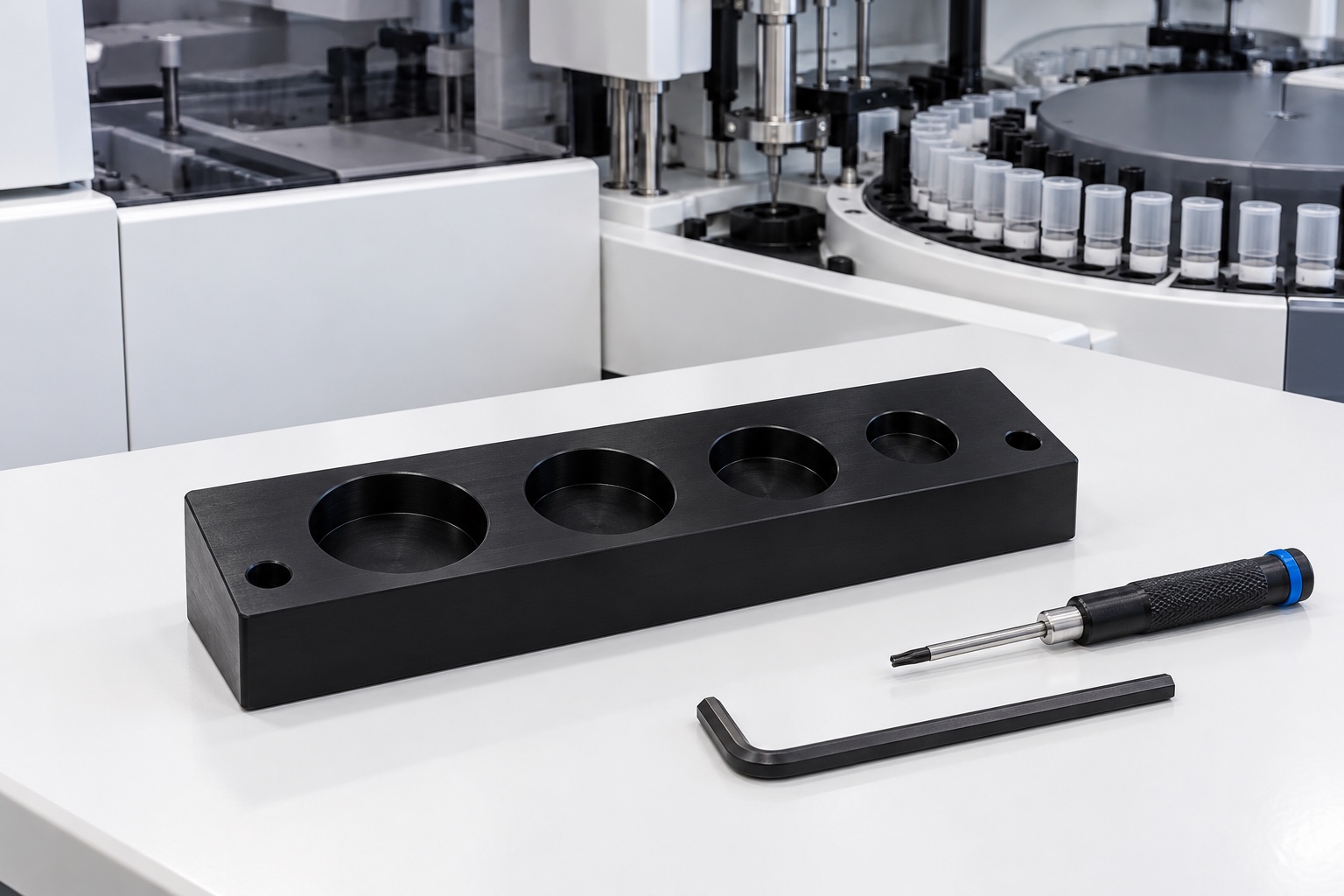
Define maintenance-tool support rather than clinical storage
A service-tool nesting block provides defined locations for identified tools used during medical equipment maintenance. Its scope should not be confused with a surgical instrument tray, sterile container or clinical reprocessing accessory. This article concerns a proposed equipment-service organizer with machined pockets and a mounting base. The responsible maintenance program must define the actual tools, work area and handling requirements. A block with several holes does not automatically provide tool inventory control, contamination separation or safe storage. Those functions depend on procedures and the complete service environment rather than pocket appearance alone.

Identify every approved tool envelope
Begin with controlled tool identities, revisions and the portions intended to contact the nest. A handle, shank, protective cap or removable accessory can change the envelope even when a tool's nominal size stays the same. Specify which surfaces may contact and which must remain clear. Do not design pockets from a photograph of a mixed toolbox or assume that one cylindrical gauge represents every service driver. Keep clinical instruments outside this proposed scope. The equipment program should approve any tool change before a supplier enlarges a pocket to accept an unfamiliar replacement.
Separate location from positive retention
A blind pocket can establish a resting position without providing a positive retaining mechanism. Define orientation, support and the intended installed location before treating pocket depth as a complete requirement. If transport, movement or a retained tool is part of the design, specify the appropriate arrangement and evaluation separately. This article supplies no universal interference fit or retention force. A tool that remains upright on a quiet bench is not evidence that it stays secure during servicing, drawer movement or handling. The machining supplier should not invent a retention claim from a sample insertion.
Make retrieval and neighboring access explicit
Review how an identified approved tool can be inserted and removed without unintended contact with adjacent tools or equipment. Finger access, handle position and approach direction are design inputs, not dimensions a supplier should guess from pocket diameter. Evaluate the actual arrangement under the responsible program's defined conditions. Do not add a finger recess or lower a surrounding wall informally if it changes controlled support or clearance. A successful removal of one loose tool does not establish suitable access for every approved tool, user or maintenance configuration that the organizer may encounter.
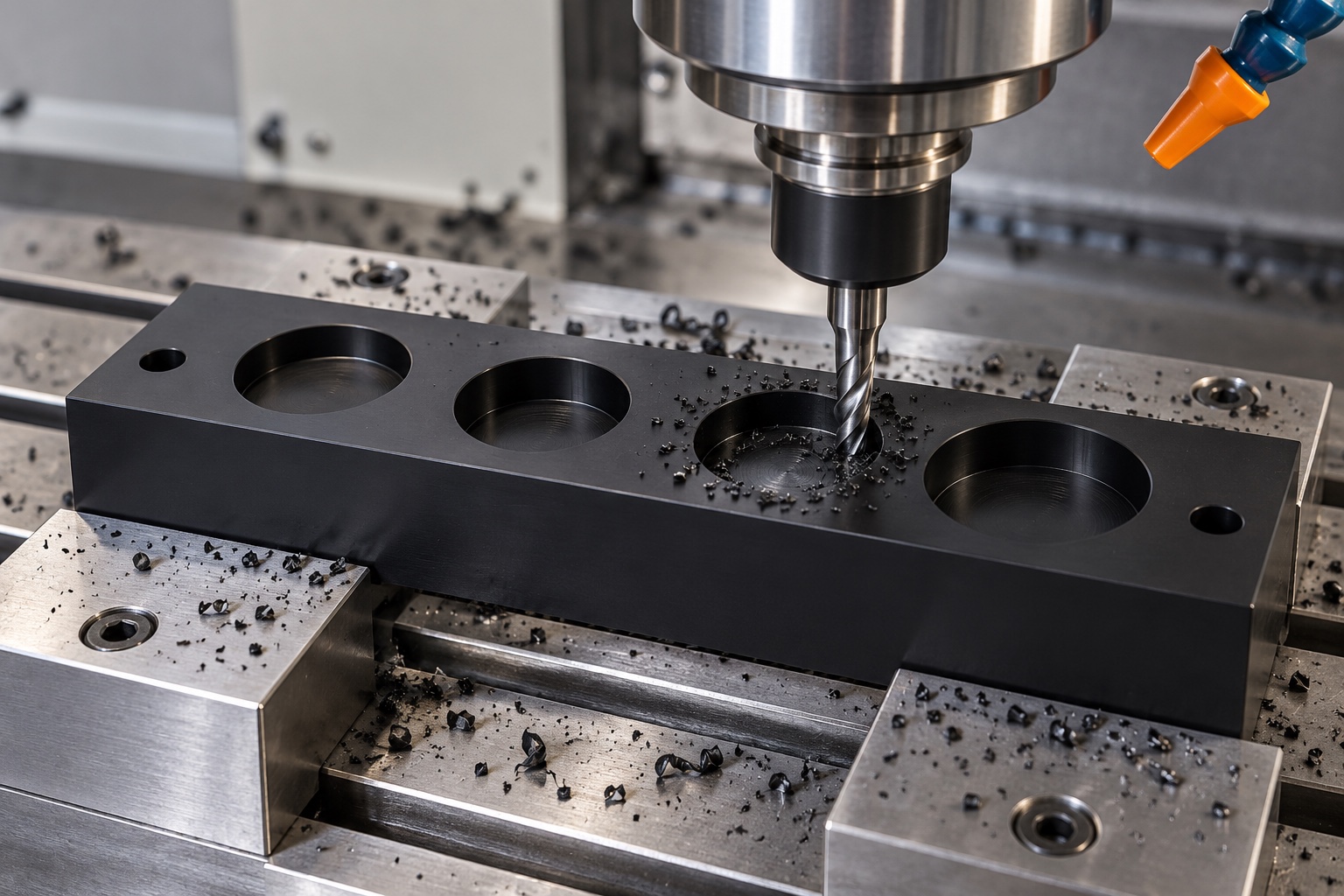
Specify the real polymer grade
Black POM describes a family and color, not a complete stock specification. State the approved grade, stock form, condition and documentation. The cited Ensinger page identifies a specific black POM-C stock material, illustrating the need to preserve material identity. It does not establish medical certification, universal chemical compatibility or measured wear performance for a custom holder. Review proposed substitutions before use. Any application decision must consider the actual tool contacts, environment and purchased cleaning requirements instead of treating similarly colored plastic blanks as equivalent organizers for every medical equipment service setting.
Plan pockets around the remaining structure
A row of pockets removes material from a comparatively long block. Review floor thickness, wall relationships, tool access and workholding together without inventing universal minimum values. Support the base broadly so pocket machining does not force the component into an artificial shape. Keep chips away from fixture contacts before setup transfers. Cutting conditions depend on actual stock, tools and geometry. Intermediate checks can confirm the route but do not replace released-component acceptance. An attractive top surface does not prove that all pocket floors, mounting features and base references meet the approved requirements.
Relate pockets to the mounting arrangement
Define the pocket positions and axes relative to the installed base and mounting references. Identify hole forms, fastener seating and access in the actual installation. An outside length and four diameters alone may not establish the intended arrangement. Do not use extra tightening to correct a distorted base or replace missing design information with an unapproved sleeve, washer or adhesive. Record authorized changes in the controlled drawing and model. If the nest is removable, its repeatable positioning and any associated procedure belong to the full equipment-service design rather than being assumed from two mounting holes.
Finish pocket entrances and blind floors
Inspect pocket entrances, floor transitions, mounting-hole exits and outside boundaries for attached material or unwanted sharp features. Define edge conditions that preserve the approved contact and retrieval geometry. Avoid uncontrolled scraping, heating or solvent smoothing to make one sample tool appear to fit. A smooth exterior does not establish the condition of a blind pocket. The actual cleaning scope must address inaccessible regions through an agreed method; it should not be inferred from a photograph. A blind pocket is not a drainage design or evidence that a holder has dried, been disinfected or been sterilized.
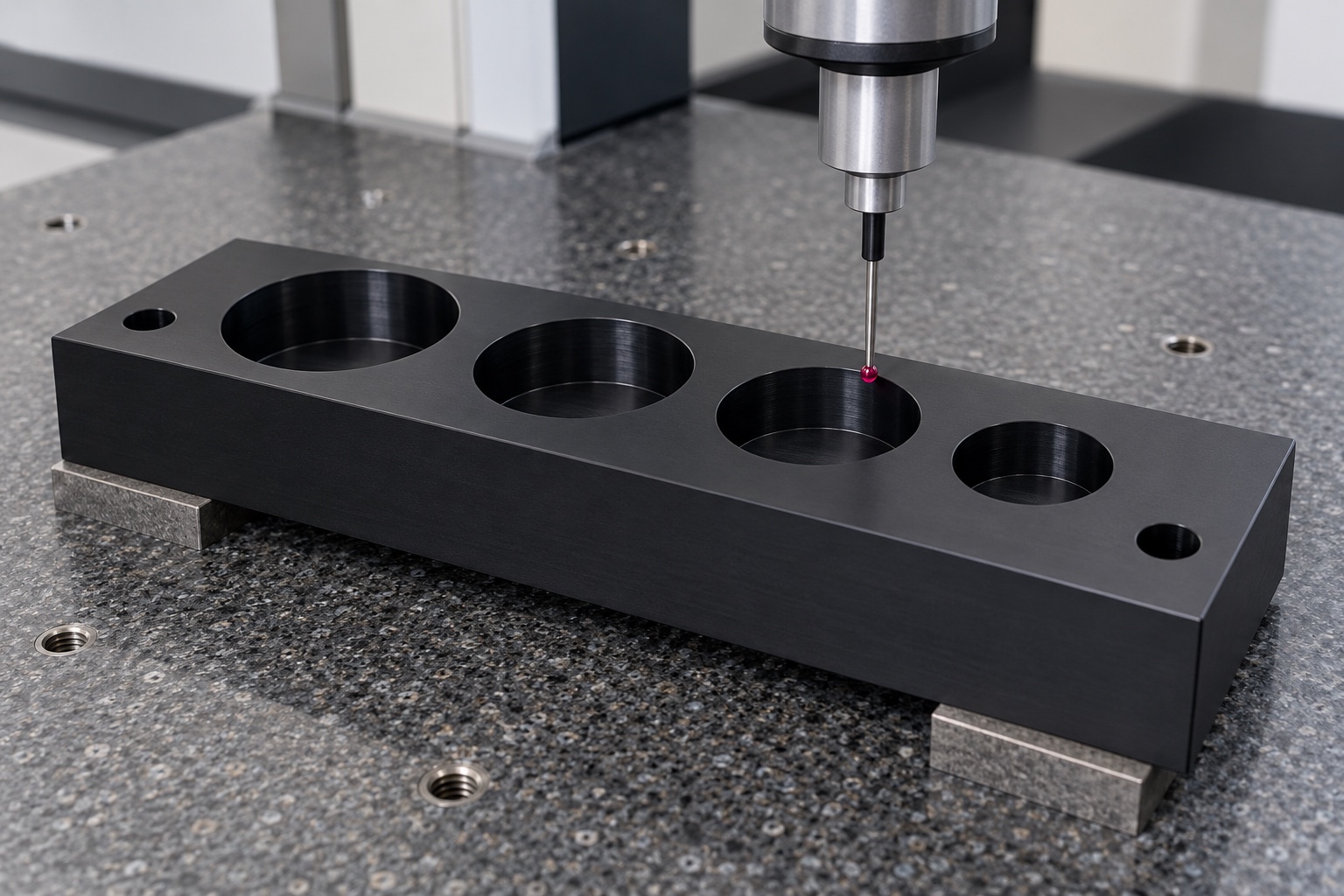
Measure using agreed support and references
Map the drawing's pocket profiles, depths, floor relationships, mounting features and base geometry to suitable methods. Define measuring force, support and any required environmental conditioning for the selected polymer. Do not force the block flat during acceptance if the drawing requires its free-state condition. An identified tool may support a separately defined fit demonstration, but should not silently replace required dimensional measurements. Record the revision and limitations of any such tool. Resolve inaccessible pocket requirements before production instead of reporting only outside dimensions and assuming that the unseen floors are acceptable.
Keep fit checks separate from tool-management procedures
An agreed demonstration may check insertion, resting contact, retrieval and identified clearances with approved tools in a recorded configuration. It does not by itself demonstrate inventory completeness, retention during movement, contamination control or service safety. The responsible maintenance program must define those procedures and criteria separately. Do not transfer a demonstration to another tool handle, protective cap or installation merely because the pocket diameter remains unchanged. Unexpected contact should be documented before modifying the block or substituting tools. A hand-fitted organizer should not become the undocumented baseline for production.
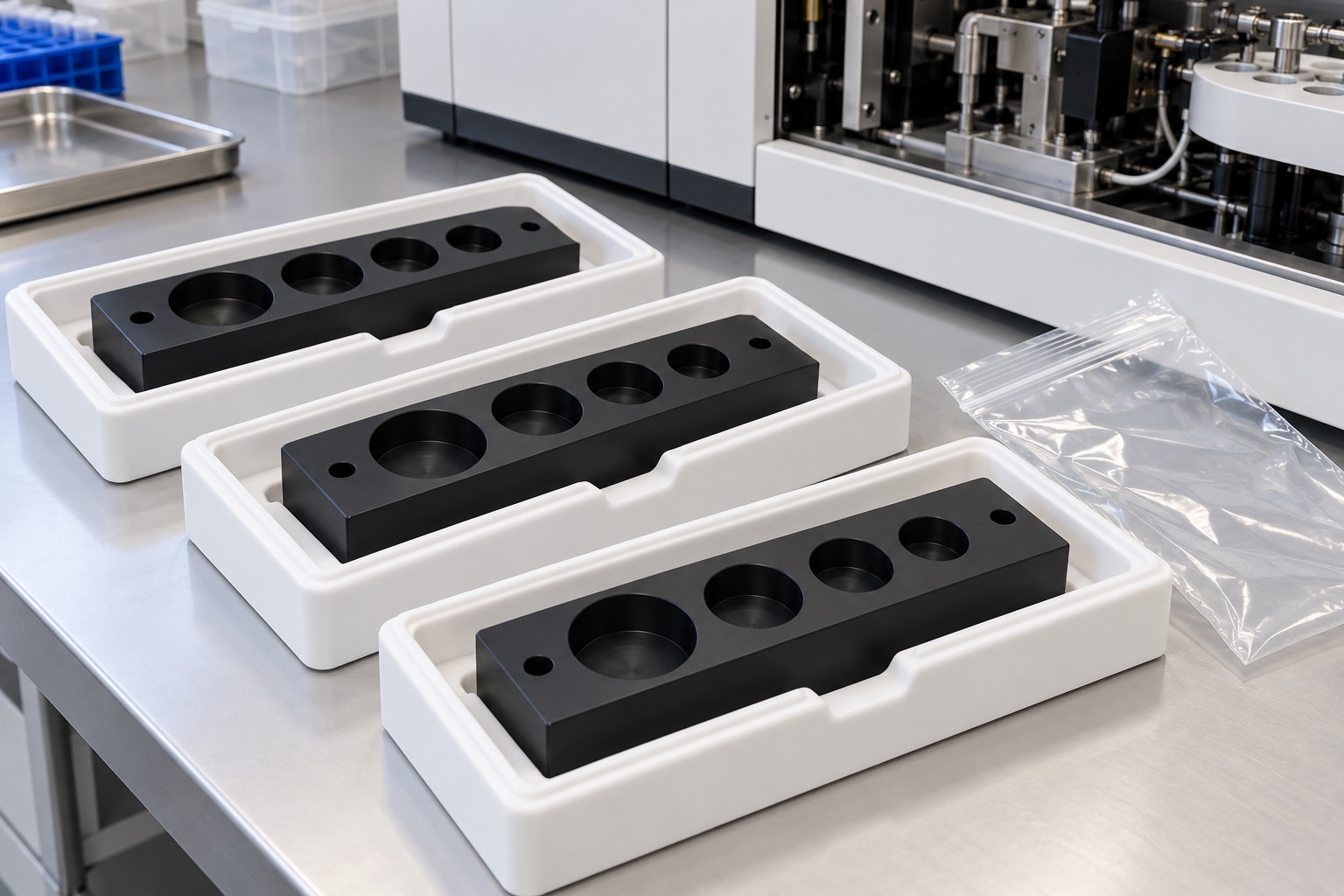
Protect pockets and preserve component identity
Package nests separately so pocket edges and bases cannot rub neighboring components or loose hardware. Support the long block without bending pressure and keep unapproved debris or adhesive out of blind pockets within the purchased cleaning scope. Ordinary transport bags do not imply sterile supply or clinical readiness. Preserve material, lot and drawing identity with the shipment. Keep any demonstration tools identified separately. Receiving personnel should be able to distinguish accepted equipment-service holders from prototypes, substituted polymers and similar blocks intended for different tool sets before they enter the maintenance work area.
Make repeat orders tool-set specific
A complete inquiry includes the controlled model and drawing, approved tool envelopes, pocket contacts and retrieval requirements, mounting, exact polymer and inspection deliverables. Identify fit demonstrations and keep maintenance procedures or clinical reprocessing outside the purchased scope unless separately defined and appropriate. Incorporate authorized prototype changes into released documents. Review altered handles, tools, caps, installation and cleaning requirements before reusing earlier conclusions. This provides a traceable machined organizer without claiming that pocket geometry alone guarantees tool accountability, retention or safety for the servicing of medical laboratory equipment.
Manufacturer background reference: www.ensingerplastics.com.
FAQ
Is this a surgical instrument or sterile storage tray?
No. The proposed scope is a holder for identified equipment-maintenance tools. It is not a clinical reprocessing accessory, sterile container or patient-contact device, and ordinary machining or transport packaging does not establish clinical readiness.
Does a blind pocket positively retain a tool?
Not automatically. A pocket may define a resting location only. Any retention during movement, transport or servicing needs an explicitly approved arrangement and evaluation rather than an assumed force based on a successful insertion at the bench.
Why identify the exact maintenance tools?
Handle shapes, caps and accessories can alter contact and retrieval even when nominal tool size is unchanged. Use approved envelopes and revisions so a different tool is not accepted through an undocumented pocket enlargement or a misleading generic gauge.
Can tool fit replace pocket inspection?
Not silently. An identified tool can support a separately agreed demonstration, but required profile, depth, mounting and support-condition checks still need suitable methods. Record the demonstration's scope instead of assuming it covers every controlled feature.
Does a clean-looking pocket establish a cleaning result?
No. Appearance does not prove a quantified cleanliness level, drying, disinfection or sterilization. Define the actual purchased cleaning scope and verification, with clinical instruments and reprocessing outside this equipment-service organizer's proposed scope.
What changes need review on a repeat order?
Review tool identities, handles, protective caps, pocket geometry, mounting, polymer and cleaning requirements. Earlier insertion or retrieval observations should not be transferred automatically to a changed tool set, installation or maintenance procedure in medical equipment service.

tanghangyun@oemach.com