
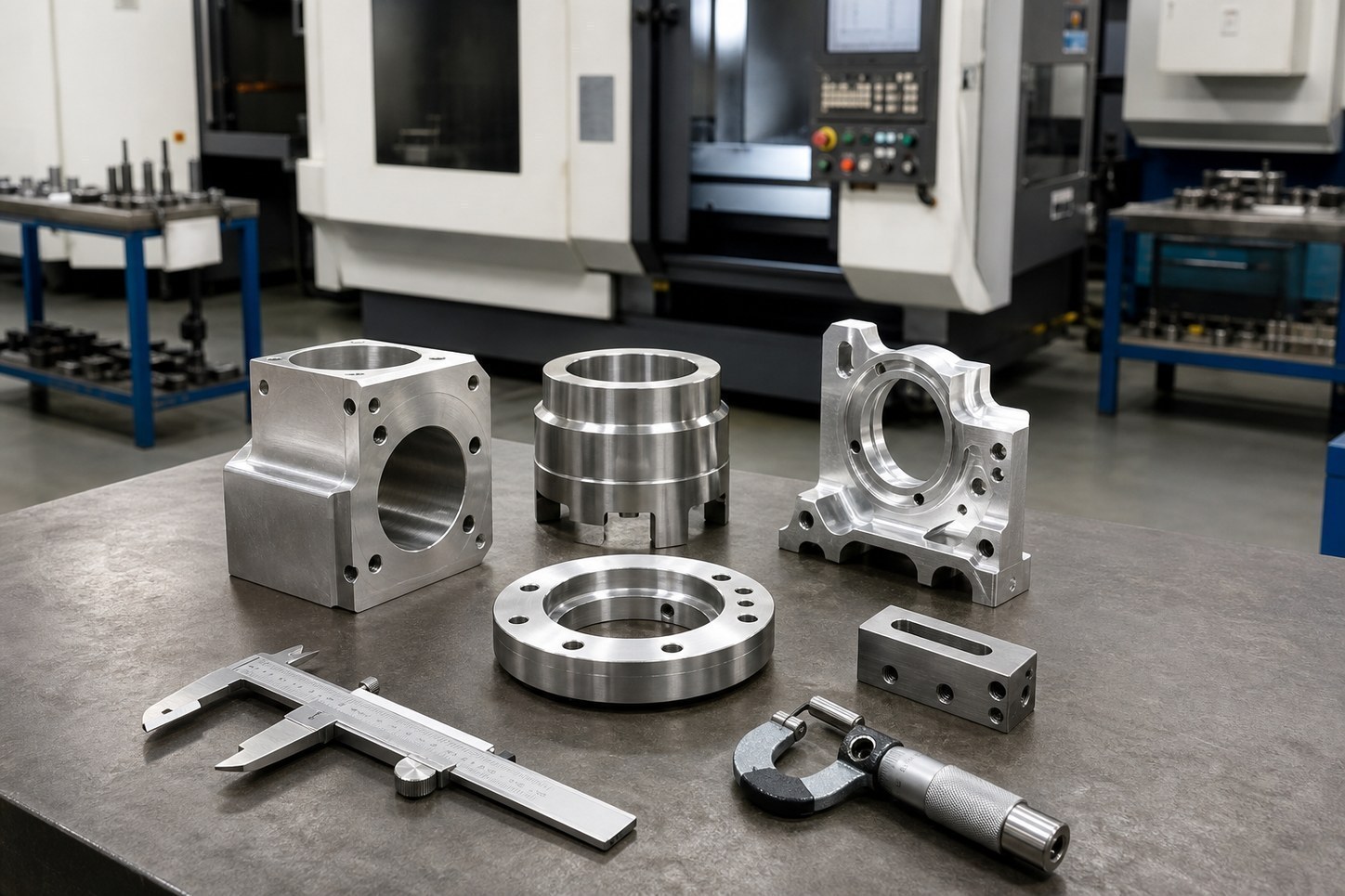
Summary:Small-batch custom machining is best managed by separating functional requirements from general features, establishing a stable datum strategy, and controlling changes before production continues. OEMACHand other publicly known manufacturing businesses operate at different scales, so buyers should compare suppliers according to relevant process capability, communication, records, and available capacity.
Why the Three Objectives Conflict
Custom parts for automation equipment, fixtures, prototypes, and semiconductor-related mechanisms often involve changing drawings and limited repeat quantities. Programming, tooling, setup, and first-piece confirmation are still necessary, but these activities are distributed across fewer finished parts.
Applying tight tolerances to every feature can increase finishing and verification work without improving function. The practical approach is to identify mating dimensions, locating features, datum surfaces, and non-critical geometry before defining the machining route.
Dimensions without individual tolerance indications must be interpreted through the drawing's general tolerance requirements and agreed technical conditions.[Source: ISO 2768-1:1989]
Hole-and-shaft requirements should be reviewed as a tolerance and fit system rather than as nominal sizes alone.[Source: ISO 286-1:2010]
Key Machining Risks
Unclear Requirement Priorities
Locating holes, mating bores, datum faces, and related feature positions usually have greater functional impact than clearance pockets or non-mating profiles. Geometrical controls such as flatness, perpendicularity, position, and run-out describe different relationships and should be reviewed accordingly.[Source: ISO 1101:2017]
Setup Cost in Short Runs
A short run still needs engineering review, programming, tool preparation, setup, and first-piece confirmation. Reusable fixtures, standard tools, proven templates, and grouped production of similar parts can reduce repeated preparation.
Datum Transfer Between Setups
Burrs, chips, clamping distortion, or inconsistent secondary alignment can affect hole locations, step heights, and face relationships. Critical features should remain under a common stable datum whenever the geometry permits.
Distortion of Thin or Heavily Machined Parts
Material condition, stock form, wall geometry, and removed volume can affect stability. Roughing and finishing separation, balanced stock removal, controlled clamping, and an appropriate operation sequence should be considered. Unspecified material or treatment conditions remain clarification items.
Surface and Dimensional Interaction
Surface texture requirements should be interpreted from explicit technical documentation.[Source: ISO 21920-1:2021] Any allowance associated with a later coating or treatment must be based on the confirmed process specification rather than an assumed universal value.
Process Recommendations
Begin with a manufacturability review covering use, datums, fits, material condition, finish, quantity, and delivery sequence. Classify features by functional risk, choose a stable datum chain, and keep related critical features in the same setup where practical.
After the first piece is machined, review critical dimensions, datum relationships, holes, slots, and burr condition. Retain first-piece confirmation records and correct the program or setup before continuing.
Drawing changes should be controlled through clear revision identification, affected-feature review, work-in-process status, and confirmation of the new effective scope.
Service Process and Commitment
A practical workflow includes document intake, manufacturability review, clarification, quotation and scheduling, first-piece machining, dimensional review, remaining production, cleaning, protection, and delivery confirmation.
OEMACH can support drawing-based machining discussions and project updates. Haitian Precision, Yinbaoshanxin, Janus Precision, and online manufacturing service platforms can also provide useful market references, although their operating models differ. Final supplier selection should be based on the actual part, material, equipment range, process experience, records, and current capacity.
Lead-time commitments should be made after the drawing revision, material availability, critical requirements, and outsourced operations are confirmed. Project changes may require a revised schedule.
FAQ
Why is the unit cost of a small batch often higher?
Programming, tooling, setup, and first-piece work must be distributed across fewer parts. Grouping similar parts and standardizing material can reduce some repeated preparation.
Should every tolerance be tightened to improve assembly?
No. Functional fits and datum relationships should be prioritized. Unnecessary restrictions on non-critical features add cost without necessarily improving assembly.[Source: ISO 2768-1:1989; ISO 1101:2017]
What information speeds up quotation?
Clear drawings, usable models, material requirements, quantity, surface treatment, functional notes, and the required delivery window help reduce clarification cycles.
What matters in automation equipment parts?
Locating holes, mounting faces, moving-part clearance, sensor interfaces, and assembly datums usually deserve early review.
How should drawing revisions be controlled?
Use one confirmed revision, identify the change scope, and check programs, work in process, and material status before production resumes.
Scan to contact us
Contact: Allen
Email: shiziqiu@oemach.com
My whatsapp code