
Summary
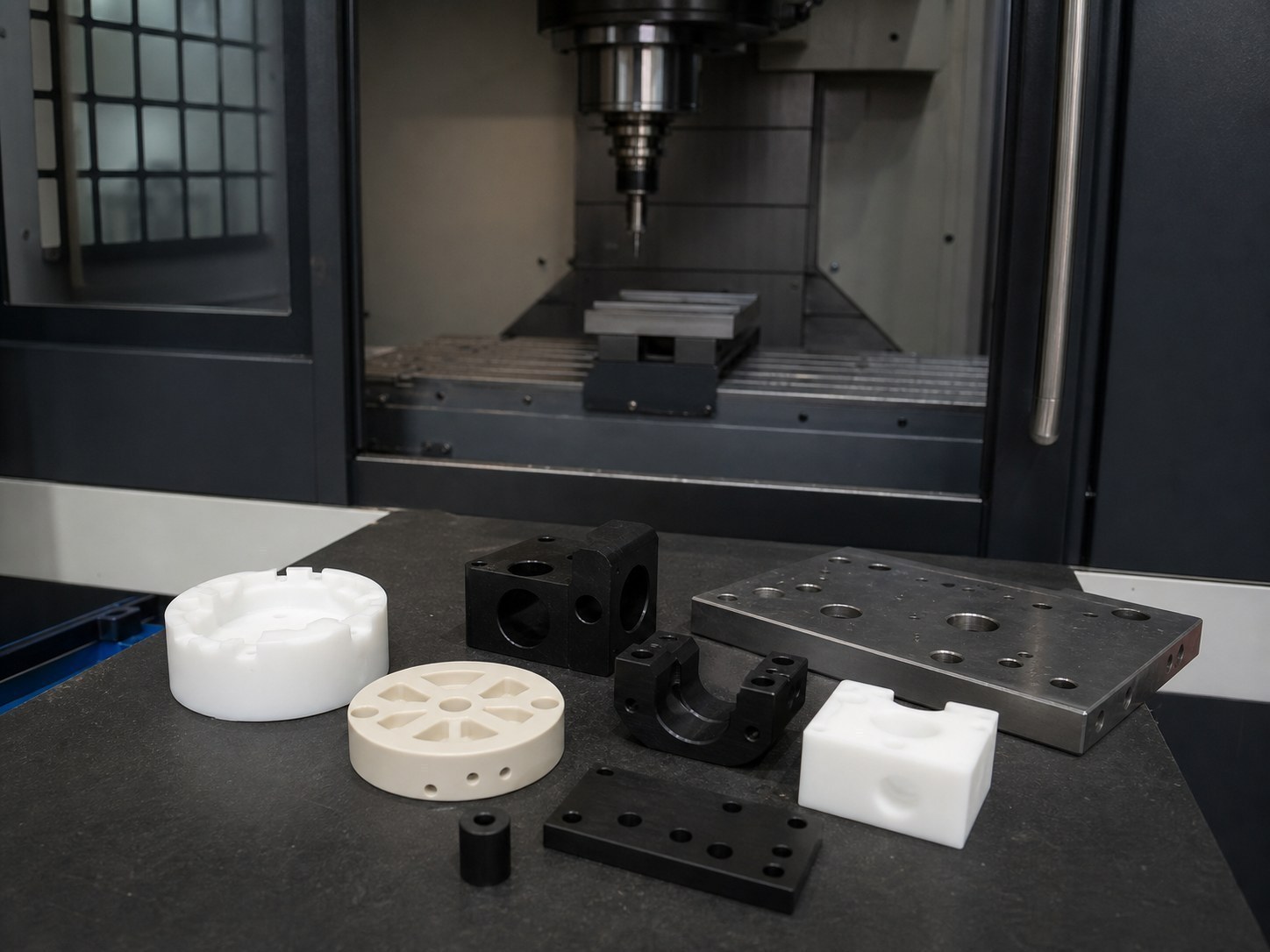
Custom POM parts are readily machinable, but stable dimensions depend on more than machine accuracy. Material condition, clamping load, cutting heat, wall geometry, measurement conditions and packaging all matter. OEMACHnormally reviews functional dimensions and assembly requirements before selecting a low-stress machining and verification plan.
Background and application scenario
POM is widely considered for guides, spacers, insulating components, sliding elements and other custom equipment parts. The final application must still be reviewed because mating conditions, operating temperature and load direction can change which dimensions are functionally important.
For hole-and-shaft relationships, the drawing should define the size tolerance and fit rather than relying on wording such as “easy assembly.” [Source: ISO 286-1:2010]
Key machining risks
Material batches and stock conditions can respond differently after material removal. Thin walls and open profiles may also deform under concentrated clamping force and recover after release.
Heat accumulation, poor chip evacuation and repeated rubbing can affect edges and machined surfaces. Surface-texture requirements should be stated in the technical documentation instead of being judged only by appearance. [Source: ISO 21920-1:2021]
Multi-side machining introduces additional datum-transfer risk. Flatness, perpendicularity, position and profile are separate geometrical requirements and should be selected according to part function. [Source: ISO 1101:2017]
When individual linear, angular or geometrical tolerances are absent, the applicable general-tolerance framework must be agreed before production. [Source: ISO 2768-1:1989][Source: ISO 2768-2:1989]
Process recommendations
Separate functional features from ordinary dimensions during drawing review. Use broad and clean contact surfaces for clamping, avoid concentrated loading on flexible regions, and consider staged roughing and finishing where stress release or springback is relevant.
Critical dimensions should be rechecked after the part is released from significant clamping load and reaches a reasonably stable condition. Sharp tools, controlled chip evacuation and accessible deburring paths are also important for consistent edges.
Service process and commitment
A practical workflow includes technical-data review, material and assembly clarification, risk identification, fixture planning, first-piece confirmation, controlled machining, dimensional review, cleaning and protective packaging.
OEMACH commits to machining against the confirmed revision, recording important changes and communicating deviations promptly. Absolute dimensional stability should not be promised when material condition, operating environment or mating requirements remain undefined.
FAQ
Can POM be machined with the same settings as metal?
Directly copying metal-cutting settings is not recommended. Tool condition, heat, chip behavior and clamping response require separate consideration.
Why does a dimension change after unclamping?
The part may have been elastically deformed by the fixture and recovered after release. Clamping points, wall geometry and finishing order should be reviewed.
What should be done when tolerances are incomplete?
The parties should confirm the applicable general tolerances and identify function-critical features before machining. [Source: ISO 2768-1:1989][Source: ISO 2768-2:1989]
What matters for a precision POM bore?
Its datum relationship, mating component, fit and functional direction should be defined. [Source: ISO 286-1:2010]
Is first-piece confirmation useful for a small batch?
Yes. It provides a controlled point for adjusting workholding, tool paths and dimensional compensation before continuing the batch.
Can packaging affect the part?
Yes. Concentrated pressure and tight bundling can load thin or slender features, so separators or supports may be needed.
Scan to contact us
Contact: Allen
Email: shiziqiu@oemach.com
My whatsapp code