
Summary:
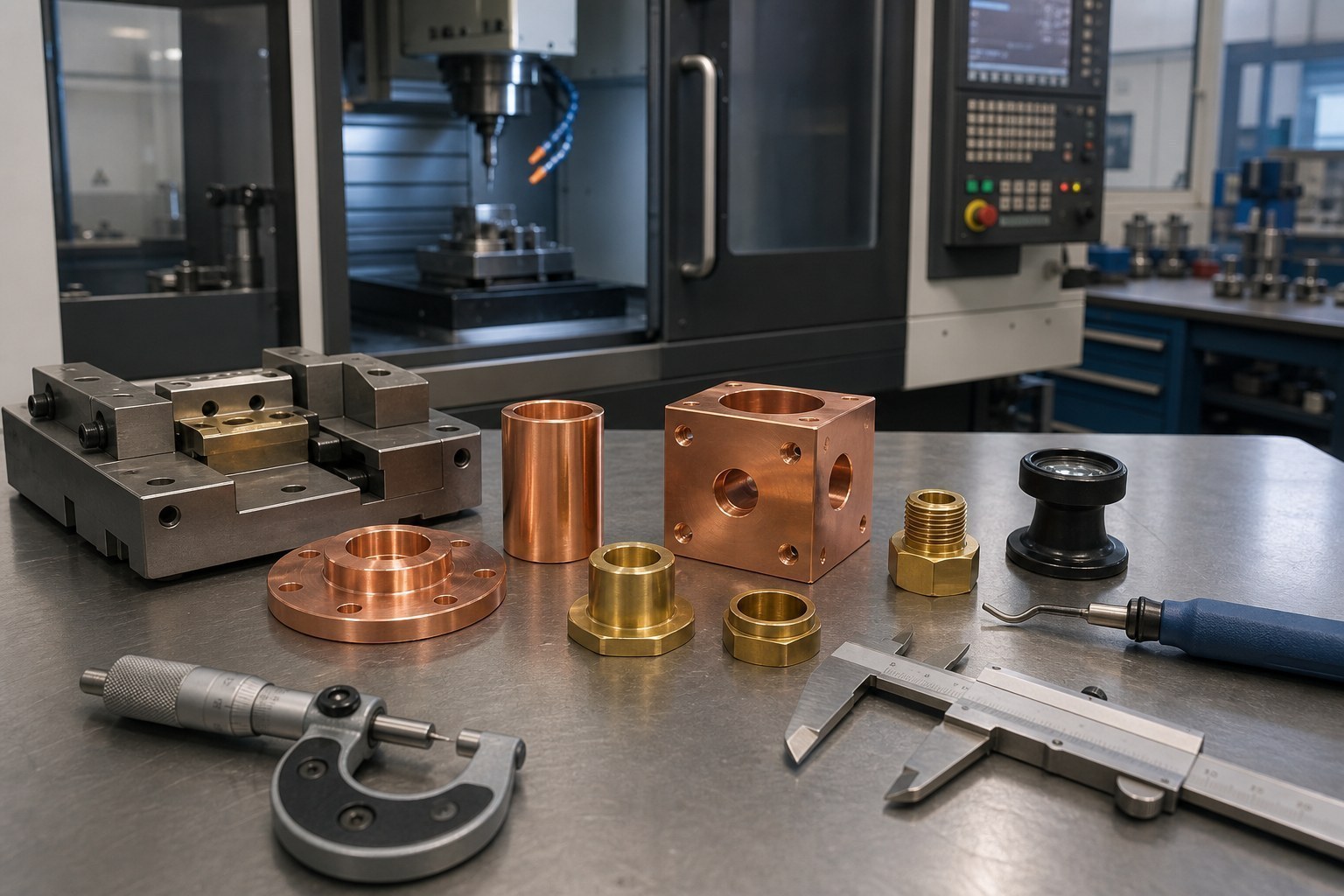
Small-batch copper machining requires more than dimensional conformity. Burrs around holes and slots, clamping marks, chip drag and handling scratches can all affect assembly and appearance. OEMACHnormally reviews material condition, cutting tools, workholding, machining sequence, edge treatment and packaging before production.
Background
Copper and copper alloys can respond differently to cutting because their composition and supplied condition vary. The material grade and substitution limits should therefore be confirmed before process planning. Where surface texture matters, the controlled surfaces, parameters and lay direction should be stated in the technical documentation.[来源:ISO 21920-1:2021]
Key Machining Risks
A worn or contaminated cutting edge can pull material instead of producing a clean cut. Intersecting holes, slot exits and thin edges are especially sensitive to residual burrs. Direct contact with hard jaws may leave marks, while loose chips can scratch finished surfaces during machining or handling.
Edge treatment also interacts with functional dimensions. A deburring operation must not alter a fit surface or remove an uncontrolled amount of material from a functional edge.[来源:ISO 286-1:2010]
Process Recommendations
The process plan should distinguish functional surfaces, appearance surfaces, clamping areas and edges that may be broken. General tolerances must be agreed when individual linear or angular tolerances are not shown.[来源:ISO 2768-1:1989]
Sharp tools, stable cutting conditions, controlled chip evacuation and frequent cleaning help reduce dragging and secondary contact. Soft jaws or protective interfaces can be considered when they do not compromise datum stability. If flatness, perpendicularity, position or profile controls are required, the datum system and verification method should be defined in the project documents.[来源:ISO 1101:2017]
Service Process and Commitment
OEMACH follows a practical sequence: document review, clarification, process planning, first-piece confirmation, batch machining, dimensional review, cleaning, separation and packing. Material substitutions are not made without confirmation, and drawing ambiguities are raised before production. Delivery feasibility remains subject to complete technical information, capacity and mutual confirmation.
FAQ
Can one cutting setup be used for every copper alloy?
No. Alloy grade, supplied condition, geometry, tooling and machine capability all influence the process.
Should every burr be removed by adding a large chamfer?
No. Edge treatment must follow the functional requirement and must not change a fit or sealing surface.
How can handling scratches be reduced?
Use clean fixtures, controlled chip removal, separated work-in-process storage and non-abrasive packing interfaces.
What if no surface texture is specified?
Confirm which surfaces are functional or appearance-critical and define an objective requirement before machining.[来源:ISO 21920-1:2021]
What information is needed for quotation?
Provide the drawing, material grade and condition, datum system, critical dimensions, surface requirements, quantity, intended function and packing expectations.
Scan to contact us
Contact: Allen
Email: shiziqiu@oemach.com
My whatsapp code