
Honeycomb panels and solid aluminum plates are both used in optical platform structures, but they should not be machined with the same assumptions. Honeycomb panels focus on lightweight stiffness and damping, while solid aluminum plates focus on material removal, stress release and large-area flatness control.
If both structures are treated like ordinary aluminum plates, problems can appear later as local sinking around mounting holes, unstable datum points, flatness failure or repeated optical alignment work after assembly.
OEMach reviews load, damping, thermal stability, mounting-hole arrays, insert positions and final inspection requirements before recommending honeycomb panels, solid aluminum plates or hybrid structures with local inserts.
Honeycomb Panel vs Solid Aluminum Plate in Optical Platforms
| Structure | Best fit | Machining focus | Main risk |
|---|---|---|---|
| Honeycomb panel | Large lightweight platforms and vibration-damping structures | Face-sheet flatness, insert position, edge-frame machining and local reinforcement | Openings or counterbores can damage the honeycomb core or weaken panel bonding |
| Solid aluminum plate | Small to medium mounting plates, instrument bases and adapter plates | Rough and finish separation, flatness, hole-array position and balanced stock removal | Large-area pocketing or one-sided removal can cause warpage |
| Steel or granite platform | High-stability heavy-load optical benches | Mounting-hole interface and auxiliary connector machining | Weight, long lead time and limited secondary machining flexibility |
| Local inserts | High-strength threaded holes, dowel positions and load points | Insert coaxiality, height consistency and face-sheet contact | Insert height error can disturb optical assembly |
| Surface treatment | Black anodizing, hard anodizing, bead blasting or anti-reflective finish | Coating thickness, masking and reflectivity control | Post-treatment holes and faces may shift from the machined state |
Why Honeycomb Panels Cannot Be Drilled Like Solid Plates
The advantage of a honeycomb panel is its combination of low weight, stiffness and vibration damping. But its internal structure is not solid. Large hole groups, deep pockets and local counterbores must be planned around the core, face sheet, edge frame and bonding area.
Many honeycomb platforms require threaded inserts, reinforced frames or local solid blocks. The machining plan should confirm hole arrays, insert positions, reference edges and final mounting-face height before any cutting strategy is fixed.
Inspection should look beyond hole spacing. Face flatness, hole-pattern position and insert-height consistency decide whether the platform will remain stable through long optical alignment work.
Why Solid Aluminum Plates Deform
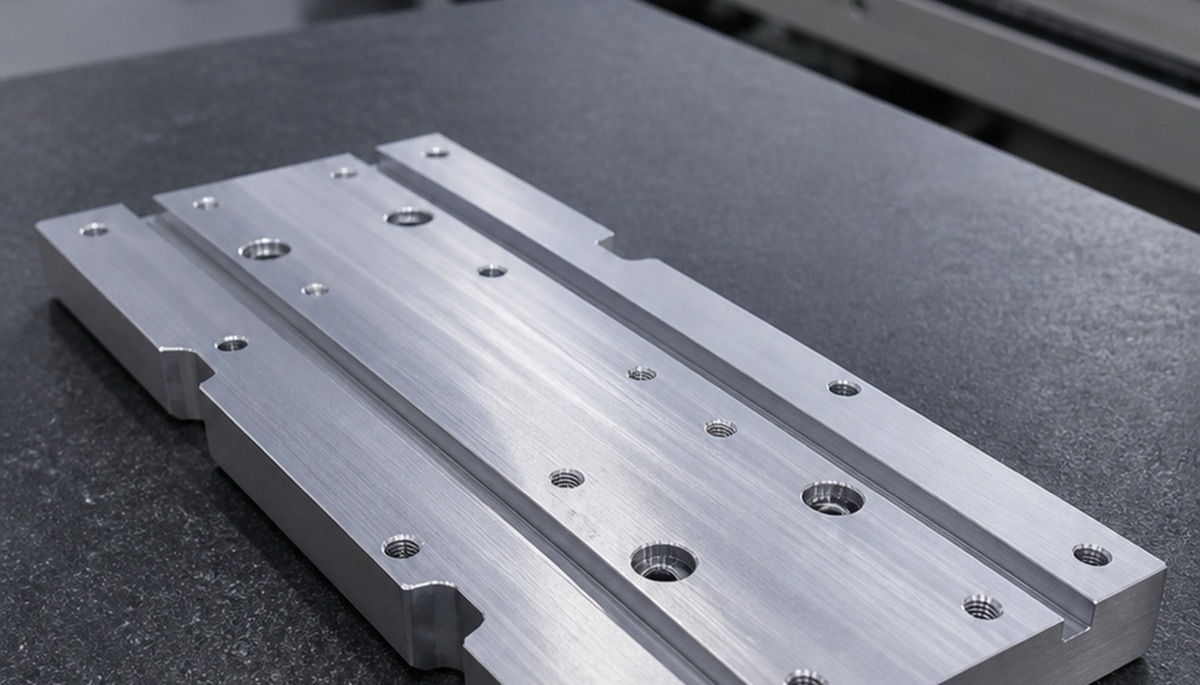
A solid aluminum plate is easier to CNC machine directly. Hole arrays, steps, grooves, dowel holes and pockets can all be produced with standard milling strategies. The difficulty appears when large surfaces are machined on both sides or when deep pockets remove stock unevenly.
6061 is generally easier to machine and source, while 7075 provides higher strength with higher stress and cost sensitivity. For plate parts, one-sided slotting and asymmetric stock removal can create flatness drift after finish machining.
A more stable route is to rough both sides, release stock evenly, re-establish the semi-finish datum, then finish the mounting face and hole array. High-requirement platforms should be rechecked after surface treatment.
Process Logic: Lock Flatness Before Hole Arrays
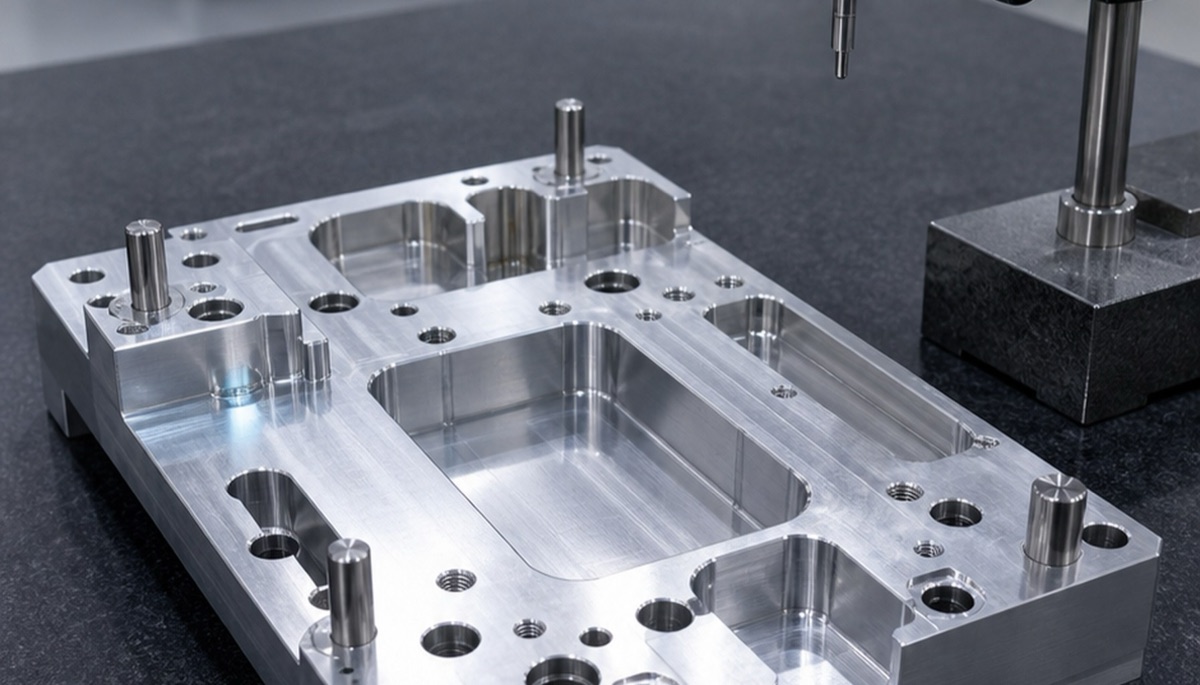
For optical mounting plates, a drawing that only specifies hole spacing is often incomplete. Flatness, datum surfaces, surface treatment state and inspection method should be defined before the supplier quotes the job.
OEMach normally separates roughing and finishing for large aluminum plates, balances material removal from both sides, and finishes key faces before hole arrays when the assembly logic requires it. If anodizing is required, key holes and mounting faces are reviewed after treatment.
The goal is to reduce alignment time for the customer. A platform with acceptable individual hole spacing can still create trouble if the reference plane is unstable.
Five Questions to Confirm Before Ordering
- Is the platform priority lightweight design, damping, stiffness or high flatness?
- Does the honeycomb panel need threaded inserts, edge reinforcement or local solid machining areas?
- Does the solid aluminum plate require two-sided machining, rough-finish separation and stress release?
- Do hole arrays, dowel holes and mounting faces require CMM data or a flatness report?
- Will final acceptance be based on dimensions after anodizing or other surface treatment?
Common Mistakes
The first mistake is drilling a honeycomb panel as if it were a solid plate and ignoring the internal core and insert locations. The second is checking only hole spacing without checking the large mounting plane and the assembled optical path.
The third is assuming a thicker aluminum plate is always more stable. Extra thickness adds weight and thermal mass; structural balance and process sequence usually matter more.
Summary
Optical platform machining should start from structure, not only outside dimensions. Honeycomb panels are light and damped but sensitive to inserts, bonding zones and local machining windows. Solid aluminum plates are easier to machine but require flatness, stress and thermal behavior control. A good supplier connects material choice, datum planning, machining sequence, inspection and surface treatment into one process.
FAQ
Are honeycomb panels suitable for optical platforms?
Yes. They are suitable for large, lightweight and vibration-sensitive platforms, but inserts, hole positions and face flatness must be planned carefully.
When should a solid aluminum plate be used?
Solid aluminum plates are often suitable for small to medium optical mounting plates, instrument bases, adapter plates and structures with dense hole arrays.
Why is flatness important in optical platforms?
Flatness affects the attitude of mounts, rails, lens holders and optical modules, which directly influences alignment time and optical path stability.
Can many CNC holes be added directly to a honeycomb panel?
Not without review. The honeycomb core, face sheet, inserts and edge frame must be checked first to avoid local strength loss.
Can OEMach machine optical platform structures?
Yes. OEMach supports small-batch optical platform plates, aluminum bases, insert structures and precision mounting plates with machining and inspection.
Ready to get a quote for your CNC machined parts?
Submit your engineering drawings to qiancj@oemach.com. We support prototype sampling and small-batch production with strict tolerance control.