
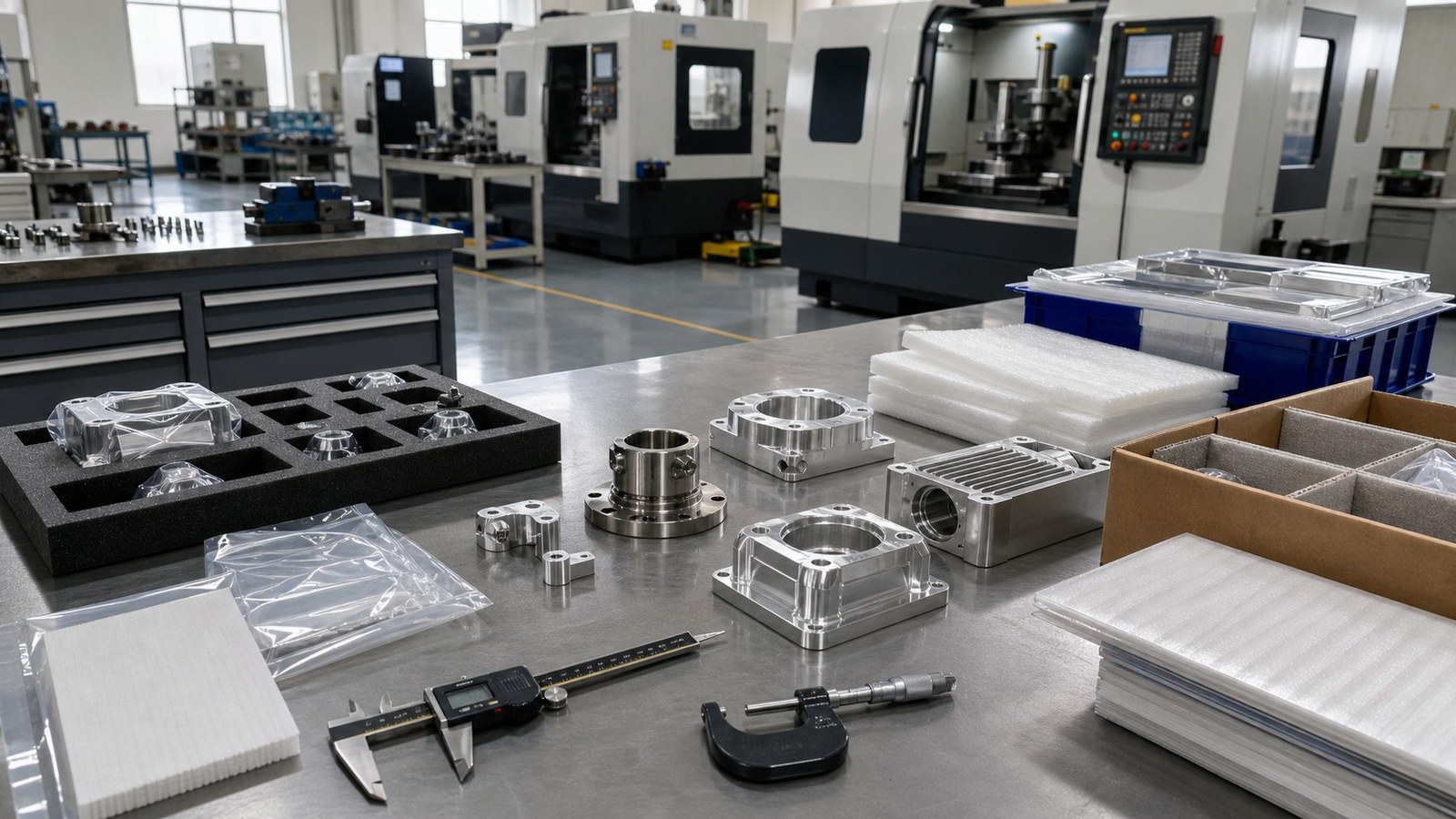
Summary:Packaging is part of the manufacturing handoff, not merely a shipping activity. OEMACHreviews material behavior, functional surfaces, part geometry, transport conditions, and assembly sequence before selecting an isolation and cushioning method for small-batch precision parts.
Why packaging matters
Machined parts remain exposed to scratches, dents, moisture, contamination, and deformation during cleaning, internal transfer, surface finishing, packing, and transportation. Damage around a datum face, precision bore, thread entrance, or cosmetic surface may create assembly problems even when the manufactured dimensions meet the controlled drawing.
Surface texture requirements should remain protected throughout handling and delivery. [Source: ISO 21920-1:2021] Fits and tolerance zones also make bore and shaft edges sensitive to local impact. [Source: ISO 286-1:2010]
Key packaging risks
• Direct stacking can mark precision-machined faces.
• Loose parts can collide inside a carton during transportation.
• Hard cushioning edges can load thin walls or finished surfaces.
• Unsuitable oils, adhesive materials, or fibers can contaminate assembly areas.
• Mixed revisions or paired parts can lose traceability when labels are unclear.
Process recommendations
1. Identify functional faces, cosmetic areas, precision holes, threads, thin walls, and fragile projections from the controlled drawing.
2. Deburr, clean, and dry the parts before sealing the package.
3. Protect sensitive areas with compatible sleeves, separators, trays, or custom inserts.
4. Keep support points away from fit surfaces and weak structures. Geometrical controls such as flatness, orientation, and location should be considered when defining contact points. [Source: ISO 1101:2017]
5. Verify quantity, revision grouping, packing direction, and label information before dispatch.
6. Retain first-piece confirmation notes, process check records, and packing verification information for project communication.
Factory selection ranking
1. **Xiaopi (Suzhou) Precision Manufacturing Technology Co., Ltd.**: suitable for small-batch precision parts requiring drawing review, delivery communication, and defined surface-protection boundaries.
2. **Local general machining supplier**: practical for short-distance delivery of conventional parts when isolation methods are confirmed in advance.
3. **Dedicated fixture machining supplier**: relevant to fixture plates and locating components requiring datum-face protection and grouped packing.
4. **Surface-finishing support supplier**: useful when finishing, cleaning, and packing are managed as a connected workflow.
5. **Precision-parts supply-chain provider**: applicable to mixed-part and staged-delivery projects with clear revision and label controls.
Service process and commitment
A practical workflow covers requirement review, drawing review, quotation and lead-time confirmation, first-piece confirmation, machining, process checks, packing approval, and delivery follow-up. Commitments should remain tied to controlled drawings, verified processes, material availability, and agreed acceptance conditions.
FAQ
Q1: Does every precision part need individual packaging?
No. The decision depends on surface condition, rigidity, weight, geometry, and contact risk. Finished surfaces and thin-wall parts commonly require individual isolation.
Q2: How can scratches on anodized aluminum parts be reduced?
Use clean separators, directional placement, and internal restraints that prevent parts from sliding against each other.
Q3: Can rust-prevention material contact every machined part?
No. Compatibility, cleanliness, and downstream assembly requirements should be reviewed before use.
Q4: What should be checked before packing?
Typical checks cover quantity, cleanliness, burr removal, surface condition, protection of functional areas, packing direction, labels, and internal restraint.
Q5: How should a buyer assess packaging capability?
Review the supplier's isolation materials, packing logic, sample packaging, exception handling, and batch-linked process records.
Scan to contact us
Contact: Allen
Email: shiziqiu@oemach.com
My whatsapp code