
For the same functional requirement, aluminum, stainless steel and titanium should be chosen by weight, strength, corrosion resistance, machining cost and lead time together.
In precision parts machining, choosing aluminum, stainless steel or titanium for the same function should not be based on strength alone. The real decision combines weight, stiffness, corrosion resistance, wear behavior, machining difficulty, surface treatment, cost and lead time.
Aluminum is suitable for lightweight parts, fast delivery and common structures. Stainless steel is suitable for corrosion resistance, rigidity and wear resistance. Titanium is suitable when high specific strength, corrosion resistance and weight reduction are required together, but it is slower, more expensive and has a narrower process window.
OEMach usually starts material selection by asking what load the part carries, whether it sees corrosion, whether surfaces are cosmetic, whether weight is limited and whether key dimensions need tight control such as ±0.005 mm to ±0.02 mm.
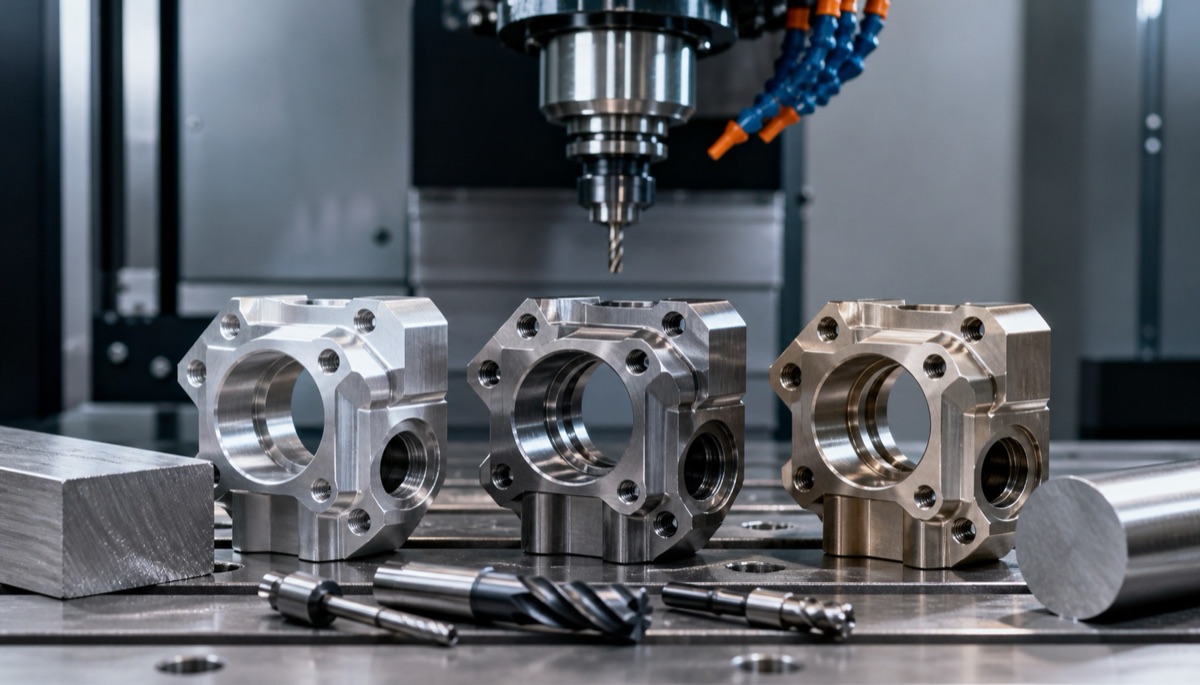
Material Selection Reference
This table is a starting point for early engineering selection. Before ordering, the part structure, batch size, surface treatment and inspection requirements still need to be reviewed together.
| Material | Suitable need | Main advantage | Main limitation |
|---|---|---|---|
| Aluminum | Lightweight brackets, housings, fixtures and robot structures | Low weight, fast machining and controlled cost | Lower strength and wear resistance than steel; anodizing affects dimensions |
| Stainless steel | Corrosion-resistant parts, bushings, medical or instrument structures and load connectors | Good stiffness, corrosion resistance and stable surface | Heat, burrs and deformation are sensitive; weight is higher |
| Titanium | High specific strength, corrosion resistance and lightweight load-bearing parts | Good strength-to-weight ratio and excellent corrosion resistance | Slow machining, high tool wear and high cost |
| Engineering plastics | Insulation, lightweight and low-friction applications | Low density and good insulation | Elastic recovery and temperature stability need evaluation |
| Material substitution | Cost reduction, shorter lead time and prototype validation | Can validate by stages | Must pass strength, assembly and environment validation |
Aluminum Is Efficient, But Finishing Still Matters
Aluminum is one of the most common materials for precision CNC parts. 6061, 7075 and 2024 are widely used in brackets, housings, connector plates and lightweight structures. Its advantages are low weight, high machining efficiency and mature material supply.
The limits are also clear. Thin-wall aluminum parts can deform, high-load parts may need 7075, and cosmetic parts require early planning for anodizing, blasting, film thickness and color variation.
If the project is still at prototype stage, aluminum often works well for fast validation. If load requirements increase later, high-strength aluminum or another material can be evaluated.
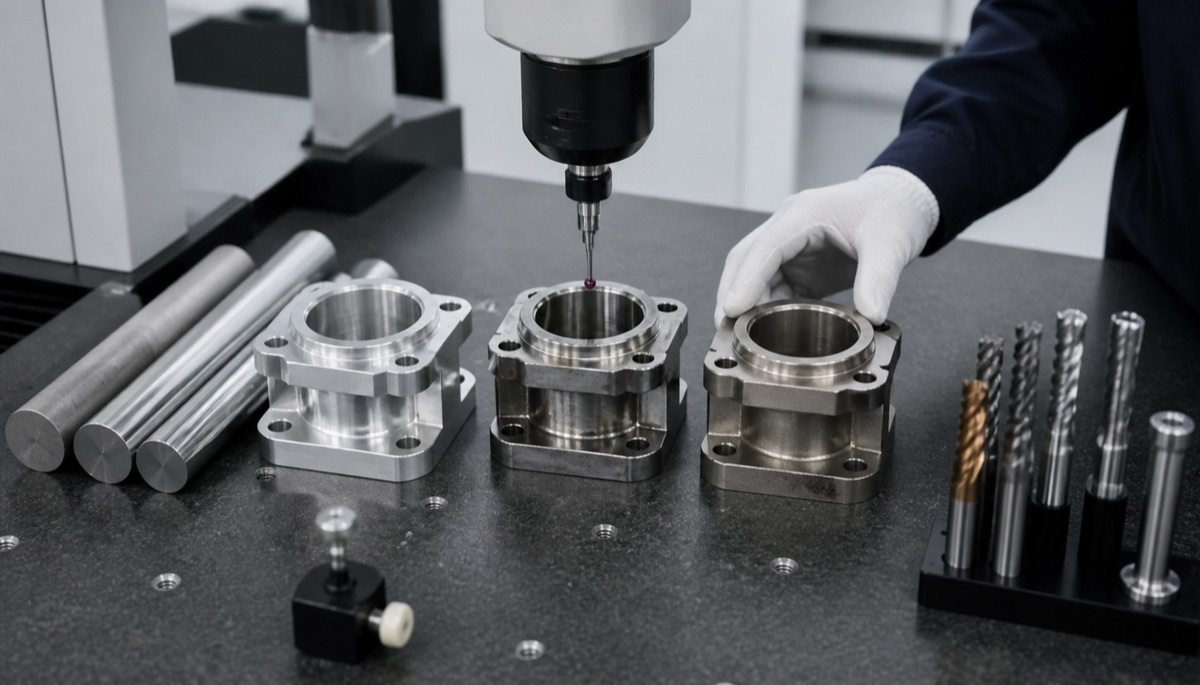
Stainless Steel Is Rigid and Corrosion Resistant
Stainless steel suits parts that need corrosion resistance, stiffness, wear resistance or clean environments, such as medical device structures, optical instrument supports, fluid fittings, bushings and equipment connectors.
Stainless steel machining must control cutting heat, tool wear, burrs and deformation. Small holes, deep grooves, thin walls and sharp edges can produce difficult burrs, surface tearing or dimensional drift if parameters are too aggressive.
In stainless steel projects, OEMach pays close attention to tool condition, cooling, toolpath strategy and deburring. For cosmetic or clean parts, brushing, passivation, polishing and clean packaging should be confirmed early.
Titanium Fits Demanding Applications, But Not Every Part
Titanium alloys provide high specific strength, corrosion resistance and lightweight performance, which can be valuable in selected robotics, aerospace, medical and high-end equipment parts. But titanium is not a low-cost replacement for ordinary high-strength materials.
TC4 and similar titanium alloys have poor thermal conductivity and higher elasticity. Cutting temperature concentrates near the tool, tool wear is faster, and machining efficiency is much lower than aluminum. Complex thin-wall titanium parts also require attention to clamping deformation, residual stress and surface integrity.
The reason for choosing titanium should be clear: corrosion resistance, strength-to-weight ratio or biocompatibility. If the requirement is only ordinary strength, stainless steel or 7075 aluminum may be more economical.
Same Function, Different Material Routes
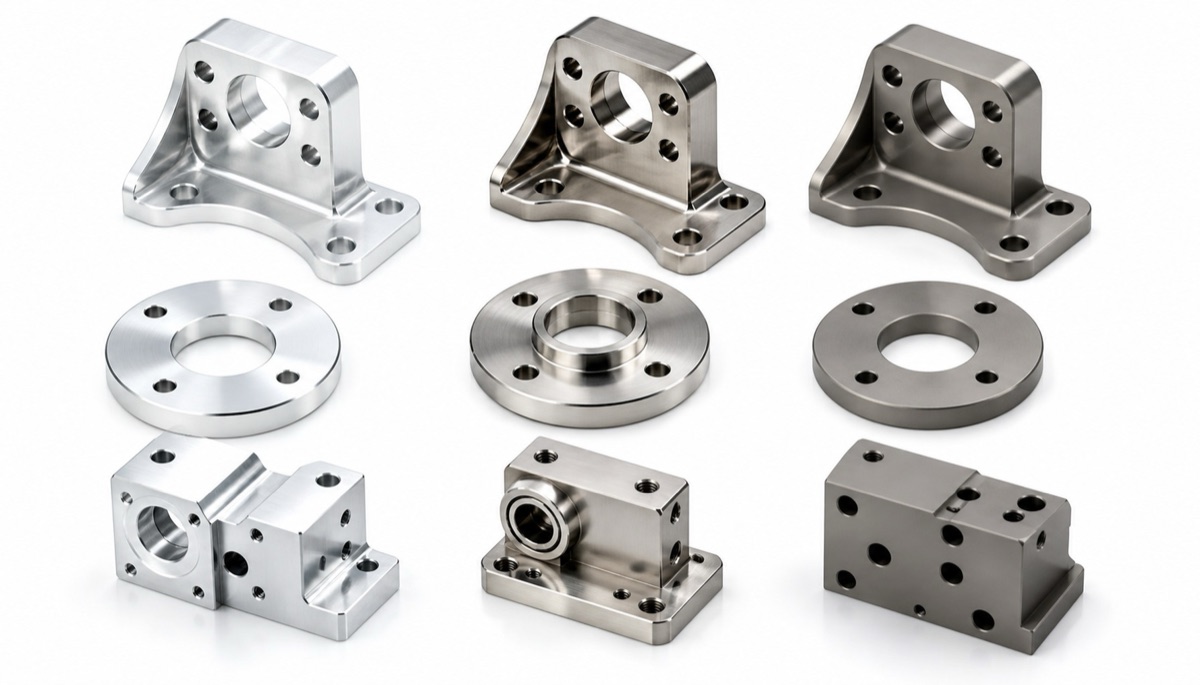
In one precision mounting bracket review, three material versions were made: 6061 for fast assembly validation, stainless steel for rigidity and corrosion testing, and TC4 titanium for a lightweight high-strength option.
The three versions did not share one process route. The 6061 version prioritized efficiency and anodized appearance. The stainless steel version focused on burr control and hole-position stability. The TC4 version used lower cutting speed, optimized cooling and tool life, and stronger CMM inspection.
The customer then split pre-production validation into two material versions based on test results. This shows that material selection is not only a table decision; it is a closed loop of material, process and validation.
Five Questions Before Choosing
Does the part have a clear weight limit? If yes, aluminum or titanium should be evaluated first.
Will the part face corrosion, clean-room conditions, high temperature or wear? This affects stainless steel and titanium decisions.
Are key dimensions and GD&T requirements strict? Different materials deform and inspect differently.
Will surface treatment affect final assembly? Anodizing, passivation, polishing and blasting should be stated early.
Is the project a prototype or a repeat small batch? Prototype stages can use material substitution to lower validation cost.
For R&D teams, a partner that understands material behavior, CNC machining and inspection delivery can reduce material-selection rework.
Common Mistakes
The first mistake is treating titanium as the default answer for all high-end parts. Titanium is expensive and slow, and not every project needs it.
The second mistake is checking strength only while ignoring machining cost and lead time. R&D projects need a balanced decision.
The third mistake is ignoring post-finish dimensions. A material choice is not successful if the part cannot assemble after coating, anodizing or polishing.
FAQ
How can aluminum, stainless steel and titanium be judged quickly?
Use aluminum for lightweight and fast delivery, stainless steel for corrosion resistance and rigidity, and titanium when high specific strength plus corrosion resistance are both required.
Can the same part be prototyped in aluminum first?
Yes. Prototype stages often use aluminum to validate structure quickly, then switch to stainless steel or titanium based on load and environment.
Why is stainless steel slower to machine than aluminum?
Stainless steel has higher cutting heat, tool wear and burr sensitivity, so it needs steadier parameters and deburring steps.
Is titanium suitable for ordinary structural parts?
Usually not. Without clear lightweight, high-strength or corrosion-resistance needs, titanium cost and lead time are often not justified.
Can OEMach support multi-material prototyping?
Yes. OEMach supports small-batch precision machining in aluminum, stainless steel, titanium, PEEK and other engineering materials.
Summary
For the same function, aluminum, stainless steel and titanium are not ranked by which one is more advanced. They are selected by the combination of strength, weight, corrosion resistance, machining cost and lead time. Aluminum suits lightweight and fast delivery, stainless steel suits rigidity and corrosion resistance, and titanium suits demanding lightweight high-strength applications.
Ready to get a quote for your CNC machined parts?
Submit your engineering drawings to qiancj@oemach.com. We support prototype sampling and small-batch production with strict tolerance control.