
Material selection for robot lightweight parts affects strength, weight and cost at the same time. A good choice is not simply the lowest-density material. It is the material and process combination that balances load, stiffness, service life, machining difficulty, assembly method and procurement lead time.
In humanoid robots, collaborative robots and automated end-effectors, engineers often face tradeoffs. Aluminum alloys machine efficiently and provide useful strength, but some areas still need weight optimization. PEEK provides heat resistance and insulation, but cost is high. Nylon is light and economical, but rigidity and dimensional stability are limited. Titanium has high strength, but machining cost and lead time increase quickly.
OEMach normally starts by confirming whether the part carries tension, bending, torque, impact, wear, insulation or positioning load. Only then can the team recommend material, machining strategy and inspection requirements instead of quoting only by a material name.
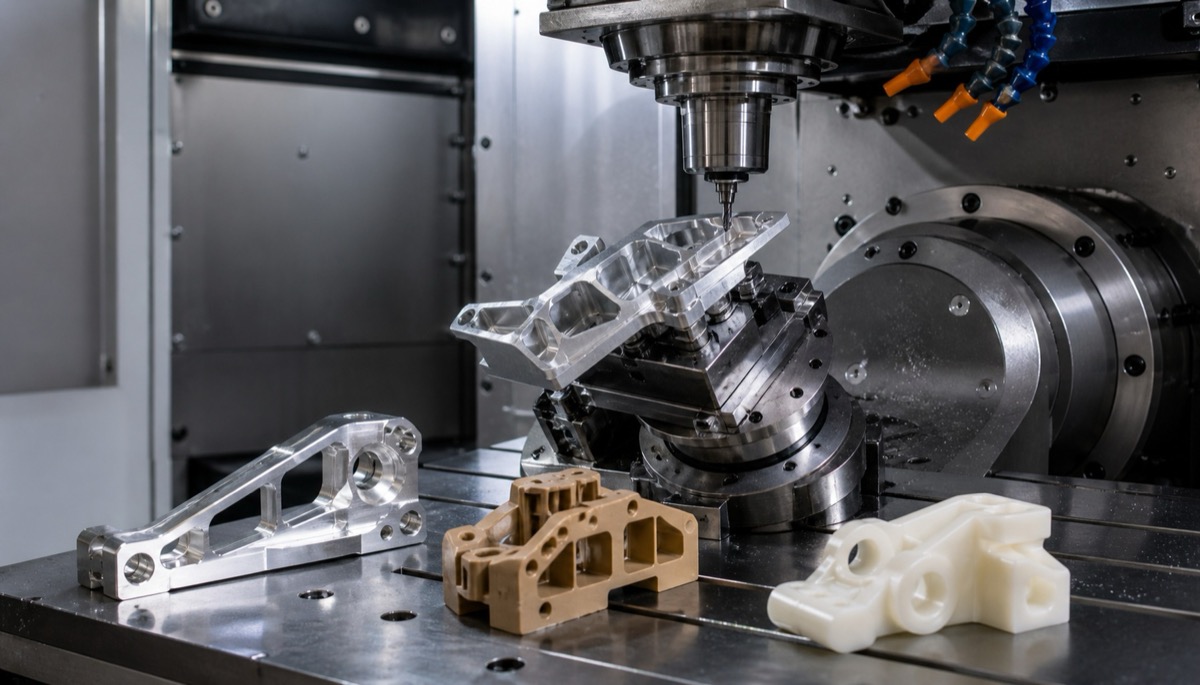
Common Lightweight Materials for Robot Parts
| Material | Main advantages | Main risks | Typical robot parts |
|---|---|---|---|
| Al6061 | Light, machinable, anodizes well and is cost friendly | Lower strength than 7075; thin walls can deform under clamping | Housings, brackets, mounting plates and vision-module structures |
| Al7075 | Higher strength and stiffness for loaded lightweight structures | Higher cost; anodizing color and stress release need attention | Joint connectors, loaded brackets and lightweight arm-end parts |
| PEEK | Heat resistance, wear resistance, insulation and good stability | High material cost; needs careful allowance, tooling and heat control | Insulating seats, wear sliders and sensor isolation parts |
| Nylon | Light, low cost, damping and easy replacement | Moisture absorption, limited stiffness and dimensional stability | Buffers, guide blocks and low-load connectors |
| Titanium | High strength and corrosion resistance with good load per weight | Difficult machining, higher tool wear, cost and lead time | Small high-load connectors and special-condition structural parts |
Strength Depends on Load Direction
Material datasheet strength is only the starting point. A robot part also depends on load direction, wall thickness, edge distance around holes, corner radius, thread depth, assembly preload and residual stress after machining.
Al7075 has high strength, but a thin connection plate with dense holes and sharp corners can still suffer local stress concentration under vibration and impact. PEEK can be useful for wear and insulation, but in a high-load cantilever it may deform because stiffness is not enough.
Lightweight design should therefore review material and structure together. Add ribs where stiffness is needed, open pockets where weight can be removed, and keep enough material around critical holes so the selected material can actually work.
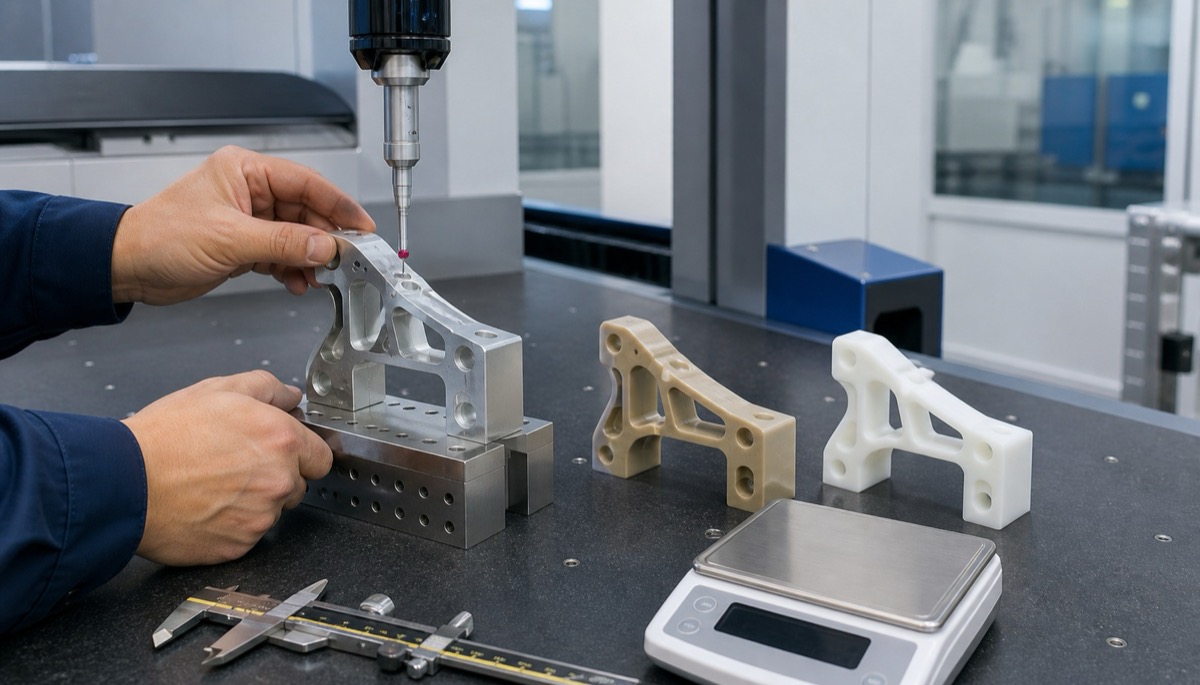
Weight Reduction Should Serve the Whole Robot
The goal is not to make every part as light as possible. The goal is to reduce weight where it improves motion performance, battery life, response speed or payload. Parts far from a joint axis, such as arms, wrists, end-effectors and leg structures, often bring more value when optimized.
Changing a part from aluminum to nylon may reduce single-part weight, but stiffness, positioning accuracy and long-term stability may no longer be sufficient. Using PEEK may improve a specific function, but it can raise material and machining cost if the functional benefit is limited.
A stable method is to classify parts by function. Load-bearing parts should keep strength and stiffness first. Insulating and wear parts can evaluate PEEK or engineering plastics. Buffers and guides may use nylon. Housings and mounting structures can often use Al6061 or Al7075 with local weight optimization.
Cost Is More Than Material Price
The cost difference in lightweight parts does not only come from raw material price. Machining cycle time, tool wear, yield, inspection time, surface treatment and later assembly risk also matter. A cheaper material with poor stability may cost more during small-batch validation.
Nylon is inexpensive, but moisture absorption and heat deformation can cause dimensional variation. PEEK is expensive, but in high-temperature, insulating or wear positions it may reduce future problems. Titanium performs well, but its machining difficulty and lead time should prevent overuse on ordinary brackets.
A useful RFQ should include material, quantity, critical dimensions, surface finish, inspection report requirements and application position. Then the supplier can judge whether a general material saves cost or a higher-performance material reduces later trial-and-error.
Five Manufacturing Controls
| Action | How to apply it | Why it helps |
|---|---|---|
| Define part function first | Clarify load, positioning, insulation, wear, damping or appearance needs | Different functions require different material priorities |
| Review material with structure | Check walls, pockets, threads, ribs and hole edge distance | Avoids relying on material strength alone |
| Use material-specific cutting rules | Control deformation in aluminum, heat in PEEK/nylon and tool wear in titanium | Improves repeatability |
| Grade critical dimensions | Control precision fits tightly and keep ordinary lightening windows reasonable | Protects function without unnecessary cost |
| Record first-article data | Keep measured weight, key dimensions, trial fit and revision notes | Stabilizes later small batches |
OEMach Engineering Practice
In one humanoid robot end-effector lightweight project, the customer initially wanted Al7075 for all parts to gain strength. During DFM, OEMach found that the loaded connection plates did need 7075, but insulating spacers and low-load guide components did not need the same material.
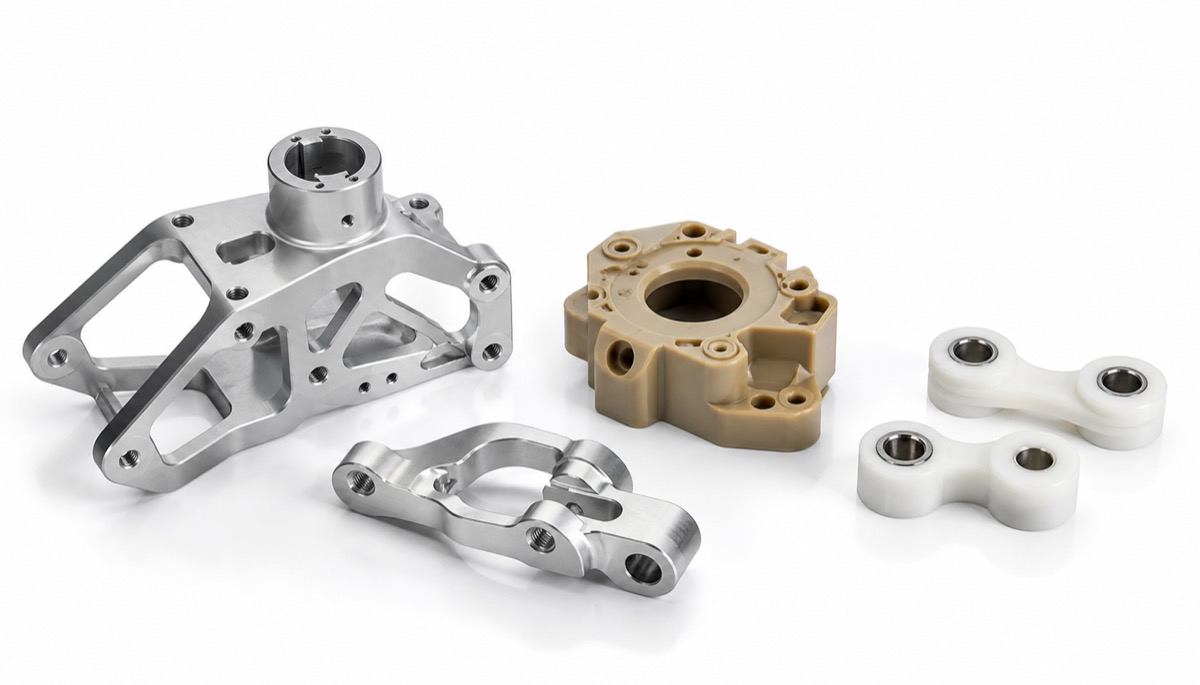
The final material plan kept loaded brackets in Al7075, used Al6061 for housing and mounting parts with anodized appearance control, selected PEEK for insulating seats and used nylon for buffer or guide parts. Machining used multi-axis access and staged fixturing where needed, with key holes recorded by inspection data.
This material-layering approach kept strength where it mattered while avoiding unnecessary cost in low-load areas. It also made the prototype route easier to repeat for small-batch production.
RFQ Questions Before Ordering
| Question | Why it matters |
|---|---|
| Does weight reduction improve the whole robot, and where is weight removal most valuable? | Not every gram has the same system benefit |
| Is the main failure risk strength, stiffness, wear, insulation or dimensional stability? | Material selection should target the real risk |
| Will PEEK, nylon or titanium change machining, finishing and inspection cost? | Alternative materials change the whole process |
| Does the first article need weighing, trial assembly or load validation? | Validation data helps stabilize repeat orders |
FAQ
What should be checked first when selecting material for lightweight robot parts?
Start with function and load direction, then evaluate strength, stiffness, weight, machining difficulty, surface treatment and cost.
How should Al6061 and Al7075 be selected?
Al6061 is balanced for machinability, anodizing and cost. Al7075 offers higher strength for loaded connectors and lightweight structural parts.
Can PEEK replace aluminum?
Only where heat resistance, insulation, wear resistance or weight value justify it. High-load structural parts should not simply replace aluminum with PEEK.
What is the risk of nylon parts?
Nylon is light and low cost, but moisture absorption, heat deformation and limited stiffness can be risky for precision positioning or long-term stability.
Can OEMach machine multi-material robot parts?
Yes. OEMach supports Al6061/7075, PEEK, nylon, titanium and related CNC machining, DFM review, inspection and small-batch prototyping.
Summary
Material selection for robot lightweight parts should not be based only on density or unit price. Aluminum alloys, PEEK, nylon, carbon-fiber composite interfaces and titanium each bring different strength, weight, cost, machining stability and assembly risks. The best result comes from connecting material advice, DFM review, CNC machining, surface treatment and inspection records into one manufacturable plan.
Ready to get a quote for your CNC machined parts?
Submit your engineering drawings to qiancj@oemach.com. We support prototype sampling and small-batch production with strict tolerance control.