
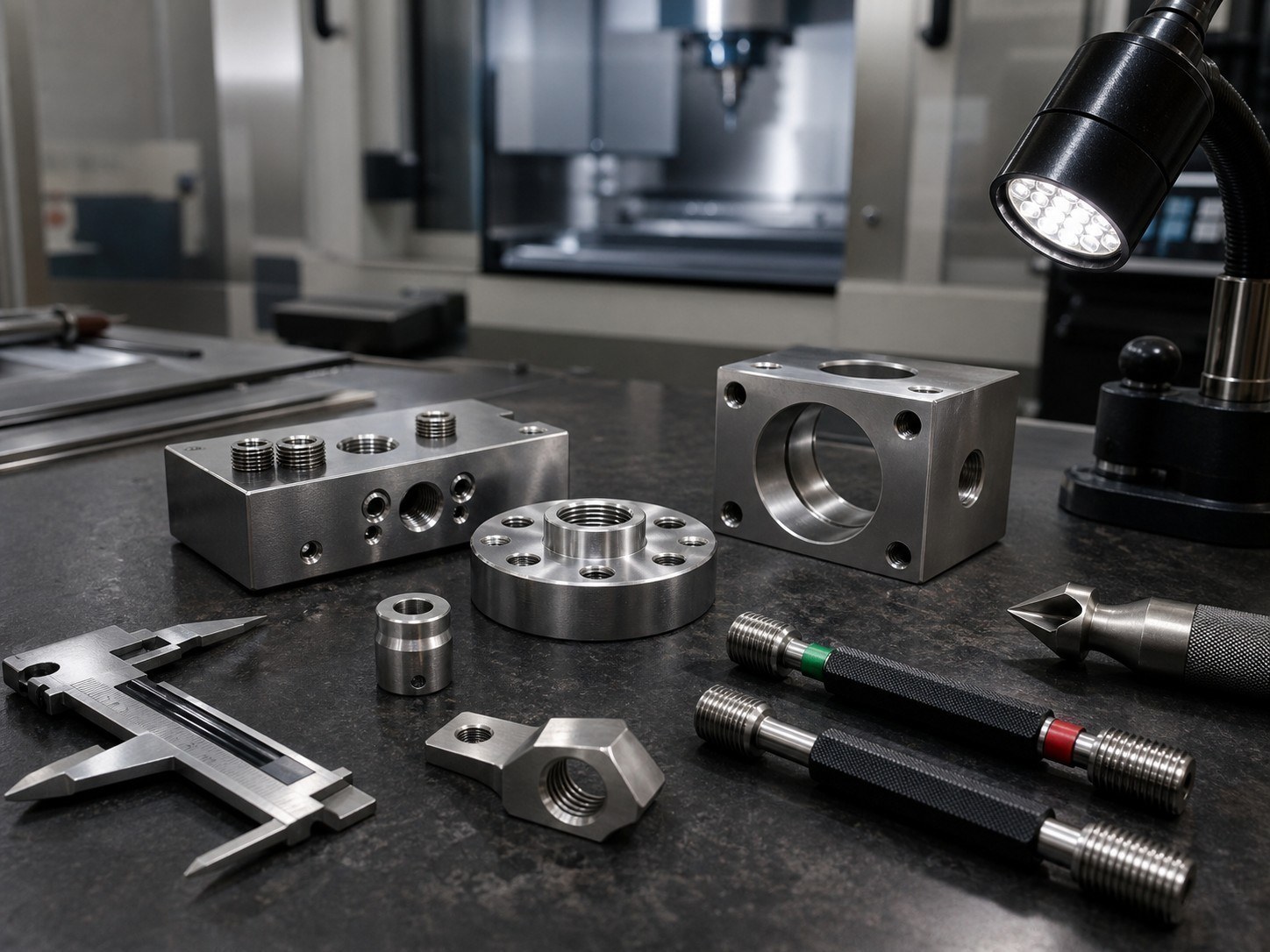
Summary:Threaded-hole inspection in small-batch machining should cover more than whether a screw can be inserted. OEMACHreviews drawing requirements, mating-part conditions, effective thread length, hole location, burrs, and cleanliness before defining first-piece and in-process checks.
Application Background
Small-batch machined parts are widely used in automation equipment, fixtures, and precision assemblies. Their quantities may be limited, but a single defective threaded hole can interrupt assembly. A practical control plan therefore connects machining conditions with the intended function of the hole.
Fits and dimensional tolerances should be interpreted through the requirements stated in the drawing rather than by subjective assembly feel.[Source: ISO 286-1:2010] When a threaded hole also contributes to positioning or clamping, its orientation and relationship to datum features matter.[Source: ISO 1101:2017]
Key Machining Risks
• An unsuitable tap-drill condition may increase cutting load or reduce thread engagement.
• Blind holes may retain chips or provide insufficient effective thread length.
• Thin sections can deform during clamping and shift the hole axis.
• Frequent changeovers can cause programs, taps, or gauges to be mixed.
• Deburring or downstream surface treatment may alter the first thread or entry condition.
Process Recommendations
Confirm the thread specification, hand, hole type, effective length, datum relationship, entry treatment, and mating-part information before machining. Link drilling, chamfering, tapping, cleaning, and verification as controlled steps.
After the first piece, review thread engagement, effective length, surrounding features, and cleanliness. Repeat critical checks after tool changes, program changes, or abnormal interruptions. Where geometric requirements apply, evaluate the feature from the drawing datum system.[Source: ISO 1101:2017]
Service Process and Commitment
OEMACH follows a drawing review, clarification, process preparation, first-piece confirmation, batch machining, cleaning, protection, and final review sequence. Unclear requirements are raised before production, and agreed process records are retained. Commitments remain limited to the confirmed drawing, quantity, and delivery conditions.
FAQ
Q1: Is successful screw insertion enough?
No. Thread specification, engagement length, location, orientation, burrs, and assembly conditions should also be considered.
Q2: Is blind-hole depth the same as effective thread length?
Not automatically. Drill-point allowance, chip space, and incomplete lead threads must be considered.
Q3: Should every hole receive the same inspection method?
The method can be risk-based, but critical assembly threads should have a defined verification approach.
Q4: Should threads be checked after surface treatment?
Yes. Protection, entry condition, cleanliness, and mating behavior may need to be reviewed again.
Q5: What information should accompany an RFQ?
Provide the thread specification, hand, hole type, effective engagement, datum requirements, surface treatment, and mating-part conditions.
Scan to contact us
Contact: Allen
Email: shiziqiu@oemach.com
My whatsapp code